

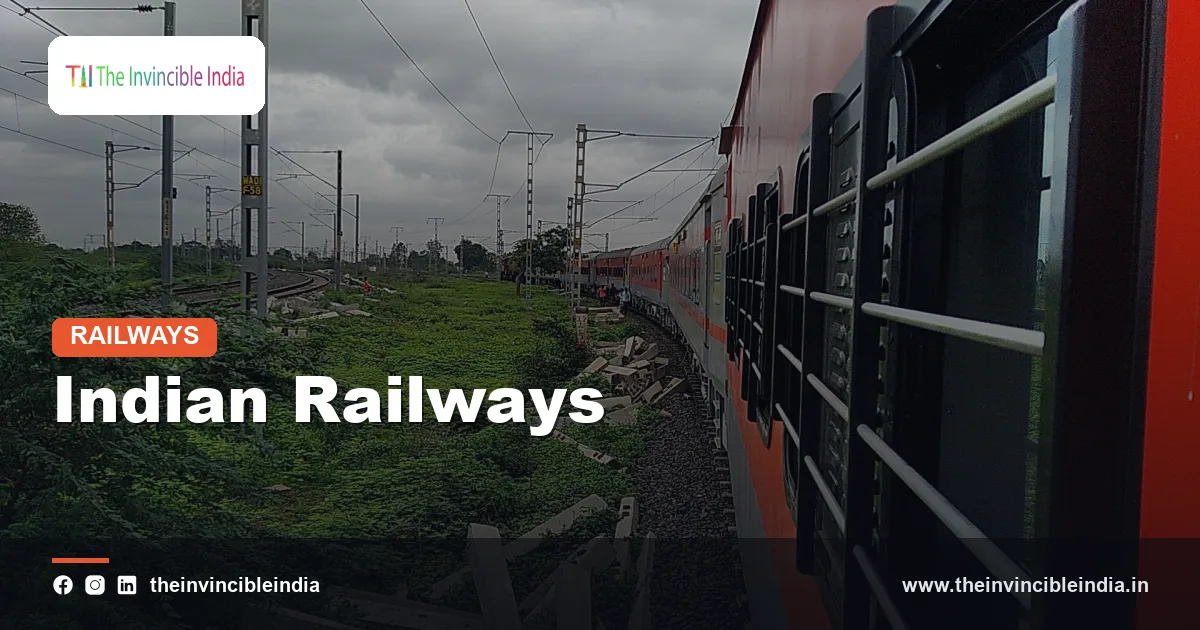
Few institutions touch as many Indian lives every single day as Indian Railways. It moves millions of passengers, carries the coal that lights homes, the grain that feeds cities and the containers that connect ports to factories. For well over a century and a half it has stitched a subcontinent together, making it possible for a student from Bihar to study in Pune, a fruit trader from Kashmir to reach Delhi, and a pilgrim from Kerala to visit Varanasi at a price ordinary families can afford.
Structurally, Indian Railways is a statutory department of the Government of India, functioning under the Ministry of Railways and administered by the Railway Board. It is widely described as one of the largest rail networks in the world under a single management, and it is among the biggest employers anywhere. This explainer walks through its history, its geography, its trains, its technology and the way the whole machine is organised, using stable and well-established facts rather than fast-changing statistics.
Quick Facts
| Aspect | Detail |
|---|---|
| Parent body | Ministry of Railways, Government of India |
| Administrative apex | Railway Board (constituted in 1905) |
| First passenger train | 16 April 1853, Bori Bunder (Bombay) to Thane, roughly 34 km |
| Unified national system | Regrouped into zones from 1951 after nationalisation of earlier railway companies |
| Network size (approximate) | Over 68,000 route km, with more than 7,000 stations |
| Daily operations (approximate) | Well over 13,000 passenger trains, plus thousands of freight trains |
| Administrative structure | Around 18 to 19 zones, subdivided into divisions |
| UNESCO World Heritage railways | Darjeeling Himalayan, Nilgiri Mountain, Kalka-Shimla and Chhatrapati Shivaji Maharaj Terminus |
Figures are rounded and approximate; the network grows and is updated every year, so treat them as indicative. Last reviewed: 29 September 2026.
The Lifeline of the Nation
Ask an Indian to describe a journey they remember and there is a good chance a train features in it: a summer holiday to a grandparent’s town, a long overnight trip to a new city for a first job, a pilgrimage with an extended family and a steel trunk full of food. The railway is woven into the country’s literature, cinema, cuisine and everyday speech. That cultural presence reflects a practical reality, because rail remains the most affordable long-distance transport for a vast majority of citizens.
The economic role is just as significant. Indian Railways is a major carrier of bulk freight, particularly coal, iron ore, cement, fertiliser, foodgrains, petroleum products and containers. Power plants, steel mills, ports and mandis all depend on regular rail movement. Because rail is comparatively energy-efficient, it also plays an important part in India’s efforts to keep the transport sector’s carbon footprint in check.
A network of many kinds of services
- Long-distance express and mail trains that connect state capitals and pilgrimage centres.
- Suburban systems in metropolitan regions such as Mumbai, Kolkata, Chennai and Delhi, which carry commuters in very large numbers.
- Freight services that generate the bulk of the system’s earnings.
- Heritage and tourist trains that showcase the country’s landscapes and royal past.
History: From Bori Bunder to a Continental Network
The story begins on 16 April 1853, when the first passenger train in India left Bori Bunder in Bombay for Thane, covering about 34 km. The line was built by the Great Indian Peninsula Railway, and the occasion was marked with a gun salute and public celebration. Within a year a line opened in eastern India between Howrah and Hooghly, and in 1856 the first services began in Madras. The idea spread quickly, driven largely by colonial priorities such as moving raw cotton, jute, coal and troops to ports and garrisons.
By the late nineteenth century, several private companies, many financed by British capital under guaranteed-return arrangements, had laid the skeleton of the trunk routes that still exist. Princely states built their own systems as well. The Railway Board was constituted in 1905 to bring coherence to policy, and over the following decades the government steadily took over company-run lines.
Key milestones
| Year | Milestone |
|---|---|
| 1853 | First passenger train, Bori Bunder to Thane |
| 1854 | First passenger service in eastern India, Howrah to Hooghly |
| 1881 | Darjeeling Himalayan Railway opens for traffic |
| 1905 | Railway Board constituted |
| 1951 | Regrouping of older railways into zonal systems begins after nationalisation |
| 1969 | First Rajdhani Express introduced |
| 1986 | Computerised passenger reservation begins in Delhi |
| 1998 | Konkan Railway fully opens |
| 2019 | First Vande Bharat Express enters service |
Nationalisation and the making of a unified system
At Independence in 1947, the railway map was a patchwork. Many lines were owned by separate companies or princely states, they used different practices, and a number of important routes had been cut by Partition. The new government moved to bring these pieces under one roof, absorbing company-owned and princely-state railways over the following years.
The decisive step came in the early 1950s. From 1951 onwards, the earlier railways were merged and regrouped into large regional zones, beginning with the formation of Southern Railway. The purpose was to build a single, national organisation, with common rules, common rolling-stock standards and a shared identity. That is the point at which the modern Indian Railways, as a unified system, effectively came into being.
A separate budget, later merged
For decades the railways had their own Railway Budget presented to Parliament, a tradition dating back to the colonial period. That practice ended in 2017, when the railway budget was merged into the general Union Budget. The Ministry of Railways nevertheless continues to manage its finances and operations as a major commercial department of the Union government.
How Indian Railways Is Organised
The Railway Board sits at the top and is responsible for policy, planning and coordination. It functions under the Ministry of Railways and is headed by a chairperson, with members responsible for areas such as infrastructure, operations, rolling stock and finance. Below the Board, the network is divided geographically into zones, each headed by a General Manager. Historically there were 16 zones, and the number has since grown to around 18 or 19 as new zones were carved out.
Each zone is further split into divisions, led by a Divisional Railway Manager. The divisions are where the day-to-day business happens: running trains, maintaining tracks, signalling, and looking after stations. There are well over sixty divisions across the country.
Supporting institutions
- Production units such as Chittaranjan Locomotive Works, the Integral Coach Factory in Chennai and the Rail Coach Factory in Kapurthala manufacture locomotives and coaches in India.
- Research Designs and Standards Organisation (RDSO) in Lucknow serves as the technical adviser and standard-setting body.
- Railway Protection Force (RPF) safeguards railway property and passenger areas.
- IRCTC handles catering, tourism and online ticketing.
- Dedicated public-sector undertakings handle areas such as freight corridors, rail finance, construction and consultancy.
Scale: Tracks, Stations and Trains
Numbers help convey the scale, though they should be read as approximate. The route length is on the order of over 68,000 km, and the total track length is considerably higher once double lines, sidings and yards are included. There are more than 7,000 stations, ranging from single-platform halts in villages to giant terminals in metropolitan centres. Every day, well over 13,000 passenger trains run, alongside a very large number of freight trains.
The workforce runs to well over a million people, which makes the railways one of the largest single employers in the world. Behind each train is an unseen army of loco pilots, guards, station masters, signal maintainers, track workers, engineers, ticket staff and cleaners.
Passenger and freight
Passenger services are more visible, but freight is commercially crucial. Bulk commodities, especially coal, form the largest share of loading, and cross-subsidy from freight has traditionally helped keep passenger fares low. The railways also carry parcels, mail and, increasingly, containerised cargo linked to ports.
Gauges and Project Unigauge
A railway gauge is the distance between the two rails. India historically ended up with several: broad gauge (about 1,676 mm), metre gauge (1,000 mm) and narrow gauge (commonly 762 mm, with some 610 mm lines). The mix meant that passengers and goods often had to change trains at gauge-break stations, causing delays and extra handling costs.
To fix this, the railways launched Project Unigauge in the early 1990s. It aimed to convert the major metre-gauge and narrow-gauge routes to broad gauge, so that trains could run without transhipment across the country. Over the following decades, most of the network was converted, and broad gauge now dominates. A few narrow-gauge lines have been kept deliberately, mainly for heritage and tourism reasons.
Why gauge matters
- Broad gauge supports higher speeds, heavier axle loads and greater stability.
- Uniform gauge allows through running of trains and easier wagon movement across regions.
- Conversion opened up remote areas, such as parts of the north-east and Rajasthan, to modern services.
Classes of Travel and Booking
Indian Railways offers a wide range of travel classes to suit different budgets. The most common are:
- First AC (1A) with lockable cabins and the highest fares.
- Second AC (2A) with open bays of berths and curtains for privacy.
- Third AC (3A) and the economy variant, which carry a large share of air-conditioned passengers.
- Sleeper Class (SL), non-air-conditioned berths for overnight travel.
- AC Chair Car (CC) and Executive Chair Car (EC) on daytime intercity trains.
- Second Sitting (2S) and unreserved general coaches for the most affordable travel.
Reservation, IRCTC and Tatkal
Computerised reservation began in the mid-1980s and has grown into one of the country’s largest transaction systems. The Indian Railway Catering and Tourism Corporation (IRCTC), set up in 1999, took over catering and tourism and later became synonymous with online ticketing, which began in the early 2000s. Passengers today book through the IRCTC website and app, as well as at counters and through authorised agents.
The Tatkal scheme, introduced in the late 1990s, lets passengers book seats at short notice for an extra charge, generally opening a day before departure. The advance reservation period, waiting-list rules and refund policies are revised from time to time, so travellers should always check current rules on the official portal.
Iconic Trains and Heritage Railways
Some trains have become household names. The Rajdhani Express, introduced in 1969, links the national capital with state capitals through fast, air-conditioned service. The Shatabdi Express, launched in 1988, offers daytime intercity chair-car travel. The Duronto services, brought in around 2009, are long-distance non-stop or few-stop trains. The Vande Bharat Express, first flagged off in 2019, brought semi-high-speed, self-propelled trainsets built in India.
Luxury tourism trains include the Palace on Wheels, which began in 1982 to showcase Rajasthan, and the Maharajas’ Express, introduced around 2010, along with the Deccan Odyssey and other tourist trains.
Notable trains and heritage lines
| Name | What makes it special |
|---|---|
| Rajdhani Express | Premium fast trains connecting Delhi with state capitals; first ran in 1969 |
| Shatabdi Express | Daytime intercity chair-car trains, introduced in 1988 |
| Vande Bharat Express | Semi-high-speed indigenous trainsets, first launched in 2019 |
| Palace on Wheels | Luxury tourist train showcasing Rajasthan, started in 1982 |
| Maharajas’ Express | Ultra-luxury journeys across heritage circuits |
| Darjeeling Himalayan Railway | Narrow-gauge “Toy Train” opened in 1881; UNESCO World Heritage Site since 1999 |
| Nilgiri Mountain Railway | Rack-and-pinion line from Mettupalayam to Udhagamandalam; UNESCO-listed |
| Kalka-Shimla Railway | Narrow-gauge hill line opened in 1903 with about a hundred tunnels; UNESCO-listed in 2008 |
| Chhatrapati Shivaji Maharaj Terminus | Victorian Gothic station in Mumbai, inscribed by UNESCO in 2004 |
India’s mountain railways are living museums, still carrying passengers on gradients and curves that seem improbable for the era in which they were built.
Engineering Feats: Chenab Bridge and the Konkan Railway
Indian rail engineering has produced some remarkable projects. The Chenab Bridge in Jammu and Kashmir, part of the Udhampur-Srinagar-Baramulla Rail Link, is recognised as the world’s highest railway arch bridge, rising roughly 359 metres above the riverbed. It was opened in 2025, and it symbolises the effort to connect the Kashmir valley to the national network across some of the most difficult Himalayan terrain.
The Konkan Railway, running roughly 740 km along the western coast from Roha in Maharashtra to Mangalore in Karnataka, is another landmark. Built by a dedicated corporation and fully opened in 1998, it cut across steep Western Ghat spurs, crossed rivers and estuaries, and required a large number of bridges and tunnels. It is often cited as a model of how challenging projects can be delivered through a special-purpose organisation with a fixed timeline.
Other landmarks
- The Pamban Bridge to Rameswaram, first opened in the early twentieth century, and its modern vertical-lift replacement.
- Long river bridges across the Ganga, Brahmaputra and Yamuna, several of which carry both rail and road traffic.
- High-altitude and coastal alignments in the north-east and the Himalayan foothills.
Electrification, Modernisation and Freight Corridors
Over the last few decades, Indian Railways has invested heavily in electric traction. By the mid-2020s, the broad-gauge network had been electrified almost entirely, with the goal of reducing dependence on imported diesel and cutting emissions. The railways have also set a long-term ambition of achieving net-zero carbon emissions by 2030, supported by solar installations and energy-efficient rolling stock.
Two long Dedicated Freight Corridors, developed by the Dedicated Freight Corridor Corporation of India Limited, are among the most ambitious projects in the sector. The Western Dedicated Freight Corridor connects the Jawaharlal Nehru Port near Mumbai to the Delhi region, while the Eastern Dedicated Freight Corridor links Punjab with West Bengal. By moving heavy freight onto separate tracks, these corridors free up the existing lines for passenger trains and permit longer and faster goods trains.
Stations and high-speed rail
- The Amrit Bharat Station Scheme aims to upgrade hundreds of stations with better amenities and design.
- Several major stations are being redeveloped as multi-modal hubs with modern passenger facilities.
- The Mumbai-Ahmedabad High-Speed Rail project, roughly 500 km long and supported by Japanese technology, is designed to bring bullet-train service to India for the first time.
Safety and Technology: Kavach and Beyond
Running so many trains on shared tracks puts a heavy premium on safety. Over the years, the railways have invested in track renewal, modern signalling, interlocking systems, fog-safety devices and the replacement of older coaches with safer designs such as LHB coaches. Unmanned level crossings on the broad-gauge network have been largely eliminated.
Kavach is India’s indigenously developed automatic train protection system, designed by RDSO along with domestic industry partners. It is intended to help prevent collisions by alerting loco pilots and automatically applying brakes when a train exceeds speed limits or fails to stop at a danger signal. Its rollout across the network is a gradual, multi-year task, and it remains a central part of the safety strategy.
Other technology initiatives
- Computer-based interlocking and centralised traffic control for smoother operations.
- Real-time train tracking using GPS and mobile applications.
- Growing use of drones, sensors and data analytics for track and asset monitoring.
- Paperless ticketing and digital payments across most services.
The Social and Economic Role of Indian Railways
The railways have always been more than a transport provider. They employ a very large number of people directly and support many more through vendors, contractors and small businesses on platforms and around stations. Subsidised fares for students, senior citizens, patients and other categories have made travel accessible for people who might otherwise be unable to afford it.
The railways also play a role during crises, moving relief material, running special trains during festivals and large gatherings such as the Kumbh Mela, and carrying migrants and essential goods when demand spikes. Railway colonies, schools, hospitals and sports clubs form communities of their own in many towns. Above all, the railway stands as a shared national space in which people from every region, language and background travel side by side.
Conclusion
From a 34 km journey out of Bori Bunder in 1853 to a continent-spanning network of tracks, stations and trains, Indian Railways has grown alongside the nation it serves. It faces genuine challenges, including congestion, safety, financial pressures and the need to modernise, yet it keeps evolving through electrification, freight corridors, new-generation trains and technology-driven reforms. Understanding how it works offers a window into how India moves, trades and connects.
Frequently Asked Questions
When did the first train run in India?
The first passenger train ran on 16 April 1853 from Bori Bunder in Bombay to Thane, a distance of roughly 34 km. It was operated by the Great Indian Peninsula Railway and marked the beginning of the railway age in the country.
Who runs Indian Railways?
Indian Railways is a statutory department of the Government of India, working under the Ministry of Railways. Day-to-day policy and coordination are handled by the Railway Board, while operations are managed through zones and divisions.
How many zones does Indian Railways have?
The network is organised into around 18 to 19 zones, each led by a General Manager, and each zone is further divided into divisions. The exact number has changed over time as new zones have been created, so it is best to check the official Indian Railways website for the current list.
What is Project Unigauge?
Project Unigauge was launched in the early 1990s to convert the metre-gauge and narrow-gauge lines into broad gauge. The aim was to remove gauge breaks so that trains and wagons could run across the country without transhipment, and most of the network has since been converted.
Which Indian railways are UNESCO World Heritage Sites?
The Darjeeling Himalayan Railway, the Nilgiri Mountain Railway and the Kalka-Shimla Railway are together recognised as the Mountain Railways of India, while the Chhatrapati Shivaji Maharaj Terminus in Mumbai is inscribed separately. They are valued for their engineering, history and scenic routes.
What is Kavach on Indian Railways?
Kavach is an indigenously developed automatic train protection system designed to help prevent collisions. It warns loco pilots and can apply brakes automatically if a train breaks speed limits or overshoots a danger signal, and it is being rolled out in phases across the network.
{“@context”:”https://schema.org”,”@graph”:[{“@type”:”FAQPage”,”mainEntity”:[{“@type”:”Question”,”name”:”When did the first train run in India?”,”acceptedAnswer”:{“@type”:”Answer”,”text”:”The first passenger train ran on 16 April 1853 from Bori Bunder in Bombay to Thane, a distance of roughly 34 km. It was operated by the Great Indian Peninsula Railway and marked the beginning of the railway age in the country.”}},{“@type”:”Question”,”name”:”Who runs Indian Railways?”,”acceptedAnswer”:{“@type”:”Answer”,”text”:”Indian Railways is a statutory department of the Government of India, working under the Ministry of Railways. Day-to-day policy and coordination are handled by the Railway Board, while operations are managed through zones and divisions.”}},{“@type”:”Question”,”name”:”How many zones does Indian Railways have?”,”acceptedAnswer”:{“@type”:”Answer”,”text”:”The network is organised into around 18 to 19 zones, each led by a General Manager, and each zone is further divided into divisions. The exact number has changed over time as new zones have been created, so it is best to check the official Indian Railways website for the current list.”}},{“@type”:”Question”,”name”:”What is Project Unigauge?”,”acceptedAnswer”:{“@type”:”Answer”,”text”:”Project Unigauge was launched in the early 1990s to convert the metre-gauge and narrow-gauge lines into broad gauge. The aim was to remove gauge breaks so that trains and wagons could run across the country without transhipment, and most of the network has since been converted.”}},{“@type”:”Question”,”name”:”Which Indian railways are UNESCO World Heritage Sites?”,”acceptedAnswer”:{“@type”:”Answer”,”text”:”The Darjeeling Himalayan Railway, the Nilgiri Mountain Railway and the Kalka-Shimla Railway are together recognised as the Mountain Railways of India, while the Chhatrapati Shivaji Maharaj Terminus in Mumbai is inscribed separately. They are valued for their engineering, history and scenic routes.”}},{“@type”:”Question”,”name”:”What is Kavach on Indian Railways?”,”acceptedAnswer”:{“@type”:”Answer”,”text”:”Kavach is an indigenously developed automatic train protection system designed to help prevent collisions. It warns loco pilots and can apply brakes automatically if a train breaks speed limits or overshoots a danger signal, and it is being rolled out in phases across the network.”}}]}]}


