

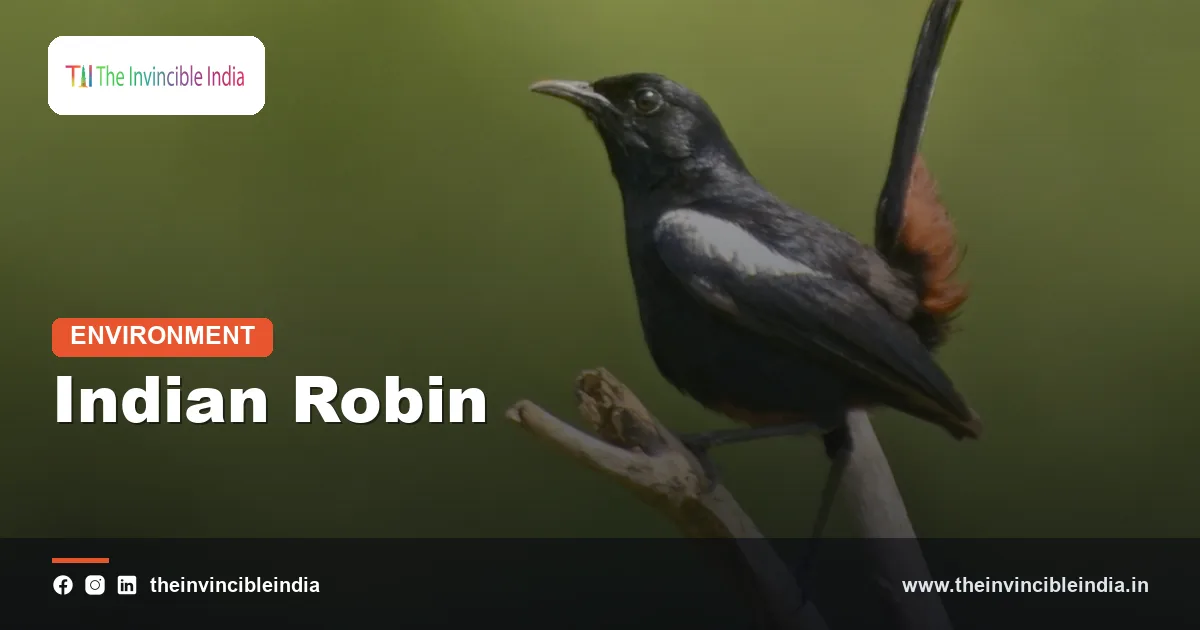
The Indian robin (Copsychus fuliginosus) is a small, ground-feeding songbird of South Asia, easily recognised by the way it carries its tail cocked upright and by its chestnut patch under the tail, with the male glossy black and the female brownish-grey. It is a familiar bird of dry scrub, rocky hillsides, farmland edges, village compounds and gardens across much of India, where it hops and runs across the ground hunting insects.
Despite the name, the Indian robin is not closely related to the European robin. This explainer covers how to identify the species, how males and females differ, where the bird lives, what it eats, how it sings and displays, how it nests and what its conservation status is. It was last reviewed on 23 October 2026, and statements about numbers are kept general on purpose.
Indian Robin Quick Facts
| Common name | Indian robin |
|---|---|
| Scientific name | Copsychus fuliginosus (older checklists use Saxicoloides fulicatus or Copsychus fulicatus) |
| Family | Muscicapidae (Old World flycatchers and chats) |
| Size | About 15 to 17 cm long |
| Signature feature | Tail held cocked and often flicked; chestnut undertail patch |
| Main food | Insects such as ants, beetles, termites and caterpillars |
| Habitat | Dry scrub, rocky ground, open country, farmland edges, villages and gardens |
| Range | Mostly the Indian subcontinent, especially peninsular India |
| IUCN status | Least Concern |
Key Takeaways
- The Indian robin is a small songbird of the Old World flycatcher family, roughly 15 to 17 cm long, found mainly across the Indian subcontinent.
- The male Indian robin is glossy black with a chestnut patch beneath the tail, and many southern forms also show a white shoulder patch.
- The female Indian robin is brownish-grey above and paler below, and she also carries the chestnut undertail patch.
- The Indian robin typically holds its tail cocked upright and flicks it, a habit that makes the bird easy to identify even at a distance.
- The Indian robin feeds mostly on the ground on ants, beetles, termites, caterpillars and other small insects.
- The Indian robin is not related to the European robin, and the IUCN classifies it as Least Concern because it is widespread and adaptable.
What is the Indian robin?
The Indian robin is a small songbird in the family Muscicapidae, the Old World flycatchers and chats, and it is native to the dry and open parts of the Indian subcontinent. The scientific name Copsychus fuliginosus is used in current treatments, while older field guides refer to it as Saxicoloides fulicatus, so readers will meet more than one name in books and databases.
The genus Copsychus also contains the Oriental magpie-robin, a close relative that is common in Indian cities, and the white-rumped shama of forests. The Indian robin shares with them an upright posture, a cocked tail and a rich song.
The word “robin” was applied by British colonial naturalists who saw a likeness to the robin back home. The European robin (Erithacus rubecula) belongs to a different genus, so the common name reflects resemblance in habits and not close family ties.
How do you identify an Indian robin?
An Indian robin is identified by its small size, its upright stance and its cocked tail, together with a chestnut patch under the tail. The bird often stands on a rock, a low wall or a fence post, droops its wings slightly and flicks the tail up over its back.
Key field marks include the following.
- Male: glossy blue-black on the head, breast and upper body, with a bright chestnut vent and, in many southern races, a white patch on the shoulder.
- Female: dull brown or greyish-brown above and a little paler below, with the same chestnut vent but without the glossy black.
- Tail: relatively long, often cocked at a steep angle, dark above and sometimes showing white at the base of the outer feathers.
- Behaviour: hops and runs on open ground, pausing with an upright posture, and often perches on rocks and wires.
The Indian robin can be confused with the Oriental magpie-robin, which is also black but shows large white wing patches and a white belly. The chestnut vent of the Indian robin is the quickest clue.
How do male and female Indian robins differ?
Male and female Indian robins differ clearly in colour: the male is glossy black while the female is brownish-grey, though both have the chestnut patch under the tail. This difference in appearance between the sexes is called sexual dimorphism and it helps observers tell pairs apart.
The appearance of males also varies by region. In the south and the peninsula, males are typically black with a white shoulder patch. In parts of north and north-western India, a form with a brown back and black underparts, often described as the northern race, is common. Ornithologists recognise several subspecies, and they differ in how much black and brown the males show.
Young birds resemble females but look a little scruffier. Young males gain their black plumage over their first year, so a patchy, mottled bird in a pair is often a young male.
Where does the Indian robin live?
The Indian robin lives in dry, open country across the Indian subcontinent, with its core range in peninsular India. It prefers scrub, rocky slopes, dry deciduous woodland edges, farmland, wasteland, village outskirts and large gardens, and it generally avoids dense evergreen forest.
The bird is a regular in semi-arid zones of Rajasthan, Gujarat, Maharashtra, Karnataka, Andhra Pradesh, Telangana and Tamil Nadu. It also occurs in parts of the Gangetic plains, and a few birds reach Sri Lanka and the neighbouring countries of Nepal, Pakistan and Bangladesh in suitable habitat. Its range extends to moderate elevations in hill country, but it is not a high-mountain bird.
Because the species likes open, stony ground and human-modified land, it often benefits from farmland and village landscapes where hedgerows, rock heaps and stone walls provide perches and nest sites.
What does the Indian robin eat?
The Indian robin eats mainly insects, and it finds most of them by hopping across open ground and picking them off the surface. Ants, beetles, termites, grasshoppers, caterpillars, bugs and spiders make up the bulk of its diet.
The feeding style is distinctive. The bird runs a short distance, stops with its tail raised, scans the ground and then lunges at prey. It may also snatch insects from low vegetation or take them from stone walls and the base of shrubs. After rain, termites and other emerging insects can attract several robins together.
Occasional records show the species taking small seeds, nectar or tiny fruits, but insects remain the staple. Because it eats many ground-dwelling pests, the Indian robin is a useful natural pest controller on farms and in gardens.
How does the Indian robin sing and display?
The Indian robin sings a clear, whistling and warbling song, delivered mainly by the male from a prominent perch such as a rock, a wire or the top of a bush. The song is often heard at dawn and in the breeding season, when males defend their territories with song.
The male also uses visual display. He fans the tail, droops the wings and shows off the white shoulder patch and chestnut vent while facing a rival or a female. Males may chase each other across open ground, and neighbouring territories are often marked by regular singing posts.
Calls are shorter, including a sharp “chik” or scolding notes used as an alarm. The song is not as famous as that of the magpie-robin, but it is melodious and carries well across open scrub.
How does the Indian robin nest and breed?
The Indian robin nests in holes and crevices, building a cup-shaped nest of grass, rootlets, hair and feathers inside a cavity in a wall, a rock pile, a tree hollow or a bank. Nests are sometimes found in odd places such as old pots, tins, drainpipes or gaps in buildings.
The female usually lays two or three eggs that are pale greenish or bluish-white with reddish-brown markings. She does most of the incubation, which lasts about two weeks, while the male guards the territory and brings food. The breeding season varies across the range, with peaks that often follow the pre-monsoon and monsoon months, and pairs may raise more than one brood in a year.
Both parents feed the chicks with insects. Because nests are placed low and close to human activity, disturbance and domestic cats are common threats, so it is best to watch nesting robins from a distance.
Indian robin compared with similar birds
The Indian robin is easiest to separate from similar black or brown birds by its chestnut undertail and cocked tail. The table below compares it with two birds that it is often confused with.
| Feature | Indian robin | Oriental magpie-robin | Pied bushchat |
|---|---|---|---|
| Scientific name | Copsychus fuliginosus | Copsychus saularis | Saxicola caprata |
| Male colour | Glossy black with chestnut vent | Black and white, with white belly and wing patch | Black with white rump and white vent |
| Female colour | Brownish-grey with chestnut vent | Grey and white | Brown with a rusty rump |
| Habitat | Dry scrub and stony open ground | Gardens, towns and woodland edges | Open grassland and cultivation |
| Tail posture | Cocked and flicked | Cocked and often fanned | Flicked with wing-flicks |
Is the Indian robin a threatened bird?
The Indian robin is not threatened, and the IUCN Red List classifies it as Least Concern because it is widespread across its range and tolerates human-modified land. The species is regarded as common in suitable habitat in many parts of India.
Local pressures do exist. Conversion of dry scrubland to intensive agriculture, pesticide use that reduces insects, loss of rock outcrops and old walls for nesting, and road traffic can affect local numbers. Population trends differ from place to place, and no precise national count is available.
Like other native wild birds, the Indian robin is protected in India under the Wildlife (Protection) Act, 1972, which prohibits capture and trade of wild birds. Observers can contribute sightings to citizen-science programmes, which help track changes over time.
How can you watch Indian robins responsibly?
You can watch Indian robins responsibly by observing from a distance, visiting open scrub and farmland edges in the early morning or late afternoon, and avoiding disturbance near nests. These are the hours when males sing and the birds forage most actively on open ground.
- Look on rocks, low walls, fence posts and wires, where males often perch to sing and survey their territory.
- Scan the ground near scrub and stone heaps for a bird running a few steps, stopping and raising its tail.
- Use binoculars instead of walking close, so that the birds keep feeding and are not pushed away from their nests.
- Avoid playing recorded calls repeatedly, since this can stress territorial males during the breeding season.
- Note the date, place and plumage, and share the record with a citizen-science platform such as eBird, which helps researchers follow long-term trends.
Beginners often find the Indian robin a rewarding first species for learning about bird behaviour. The male’s black plumage, upright posture and regular singing perch make him easy to track, and repeated visits to the same patch of scrub will usually reveal a pair’s territory over several weeks.
Bottom Line
The Indian robin is a lively, cocked-tail songbird of India’s dry country and village edges, easy to identify by the male’s glossy black plumage and the chestnut under the tail in both sexes. It is common, harmless and helpful as an insect hunter, and its main needs are open ground, stone and scrub, and insects to eat.
Frequently Asked Questions
Is the Indian robin related to the European robin?
No, the Indian robin is not closely related to the European robin. Both belong to the Old World flycatcher family, but they are placed in different genera. The Indian robin received its name from early naturalists who saw a likeness in size and habits.
How can I tell a male Indian robin from a female?
A male Indian robin is glossy black, while a female is brownish-grey. Both sexes have a chestnut patch under the tail, and many southern males also show a white shoulder patch. Young males look like females at first and darken over time.
Why does the Indian robin keep its tail raised?
The Indian robin keeps its tail raised as part of its normal posture and signalling behaviour. The cocked, flicked tail helps with communication between birds and makes the chestnut undertail patch more visible. Many birds in the same genus show a similar tail posture.
What does the Indian robin eat?
The Indian robin eats mainly small insects found on the ground. Ants, beetles, termites, grasshoppers and caterpillars are typical foods, along with spiders. The bird hops, pauses and lunges to catch prey in open scrub and gardens.
Where does the Indian robin build its nest?
The Indian robin builds its nest in holes and crevices, such as gaps in walls, rock piles, tree hollows and banks. The nest is a cup of grass, rootlets, hair and feathers, and the female usually lays two or three eggs. Nests are sometimes found in man-made objects like old pots or pipes.
Is the Indian robin found only in India?
No, the Indian robin is not found only in India, although India holds most of its range. The bird also occurs in neighbouring parts of South Asia such as Nepal, Pakistan, Bangladesh and Sri Lanka in suitable dry habitat. Its distribution is centred on peninsular India.
{“@context”:”https://schema.org”,”@graph”:[{“@type”:”FAQPage”,”mainEntity”:[{“@type”:”Question”,”name”:”Is the Indian robin related to the European robin?”,”acceptedAnswer”:{“@type”:”Answer”,”text”:”No, the Indian robin is not closely related to the European robin. Both belong to the Old World flycatcher family, but they are placed in different genera. The Indian robin received its name from early naturalists who saw a likeness in size and habits.”}},{“@type”:”Question”,”name”:”How can I tell a male Indian robin from a female?”,”acceptedAnswer”:{“@type”:”Answer”,”text”:”A male Indian robin is glossy black, while a female is brownish-grey. Both sexes have a chestnut patch under the tail, and many southern males also show a white shoulder patch. Young males look like females at first and darken over time.”}},{“@type”:”Question”,”name”:”Why does the Indian robin keep its tail raised?”,”acceptedAnswer”:{“@type”:”Answer”,”text”:”The Indian robin keeps its tail raised as part of its normal posture and signalling behaviour. The cocked, flicked tail helps with communication between birds and makes the chestnut undertail patch more visible. Many birds in the same genus show a similar tail posture.”}},{“@type”:”Question”,”name”:”What does the Indian robin eat?”,”acceptedAnswer”:{“@type”:”Answer”,”text”:”The Indian robin eats mainly small insects found on the ground. Ants, beetles, termites, grasshoppers and caterpillars are typical foods, along with spiders. The bird hops, pauses and lunges to catch prey in open scrub and gardens.”}},{“@type”:”Question”,”name”:”Where does the Indian robin build its nest?”,”acceptedAnswer”:{“@type”:”Answer”,”text”:”The Indian robin builds its nest in holes and crevices, such as gaps in walls, rock piles, tree hollows and banks. The nest is a cup of grass, rootlets, hair and feathers, and the female usually lays two or three eggs. Nests are sometimes found in man-made objects like old pots or pipes.”}},{“@type”:”Question”,”name”:”Is the Indian robin found only in India?”,”acceptedAnswer”:{“@type”:”Answer”,”text”:”No, the Indian robin is not found only in India, although India holds most of its range. The bird also occurs in neighbouring parts of South Asia such as Nepal, Pakistan, Bangladesh and Sri Lanka in suitable dry habitat. Its distribution is centred on peninsular India.”}}]}]}


