

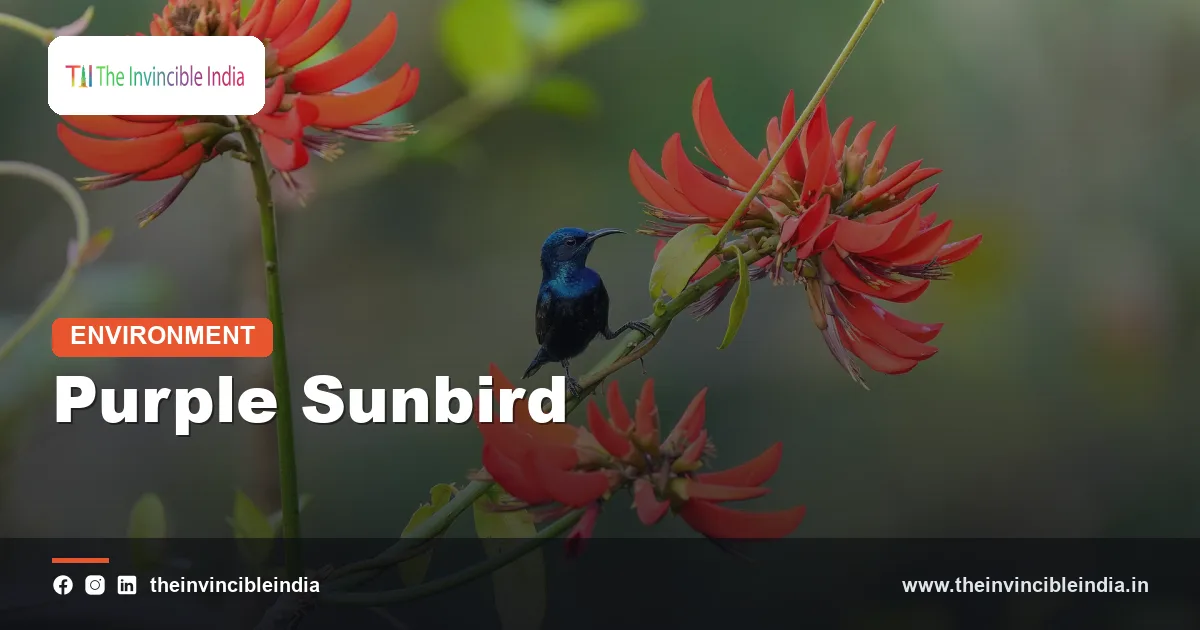
The purple sunbird (Cinnyris asiaticus) is a tiny nectar-feeding bird of South Asia, best known for the breeding male’s glossy, metallic purple-black plumage, a slender downcurved bill and a habit of probing flowers in gardens, orchards and village edges across India. It is one of the smallest birds a person is likely to see from a balcony, a terrace or a flowering hedge, and it is often mistaken for a hummingbird even though no hummingbirds live in Asia.
This explainer covers how to identify the purple sunbird, why the male looks black one moment and shining violet the next, what the bird eats, how it feeds on flowers, where it nests and how it fits into Indian gardens and ecosystems. It was last reviewed on 23 October 2026, and population statements are deliberately general because bird numbers change over time.
Purple Sunbird Quick Facts
| Common name | Purple sunbird |
|---|---|
| Scientific name | Cinnyris asiaticus |
| Family | Nectariniidae (sunbirds) |
| Size | About 10 cm long; among the smallest birds of urban India |
| Main food | Flower nectar, supplemented by small insects and spiders |
| Habitat | Gardens, scrub, open woodland, orchards, farmland edges and towns |
| Range | Indian subcontinent, extending west into parts of Arabia and Iran and east into mainland Southeast Asia |
| Nest | Hanging, pouch-shaped structure of cobweb, plant fibre and debris, built by the female |
| IUCN status | Least Concern |
Key Takeaways
- The purple sunbird is a small nectar-feeding bird, roughly 10 cm long, found across most of India in gardens, scrub and open woodland.
- The breeding male purple sunbird looks black in poor light but shows glossy metallic purple, blue and green when sunlight strikes its feathers at the right angle.
- Outside the breeding season, the male purple sunbird moults into a duller eclipse plumage of olive-brown and yellowish tones with a dark stripe down the throat and breast.
- Purple sunbirds drink nectar through a tubular, brush-tipped tongue and also catch small insects and spiders, which are important food for growing chicks.
- The female purple sunbird builds a hanging, pear-shaped nest of cobweb and plant material that is often placed close to houses.
- The purple sunbird is classified by the IUCN as Least Concern, and its flower-visiting habit makes it a useful pollinator in many Indian gardens.
What is the purple sunbird?
The purple sunbird is a small passerine bird in the sunbird family, Nectariniidae, and it belongs to the Old World group of birds that specialise in drinking flower nectar. Its scientific name is Cinnyris asiaticus, and it was described by European naturalists in the late eighteenth century.
Sunbirds are not related to hummingbirds. Hummingbirds live only in the Americas, while sunbirds occur in Africa, the Middle East, South Asia and parts of Southeast Asia and Australasia. The similar shape, curved bill and nectar diet in the two groups are the result of convergent evolution, in which unrelated birds develop similar features because they exploit similar food.
In India the purple sunbird is one of several sunbird species. Its close neighbours include the purple-rumped sunbird, Loten’s sunbird and several forest sunbirds of the Himalaya, the Western Ghats and the north-east. Of these, the purple sunbird is the one most often met in towns and cities.
How do you identify a purple sunbird?
A purple sunbird is identified by its small size, long thin downcurved bill, short legs and, in males, dark body plumage that flashes violet and blue in sunlight. The bird usually measures about 10 cm from bill tip to tail tip, which makes it smaller than a sparrow.
The key field marks can be listed simply.
- Breeding male: appears all dark from a distance, with a metallic purple-blue sheen on the head, back and breast and a blackish belly.
- Pectoral tufts: small yellow and reddish tufts on the sides of the breast, usually hidden but shown during display and sometimes when the bird stretches its wings.
- Female: olive-brown above and pale yellowish below, with a faint pale eyebrow and no dark stripe.
- Bill: long, slim and curved, and longer-looking in side view than the head is deep.
- Voice: a sharp, metallic call, often written as a thin “chwee”, and a quick, high-pitched song from the male.
Beginners sometimes confuse the female purple sunbird with other small olive-brown birds such as warblers and white-eyes. The curved bill, the habit of probing flowers and the sunbird’s quick, jerky movements usually settle the matter.
Why does the male purple sunbird look black and purple?
The male purple sunbird looks black and purple because its feathers produce structural colour, in which microscopic feather structures reflect specific wavelengths of light rather than the colour coming from a pigment. This is why the male often looks plain black on a cloudy day or when seen against the light, yet shines violet, blue and even green when the sun falls at a sharper angle.
Structural iridescence works through layers of tiny platelets within each feather barbule that interfere with light waves. Because the effect depends on the viewing angle, a bird that is dark in shade can look dazzling in sunlight. The same principle is responsible for the shimmer on peacock, kingfisher and starling feathers.
The glossy plumage serves a social purpose. Males use their shining colour, often together with the hidden pectoral tufts, to attract females and to signal strength to rival males during the breeding season.
What is eclipse plumage in the purple sunbird?
Eclipse plumage is the duller, female-like plumage that the male purple sunbird wears outside the breeding season, after a partial moult. In this phase the male is olive-brown above and yellowish below, but it keeps a dark metallic-blue stripe running down the centre of the throat and breast, which separates it from a true female.
The term “eclipse” is used in ornithology because the bright breeding colours seem temporarily eclipsed. The change is gradual and not uniform, so in some months a male may show patches of dark metallic feathers mixed with olive ones. The timing varies with region and climate and is linked to the local breeding season, so observers may see males in different stages of colour in the same garden.
This seasonal change often leads to questions such as “where did the purple sunbird go?”. The bird usually has not left; it has simply become harder to recognise.
What does the purple sunbird eat?
The purple sunbird eats mainly flower nectar, and it also eats small insects and spiders that supply the protein it needs. Nectar is a sugar-rich fuel for a very small, active bird, while insects are especially important when the female is laying eggs and when the parents are feeding chicks.
A tubular tongue with a brush-like or split tip helps the bird draw up nectar. Sunbirds are commonly seen visiting a wide range of Indian flowering plants, including hibiscus, bottlebrush, coral tree, silk-cotton, cannas, ixora and the flowers of many shrubs and trees. The bird also visits the flowers of mistletoe-like parasitic plants, which depend heavily on birds for pollination and seed spread.
Gardeners often notice sunbirds at nectar-rich flowers early in the morning and again in the late afternoon, which are the most active feeding periods in warm weather.
How does the purple sunbird feed on flowers?
The purple sunbird feeds by perching on or near a flower, inserting its curved bill into the blossom and drawing up nectar with its tongue; it can also hover briefly in front of a flower when no perch is convenient. Unlike a hummingbird, a sunbird relies mostly on perching and only hovers for short spells.
The feeding styles can be divided as follows.
- Legitimate feeding: the bird enters the flower through the opening, touches the anthers and stigma with its head and bill, and carries pollen between flowers.
- Nectar robbing: when a flower tube is long or narrow, the bird may pierce the base of the flower and take nectar without touching the reproductive parts, so little or no pollination occurs.
- Insect gleaning: the bird picks small insects and spiders from leaves, flowers and cobwebs, sometimes briefly hovering to do so.
Because the same bird may pollinate some plants and rob others, scientists describe sunbirds as both pollinators and occasional nectar thieves, depending on the flower.
Where is the purple sunbird found in India?
The purple sunbird is found across most of India, from the plains and plateaus to the lower hills, wherever flowering plants and some shrub or tree cover are present. It is common in cities, villages, orchards, scrubland and open forest, and it tends to avoid dense, humid forest, where other sunbird species take over.
Outside India, the species ranges through Pakistan, Nepal, Bangladesh and Sri Lanka, and also reaches parts of the Arabian Peninsula, Iran and mainland Southeast Asia. In dry western India, populations are often more visible in irrigated gardens, while in the humid south they share space with other sunbirds.
The purple sunbird is mostly resident, although local movements occur in response to flowering seasons, with birds shifting to areas where nectar is abundant. Numbers are generally described as stable or widespread, though no precise national count exists.
How does the purple sunbird breed and build its nest?
The purple sunbird breeds by building a hanging, pear-shaped nest, which the female constructs from cobweb, plant fibre, fine grass, lichen and bits of debris and attaches to a twig, creeper or even a wire. A small hooded entrance opens on the side, and the outside is often decorated with scraps that help the nest blend into its surroundings.
The female usually lays two small eggs and does most of the incubation, which lasts about two weeks. Both parents feed the chicks, often with insects and spiders in addition to nectar. Breeding seasons differ by region, but in much of India they fall in the warmer, drier months and may extend into the rains in some areas.
The nest is often built close to human activity, including balconies, porches, plant pots, hanging baskets and verandah ropes. If a pair nests near a house, it is best to leave the nest undisturbed until the chicks have fledged.
How can you attract purple sunbirds to a garden?
You can attract purple sunbirds to a garden by planting nectar-rich flowering shrubs and trees, keeping some pesticide-free insect life and providing safe nesting cover. Native and long-flowering plants are generally the best choice, since they keep nectar available through many months.
- Plant hibiscus, bottlebrush, ixora, canna, other native flowering shrubs and flowering trees so that something is in bloom in most months.
- Avoid or limit chemical pesticides, since insects and spiders are a key part of the diet.
- Leave spider webs, dry twigs and fibre in quiet corners, because the female uses such material for the nest.
- Offer a shallow dish of clean water, which is also useful for other garden birds.
- Avoid sugar water feeders, as the sweetened water can ferment and spoil, and natural flowers meet the bird’s needs.
Purple sunbird compared with other Indian sunbirds
The purple sunbird differs from other common Indian sunbirds mainly in the male’s overall dark metallic body and in habitat preference. The table below sets out how it compares with two other sunbirds that are often seen in Indian gardens.
| Feature | Purple sunbird | Purple-rumped sunbird | Loten’s sunbird |
|---|---|---|---|
| Scientific name | Cinnyris asiaticus | Leptocoma zeylonica | Cinnyris lotenius |
| Male look | Metallic purple-black overall | Maroon throat, purple rump, yellow belly | Dark metallic head with maroon breast band, very long bill |
| Bill | Long and curved | Medium and curved | Very long and strongly curved |
| Typical habitat | Gardens, scrub, towns | Gardens and light woodland | Wooded areas of southern India and Sri Lanka |
| Seasonal change | Eclipse plumage with dark central stripe | Less dramatic seasonal change | Duller plumage outside breeding |
Is the purple sunbird threatened?
The purple sunbird is not threatened; the IUCN Red List classifies it as Least Concern because it is widespread, adaptable and generally common across its range. Its tolerance of towns and gardens has helped it survive habitat change better than many forest-dependent species.
Local risks still exist. The loss of flowering trees, heavy pesticide use that reduces insects, window collisions and predation by cats and crows can affect individual birds and nests. Like all wild birds, the purple sunbird is covered by India’s wildlife protection framework, which prohibits hunting and capture of native wild birds.
Citizen-science platforms such as eBird and various bird-count events allow ordinary observers to record sunbird sightings, and such records help researchers track long-term changes in abundance and seasonal timing.
Bottom Line
The purple sunbird is a small, adaptable and beautiful nectar-feeder that lives close to people across India, and its metallic male plumage, hanging nest and flower-probing behaviour make it one of the easiest wild birds to watch. Protecting flowering plants and reducing pesticide use are simple steps that help the species stay common.
Frequently Asked Questions
Is the purple sunbird a hummingbird?
No, the purple sunbird is not a hummingbird. Hummingbirds live only in the Americas, whereas sunbirds belong to a separate family, Nectariniidae, found in Africa, Asia and Australasia. The two groups look similar because they evolved similar features for drinking nectar.
Why does the male purple sunbird look black?
The male purple sunbird looks black because its feathers show structural colour that depends on the angle of light. In shade or against the light the plumage appears dark, but in direct sunlight it shines metallic purple, blue and green. Outside the breeding season, the male also moults into a duller eclipse plumage.
What do purple sunbirds eat?
Purple sunbirds eat mainly flower nectar, along with small insects and spiders. Nectar provides quick energy, while insects supply protein, especially during breeding. They commonly visit flowers such as hibiscus, bottlebrush, coral tree and canna.
Where do purple sunbirds build their nests?
Purple sunbirds build their nests on hanging twigs, creepers, wires and ropes, often close to houses. The female weaves a pear-shaped pouch from cobweb, plant fibre and debris, with a small hooded side entrance. The nest should be left undisturbed until the chicks fledge.
Can you keep a purple sunbird as a pet?
No, you should not keep a purple sunbird as a pet, because wild birds native to India are protected under the Wildlife (Protection) Act, 1972. The bird also has very specialised feeding needs that are almost impossible to meet in a cage. It is best enjoyed in a garden where it can feed freely.
How can I attract purple sunbirds to my balcony or garden?
You can attract purple sunbirds by planting nectar-rich flowering plants and avoiding pesticides. Pots of hibiscus, ixora, canna or other long-flowering plants work well even on a balcony. Leaving some spider webs and fine plant fibre nearby can also encourage a pair to nest.
{“@context”:”https://schema.org”,”@graph”:[{“@type”:”FAQPage”,”mainEntity”:[{“@type”:”Question”,”name”:”Is the purple sunbird a hummingbird?”,”acceptedAnswer”:{“@type”:”Answer”,”text”:”No, the purple sunbird is not a hummingbird. Hummingbirds live only in the Americas, whereas sunbirds belong to a separate family, Nectariniidae, found in Africa, Asia and Australasia. The two groups look similar because they evolved similar features for drinking nectar.”}},{“@type”:”Question”,”name”:”Why does the male purple sunbird look black?”,”acceptedAnswer”:{“@type”:”Answer”,”text”:”The male purple sunbird looks black because its feathers show structural colour that depends on the angle of light. In shade or against the light the plumage appears dark, but in direct sunlight it shines metallic purple, blue and green. Outside the breeding season, the male also moults into a duller eclipse plumage.”}},{“@type”:”Question”,”name”:”What do purple sunbirds eat?”,”acceptedAnswer”:{“@type”:”Answer”,”text”:”Purple sunbirds eat mainly flower nectar, along with small insects and spiders. Nectar provides quick energy, while insects supply protein, especially during breeding. They commonly visit flowers such as hibiscus, bottlebrush, coral tree and canna.”}},{“@type”:”Question”,”name”:”Where do purple sunbirds build their nests?”,”acceptedAnswer”:{“@type”:”Answer”,”text”:”Purple sunbirds build their nests on hanging twigs, creepers, wires and ropes, often close to houses. The female weaves a pear-shaped pouch from cobweb, plant fibre and debris, with a small hooded side entrance. The nest should be left undisturbed until the chicks fledge.”}},{“@type”:”Question”,”name”:”Can you keep a purple sunbird as a pet?”,”acceptedAnswer”:{“@type”:”Answer”,”text”:”No, you should not keep a purple sunbird as a pet, because wild birds native to India are protected under the Wildlife (Protection) Act, 1972. The bird also has very specialised feeding needs that are almost impossible to meet in a cage. It is best enjoyed in a garden where it can feed freely.”}},{“@type”:”Question”,”name”:”How can I attract purple sunbirds to my balcony or garden?”,”acceptedAnswer”:{“@type”:”Answer”,”text”:”You can attract purple sunbirds by planting nectar-rich flowering plants and avoiding pesticides. Pots of hibiscus, ixora, canna or other long-flowering plants work well even on a balcony. Leaving some spider webs and fine plant fibre nearby can also encourage a pair to nest.”}}]}]}


