

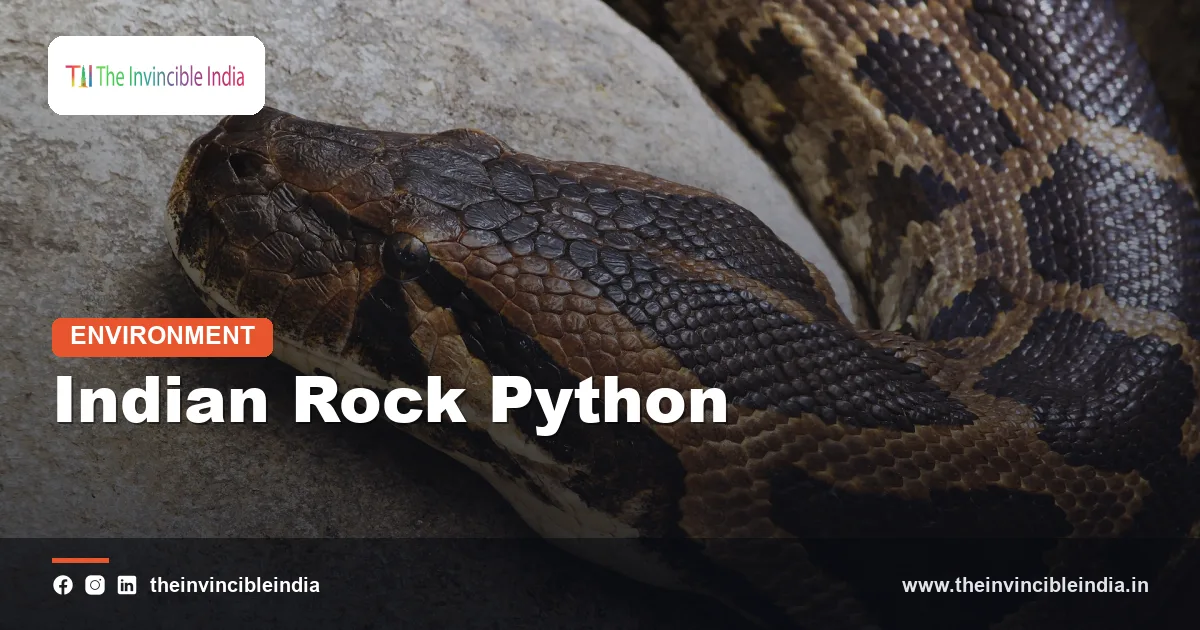
The Indian rock python (Python molurus) is a large, non-venomous constrictor snake native to the Indian subcontinent, and it is one of the most strictly protected reptiles in India. It lives in grasslands, scrub, rocky hills, wetland edges and forests, kills its prey by squeezing rather than by venom, and plays a quiet but important role in keeping rodent and small-mammal populations in check.
Indian rock python conservation matters because the species was hunted heavily for its patterned skin in the twentieth century and still loses habitat, food and lives to roads, farming and persecution. This explainer covers the snake’s biology, range, ecological role, legal protection under the Wildlife (Protection) Act, 1972 and CITES, and what to do when a rock python turns up near a home.
Quick Facts
| Attribute | Detail |
|---|---|
| Scientific name | Python molurus (nominate form Python molurus molurus) |
| Type of animal | Large, non-venomous constrictor snake (family Pythonidae) |
| Typical adult length | About 3 to 4 metres; exceptional individuals are reported to be longer |
| Native range | India, Nepal, Pakistan, Bangladesh, Sri Lanka and adjoining areas of the subcontinent |
| Habitat | Grassland, scrub, rocky outcrops, open and moist deciduous forest, marshes and river margins |
| Indian legal status | Schedule I of the Wildlife (Protection) Act, 1972 (highest protection) |
| International trade status | Listed in CITES Appendix I |
| IUCN Red List status | Near Threatened (population declining) |
| Reproduction | Egg-laying; the female coils around the clutch and guards it during incubation |
Key Takeaways
- The Indian rock python is a non-venomous constrictor that kills prey by tight coils, and research on constrictors indicates that death usually results from stopped blood circulation rather than from simple suffocation.
- Python molurus is placed in Schedule I of the Wildlife (Protection) Act, 1972, so killing, capturing or trading the Indian rock python is a serious offence in India.
- The Indian rock python is listed in CITES Appendix I, which bans commercial international trade in wild-caught specimens and their skins.
- The Indian rock python was hunted in large numbers for its patterned leather in the twentieth century, and that skin trade is a major reason the species is protected today.
- An Indian rock python feeds on rats, birds, small deer and similar prey, and it can go weeks or months between large meals.
- Indian rock python attacks on adult humans are extremely rare, and the safest response to an encounter is to keep distance and call the forest department or a trained rescuer.
What is the Indian rock python?
The Indian rock python is a heavy-bodied constrictor of the family Pythonidae, found across much of the Indian subcontinent and recognised by its pale tan to yellowish-brown body marked with large, irregular, dark brown blotches. The head carries a darker, spear-shaped or arrow-shaped marking on top, and a dark stripe runs from the eye to the corner of the mouth.
Adult Indian rock pythons usually measure roughly three to four metres and can weigh several tens of kilograms, although the biggest individuals are said to be larger. Males and females look similar, but females tend to grow bigger. Like all pythons, the species has small remnants of hind limbs, visible as short “spurs” near the vent, which are tiny vestigial claws.
The snake’s scales are smooth and glossy, and the lips carry heat-sensitive pits that help detect warm-blooded prey in the dark. The tongue is forked and flicks in and out to carry chemical cues to the Jacobson’s organ in the roof of the mouth.
How is the Indian rock python different from the Burmese python?
The Indian rock python and the Burmese python (Python bivittatus) were long treated as two subspecies of one species, but taxonomists now classify them as separate species. The Burmese python is generally larger, darker and more richly patterned, and it is found mainly in the eastern and north-eastern parts of South Asia and in South-East Asia.
The split matters for conservation because management plans, legal listings and rescue records are written for a specific species. In north-eastern India, where both Python bivittatus and the reticulated python (Malayopython reticulatus, in the island territories and parts of the east) may occur, correct identification affects how an animal is recorded and where it is released.
Where does the Indian rock python live?
The Indian rock python lives across most of peninsular India and the northern plains, extending into Nepal, Pakistan, Bangladesh and Sri Lanka, and it prefers places with cover, water and a steady supply of prey. It is not a deep-forest specialist. It does well in a mosaic of grassland, thorny scrub, rocky hillsides, mangrove edges, swamps and river banks.
Habitat use shows several patterns:
- Near water: Rock pythons swim well and often rest in or beside streams, marshes and tanks, particularly in dry seasons.
- Burrows and crevices: Abandoned animal burrows, termite mounds, rock crevices and hollow trees give shelter from heat and predators.
- Protected landscapes: The species is regularly recorded in national parks and sanctuaries such as Keoladeo National Park in Rajasthan, and in the forests of the Western Ghats and central India.
- Human edges: Because rats gather around farms, granaries and rubbish, pythons sometimes enter villages, plantations and even the edges of large cities.
How does the Indian rock python hunt and kill?
The Indian rock python is an ambush predator that waits motionless, strikes at passing prey, grips it with backward-curving teeth and then wraps its body in coils to kill it. It does not inject venom, and it does not crush bones in the way popular stories suggest.
The hunting sequence usually follows a fixed order:
- The snake locates prey by smell, vision and the heat-sensing pits along its lips.
- It lunges and bites to hold the animal, using several rows of sharp, recurved teeth.
- It throws loops of its body around the prey and tightens them with each breath the animal takes out.
- Studies on constricting snakes show that the pressure rapidly stops blood flow, and unconsciousness and death follow quickly.
- The python then swallows the prey whole, head first, using its flexible jaws, which are connected by stretchy ligaments.
After a large meal the snake rests for days while digestion takes place. Its metabolism rises sharply during digestion, and a big meal can keep a python inactive and hidden for a long time.
What does the Indian rock python eat?
The Indian rock python eats mainly mammals and birds, with the menu growing larger as the snake grows. Young pythons take frogs, lizards, small birds and rodents, while adults take larger prey including porcupines, hares, jackals, monitor lizards, fowl, and young chital (spotted deer), wild pig or goats.
Because the snake takes large meals only occasionally, a single python may eat just a handful of big meals a year. This pattern is typical of ambush-hunting pythons and explains why they appear so rarely in the open. Rodents form a staple in farmland and village edges, and this is the link between pythons and human interests.
Why does the Indian rock python matter ecologically?
The Indian rock python matters ecologically because it is a mid-to-top predator of small and medium animals, and it helps regulate rodent numbers and other prey populations. By eating rats and similar pests, the snake indirectly protects stored grain and standing crops.
The python is also prey itself during its early life. Eggs and hatchlings are eaten by monitor lizards, mongooses, birds of prey and other animals, while adult pythons have few natural enemies besides large crocodilians and big cats. The result is a food-web link that connects small mammals, reptiles and larger carnivores.
Snakes are also useful indicators of habitat health. A healthy rock python population usually signals that grassland, scrub or wetland habitats still support a full set of prey species and that fragmentation has not progressed too far.
How does the Indian rock python breed?
The Indian rock python breeds by laying eggs, and the female stays with the clutch to protect it during incubation. Mating takes place in the cooler months, and the female lays a clutch of several dozen eggs in a sheltered burrow, hollow or thicket after a few months.
The mother coils around the eggs and, according to studies of Indian pythons, can raise their temperature by rhythmic muscle contractions, a behaviour described as shivering thermogenesis. She does not usually feed during this time. After roughly two months the hatchlings emerge on their own and receive no further parental care.
Newly hatched pythons are vulnerable. Only a fraction survive to adulthood, which is why the loss of breeding adults has a lasting effect on local populations.
Why was the Indian rock python hunted, and what was the skin trade?
The Indian rock python was hunted mainly for its skin, which was tanned into leather for shoes, handbags, belts and decorative goods. The large, patterned, durable skin made pythons a target for hunters and dealers in the twentieth century, when python and other reptile leather had a strong demand in international fashion markets.
Large-scale hunting caused visible declines in many areas. Skin traders collected animals from forests, grasslands and villages, and the trade extended across borders. Pythons were also killed for meat, for fat used in folk remedies and out of fear.
The widespread alarm about falling reptile populations contributed to the stricter legal framework of the 1970s, which placed the Indian rock python among the best-protected reptiles in the country. Today, any trade in Indian rock python skins taken from the wild is illegal.
How is the Indian rock python legally protected?
The Indian rock python is protected in India by Schedule I of the Wildlife (Protection) Act, 1972, and internationally by Appendix I of CITES. Schedule I carries the Act’s strongest penalties, and they apply to hunting, injuring, keeping or trading the animal or its parts without lawful permission.
| Instrument | Year | What it does for the Indian rock python |
|---|---|---|
| Wildlife (Protection) Act | 1972 | Lists the species in Schedule I and bans hunting, trade and possession, with imprisonment and fines for offenders |
| Wildlife (Protection) Amendments | Later years, including 2022 | Strengthen enforcement and penalties and reorganise the schedules while keeping top-tier protection |
| CITES | Effective 1975 (India a party) | Appendix I listing prohibits commercial international trade in wild specimens |
| IUCN Red List | Periodic assessments | Classifies the species as Near Threatened, flagging a declining population |
| Protected area network | Ongoing | National parks and sanctuaries provide habitat where the snake is not hunted |
The Convention on International Trade in Endangered Species of Wild Fauna and Flora (CITES) is an international treaty that regulates cross-border trade in species whose survival could be threatened by it. Appendix I is its strictest category, so legal commercial export of wild Indian rock python skins is effectively closed.
What threatens the Indian rock python today?
The main threats to the Indian rock python today are habitat loss, road mortality, retaliatory killing and illegal capture, rather than organised skin hunting alone. Conversion of grassland, scrub and wetland into farms, plantations and construction sites reduces both shelter and prey.
The major pressures include:
- Habitat fragmentation: Roads, canals and fenced fields cut populations into small pockets.
- Road deaths: Large, slow-moving snakes crossing roads at night are easily run over.
- Persecution: Fear and misinformation lead some people to kill pythons found near homes or poultry sheds.
- Poaching and trade: Illegal capture for meat, folk medicine, skin or the exotic pet market continues in places.
- Prey decline: Loss of small mammals and birds weakens the python’s food base.
- Fire and farm chemicals: Burning of grassland and use of rodenticides can harm snakes directly or through poisoned prey.
What should you do if you find a rock python near your home?
If you find an Indian rock python near your home, stay calm, keep people and pets at a distance, and contact the local forest department or a trained wildlife rescue team instead of trying to catch or kill it. Because the species is legally protected, harming it is an offence, and amateur handling often injures both the snake and the handler.
Some practical guidance is widely recommended by rescuers:
- Do not poke, corner, throw objects at or try to carry the snake.
- Keep children and domestic animals indoors until the snake has been removed.
- Note the location and take a photograph from a safe distance to help rescuers identify the species.
- Allow only trained rescuers to move the snake, and have it released in suitable habitat near where it was found.
- Secure chicken coops, rabbit hutches and goat pens, since these attract pythons by drawing prey.
Adult Indian rock pythons are not generally dangerous to people, because the species is shy and attacks on adult humans are extremely rare, although small children, pets and poultry fall within its prey range. A rock python bite is not venomous, but it can be painful and may become infected, so any bite should be washed and seen by a doctor.
Bottom Line
The Indian rock python is a harmless-to-humans, strictly protected constrictor whose survival depends on tolerant communities, intact habitat and firm enforcement of the Wildlife (Protection) Act, 1972. Protecting this snake also protects grassland, scrub and wetland ecosystems and the rodent control they provide. 15 October 2026
Frequently Asked Questions
Is the Indian rock python venomous?
No, the Indian rock python is not venomous. It kills its prey by constriction after gripping it with sharp, backward-pointing teeth. A bite can still cause deep puncture wounds that need cleaning and medical attention.
How big does the Indian rock python grow?
An adult Indian rock python usually grows to about three to four metres in length. Females are generally larger and heavier than males, and exceptional individuals are reported to exceed this size. Weight can reach several tens of kilograms.
Is it illegal to kill or keep an Indian rock python in India?
Yes, killing, capturing, keeping or trading an Indian rock python is illegal in India. The species is listed in Schedule I of the Wildlife (Protection) Act, 1972, which carries the strongest penalties, including imprisonment and fines. Only the authorities may permit handling in special circumstances.
What is the difference between the Indian rock python and the Burmese python?
The Indian rock python and the Burmese python are now treated as two separate species, Python molurus and Python bivittatus. The Burmese python is typically larger, darker and found farther east, while the Indian rock python ranges across the Indian subcontinent. Both are non-venomous constrictors.
What does the Indian rock python eat?
The Indian rock python eats mainly rodents, birds and other small to medium mammals. Adults can swallow animals such as jackals, porcupines and young deer whole. A large meal can sustain the snake for weeks or even months.
What should I do if I see a rock python?
If you see a rock python, keep a safe distance and call the forest department or a trained snake rescuer. Do not attempt to catch, hit or harass the snake, because it is protected by law and can bite if cornered. Rescuers usually relocate it to nearby suitable habitat.
{“@context”:”https://schema.org”,”@graph”:[{“@type”:”FAQPage”,”mainEntity”:[{“@type”:”Question”,”name”:”Is the Indian rock python venomous?”,”acceptedAnswer”:{“@type”:”Answer”,”text”:”No, the Indian rock python is not venomous. It kills its prey by constriction after gripping it with sharp, backward-pointing teeth. A bite can still cause deep puncture wounds that need cleaning and medical attention.”}},{“@type”:”Question”,”name”:”How big does the Indian rock python grow?”,”acceptedAnswer”:{“@type”:”Answer”,”text”:”An adult Indian rock python usually grows to about three to four metres in length. Females are generally larger and heavier than males, and exceptional individuals are reported to exceed this size. Weight can reach several tens of kilograms.”}},{“@type”:”Question”,”name”:”Is it illegal to kill or keep an Indian rock python in India?”,”acceptedAnswer”:{“@type”:”Answer”,”text”:”Yes, killing, capturing, keeping or trading an Indian rock python is illegal in India. The species is listed in Schedule I of the Wildlife (Protection) Act, 1972, which carries the strongest penalties, including imprisonment and fines. Only the authorities may permit handling in special circumstances.”}},{“@type”:”Question”,”name”:”What is the difference between the Indian rock python and the Burmese python?”,”acceptedAnswer”:{“@type”:”Answer”,”text”:”The Indian rock python and the Burmese python are now treated as two separate species, Python molurus and Python bivittatus. The Burmese python is typically larger, darker and found farther east, while the Indian rock python ranges across the Indian subcontinent. Both are non-venomous constrictors.”}},{“@type”:”Question”,”name”:”What does the Indian rock python eat?”,”acceptedAnswer”:{“@type”:”Answer”,”text”:”The Indian rock python eats mainly rodents, birds and other small to medium mammals. Adults can swallow animals such as jackals, porcupines and young deer whole. A large meal can sustain the snake for weeks or even months.”}},{“@type”:”Question”,”name”:”What should I do if I see a rock python?”,”acceptedAnswer”:{“@type”:”Answer”,”text”:”If you see a rock python, keep a safe distance and call the forest department or a trained snake rescuer. Do not attempt to catch, hit or harass the snake, because it is protected by law and can bite if cornered. Rescuers usually relocate it to nearby suitable habitat.”}}]}]}


