

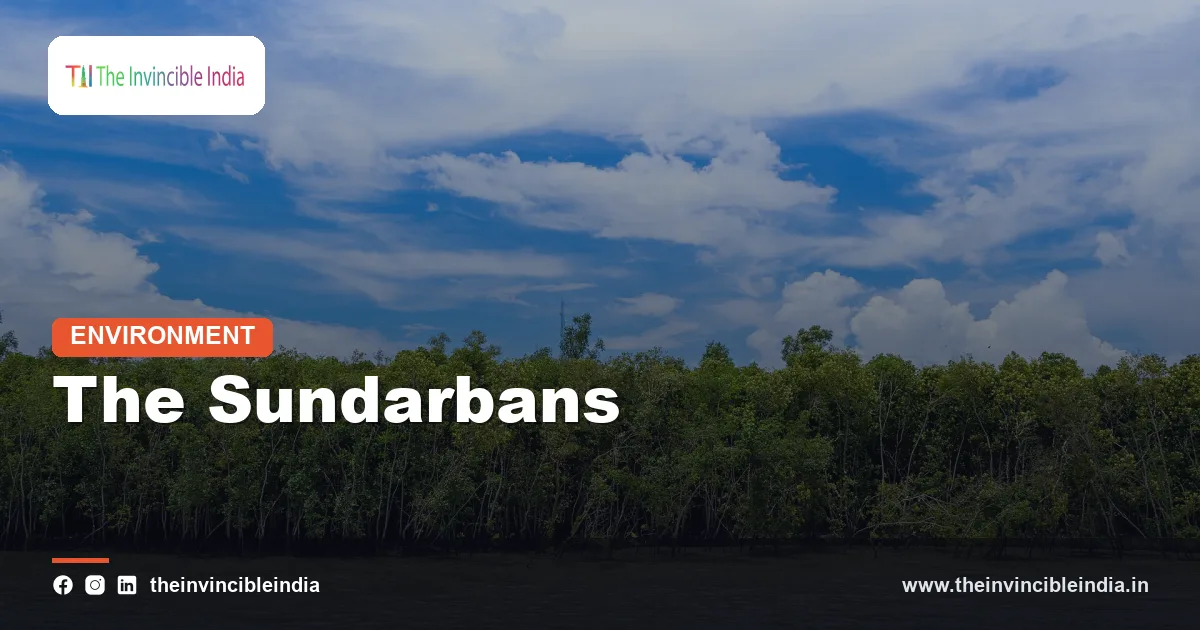
The Sundarbans is the world’s largest mangrove forest, a vast tidal delta at the mouth of the Ganga, Brahmaputra and Meghna rivers that is shared between India and Bangladesh and is home to the Royal Bengal tiger. Spread across a maze of islands, tidal creeks and muddy channels along the Bay of Bengal, the Sundarbans ecosystem is both a biodiversity stronghold and the living home of millions of people.
The Sundarbans is globally known for its swimming tigers, its salt-tolerant mangrove trees and its protection as a UNESCO World Heritage Site, a Ramsar wetland and a biosphere reserve. This explainer sets out how the Sundarbans formed, what lives there, how people survive in it, how it is protected and why rising seas and cyclones now threaten it.
Quick Facts
| Attribute | Detail |
|---|---|
| Type | Tidal mangrove forest and river delta ecosystem |
| Location | Ganga-Brahmaputra-Meghna delta; West Bengal (India) and Khulna and Barisal regions (Bangladesh) |
| Approximate total area | About 10,000 square kilometres, of which roughly 40 per cent lies in India and 60 per cent in Bangladesh |
| Indian districts | North 24 Parganas and South 24 Parganas, West Bengal |
| Flagship species | Royal Bengal tiger (Panthera tigris tigris) |
| Dominant mangrove trees | Sundari (Heritiera fomes), gewa (Excoecaria agallocha), goran (Ceriops), keora (Sonneratia apetala) and others |
| Indian protected-area milestones | Tiger Reserve (1973), Sundarbans National Park (1984), Biosphere Reserve (1989), UNESCO World Heritage Site (1987), Ramsar site (2019) |
| Main threats | Sea-level rise, cyclones, salinity, erosion, human-wildlife conflict and pollution |
Key Takeaways
- The Sundarbans is the largest contiguous mangrove forest in the world, covering roughly 10,000 square kilometres across India and Bangladesh.
- The Sundarbans is the only major mangrove habitat where tigers live in large numbers, and its Royal Bengal tigers are strong swimmers that cross tidal channels.
- The Indian Sundarbans was inscribed as a UNESCO World Heritage Site in 1987 and designated a Ramsar wetland of international importance in 2019.
- Sundarbans mangrove trees survive in salty water through special adaptations such as breathing roots called pneumatophores and seeds that sprout while still on the tree.
- Tens of lakhs of people in the Indian Sundarbans depend on farming, fishing, crab collection and honey gathering, and many of them enter tiger territory to earn a living.
- Rising sea levels, powerful cyclones and increasing salinity are the most serious long-term threats to the Sundarbans ecosystem.
What is the Sundarbans?
The Sundarbans is a vast mangrove-covered delta where the Ganga, Brahmaputra and Meghna rivers meet the Bay of Bengal, and it is the largest forest of its kind on Earth. The region is made up of hundreds of low-lying islands separated by tidal rivers, creeks and channels that are flooded and drained by the sea twice a day.
The name is usually explained in two ways. One view links it to the sundari tree, Heritiera fomes, once abundant in the forest. Another reads the word as the Bengali “beautiful forest”. Either way, the Sundarbans is divided between West Bengal in India and the southern districts of Bangladesh, and the boundary runs through a single connected ecosystem.
The Indian part lies in the districts of North and South 24 Parganas, and includes the Sundarbans Tiger Reserve and the Sundarbans National Park. The larger Bangladeshi portion has its own protected forest areas.
How was the Sundarbans formed?
The Sundarbans was formed over thousands of years by the silt that the Ganga, Brahmaputra and Meghna rivers carry down from the Himalaya and deposit at the Bay of Bengal. This sediment slowly built up a delta, the largest on Earth, and mangroves colonised the muddy new land.
The delta continues to change shape. Some islands grow as silt gathers, while others shrink as tides, storms and subsidence wear them down. Because the land is only slightly above sea level, tidal water reaches deep inland, creating the brackish conditions that define the habitat.
The delta is therefore both young and dynamic. Its channels move, its islands shift, and its mangroves help hold the soil in place against waves and currents.
How do mangroves survive in the Sundarbans?
Mangroves survive in the Sundarbans through physical adaptations that let them live in salty, waterlogged, low-oxygen mud. These trees are called halophytes, meaning plants that tolerate salt, and the Sundarbans hosts a large variety of them.
The main adaptations include:
- Pneumatophores: Pencil-like breathing roots that grow upward out of the mud to absorb oxygen, seen in species such as Avicennia and Sonneratia.
- Prop and stilt roots: Arching roots, common in Rhizophora, that anchor the tree in soft mud and tide-swept soil.
- Salt management: Some species filter salt at the roots, while others excrete it through leaves, so the plant avoids a harmful build-up.
- Viviparous seeds: In several species the seed germinates while still attached to the parent and then drops as a ready-grown seedling that can root quickly in mud.
These traits allow the forest to form a dense green barrier along the coast. Mangrove roots slow waves, trap sediment and shelter young fish, prawns and crabs, which is why the forest acts as a nursery for the wider estuary.
Why are the Sundarbans tigers so famous?
The Sundarbans tigers are famous because they are Royal Bengal tigers that live in a mangrove swamp, swim across wide tidal channels and have a long reputation as man-eaters. No other major tiger habitat looks like this, and the animals have adapted to it in unusual ways.
Sundarbans tigers swim between islands to hunt, and they cope with salty water and tidal mud. They prey on chital (spotted deer), wild boar, fish, crabs and monitor lizards. Their home ranges are shaped by the creeks, and the thick vegetation makes them hard to see.
The Sundarbans Tiger Reserve was created in 1973, as part of Project Tiger, India’s national tiger conservation programme. India’s estimates in recent years have put the Indian Sundarbans tiger population at roughly one hundred animals, though counting is difficult in such terrain.
Are the Sundarbans tigers really man-eaters?
Yes, Sundarbans tigers have a documented history of attacking people, and the region is associated more strongly with tiger attacks on humans than almost any other habitat. Honey collectors, fishermen, crab catchers and woodcutters working in the creeks are the usual victims.
Several explanations have been offered. The tigers live in dense cover with limited sight lines, so encounters happen at very short range. People enter their territory on foot or in small boats for work. Salinity and the difficult terrain may also affect prey availability and behaviour, although researchers do not agree on one single cause.
Local people and the forest department have devised responses to this threat:
- Fishermen and honey collectors wear face masks on the back of the head, based on the belief that tigers attack from behind.
- Villages have lost men to tigers, and widows in some villages are called “tiger widows”.
- Nylon-net fencing along village edges, camera traps and patrol boats help keep tigers away from settlements.
- Rural communities have been encouraged to use alternative livelihoods and to follow forest permit rules.
- Many villages worship Bonbibi, a forest deity honoured by both Hindus and Muslims who seek protection while entering the forest.
What other wildlife lives in the Sundarbans?
The Sundarbans supports a wide range of wildlife beyond tigers, including estuarine crocodiles, river dolphins, fishing cats, deer, monitor lizards, turtles and hundreds of species of birds and fish. The mix of freshwater, brackish water and salt water supports a rich food web.
| Group | Examples found in the Sundarbans |
|---|---|
| Big cats and carnivores | Royal Bengal tiger, fishing cat, jungle cat, small Indian civet |
| Hoofed mammals | Chital (spotted deer), wild boar |
| Reptiles | Saltwater (estuarine) crocodile, water monitor lizard, king cobra, olive ridley and other sea turtles, river terrapin |
| Aquatic mammals | Ganges river dolphin, Irrawaddy dolphin, finless porpoise |
| Birds | Kingfishers, herons, egrets, storks, whimbrels, brown-winged kingfisher and many migratory waders |
| Fish and crustaceans | Hilsa, mullet, prawns, mud crab, horseshoe crab |
| Mangrove trees | Sundari, gewa, goran, keora, bain, nypa palm |
The saltwater crocodile is the largest reptile of the delta, and the river terrapin (Batagur baska) and other turtles have been the subject of conservation breeding. Migratory birds use the mudflats and creeks as feeding stops.
How do people live in the Sundarbans?
People in the Sundarbans live mostly by small-scale farming, fishing, crab collection, honey gathering and aquaculture, in villages protected by earthen embankments. The Indian Sundarbans has a population of several million people spread across inhabited islands, and many are among the poorest in the state.
Livelihoods are strongly tied to the tide and the forest:
- Agriculture: Farmers grow a single main rice crop in the monsoon season, because soil and water turn too salty in the dry months.
- Fishing and crabbing: Fishers work the creeks for fish, prawns and mud crabs, using permits from the forest department.
- Honey collection: Honey collectors, known locally as mouals, harvest wild honeycombs in the spring, which is one of the most dangerous jobs in the forest.
- Tourism: Boat safaris and visits to watchtowers and village markets create seasonal income.
- Migration: After cyclones and crop failure, many younger people migrate to cities for work.
Houses are built of mud and thatch on raised ground, and the embankments that keep out tidal water are maintained by communities and the irrigation department. When embankments breach, salt water floods fields and ponds, which is why recovery after storms can take years.
What is the protected status of the Sundarbans?
The Sundarbans holds multiple layers of protection, including tiger reserve status, national park status, biosphere reserve status, UNESCO World Heritage listing and Ramsar designation. Each layer protects the ecosystem under a different law or convention.
| Designation | Year | Meaning |
|---|---|---|
| Sundarbans Tiger Reserve | 1973 | Created under Project Tiger as one of India’s first tiger reserves |
| Sundarbans National Park | 1984 | Core area given national park status under the Wildlife (Protection) Act, 1972 |
| UNESCO World Heritage Site (India) | 1987 | Inscribed for outstanding natural value, with the Bangladeshi Sundarbans inscribed separately in 1997 |
| Sundarban Biosphere Reserve | 1989 | Designated as a multi-use reserve with core, buffer and transition areas |
| Ramsar site (India) | 2019 | Recognised as a wetland of international importance, and the largest protected wetland in India |
The Ramsar Convention is an international treaty on wetlands, signed in 1971 in the Iranian city of Ramsar. The biosphere reserve system, run under UNESCO’s Man and the Biosphere programme, seeks to combine conservation with sustainable use by local people.
How do India and Bangladesh share the Sundarbans?
India and Bangladesh share the Sundarbans as one continuous ecosystem that is managed by two national forest departments, with the larger share lying in Bangladesh and the smaller in India. Tigers, dolphins and migratory birds cross the boundary without regard to the border.
The two countries have cooperated on conservation and on tiger protection, and the shared river system also links them through water and sediment flows. Joint concerns include illegal wildlife trade, cross-border fishing, river management and climate adaptation. Both governments also face the same cyclones, so disaster preparedness and early warning are areas of shared interest.
How do climate change and cyclones threaten the Sundarbans?
Climate change threatens the Sundarbans through rising sea levels, stronger cyclones and growing salinity, all of which can erode islands, damage mangroves and displace villagers. The delta is among the most vulnerable coastal areas in the world because so much of it lies barely above sea level.
The main impacts are:
- Sea-level rise and erosion: Islands such as Ghoramara have shrunk, and Lohachara, a small island, was reported to have disappeared beneath the sea by the early 2000s.
- Cyclones and storm surges: Severe storms such as Cyclone Sidr (2007), Aila (2009), Amphan (2020) and Yaas (2021) breached embankments and flooded farmland.
- Salinity: Higher salt levels in soil and water reduce rice yields, stress freshwater-dependent trees such as sundari and push people toward other work.
- Human-wildlife conflict: Habitat change and lost livelihoods push more people into the forest, raising the risk of tiger encounters.
- Pollution and development pressures: Shipping, industrial discharge and plastic waste affect water quality and wildlife.
The mangroves themselves are also part of the defence. Healthy mangrove belts reduce wave energy and storm surge and store large amounts of carbon, so protecting and replanting them is a core adaptation strategy. Embankment repair, salt-tolerant crops, cyclone shelters and community-based early warning systems complement forest protection.
Bottom Line
The Sundarbans is a shared, living delta where tigers, mangroves and millions of people depend on the same fragile tidal system. Protecting its forests and strengthening the resilience of its villages are two sides of the same task, especially as seas rise and storms intensify. 15 October 2026
Frequently Asked Questions
What is the Sundarbans?
The Sundarbans is the world’s largest mangrove forest, located in the delta of the Ganga, Brahmaputra and Meghna rivers on the Bay of Bengal. It is shared between India and Bangladesh and covers about 10,000 square kilometres. It is home to the Royal Bengal tiger and numerous other species.
Why are Sundarbans tigers called man-eaters?
Sundarbans tigers are called man-eaters because they have a long record of attacking people who enter the forest to fish, collect honey or cut wood. The dense mangroves, tidal creeks and close encounters at short range all contribute. Authorities use measures such as village fencing, patrols and awareness programmes to reduce attacks.
Can tigers swim in the Sundarbans?
Yes, Sundarbans tigers are strong swimmers and regularly cross tidal rivers and creeks to move between islands. This ability is rare among big cats and is shaped by the delta’s maze of waterways. They also tolerate brackish water in this habitat.
Which part of the Sundarbans is in India?
About 40 per cent of the Sundarbans lies in India, in the state of West Bengal, in the districts of North 24 Parganas and South 24 Parganas. The remaining larger share lies in southern Bangladesh. The Indian part includes the Sundarbans National Park and Tiger Reserve.
Is the Sundarbans a UNESCO World Heritage Site?
Yes, the Sundarbans National Park in India was inscribed as a UNESCO World Heritage Site in 1987, and the Sundarbans in Bangladesh was inscribed separately in 1997. The Indian Sundarbans was also designated a Ramsar wetland of international importance in 2019. It is also a notified biosphere reserve.
How is climate change affecting the Sundarbans?
Climate change is affecting the Sundarbans through sea-level rise, stronger cyclones, coastal erosion and rising salinity. These changes are shrinking some islands, damaging farmland and forcing people to migrate. Protecting mangroves and strengthening embankments and early warning systems are key responses.
{“@context”:”https://schema.org”,”@graph”:[{“@type”:”FAQPage”,”mainEntity”:[{“@type”:”Question”,”name”:”What is the Sundarbans?”,”acceptedAnswer”:{“@type”:”Answer”,”text”:”The Sundarbans is the world’s largest mangrove forest, located in the delta of the Ganga, Brahmaputra and Meghna rivers on the Bay of Bengal. It is shared between India and Bangladesh and covers about 10,000 square kilometres. It is home to the Royal Bengal tiger and numerous other species.”}},{“@type”:”Question”,”name”:”Why are Sundarbans tigers called man-eaters?”,”acceptedAnswer”:{“@type”:”Answer”,”text”:”Sundarbans tigers are called man-eaters because they have a long record of attacking people who enter the forest to fish, collect honey or cut wood. The dense mangroves, tidal creeks and close encounters at short range all contribute. Authorities use measures such as village fencing, patrols and awareness programmes to reduce attacks.”}},{“@type”:”Question”,”name”:”Can tigers swim in the Sundarbans?”,”acceptedAnswer”:{“@type”:”Answer”,”text”:”Yes, Sundarbans tigers are strong swimmers and regularly cross tidal rivers and creeks to move between islands. This ability is rare among big cats and is shaped by the delta’s maze of waterways. They also tolerate brackish water in this habitat.”}},{“@type”:”Question”,”name”:”Which part of the Sundarbans is in India?”,”acceptedAnswer”:{“@type”:”Answer”,”text”:”About 40 per cent of the Sundarbans lies in India, in the state of West Bengal, in the districts of North 24 Parganas and South 24 Parganas. The remaining larger share lies in southern Bangladesh. The Indian part includes the Sundarbans National Park and Tiger Reserve.”}},{“@type”:”Question”,”name”:”Is the Sundarbans a UNESCO World Heritage Site?”,”acceptedAnswer”:{“@type”:”Answer”,”text”:”Yes, the Sundarbans National Park in India was inscribed as a UNESCO World Heritage Site in 1987, and the Sundarbans in Bangladesh was inscribed separately in 1997. The Indian Sundarbans was also designated a Ramsar wetland of international importance in 2019. It is also a notified biosphere reserve.”}},{“@type”:”Question”,”name”:”How is climate change affecting the Sundarbans?”,”acceptedAnswer”:{“@type”:”Answer”,”text”:”Climate change is affecting the Sundarbans through sea-level rise, stronger cyclones, coastal erosion and rising salinity. These changes are shrinking some islands, damaging farmland and forcing people to migrate. Protecting mangroves and strengthening embankments and early warning systems are key responses.”}}]}]}


