

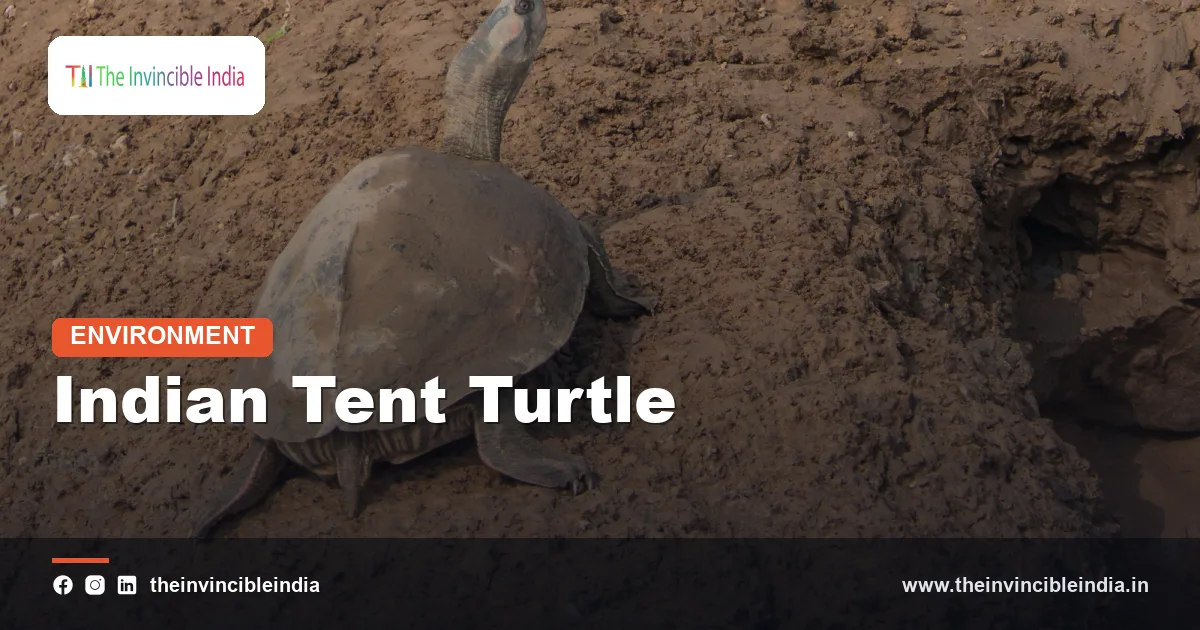
The Indian tent turtle (Pangshura tentoria) is a small freshwater turtle of the Indian subcontinent, named for the ridged, roof-like shape of its shell, and it is commonly seen basking on logs and riverbanks in India’s rivers, ponds and reservoirs. It is one of several “roofed turtles” of South Asia and is found mainly in the large river systems of the Indian plains and the peninsula.
Because the species is small, shy and quick to slip into the water, many people who walk past a river never notice it. Yet the Indian tent turtle plays a quiet role in cleaning waterways, feeding on plants, insects and dead matter, and it also serves as a useful signal of how healthy a river is. This article explains how to recognise the species, where it lives, what it eats, how it breeds and why freshwater turtles in India need protection.
| Quick Facts | Details |
|---|---|
| Common name | Indian tent turtle |
| Scientific name | Pangshura tentoria |
| Family | Geoemydidae (Asian river and pond turtles) |
| Size | Shell length usually about 15 cm to 25 cm, with females growing larger than males |
| Range and habitat in India | Rivers, canals, ponds and reservoirs of the Ganga plains, eastern India and the peninsula |
| Diet | Mainly aquatic plants and algae, plus insects, snails and carrion |
| Breeding and life cycle | Egg-laying; the female buries a small clutch of hard-shelled eggs in sand or soil near the water |
| Defining feature | A raised keel along the middle of the shell that gives it a tent-like profile |
| Protection and status | Freshwater turtles are protected by the Wildlife (Protection) Act, 1972; trade is restricted |
Key Takeaways
- The Indian tent turtle (Pangshura tentoria) is a small freshwater turtle whose raised central keel gives its shell a tent-like shape.
- An Indian tent turtle usually has a shell about 15 cm to 25 cm long, and females grow noticeably larger than males.
- The Indian tent turtle lives in rivers, canals, ponds and reservoirs of India, and it often basks in groups on logs, rocks and banks.
- The diet of the Indian tent turtle is mainly plant matter such as algae and water weeds, supplemented by insects, snails and dead animals.
- A female Indian tent turtle lays a small clutch of eggs in a nest she digs in sand or soil near the water, and the young hatch without parental care.
- Freshwater turtles in India are protected by law, and the Indian tent turtle is threatened locally by capture for the pet and meat trade, nest loss and river pollution.
What is the Indian tent turtle?
The Indian tent turtle is a small, mostly aquatic turtle in the family Geoemydidae, found in the rivers and wetlands of India and some neighbouring countries. It belongs to the genus Pangshura, a group of South Asian turtles that are often called roofed turtles because their shells rise to a ridge in the middle.
The species name tentoria reflects the tent-like outline of the shell, which is the most useful feature for recognising the animal. The turtle is an air-breathing reptile, so it must come to the surface to breathe, but it spends most of its life in water and leaves only to bask, nest or, rarely, move between water bodies.
Several forms of the Indian tent turtle are recognised across the Indian subcontinent, and these differ slightly in shell colour and head markings from one river system to another. This variation is one reason why the species is sometimes confused with other roofed turtles living in the same waters.
How can you recognise an Indian tent turtle?
An Indian tent turtle can be recognised by its olive-brown to dark brown shell with a prominent keel running along the centre of the back, a pattern of pale stripes or markings on the head and a plain, flattened underside. When viewed from the front or behind, the raised keel makes the shell look like a small tent.
The upper shell, called the carapace, is made of large scutes, or horny plates, which often show faint growth rings. The lower shell, called the plastron, is usually yellowish with dark blotches. The head is small and the neck is fairly long, and the head typically carries a bright stripe or patch of colour behind the eye. The feet are webbed, which helps the turtle swim, and the claws are strong enough for climbing out of the water and digging nests.
Differences between males and females
- Females are larger, with a broader and deeper shell.
- Males are smaller and have longer, thicker tails.
- The colours of both sexes are similar, though old animals often become duller or darker.
The shape of the shell varies with age. Young turtles have a sharper keel and a more pronounced tent outline, while very old animals may have a worn, smoother shell. Because the species has distinctive patterning, experienced observers can often identify it from a photograph taken on the bank.
Where does the Indian tent turtle live?
The Indian tent turtle lives in slow-moving or still freshwater across the Ganga and other river basins of the Indian plains, parts of eastern India and several rivers of the peninsula. It is a species of lowland waters rather than mountain streams.
Typical homes of the Indian tent turtle include:
- Slow stretches of large rivers with sandy banks and fallen branches.
- Canals and irrigation channels with grassy edges.
- Village ponds and tanks that retain water through the year.
- Reservoirs, oxbow lakes and backwaters with plenty of weeds.
The turtle prefers places where the water is calm and the vegetation is rich, and where there are sunny spots for basking. In these habitats, individuals often occupy the same stretch of water for long periods, moving only to find food, a mate or a nesting bank. During floods or droughts, turtles may travel overland for short distances to reach new water.
What does the Indian tent turtle eat?
The Indian tent turtle eats mainly aquatic plants and algae, along with insects, small snails, tadpoles and dead animal matter, so it is best described as an omnivore with a strong preference for vegetation. Its diet changes with age and with the food that is available in a given season.
Young turtles take more animal food, because the protein supports rapid growth. They snap up insect larvae, small worms and tiny crustaceans in shallow water. As the turtles mature, plant matter becomes more important, and adults spend much of their time grazing on submerged weeds, filamentous algae and floating plants. They also feed on fallen fruits and dead fish or amphibians that they find in the water.
Feeding takes place mostly in water, because turtles swallow more easily when their mouths are submerged. By eating weeds and carrion, the Indian tent turtle helps to keep ponds and rivers cleaner, and it keeps decaying material from piling up in warm, shallow water.
Why do Indian tent turtles bask in rows?
Indian tent turtles bask in the sun because, as cold-blooded reptiles, they need external warmth to raise their body temperature, digest food and dry their shells. Basking also helps to reduce algae, parasites and skin infections that build up on a wet shell.
Good basking spots, such as logs, rocks and sloping banks, are limited, so turtles often crowd together on the best ones. This produces the familiar sight of several turtles lined up or even stacked on a single log. They stay alert while they bask, and at the slightest disturbance they slide into the water one after another. A loud sound, a moving shadow or an approaching person is usually enough to send the whole group into the water.
Basking behaviour is also useful to scientists and conservation workers, because it makes counting turtles much easier. A survey of basking sites along a river can give a rough picture of how many turtles live there and whether numbers are changing over time.
How does the Indian tent turtle breed?
The Indian tent turtle breeds by laying eggs on land, and the female digs a nest in sand or soft soil near the water and buries a small clutch of hard-shelled eggs. After covering the nest, she returns to the water and gives no further care.
The nesting season generally falls in the drier part of the year, when river banks are exposed and the soil is easy to dig. The eggs are oval and have a firm shell, and the number laid in each clutch is small compared with that of many other turtles. The eggs incubate for a period that depends on temperature, and the hatchlings dig their way out of the nest and head directly to the water.
Stages in the life cycle
- Egg: Buried in a shallow nest and kept warm by the sun-heated soil.
- Hatchling: A tiny turtle that must find water and shelter without help.
- Juvenile: A growing turtle that feeds heavily on animal food and hides among weeds.
- Adult: A mature turtle that feeds largely on plants and breeds once it has reached a suitable size.
Survival of eggs and hatchlings is low. Monitor lizards, dogs, jackals, birds and crabs eat many of them, and human activities such as sand mining, farming on river banks and flooding of nests add to the losses. Turtles are long-lived once they reach adulthood, so the loss of adults has a much greater effect on a population than the loss of a few eggs.
How is the Indian tent turtle different from other Indian freshwater turtles?
The Indian tent turtle differs from other Indian freshwater turtles mainly in its small size and its tent-shaped shell with a central keel, whereas softshell turtles have leathery shells and larger river turtles grow much bigger. India has several groups of freshwater turtles, and each has its own shape and habits.
| Group | Example | Shell and size | General habits |
|---|---|---|---|
| Roofed turtles | Indian tent turtle, Indian roofed turtle | Hard shell with a ridge; small to medium | Bask on banks; eat plants and small animals |
| Softshell turtles | Indian softshell turtle | Flat, leathery shell; large | Bury themselves in mud; mostly carnivorous |
| Pond turtles | Indian black turtle | Domed hard shell; medium | Live in ponds and tanks; omnivorous |
| Flapshell turtles | Indian flapshell turtle | Hard shell with flaps over the limbs; small to medium | Found in ponds and slow water; omnivorous |
Within the roofed turtles, the Indian tent turtle is distinguished from relatives such as the Indian roofed turtle by its head markings and by the shape and height of its keel. Specialists often use the pattern on the head and the exact outline of the shell to separate the species.
Why are freshwater turtles important to Indian rivers?
Freshwater turtles are important to Indian rivers because they clean the water by eating dead animals and excess plant growth, and because they form part of the food chain that supports fish, birds and mammals. In this way turtles help keep aquatic ecosystems in balance.
Some turtle species are active scavengers, and by eating carcasses they reduce the spread of disease in rivers and ponds. Plant-eating species like the Indian tent turtle graze on weeds and algae and help to stop water bodies from clogging. Their eggs and young also feed many other animals, which links life in the water with life on the banks.
Turtles also matter because they respond quickly to changes in water quality and river structure. A river that loses its turtles may be suffering from pollution, over-fishing or the loss of sandy banks. For this reason, turtle surveys are widely used as one way of assessing the health of Indian rivers.
Is the Indian tent turtle protected?
Yes, freshwater turtles in India are protected by the Wildlife (Protection) Act, 1972, which prohibits capturing, keeping or trading them without lawful permission, and the Indian tent turtle falls within this broad protection. India has also acted against the turtle trade through enforcement and international agreements that regulate trade in wild species.
The International Union for Conservation of Nature (IUCN) does not rank the Indian tent turtle among the most threatened Indian turtles, but turtles as a group are among the most threatened groups of vertebrates in the world. Local populations can still be reduced sharply even when the species as a whole remains widespread, and the Indian tent turtle is therefore watched by conservation workers.
Several Indian river turtles have been the subject of breeding and release programmes, nest protection by village communities and public awareness campaigns. Such projects show that turtle conservation can work when local people are involved and when the nesting banks are kept safe.
What threatens the Indian tent turtle?
The main threats to the Indian tent turtle are capture for the pet and meat trade, loss of nesting banks, pollution and accidental death in fishing gear. Together these pressures can reduce local populations even when the turtles appear common.
- Capture for trade: Small turtles are collected for the aquarium and pet market, and some are caught for food or for use in traditional practices.
- Loss of nesting sites: Sand mining, farming on river banks and construction destroy the soft banks where females lay eggs.
- Water pollution: Sewage, industrial waste and agricultural chemicals harm both the turtles and the plants and animals they eat.
- Fishing nets and hooks: Turtles get entangled in nets or swallow hooks and often drown.
- Dams and altered flows: Changes in water levels can flood nests or dry out basking and feeding areas.
Keeping a wild turtle as a pet is often harmful, because most captive turtles die from poor diet, cold or disease, and removing them from the river deprives the wild population of breeding animals. Anyone who finds an injured turtle should hand it to the forest department or a wildlife rescue organisation instead of keeping it.
Bottom Line
The Indian tent turtle is a small, hardy, tent-shelled turtle that quietly keeps Indian rivers and ponds cleaner and healthier. Protecting sandy nesting banks, controlling pollution and refusing to buy or keep wild turtles are the most practical ways to ensure that people continue to see these basking turtles for generations.
Frequently Asked Questions
What is an Indian tent turtle?
An Indian tent turtle is a small freshwater turtle, scientifically named Pangshura tentoria, found in rivers, ponds and reservoirs of India. It is named for the central keel on its shell, which gives it a tent-like shape. It spends most of its time in water and basks on logs and banks.
How big does an Indian tent turtle grow?
An Indian tent turtle usually grows to a shell length of about 15 cm to 25 cm, with females larger than males. Males are smaller and have longer tails. Growth depends on food supply, water quality and age.
What does the Indian tent turtle eat?
The Indian tent turtle eats mainly aquatic plants and algae, along with insects, snails, tadpoles and dead animals. Young turtles eat more animal food, while adults eat more plants. This mixed diet makes it an omnivore that helps clean the water.
Is it legal to keep an Indian tent turtle as a pet?
No, it is not legal to capture or keep wild freshwater turtles in India without lawful permission, because they are protected under the Wildlife (Protection) Act, 1972. Offenders may face fines or imprisonment. People who find an injured turtle should contact the forest department or a wildlife rescue group.
Why do tent turtles bask on logs?
Tent turtles bask on logs because they are cold-blooded and need sunlight to warm their bodies, aid digestion and dry their shells. Basking also reduces algae and parasites on the shell. They often gather in groups on the best sunny spots and slide into the water if disturbed.
How do Indian tent turtles reproduce?
Indian tent turtles reproduce by laying eggs, and the female digs a nest in sand or soft soil near water and buries a small clutch. She does not guard the eggs, and the hatchlings emerge on their own after a period of incubation. Many nests are lost to predators and to changes in river banks.
{“@context”:”https://schema.org”,”@graph”:[{“@type”:”FAQPage”,”mainEntity”:[{“@type”:”Question”,”name”:”What is an Indian tent turtle?”,”acceptedAnswer”:{“@type”:”Answer”,”text”:”An Indian tent turtle is a small freshwater turtle, scientifically named Pangshura tentoria, found in rivers, ponds and reservoirs of India. It is named for the central keel on its shell, which gives it a tent-like shape. It spends most of its time in water and basks on logs and banks.”}},{“@type”:”Question”,”name”:”How big does an Indian tent turtle grow?”,”acceptedAnswer”:{“@type”:”Answer”,”text”:”An Indian tent turtle usually grows to a shell length of about 15 cm to 25 cm, with females larger than males. Males are smaller and have longer tails. Growth depends on food supply, water quality and age.”}},{“@type”:”Question”,”name”:”What does the Indian tent turtle eat?”,”acceptedAnswer”:{“@type”:”Answer”,”text”:”The Indian tent turtle eats mainly aquatic plants and algae, along with insects, snails, tadpoles and dead animals. Young turtles eat more animal food, while adults eat more plants. This mixed diet makes it an omnivore that helps clean the water.”}},{“@type”:”Question”,”name”:”Is it legal to keep an Indian tent turtle as a pet?”,”acceptedAnswer”:{“@type”:”Answer”,”text”:”No, it is not legal to capture or keep wild freshwater turtles in India without lawful permission, because they are protected under the Wildlife (Protection) Act, 1972. Offenders may face fines or imprisonment. People who find an injured turtle should contact the forest department or a wildlife rescue group.”}},{“@type”:”Question”,”name”:”Why do tent turtles bask on logs?”,”acceptedAnswer”:{“@type”:”Answer”,”text”:”Tent turtles bask on logs because they are cold-blooded and need sunlight to warm their bodies, aid digestion and dry their shells. Basking also reduces algae and parasites on the shell. They often gather in groups on the best sunny spots and slide into the water if disturbed.”}},{“@type”:”Question”,”name”:”How do Indian tent turtles reproduce?”,”acceptedAnswer”:{“@type”:”Answer”,”text”:”Indian tent turtles reproduce by laying eggs, and the female digs a nest in sand or soft soil near water and buries a small clutch. She does not guard the eggs, and the hatchlings emerge on their own after a period of incubation. Many nests are lost to predators and to changes in river banks.”}}]}]}


