

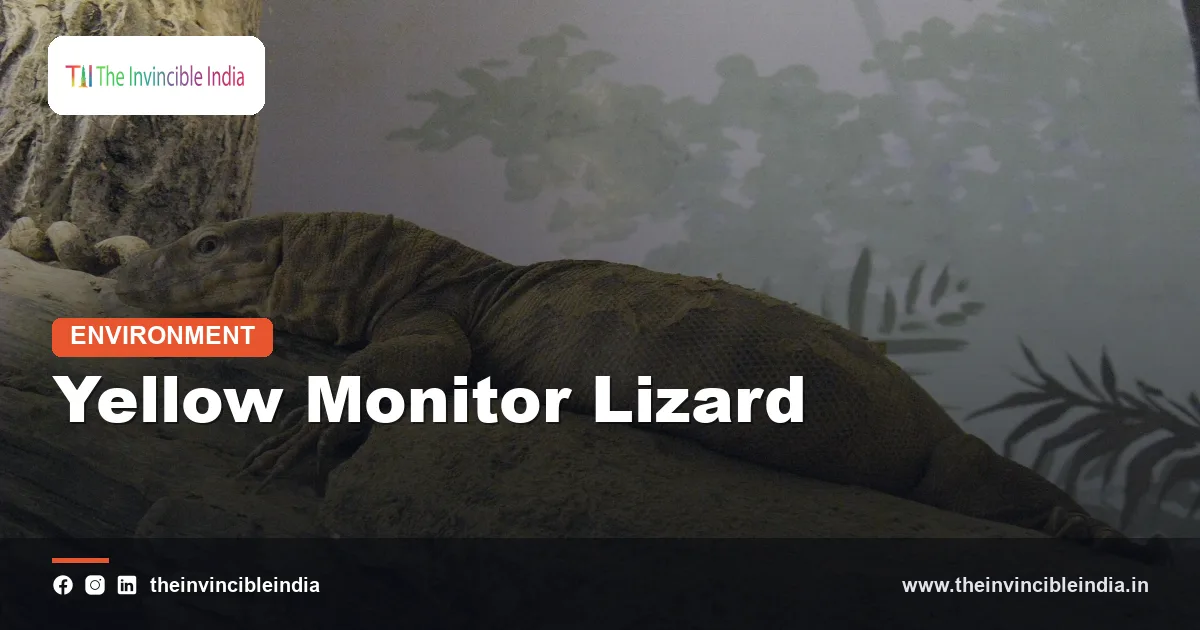
The yellow monitor (Varanus flavescens) is a medium-sized monitor lizard of the northern Indian subcontinent, recognised by the pale yellow spots and bands on its dark olive-brown back and by its fondness for wet, grassy ground near water. It is a legally protected reptile in India, where it lives in floodplains, marshes, canal banks and farmland across the Indo-Gangetic plain and neighbouring regions.
Most people who see a large lizard in an Indian field or on a village path assume it is the Bengal monitor, but the yellow monitor is a separate species with its own habits. It is an excellent swimmer, a keen digger of burrows and a hunter of insects, crabs, frogs, fish and eggs. This article explains how to recognise the animal, where it lives, what it eats, how it breeds and why it needs protection.
| Quick Facts | Details |
|---|---|
| Common name | Yellow monitor (also called yellow monitor lizard or Indian yellow monitor) |
| Scientific name | Varanus flavescens |
| Family | Varanidae (monitor lizards) |
| Size | Usually about 60 cm to 1 m in total length, including the long tail |
| Range and habitat in India | Plains of northern, north-eastern and eastern India; marshes, floodplains, grassland, paddy fields and canal banks |
| Diet | Insects, crabs, snails, frogs, fish, small reptiles, rodents, birds’ eggs and carrion |
| Breeding and life cycle | Egg-laying; the female buries a clutch of eggs in soil, and the hatchlings fend for themselves |
| Legal protection | Protected under the Wildlife (Protection) Act, 1972; international trade restricted under CITES |
| Conservation status | Assessed as Least Concern by the IUCN, with local declines from hunting and habitat loss |
Key Takeaways
- The yellow monitor (Varanus flavescens) is a monitor lizard of the Indian subcontinent that is smaller and more water-loving than the Bengal monitor.
- An adult yellow monitor usually measures between about 60 cm and 1 m, and roughly half of that length is tail.
- The yellow monitor lives in burrows dug into soft, damp ground near rivers, marshes, ponds and paddy fields, and it swims readily.
- A yellow monitor eats a wide range of animal prey, including insects, crabs, frogs, fish and eggs, which makes it a natural controller of field pests.
- Monitor lizards, including the yellow monitor, are protected in India under the Wildlife (Protection) Act, 1972, so hunting, capturing or trading them is an offence.
- The yellow monitor poses almost no danger to people, and it usually flees or hides in a burrow when approached.
What is the yellow monitor lizard?
The yellow monitor lizard is a large, long-tailed reptile belonging to the family Varanidae, the same family that includes the Komodo dragon and the more familiar Bengal monitor. Members of this family share an elongated body, strong limbs with sharp claws, a long neck and a deeply forked tongue that the animal flicks in and out to sample scent in the air.
The scientific name of the yellow monitor is Varanus flavescens, and the species name refers to its yellowish tint. The lizard belongs to a group of Asian monitors that are comfortable on land and in water. In India it is a species of the plains rather than the hills, and it is most often found where the soil is soft enough to dig and where there is water close at hand.
Like all lizards, the yellow monitor is a cold-blooded reptile. Its body temperature depends on its surroundings, so it spends part of the morning basking in the sun and then moves about to hunt when it is warm. During the cool months it becomes sluggish and spends long periods inside its burrow.
How can you identify a yellow monitor?
A yellow monitor can be identified by its dark olive, brown or blackish upper body, which is marked with rows of yellow or cream spots and crossbands, and by its relatively slender build and long tapering tail. The belly and throat are paler, often yellowish or whitish with fine dark markings.
Young animals are usually more brightly patterned than adults. Hatchlings show a vivid contrast of yellow bands against a dark background, and the colours tend to become duller and more blended as the lizard grows older. The skin is covered in small, rounded scales, and the head is long with a pointed snout.
Features that help in the field
- A yellow or cream spotted pattern on a dark olive-brown back.
- A tail that is long, tapering and somewhat flattened from side to side, which helps in swimming.
- A forked tongue that flicks constantly when the animal is alert.
- Strong claws on all four feet, used for digging, climbing banks and gripping prey.
- A habit of standing tall on its legs and raising the head to look around.
Size alone is not a reliable guide, because a young Bengal monitor and a mature yellow monitor can look similar at a distance. Colour pattern, habitat and behaviour together give a better clue, and a photograph is often needed to be certain. Many Indian monitor lizards are misidentified, which is one reason accurate public information about the yellow monitor matters.
Where does the yellow monitor live in India?
The yellow monitor lives mainly across the plains of northern, north-eastern and eastern India, and its range continues into neighbouring countries of South Asia. It is a lowland species associated with the great river systems, especially the Ganga and Brahmaputra basins and nearby wetlands.
Within that range, the yellow monitor prefers damp and open habitats. It is commonly reported from the following kinds of places:
- River floodplains and the grassy edges of marshes and oxbow lakes.
- Canal and embankment slopes where the soil is soft and burrows are easy to dig.
- Paddy fields, sugarcane fields and other farmland that stays moist for much of the year.
- Village ponds, drains and low scrub on the outskirts of settlements.
The species avoids dense, shaded forest and dry, rocky hill country. Because it depends on soft ground and water, it is closely tied to wetlands, and a wetland that is drained, paved or turned into housing often loses its monitors quickly.
What does the yellow monitor eat?
The yellow monitor eats almost any animal it can catch and swallow, including insects, crabs, snails, frogs, fish, small reptiles, rodents and the eggs of birds and other reptiles. It also feeds on dead animals, which makes it a useful scavenger around wetlands.
Young lizards depend mostly on insects such as grasshoppers, beetles and crickets. As the animal grows, it takes larger prey, and adults regularly catch crabs and frogs along the water’s edge. The yellow monitor hunts by a mix of patient stalking and active searching. It walks slowly through grass and mud, flicks its tongue to detect scent and then lunges at prey that it finds or flushes out.
Why the diet matters to farmers
Many of the animals eaten by the yellow monitor are field pests or carriers of crop damage. Rats, crabs that burrow in bunds, locusts and grasshoppers all feature on the menu. A healthy population of monitor lizards around a farm therefore provides a quiet and free form of pest control. Killing these animals out of fear or superstition removes a natural ally from the field.
How does the yellow monitor breed and grow?
The yellow monitor breeds by laying eggs, and the female buries them in soft soil or in a chamber dug into a bank. The clutch is left to develop without parental care, and the young hatch fully formed after a period of incubation that depends on the temperature of the soil.
Breeding generally takes place after the cold season, and egg laying is often timed so that the young emerge when insects and other small prey are plentiful. The number of eggs in a clutch varies with the size and condition of the female, and it can range from a handful to a few dozen. Hatchlings are only a few centimetres long at first and are vulnerable to birds, snakes, mongooses, dogs and larger monitors.
The growth of the yellow monitor is steady rather than rapid. A young animal may take a few years to reach adult size, and those that survive can live for a number of years in the wild. The high death rate among eggs and hatchlings explains why every adult female that is killed removes a great deal of future breeding potential.
How is the yellow monitor different from the Bengal monitor?
The yellow monitor differs from the Bengal monitor mainly in its smaller size, its yellow-spotted pattern, its closer link to water and its more northern and eastern distribution. Both species are protected in India, and both are often confused by villagers and by casual observers.
| Feature | Yellow monitor | Bengal monitor |
|---|---|---|
| Scientific name | Varanus flavescens | Varanus bengalensis |
| Typical size | Medium, about 60 cm to 1 m | Larger, often well over 1 m |
| Colour | Dark olive-brown with yellow spots and bands | Greyish or brownish with darker speckles |
| Preferred habitat | Wet grassland, marshes, floodplains, paddy fields | Dry scrub, forest, farmland and villages |
| Relationship with water | Strong swimmer, lives close to water | Swims when needed but ranges more widely |
| Range in India | Mainly the northern, eastern and north-eastern plains | Found across most of the country |
The simplest way to remember the difference is that the Bengal monitor is the widespread, larger lizard of drier country, while the yellow monitor is the more compact and brighter lizard of wetlands.
Why is the yellow monitor important to the ecosystem?
The yellow monitor is important because it helps regulate populations of insects, rodents, crabs and amphibians, and because it recycles dead matter by feeding on carrion. As both predator and prey, it forms a link in the food chain of Indian wetlands and farmland.
Its burrows also matter. Abandoned monitor burrows give shelter to other small animals, including frogs, snakes, rodents and insects, particularly during hot summers and cold winter nights. In this way the lizard acts as a small-scale ecosystem engineer, creating homes that other species use.
Because the yellow monitor depends on healthy wetlands, its presence is a good sign of habitat quality. Where the species disappears, it often signals that marshes have been drained, banks have been cemented or pesticide use has risen sharply. Ecologists therefore treat monitor lizards as useful indicators of the condition of wet grassland and floodplain habitats.
Is the yellow monitor protected in India?
Yes, the yellow monitor is protected in India under the Wildlife (Protection) Act, 1972, which prohibits hunting, capturing, keeping or trading the species without lawful permission. Monitor lizards are among the reptiles covered by the schedules of this law, and breaking it can lead to fines and imprisonment.
The protection reflects a long history of exploitation. Monitor lizards were once hunted for their skin, which was used in making drums and leather goods, and for their meat, fat and body parts, many of which are linked to folk beliefs and false claims of healing or luck. Internationally, the yellow monitor is covered by the Convention on International Trade in Endangered Species of Wild Fauna and Flora (CITES), which restricts cross-border trade in the species.
The conservation status of the species is better than that of many reptiles, and the International Union for Conservation of Nature (IUCN) has assessed it as Least Concern. However, a classification of Least Concern does not mean that local populations are safe, and legal protection remains important because the animal is easy to find, easy to catch and easy to mistake for a pest.
What threatens the yellow monitor?
The main threats to the yellow monitor are habitat loss, hunting and killing by people, road mortality and the use of agricultural chemicals. Each of these pressures is more severe where wetlands are shrinking quickly.
- Loss of wetlands and grassland: Drainage, construction, sand mining and the conversion of marshes to cropland remove both burrowing sites and prey.
- Hunting and persecution: Monitors are caught for meat, skin and superstitious uses, and are sometimes killed simply because they are large and look frightening.
- Road deaths: Lizards crossing roads to reach water or sunning spots are frequently run over.
- Pesticides and pollution: Chemicals reduce prey and can build up in the animals that eat contaminated frogs, fish and insects.
- Predation of young: Free-ranging dogs, birds of prey and snakes take large numbers of eggs and hatchlings.
Public awareness is a simple and effective response. Where villagers understand that a monitor is harmless and useful, the animal is far more likely to be left alone.
Is the yellow monitor dangerous to humans?
The yellow monitor is not dangerous to humans, and it will almost always run away or dive into water or a burrow rather than attack. It is a shy animal, and bites happen only when it is cornered, grabbed or threatened.
If a monitor feels trapped, it may hiss, puff up its throat, whip its tail and open its mouth. These are warning displays, and giving the animal space is usually enough to end the encounter. A bite from any large lizard can cause a painful wound with the risk of infection, so a bitten person should wash the wound well and seek medical advice.
What to do if you find one
- Keep a safe distance and do not chase, corner or pick up the animal.
- Keep dogs and children away until the lizard has left.
- If the animal is inside a house or compound, contact the local forest department or a recognised wildlife rescue group instead of using sticks or traps.
- Never kill or sell a monitor lizard, because doing so is a punishable offence.
A common myth claims that monitor lizards are poisonous or that their saliva is deadly. Some monitor species elsewhere are known to have mild venom glands, but there is no evidence that the yellow monitor is a threat to people, and the animal is better described as timid than aggressive.
Bottom Line
The yellow monitor is a harmless, useful and legally protected lizard that belongs to the wetlands and farmlands of the northern plains. Protecting marshes, leaving burrows undisturbed and refusing to hunt or trade the species are the practical steps that keep it part of the Indian countryside.
Frequently Asked Questions
What is a yellow monitor?
A yellow monitor is a medium-sized monitor lizard, scientifically named Varanus flavescens, that lives in the plains of northern and eastern India and neighbouring countries. It has a dark olive-brown body marked with yellow spots and bands. It prefers wet grassland, floodplains and farmland near water.
Is the yellow monitor lizard poisonous?
No, the yellow monitor is not poisonous and is not a danger to people. It is a timid animal that usually flees into water or a burrow when disturbed. It can bite if it is cornered or handled, so it should always be left alone.
What does a yellow monitor eat?
A yellow monitor eats insects, crabs, snails, frogs, fish, small reptiles, rodents, eggs and carrion. Young lizards feed mainly on insects, while adults take larger prey. This varied diet helps to control pests in fields and wetlands.
Is it illegal to kill or keep a monitor lizard in India?
Yes, it is illegal to kill, capture, keep or trade monitor lizards in India without lawful permission, because they are protected under the Wildlife (Protection) Act, 1972. Offenders can face fines and imprisonment. Anyone who finds a monitor in a house should call the forest department or a wildlife rescue group.
How is the yellow monitor different from the Bengal monitor?
The yellow monitor is generally smaller, more brightly marked with yellow spots and more closely tied to water than the Bengal monitor. The Bengal monitor is larger, greyer and more widespread across India. Both are protected species.
How long does a yellow monitor grow?
A yellow monitor usually grows to about 60 cm to 1 m in total length, and about half of this is the tail. Males and females look broadly similar, though size varies with age and food supply. Young animals are smaller and more brightly banded than adults.
{“@context”:”https://schema.org”,”@graph”:[{“@type”:”FAQPage”,”mainEntity”:[{“@type”:”Question”,”name”:”What is a yellow monitor?”,”acceptedAnswer”:{“@type”:”Answer”,”text”:”A yellow monitor is a medium-sized monitor lizard, scientifically named Varanus flavescens, that lives in the plains of northern and eastern India and neighbouring countries. It has a dark olive-brown body marked with yellow spots and bands. It prefers wet grassland, floodplains and farmland near water.”}},{“@type”:”Question”,”name”:”Is the yellow monitor lizard poisonous?”,”acceptedAnswer”:{“@type”:”Answer”,”text”:”No, the yellow monitor is not poisonous and is not a danger to people. It is a timid animal that usually flees into water or a burrow when disturbed. It can bite if it is cornered or handled, so it should always be left alone.”}},{“@type”:”Question”,”name”:”What does a yellow monitor eat?”,”acceptedAnswer”:{“@type”:”Answer”,”text”:”A yellow monitor eats insects, crabs, snails, frogs, fish, small reptiles, rodents, eggs and carrion. Young lizards feed mainly on insects, while adults take larger prey. This varied diet helps to control pests in fields and wetlands.”}},{“@type”:”Question”,”name”:”Is it illegal to kill or keep a monitor lizard in India?”,”acceptedAnswer”:{“@type”:”Answer”,”text”:”Yes, it is illegal to kill, capture, keep or trade monitor lizards in India without lawful permission, because they are protected under the Wildlife (Protection) Act, 1972. Offenders can face fines and imprisonment. Anyone who finds a monitor in a house should call the forest department or a wildlife rescue group.”}},{“@type”:”Question”,”name”:”How is the yellow monitor different from the Bengal monitor?”,”acceptedAnswer”:{“@type”:”Answer”,”text”:”The yellow monitor is generally smaller, more brightly marked with yellow spots and more closely tied to water than the Bengal monitor. The Bengal monitor is larger, greyer and more widespread across India. Both are protected species.”}},{“@type”:”Question”,”name”:”How long does a yellow monitor grow?”,”acceptedAnswer”:{“@type”:”Answer”,”text”:”A yellow monitor usually grows to about 60 cm to 1 m in total length, and about half of this is the tail. Males and females look broadly similar, though size varies with age and food supply. Young animals are smaller and more brightly banded than adults.”}}]}]}


