

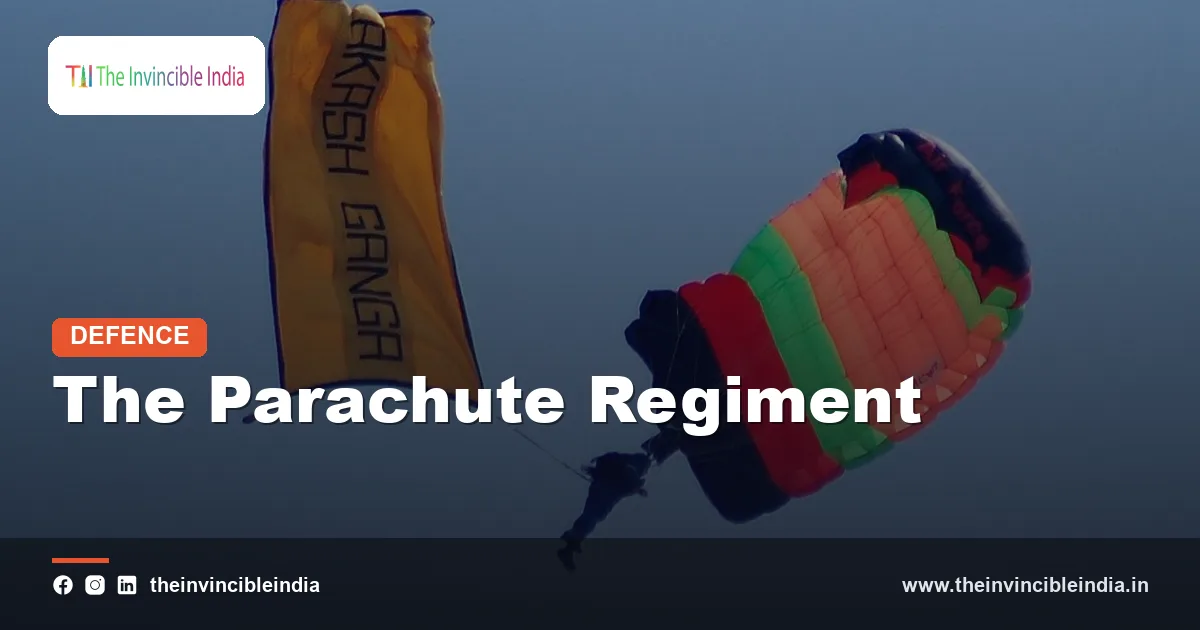
The Parachute Regiment is the airborne infantry regiment of the Indian Army and the parent regiment of the Para (Special Forces) battalions, tracing its roots to the 50th Parachute Brigade raised during the Second World War. Its soldiers are trained to be inserted by air, and its special forces battalions wear the maroon beret and the Balidan insignia, a winged dagger that is the best-known badge of India’s army commandos. The Regiment’s motto is “Shatrujeet”, meaning “Conqueror of the Enemy”.
This explainer describes the origins of the Parachute Regiment, how the airborne and special forces roles differ, the meaning of its beret and badge, and the well-known public episodes in its history. It deliberately leaves out training methods, tactics and current strength.
| Attribute | Detail |
|---|---|
| Parent force | Indian Army |
| Type | Airborne infantry regiment; includes Para (Special Forces) battalions |
| Origins | Parachute units raised in 1941, including the 50th Parachute Brigade |
| Formally constituted as a regiment | 1952 |
| Motto | Shatrujeet (Conqueror of the Enemy) |
| Headwear | Maroon beret |
| Special Forces insignia | Balidan badge, a winged dagger |
| Regimental Centre | Parachute Regimental Training Centre, Bengaluru |
| Airborne school | Paratroopers Training School, Agra |
Key Takeaways
- The Parachute Regiment is the airborne infantry arm of the Indian Army and also provides the Army’s Para (Special Forces) battalions.
- The origins of the Parachute Regiment lie in October 1941, when India’s first parachute units were raised, leading to the formation of the 50th Parachute Brigade during the Second World War.
- The Parachute Regiment was formally constituted in 1952, and its regimental motto is “Shatrujeet”, meaning “Conqueror of the Enemy”.
- Para (Special Forces) personnel wear the maroon beret and the Balidan badge, a winged dagger insignia worn by those who qualify for special forces.
- Not every soldier in the Parachute Regiment is a special forces operator: the Regiment has both airborne parachute battalions and specialised Para (Special Forces) battalions.
- Well-known public events in the Regiment’s history include the battle of Sangshak in 1944, the Tangail airdrop of 1971 and the Maldives operation of 1988.
What is the Parachute Regiment?
The Parachute Regiment is an infantry regiment of the Indian Army whose soldiers are trained and equipped to be delivered into battle by air, and whose special forces units carry out specialised missions. It is part of the Infantry arm of the Army, although it has a distinct identity, with its own training centre, traditions and uniform.
The regiment has two broad groups of units. The first are the parachute (airborne) battalions, which are light infantry battalions that can be dropped by air as part of a parachute brigade. The second are the Para (Special Forces) battalions, which are selected and trained for missions that are beyond the scope of regular infantry and that are conducted in small teams.
How did the Parachute Regiment begin?
The Parachute Regiment began in the Second World War, when the British Indian Army formed its first parachute units in 1941 and the 50th Indian Parachute Brigade took shape soon afterwards. The initial training unit was set up near Delhi, and it produced the first batches of trained military parachutists in India.
The brigade’s early units included Indian, British and Gurkha parachute battalions, and the formation was part of the effort to build airborne forces for the war against Japan. As the war progressed, the airborne forces expanded, and in 1944 the 44th Indian Airborne Division was formed.
After Independence in 1947, the airborne tradition continued with the 50th Parachute Brigade, and the Parachute Regiment was formally constituted as a regiment of the Indian Army in 1952. In the following decades the Regiment expanded, and a series of special forces units were raised from it.
| Year | Milestone |
|---|---|
| 1941 | First Indian parachute units raised; parachute training begins near Delhi |
| 1944 | 50th Parachute Brigade fights at Sangshak; 44th Indian Airborne Division formed |
| 1947 | Independence; airborne tradition continues with the 50th Parachute Brigade |
| 1950-1953 | A parachute field ambulance serves in the Korean War |
| 1952 | Parachute Regiment formally constituted |
| 1961 | Parachute units take part in the liberation of Goa |
| 1966 | First commando battalion raised, the root of the Para (Special Forces) units |
| 1971 | Parachute battalion is airdropped at Tangail in East Pakistan |
| 1988 | Airborne brigade flown to the Maldives in Operation Cactus |
What happened at the Battle of Sangshak?
The Battle of Sangshak, fought in March 1944 near Imphal in Manipur, was a key engagement in which the 50th Parachute Brigade held a defensive position against a larger Japanese force, delaying the enemy advance towards Kohima and Imphal. It was one of the first major tests of the Indian airborne force in combat, although the brigade fought on foot as infantry.
Historians have credited the stand at Sangshak with buying valuable time for the British and Indian forces, who used it to strengthen the defences at Imphal and Kohima. The battle is remembered in the Parachute Regiment as part of its heritage.
What is the difference between airborne and special forces roles?
The difference is that airborne units are conventional light infantry trained to be delivered by parachute or air transport in larger formations, while special forces units are small teams selected for specialised, high-risk tasks. Both belong to the Parachute Regiment, but they have different selection standards, equipment and missions.
- Airborne battalions: Light infantry that can be inserted behind enemy lines by parachute, seize key objectives such as airfields or bridges, and be used in rapid-response operations.
- Para (Special Forces) battalions: Volunteers who have passed a demanding probation, and who are employed for special missions, in line with the general role of special forces in any army.
Para (Special Forces) soldiers are drawn from volunteers across the Army’s infantry units. The Army does not publish details of selection or tactics, and this article does not describe them.
What do the maroon beret and the Balidan badge mean?
The maroon beret is the traditional headdress of paratroopers in the Parachute Regiment, and the Balidan badge, a dagger with wings, is the insignia worn by those who qualify as Para (Special Forces). The word “Balidan” means “sacrifice” in Hindi and signals the readiness to give one’s life for the nation.
The maroon beret has its origin in the airborne forces of the British Army in the Second World War and is a common colour of airborne troops in many Commonwealth armies. The winged dagger of the Balidan badge is a symbol of the special forces identity. It is worn on the chest uniform by personnel who have completed the probation period and are accepted into the special forces. Parachutists also wear “jump wings” on their uniforms, which show that they have qualified in military parachuting.
How did the Para (Special Forces) units begin?
The Para (Special Forces) units began in 1966, when the Indian Army raised its first commando battalion, designated 9 Para (Commando), after the experiences of the 1962 and 1965 wars showed the need for such forces. More battalions were created over the following decades.
Several of the earliest commando battalions were later redesignated as Para (Special Forces) battalions. These units come under the Parachute Regiment for administration, and they also have their own selection and training. The Special Forces play a role in the Army’s counter-insurgency and border operations, though the details are rarely made public. The Armed Forces Special Operations Division, announced in 2019, was set up to bring together special operations elements of the three services under a joint structure.
What is the training centre of the Parachute Regiment?
The Parachute Regimental Training Centre in Bengaluru is the home of the Regiment, where recruits and volunteers go through basic military and regimental training. Parachute jumping itself is taught at the Paratroopers Training School in Agra, which is also the base of the Army’s airborne brigade.
Agra has long been the centre of Indian military parachuting. Indian Air Force transport aircraft carry paratroopers to drop zones, and the Army and the Air Force jointly practise airborne operations. Jump qualification is a mark of pride, and many soldiers of other arms undergo the course as well.
What are the best-known operations of the Parachute Regiment?
The best-known public operations in which the Parachute Regiment took part include the capture of Goa in 1961, the airdrop at Tangail in the 1971 war, and the rescue mission in the Maldives in 1988. The Regiment has also contributed to later wars and to counter-insurgency operations.
Goa, 1961
In December 1961 Indian forces took over the Portuguese-held territory of Goa in Operation Vijay. Parachute units participated in the operation.
Tangail, 1971
On 11 December 1971, during the Bangladesh Liberation War, a parachute battalion of the Regiment was dropped near Tangail, north of Dhaka. The airdrop helped Indian and Mukti Bahini forces to cut the retreat of Pakistani forces and speed the advance to Dhaka.
Maldives, 1988
In November 1988, at the request of the Maldivian government, India sent a parachute brigade from Agra by air to the Maldives to put down a coup attempt. The Indian troops landed at Hulhule airport near Male and restored order, in an operation known as Operation Cactus. It showed India’s ability to project airborne forces over long distances at short notice.
Korea, 1950-1953
The 60th Parachute Field Ambulance, an airborne medical unit, served in the Korean War and was widely praised for its work, including during the Chinese offensives.
How is the Parachute Regiment organised?
The Parachute Regiment is organised into battalions, and the airborne battalions are grouped into the 50th Independent Parachute Brigade, which has its headquarters in Agra. Special forces battalions are separate and are used flexibly.
The brigade is a self-contained airborne formation with its own supporting arms, such as artillery, engineers, signals and medical elements, which are also trained to parachute. The Army does not publish the number of battalions on active strength, and the structure may change over time.
Why does the Parachute Regiment matter?
The Parachute Regiment matters because it gives India a way to project force rapidly, over long distances and into places that cannot be reached by land, and it carries the Army’s special forces tradition. In peacetime, its soldiers train for a wide range of contingencies, and they have also supported humanitarian and disaster relief missions.
Its history, from the stand at Sangshak to the airborne operations in 1971 and 1988, forms a large part of the Army’s institutional memory, and its soldiers have been decorated with many gallantry awards over the years.
How do paratroopers reach the battlefield?
Paratroopers reach the battlefield by being carried in military transport aircraft, typically provided by the Indian Air Force, and jumping out over a designated drop zone, usually with a static-line parachute that opens automatically. The Air Force and the Army plan such missions together, since the choice of aircraft, route and drop zone decides how many soldiers can be inserted and how quickly.
Airborne insertion has clear advantages and well-known limits. It lets a commander place troops behind a barrier such as a river, mountain range or enemy line without needing a road, and it surprises the enemy. However, paratroopers land with light weapons and limited supplies, so airborne operations are normally planned to link up quickly with other forces or to be resupplied by air. For this reason, parachute battalions emphasise fitness, discipline and self-reliance.
Besides parachute drops, airborne troops can be carried to an airfield by transport aircraft, or by helicopter, which are called air-landed and heliborne operations. The Parachute Regiment trains for each of these methods as part of the wider airborne task.
Bottom Line
The Parachute Regiment combines two traditions: conventional airborne infantry that can be moved by air, and Para (Special Forces) units with a separate identity marked by the maroon beret and the Balidan badge. From its Second World War beginnings in the 50th Parachute Brigade to its place in modern Indian military history, the Regiment is one of the Army’s most recognised formations.
Frequently Asked Questions
What is the Parachute Regiment of the Indian Army?
The Parachute Regiment is the airborne infantry regiment of the Indian Army. It has parachute battalions that can be delivered by air and Para (Special Forces) battalions that carry out specialised missions. It was formally constituted in 1952, with roots in the Second World War.
What does the Balidan badge mean?
The Balidan badge is a winged dagger worn by qualified Para (Special Forces) personnel. The word “Balidan” means sacrifice. It is the identifying insignia of India’s army special forces.
Are all Parachute Regiment soldiers special forces?
No, not all Parachute Regiment soldiers are special forces. The Regiment includes airborne parachute battalions of light infantry as well as separate Para (Special Forces) battalions. Special forces personnel are volunteers who pass a demanding selection.
When was the Parachute Regiment formed?
The Parachute Regiment was formally constituted in 1952, although its origins go back to 1941, when India’s first parachute units were raised. The 50th Parachute Brigade, formed during the Second World War, is the ancestor of today’s airborne formation.
What is the motto of the Parachute Regiment?
The motto of the Parachute Regiment is “Shatrujeet”, which means “Conqueror of the Enemy”. It expresses the offensive spirit of the airborne troops.
Where do Indian paratroopers train?
Indian paratroopers learn to jump at the Paratroopers Training School in Agra, and the Regiment’s recruits are trained at the Parachute Regimental Training Centre in Bengaluru. Agra is also the base of the Army’s airborne brigade, and the Indian Air Force provides the aircraft for parachute drops.
{“@context”:”https://schema.org”,”@graph”:[{“@type”:”FAQPage”,”mainEntity”:[{“@type”:”Question”,”name”:”What is the Parachute Regiment of the Indian Army?”,”acceptedAnswer”:{“@type”:”Answer”,”text”:”The Parachute Regiment is the airborne infantry regiment of the Indian Army. It has parachute battalions that can be delivered by air and Para (Special Forces) battalions that carry out specialised missions. It was formally constituted in 1952, with roots in the Second World War.”}},{“@type”:”Question”,”name”:”What does the Balidan badge mean?”,”acceptedAnswer”:{“@type”:”Answer”,”text”:”The Balidan badge is a winged dagger worn by qualified Para (Special Forces) personnel. The word “Balidan” means sacrifice. It is the identifying insignia of India’s army special forces.”}},{“@type”:”Question”,”name”:”Are all Parachute Regiment soldiers special forces?”,”acceptedAnswer”:{“@type”:”Answer”,”text”:”No, not all Parachute Regiment soldiers are special forces. The Regiment includes airborne parachute battalions of light infantry as well as separate Para (Special Forces) battalions. Special forces personnel are volunteers who pass a demanding selection.”}},{“@type”:”Question”,”name”:”When was the Parachute Regiment formed?”,”acceptedAnswer”:{“@type”:”Answer”,”text”:”The Parachute Regiment was formally constituted in 1952, although its origins go back to 1941, when India’s first parachute units were raised. The 50th Parachute Brigade, formed during the Second World War, is the ancestor of today’s airborne formation.”}},{“@type”:”Question”,”name”:”What is the motto of the Parachute Regiment?”,”acceptedAnswer”:{“@type”:”Answer”,”text”:”The motto of the Parachute Regiment is “Shatrujeet”, which means “Conqueror of the Enemy”. It expresses the offensive spirit of the airborne troops.”}},{“@type”:”Question”,”name”:”Where do Indian paratroopers train?”,”acceptedAnswer”:{“@type”:”Answer”,”text”:”Indian paratroopers learn to jump at the Paratroopers Training School in Agra, and the Regiment’s recruits are trained at the Parachute Regimental Training Centre in Bengaluru. Agra is also the base of the Army’s airborne brigade, and the Indian Air Force provides the aircraft for parachute drops.”}}]}]}


