

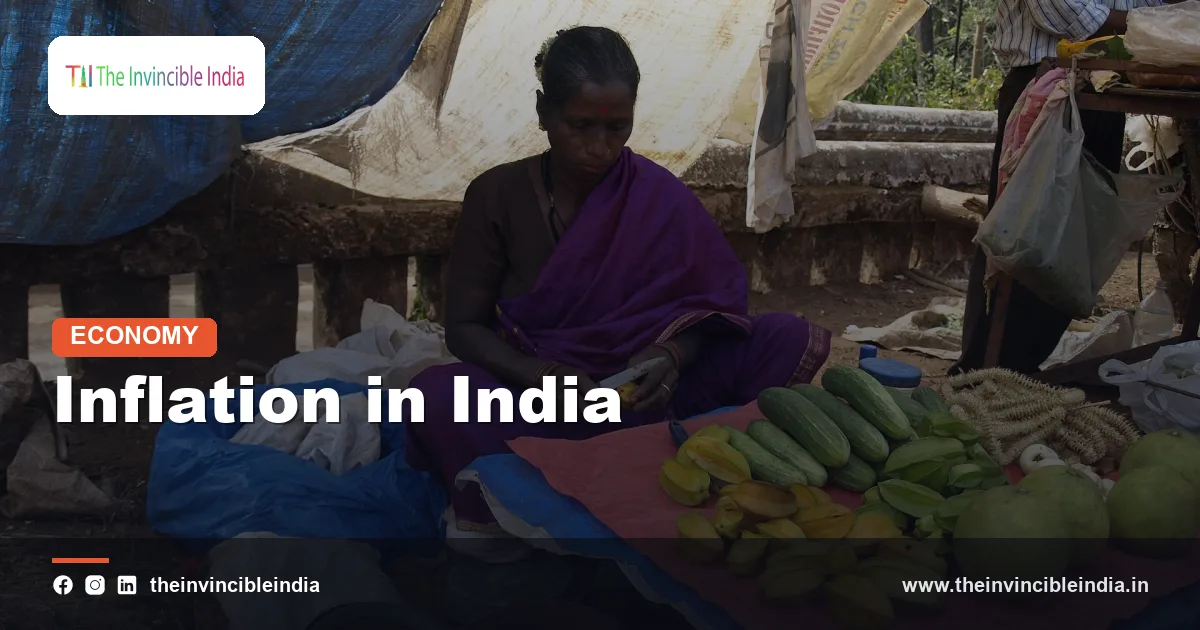
Few economic terms touch daily life as directly as inflation. Whenever a family notices that the monthly grocery bill has grown, that tomatoes cost more than last season, or that the same salary stretches less than before, it is experiencing the effect of rising prices. That is why inflation in India is not an abstract statistic for economists; it shapes household budgets, interest rates, wages, savings decisions and even the outcome of public debates.
This guide explains inflation in plain language: what it is, the different types, how India measures it through the Consumer Price Index and the Wholesale Price Index, what usually pushes prices up in the Indian context, and who is responsible for keeping them under control. It also looks at who gains and who loses when prices rise. The explanation is conceptual and evergreen, so it does not quote the latest monthly readings, which change with every release.
| Topic | Details |
|---|---|
| Definition | A sustained rise in the general price level, which reduces the purchasing power of money |
| Main official measure | Consumer Price Index (CPI), compiled by the National Statistical Office (NSO) under the Ministry of Statistics and Programme Implementation |
| Wholesale measure | Wholesale Price Index (WPI), compiled by the Office of the Economic Adviser, Ministry of Commerce and Industry |
| Main controlling authority | Reserve Bank of India (RBI), through its Monetary Policy Committee (MPC) |
| Framework | Flexible inflation targeting, formalised by an amendment to the RBI Act in 2016 |
| Target | 4 per cent CPI inflation with a tolerance band of plus or minus 2 per cent, set by the government in consultation with the RBI |
| Main policy tool | The repo rate, the rate at which the RBI lends short-term funds to banks |
| Biggest swing factor | Food prices, which carry a very large weight in the CPI basket |
| Official release | Both CPI and WPI inflation figures are released monthly |
What Is Inflation?
Inflation is the sustained increase in the general level of prices of goods and services in an economy over a period of time. The key words are “general” and “sustained”. If the price of one commodity, say onions, rises sharply for a few weeks, that is a price spike, not inflation by itself. Inflation describes a broad and persistent upward movement across a wide basket of goods and services.
The flip side of rising prices is the falling value of money. When prices rise, each rupee buys fewer goods than before, so inflation is often described as a loss of purchasing power. A rupee that bought a full bag of groceries a decade ago may now buy only part of it.
How Inflation Is Calculated
Inflation is expressed as a percentage change in a price index over a given period, usually compared with the same month a year earlier. This year-on-year comparison removes seasonal patterns such as festive demand or monsoon-driven vegetable cycles. If the index for a basket of goods is higher this month than it was twelve months ago, the percentage rise is the inflation rate.
Is Some Inflation Normal?
Yes. Economists generally agree that a mild, stable rate of inflation is healthy for a growing economy. It encourages spending and investment instead of hoarding cash, and it gives businesses room to adjust wages and prices. The concern is with inflation that is too high, too volatile or unpredictable, because it makes planning difficult and erodes incomes unevenly.
Types of Inflation Based on Causes
Economists classify inflation by what drives it. The two classic categories are demand-pull and cost-push inflation, and most real-world price rises involve a mixture of both.
Demand-Pull Inflation
Demand-pull inflation occurs when total demand for goods and services in the economy grows faster than the economy’s capacity to supply them. Too much money chasing too few goods pulls prices upward. It can be triggered by rising incomes, easy credit, higher government spending, or a surge in consumer confidence. In India, a strong festive season or a sharp rise in rural incomes can lift demand for certain goods faster than supply can respond.
Cost-Push Inflation
Cost-push inflation arises when the cost of producing goods rises, forcing producers to pass the increase on to consumers. Typical triggers include higher prices of crude oil, metals or fertilisers, increases in wages, higher transport costs, or a depreciating rupee that makes imported inputs more expensive. Because India imports a large share of its crude oil requirement, global energy prices are a major source of cost-push pressure.
Built-In Inflation and Expectations
There is also a self-reinforcing form called built-in inflation. When people expect prices to keep rising, workers demand higher wages and firms raise prices in advance, which keeps the cycle going. This is why central banks pay close attention to inflation expectations, and why credibility matters as much as any single policy action.
Related Terms: Headline, Core, Deflation, Disinflation and Stagflation
News reports on inflation use a range of related terms. Understanding them makes economic coverage much easier to follow.
- Headline inflation: The overall rate of price rise measured by the full index, including food and fuel. This is the number usually quoted in the news.
- Core inflation: Inflation after removing volatile items, typically food and fuel. It reveals the underlying, more persistent trend in prices.
- Deflation: A fall in the general price level, meaning negative inflation. Though falling prices sound pleasant, prolonged deflation can discourage spending and investment, hurt profits and increase the real burden of debt.
- Disinflation: A slowdown in the rate of inflation. Prices are still rising, but more slowly than before. It is not the same as deflation.
- Stagflation: A difficult combination of high inflation, slow growth and high unemployment. It is hard to fight because the usual cure for inflation, tighter policy, tends to slow growth further.
- Hyperinflation: An extreme and rapidly accelerating price rise that destroys the value of a currency. It is rare and associated with severe economic or political breakdown.
The distinction between headline and core inflation is especially relevant for India, where food items carry a heavy weight. A bad vegetable season can push headline inflation up even when underlying price pressures are calm.
How India Measures Inflation
No single number captures every price in a vast economy, so statisticians build price indices. A price index tracks the cost of a fixed basket of goods and services over time, with each item given a weight according to its importance. The index is set to a base year, and later movements are measured against that base. India uses several indices, each serving a different purpose.
The Consumer Price Index (CPI)
The Consumer Price Index measures changes in the prices that households actually pay for goods and services. It is now the main measure of inflation in India and the one that the RBI targets. The National Statistical Office, working under the Ministry of Statistics and Programme Implementation, compiles the all-India CPI for rural, urban and combined populations. Prices are collected from selected markets and villages across the country.
The basket covers food and beverages, clothing and footwear, housing, fuel and light, health, education, transport and other categories. Food and beverages together account for close to half of the basket, which is far higher than in most advanced economies. This is why food prices dominate Indian inflation readings. There are also separate indices such as the CPI for Industrial Workers (CPI-IW), compiled by the Labour Bureau, and others once used for agricultural and rural labourers.
The Wholesale Price Index (WPI)
The Wholesale Price Index tracks price changes of goods at the wholesale or bulk-trading level, before they reach the retail consumer. It is compiled by the Office of the Economic Adviser in the Department for Promotion of Industry and Internal Trade, Ministry of Commerce and Industry. The WPI basket is divided into three major groups: primary articles, fuel and power, and manufactured products. It covers goods only and does not include services.
Why Did India Shift Towards CPI?
For many years, WPI was the headline measure used by policymakers. But it does not capture what ordinary households pay, as it excludes services and retail margins. In the early 2010s, a committee set up by the RBI, chaired by Urjit Patel and reporting in 2014, recommended using the new combined CPI as the nominal anchor for monetary policy. India gradually moved in that direction, and the CPI became the formal basis of the inflation-targeting framework adopted in 2016.
CPI vs WPI: Why the Two Can Diverge
It is common to see CPI inflation and WPI inflation moving in different directions or by different magnitudes. This is not an error. The two indices measure different things.
| Feature | Consumer Price Index (CPI) | Wholesale Price Index (WPI) |
|---|---|---|
| What it tracks | Retail prices paid by consumers | Prices at the wholesale or bulk level |
| Compiled by | National Statistical Office (MoSPI) | Office of the Economic Adviser (Commerce Ministry) |
| Services included | Some services, such as education, health and transport | No services, goods only |
| Weight of food | Very large, close to half the basket | Much smaller share |
| Main groups | Food, housing, clothing, fuel, health, education and others | Primary articles, fuel and power, manufactured products |
| Role in policy | Main anchor for the RBI’s inflation target | Indicator of producer-side and input price pressures |
Because CPI gives food a large weight and includes services, it responds strongly to vegetable and cereal prices. WPI is more sensitive to metals, crude oil and manufactured goods, so global commodity swings show up more clearly in it. A rise in international crude prices may lift WPI quickly while CPI moves less. Likewise, retail margins, taxes and transport costs create a gap between what producers charge and what consumers pay. Analysts watch both indices because together they show whether pressure is building at the input stage or has already reached the shopper.
Causes of Inflation in India
Inflation in India has a distinct character because of the structure of the economy. Several recurring forces explain most of the price movements.
Food and Vegetable Price Shocks
Since food has a large weight in the basket, sudden changes in the prices of vegetables, pulses, cereals, milk and edible oils matter enormously. Items such as onions, tomatoes and pulses are well known for sharp seasonal spikes caused by crop damage, storage losses or transport disruption. These shocks are often temporary, but they can feed into broader inflation expectations if they last long.
The Role of the Monsoon
A large part of Indian agriculture still depends on the southwest monsoon. A weak or badly distributed monsoon can reduce crop output, raise food prices and push up the cost of rural living. A good monsoon generally improves supply and eases pressure. This is why the monsoon forecast is watched not only by farmers but also by economists and policymakers.
Fuel and Global Commodity Prices
India imports most of its crude oil, so international oil prices affect petrol, diesel, cooking gas, freight and the cost of nearly every manufactured product. Global moves in metals, edible oils and fertilisers also feed into domestic costs. A weaker rupee adds to the burden by raising the rupee price of imports.
Supply-Chain and Storage Issues
Gaps in cold storage, warehousing, transport and market access mean that surplus produce in one region may not easily reach shortage regions. Wastage and middlemen margins widen the gap between farm-gate prices and retail prices. Disruptions such as floods, strikes or global shipping problems can intensify the effect.
Demand Factors
Rising incomes, easy credit, higher government spending and strong consumer sentiment can raise demand for housing, vehicles, services and consumer goods. When demand grows faster than supply, demand-pull pressures build, particularly in core items.
Who Controls Inflation in India?
Responsibility for managing inflation is shared, but the primary role belongs to the Reserve Bank of India, which is the country’s central bank and monetary authority. The government supports this effort through fiscal and supply-side measures.
The Flexible Inflation Targeting Framework
In 2016, the RBI Act, 1934 was amended to give a statutory basis to a flexible inflation-targeting framework. Under it, the central government, in consultation with the RBI, sets an inflation target for a defined period. The target has been 4 per cent for CPI inflation, with a tolerance band of 2 per cent on either side, meaning a range of 2 to 6 per cent. The term “flexible” signals that the RBI should also keep an eye on growth, instead of pursuing the target blindly.
The framework carries accountability. If inflation stays outside the band for a stretch of consecutive quarters, the RBI must explain to the government the reasons for the failure and the remedial steps it proposes.
The Monetary Policy Committee (MPC)
Interest rate decisions are taken by the six-member Monetary Policy Committee. Three members are from the RBI, including the Governor, who chairs the committee, and three are external members appointed by the central government. Decisions are made by majority vote, and the Governor has a casting vote in the event of a tie. The MPC meets at regular intervals through the year and publishes the minutes of its meetings.
Monetary Tools: The Repo Rate and More
The RBI’s main instrument for controlling inflation is the policy interest rate, known as the repo rate. This is the rate at which the RBI lends short-term money to commercial banks against government securities.
How the Repo Rate Works
When inflation is too high, the MPC can raise the repo rate. Borrowing becomes costlier for banks, which pass the increase on to customers through higher loan rates. Costlier loans reduce demand for home loans, vehicle loans and business credit, cooling spending and easing price pressure. When inflation is low and growth needs support, the MPC can reduce the repo rate to make credit cheaper and encourage spending.
Other RBI Instruments
- Reverse repo and standing deposit facility: Tools that absorb surplus liquidity from the banking system.
- Cash Reserve Ratio (CRR): The share of deposits that banks must keep with the RBI, which affects the money available for lending.
- Statutory Liquidity Ratio (SLR): The proportion of deposits banks must hold in liquid assets such as government securities.
- Open market operations: The buying and selling of government securities to add or remove liquidity.
Monetary policy works with a time lag. A rate change today may take several months to influence prices fully. It is also better at controlling demand-side inflation than supply shocks such as a poor harvest, which is why government action is equally important.
Government Measures to Control Prices
Because many of India’s price shocks come from the supply side, the government uses a range of non-monetary tools to ease pressure.
- Buffer stocks: Agencies such as the Food Corporation of India hold reserves of foodgrains. Releasing stock into the market in open market sales can moderate prices of wheat and rice.
- Imports and import duties: Lowering import duties or allowing imports of items such as pulses and edible oils increases domestic supply when production falls short.
- Export restrictions: Limiting or banning exports of certain commodities can keep more supply in the domestic market during shortages.
- Stock limits and enforcement: Powers under the Essential Commodities Act, 1955 allow the government to regulate stocks and curb hoarding of specified items.
- Minimum Support Price (MSP): A guaranteed price announced for selected crops that protects farmers. It supports farm incomes and encourages production, though a higher MSP can also influence the cost of grains.
- Fuel taxes: Excise duty and other levies on petrol and diesel can be adjusted to cushion consumers when global oil prices rise, though this affects government revenue.
- Public distribution system: Subsidised grain through ration shops protects poorer households from food price swings.
The best results usually come when fiscal discipline, supply-side action and monetary policy move in the same direction. Heavy government borrowing and large deficits can add to demand pressure and complicate the RBI’s task.
Impact of Inflation on Households and the Economy
Inflation does not affect everyone equally. Its effects depend on how people earn, save, spend and borrow.
Households and the Cost of Living
For ordinary families, inflation raises the cost of living. Poorer households are hit hardest because they spend a larger share of income on food, which is where price swings are sharpest. When wages do not rise as fast as prices, real incomes fall, forcing families to cut spending or dip into savings.
Savers and Borrowers
Savers lose when the interest on their deposits is lower than the rate of inflation, because the real return is then negative. A fixed deposit that earns less than the rise in prices is quietly losing value. Borrowers with fixed-rate loans can gain, since they repay in rupees that are worth less than when they borrowed. However, when inflation prompts the RBI to raise rates, floating-rate borrowers face higher monthly instalments.
Fixed-Income Groups
Pensioners, retirees and others living on a fixed income are especially vulnerable because their income does not automatically grow with prices. Some groups enjoy protection through indexation, which links payments to a price index. For example, dearness allowance for government employees is revised periodically in line with consumer price movements. Many private sector workers and informal workers do not have similar cover.
Businesses and the Wider Economy
For businesses, unpredictable inflation complicates pricing, wage setting and investment planning. High inflation can reduce competitiveness of exports, force the central bank to raise interest rates, and slow economic growth. It can also widen inequality because assets such as land, gold and equity often hold their value better than cash.
Base Effect and Other Concepts
Two concepts regularly appear when inflation figures are discussed, and both help explain why numbers can look surprising.
The Base Effect
Inflation is calculated against prices from a year earlier, so the level of that earlier price, the base, influences the result. If prices a year ago were unusually high, the current year-on-year inflation looks low even if prices are still rising. If prices a year ago were unusually low, the same price level looks like high inflation. This is called the base effect, and it can make inflation appear to fall or climb without any real change in current conditions.
Indexation
Indexation means adjusting wages, pensions, contracts or tax slabs in line with an index so that their real value is protected. Beyond dearness allowance, the idea appears in the cost inflation index used to adjust the purchase price of certain assets when calculating capital gains for tax purposes.
Real vs Nominal Values
A nominal figure is the face value in current rupees, while a real figure is adjusted for inflation. Real interest rate equals the nominal interest rate minus inflation. Looking at real values is the only reliable way to judge whether incomes, savings or growth are truly improving.
Why Moderate Inflation Is Normal but High Inflation Is Harmful
A fast-growing, developing economy such as India will usually experience some price rise, because rising incomes lift demand and structural changes shift relative prices. A moderate rate gives the economy flexibility and keeps the burden of debt manageable. This is why the official target is not zero but 4 per cent.
High inflation, however, damages the economy in several ways. It erodes savings, penalises fixed-income groups, distorts investment decisions, and makes it hard for businesses to plan. It can also invite higher interest rates that slow growth. Persistently high inflation reduces the confidence of households and investors in the currency. Very low or negative inflation poses opposite risks, as it can discourage spending and weaken growth. The inflation-targeting band reflects this balance between prices that are stable and growth that is sustained.
Conclusion
Inflation in India is shaped by a mix of food supply, monsoon conditions, global commodity prices, domestic demand and policy choices. It is measured mainly through the CPI and the WPI, which capture different parts of the price chain. It is managed by the RBI through a flexible inflation-targeting framework that relies on the repo rate, along with government steps on supply, stocks, trade and taxes. Understanding these building blocks helps readers interpret each monthly inflation release, and see why moderate, predictable prices matter for households, savers and the wider economy.
Last updated: 1 October 2026.
Frequently Asked Questions
What is inflation in simple words?
Inflation is a general and sustained rise in prices over time. As prices go up, each rupee buys fewer goods and services, so the purchasing power of money falls. It is measured as the percentage change in a price index, usually compared with the same period a year earlier.
Which is the main measure of inflation in India?
The Consumer Price Index (CPI), compiled by the National Statistical Office, is the main measure and the one used by the RBI for its inflation target. The Wholesale Price Index (WPI), compiled by the Office of the Economic Adviser, is also published monthly and tracks wholesale prices of goods.
Why do CPI and WPI inflation differ?
CPI tracks retail prices paid by consumers, includes some services and gives a very large weight to food. WPI tracks wholesale goods only, with no services, and is more sensitive to fuel, metals and manufactured products. Because their baskets and weights differ, the two can move by different amounts or even in different directions.
What is the RBI’s inflation target?
Under the flexible inflation-targeting framework, the government sets the target in consultation with the RBI. It has been 4 per cent CPI inflation with a tolerance band of plus or minus 2 per cent. The target is reviewed periodically, and the Monetary Policy Committee works to keep inflation within the band while supporting growth.
How does the repo rate control inflation?
The repo rate is the rate at which the RBI lends short-term funds to banks. Raising it makes loans costlier, which reduces borrowing and spending and eases demand-driven price pressure. Lowering it makes credit cheaper and supports growth when inflation is under control.
What is the difference between headline and core inflation?
Headline inflation covers the whole basket, including volatile items such as food and fuel. Core inflation excludes food and fuel to show the underlying trend in prices. Policymakers look at both, because headline inflation affects households directly while core inflation shows how persistent price pressures are.
{“@context”:”https://schema.org”,”@graph”:[{“@type”:”FAQPage”,”mainEntity”:[{“@type”:”Question”,”name”:”What is inflation in simple words?”,”acceptedAnswer”:{“@type”:”Answer”,”text”:”Inflation is a general and sustained rise in prices over time. As prices go up, each rupee buys fewer goods and services, so the purchasing power of money falls. It is measured as the percentage change in a price index, usually compared with the same period a year earlier.”}},{“@type”:”Question”,”name”:”Which is the main measure of inflation in India?”,”acceptedAnswer”:{“@type”:”Answer”,”text”:”The Consumer Price Index (CPI), compiled by the National Statistical Office, is the main measure and the one used by the RBI for its inflation target. The Wholesale Price Index (WPI), compiled by the Office of the Economic Adviser, is also published monthly and tracks wholesale prices of goods.”}},{“@type”:”Question”,”name”:”Why do CPI and WPI inflation differ?”,”acceptedAnswer”:{“@type”:”Answer”,”text”:”CPI tracks retail prices paid by consumers, includes some services and gives a very large weight to food. WPI tracks wholesale goods only, with no services, and is more sensitive to fuel, metals and manufactured products. Because their baskets and weights differ, the two can move by different amounts or even in different directions.”}},{“@type”:”Question”,”name”:”What is the RBI’s inflation target?”,”acceptedAnswer”:{“@type”:”Answer”,”text”:”Under the flexible inflation-targeting framework, the government sets the target in consultation with the RBI. It has been 4 per cent CPI inflation with a tolerance band of plus or minus 2 per cent. The target is reviewed periodically, and the Monetary Policy Committee works to keep inflation within the band while supporting growth.”}},{“@type”:”Question”,”name”:”How does the repo rate control inflation?”,”acceptedAnswer”:{“@type”:”Answer”,”text”:”The repo rate is the rate at which the RBI lends short-term funds to banks. Raising it makes loans costlier, which reduces borrowing and spending and eases demand-driven price pressure. Lowering it makes credit cheaper and supports growth when inflation is under control.”}},{“@type”:”Question”,”name”:”What is the difference between headline and core inflation?”,”acceptedAnswer”:{“@type”:”Answer”,”text”:”Headline inflation covers the whole basket, including volatile items such as food and fuel. Core inflation excludes food and fuel to show the underlying trend in prices. Policymakers look at both, because headline inflation affects households directly while core inflation shows how persistent price pressures are.”}}]}]}


