

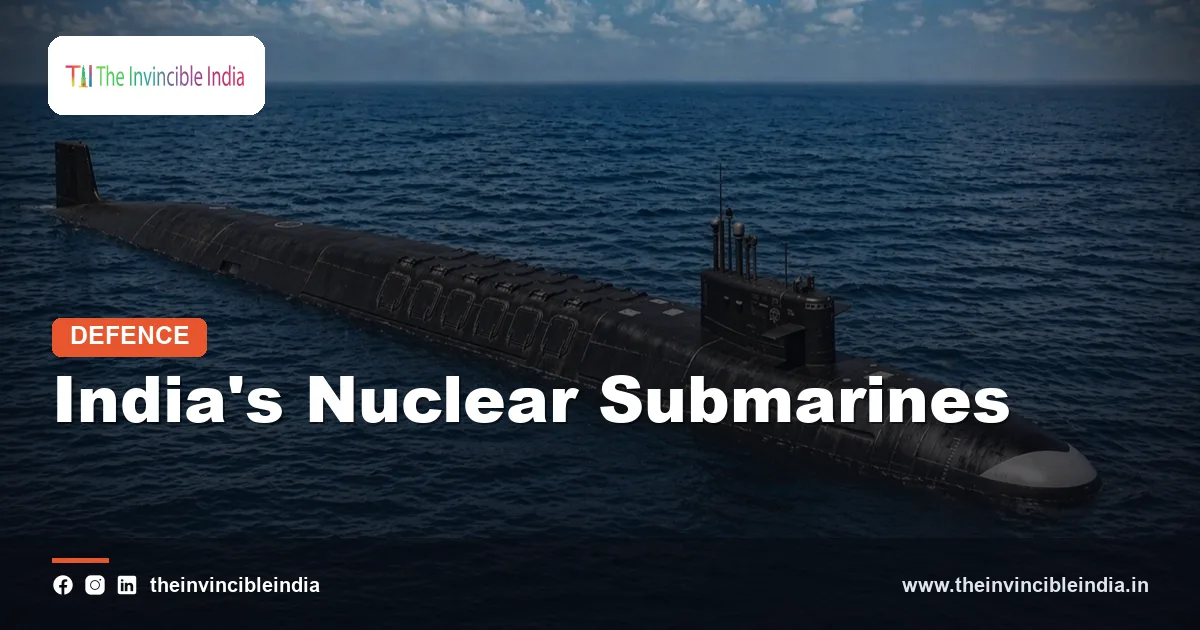
When India announced in November 2018 that its first deterrence patrol had been completed safely, the news marked a quiet but historic turning point. INS Arihant, the country’s first indigenously built nuclear-powered ballistic-missile submarine, had finished a mission that few navies in the world have ever carried out: sailing silently beneath the ocean with nuclear-capable missiles on board, ready to respond if the nation were ever attacked. With that patrol, India’s long-discussed nuclear triad, with weapons deliverable from land, air and sea, became a working reality.
This explainer unpacks the subject from the ground up. It explains how a conventional submarine differs from a nuclear attack submarine and a “boomer”, how the secretive Advanced Technology Vessel project produced Arihant, which boats and missiles have followed, how the sea-based leg connects to India’s doctrine of credible minimum deterrence and no first use, and what challenges still lie ahead in the Indian Ocean. Specifications are given as approximate, open-source figures, since much of this programme remains classified.
| Quick Facts: India’s Nuclear Submarines | |
|---|---|
| Lead boat | INS Arihant, India’s first indigenous SSBN |
| Programme | Advanced Technology Vessel (ATV) project, run under strict secrecy |
| Launched | 26 July 2009, at Visakhapatnam |
| Commissioned | Around 2016, quietly and without a public ceremony |
| First deterrence patrol | Completed and announced in November 2018 |
| Second boat | INS Arighaat, commissioned in 2024 |
| Missiles carried | K-15 Sagarika (about 750 km) and K-4 (about 3,500 km) |
| Leased SSN | INS Chakra, an Akula-class boat leased from Russia |
| Doctrine | Credible minimum deterrence and no first use |
Understanding Submarine Types: SSK, SSN and SSBN
Navy designations look like alphabet soup, but they follow a simple logic. “SS” stands for submarine, the letter “N” adds nuclear propulsion, “B” signals ballistic missiles, and “K” is the traditional label for a hunter-killer boat. Knowing the difference is essential to understanding why India’s nuclear submarines matter so much.
Conventional diesel-electric submarines (SSK)
These run on diesel engines while on or near the surface, charging large batteries that power an electric motor underwater. They are very quiet when running on batteries but must come up periodically to snorkel, unless they are fitted with air-independent propulsion (AIP). Their underwater endurance and speed are limited, but they are far cheaper to build and operate.
Nuclear-powered attack submarines (SSN)
An SSN uses a nuclear reactor to produce heat, steam and electricity, so it can stay submerged for months, limited mainly by food supplies and crew fatigue. It is fast and long-ranged, and is designed to hunt enemy submarines and warships. SSNs carry conventional torpedoes and missiles, not strategic nuclear weapons.
Nuclear-powered ballistic-missile submarines (SSBN)
The SSBN, nicknamed the “boomer”, is a different beast. Its purpose is not to hunt but to hide. It carries ballistic missiles in vertical launch tubes and keeps on patrol so that an adversary can never be sure where it is. This survivability is what gives a country an assured second-strike capability.
| Feature | SSK (diesel-electric) | SSN (nuclear attack) | SSBN (nuclear ballistic missile) |
|---|---|---|---|
| Power source | Diesel engines plus batteries | Nuclear reactor | Nuclear reactor |
| Main role | Coastal defence, sea denial, anti-ship strikes | Hunting submarines and surface fleets | Strategic nuclear deterrence |
| Underwater endurance | Days to a few weeks | Months | Months |
| Typical weapons | Torpedoes, anti-ship missiles | Torpedoes, cruise missiles | Long-range ballistic missiles |
| Indian examples | Kalvari class, Sindhughosh class | INS Chakra (leased) | INS Arihant, INS Arighaat |
India’s Nuclear Triad and the Sea Leg
A nuclear triad means a country can deliver nuclear weapons from three independent platforms: land-based missiles, aircraft and submarines. The idea is resilience. No single strike, however large, can wipe out all three at once.
India conducted its first nuclear test at Pokhran in 1974, described as a peaceful nuclear explosion, and carried out a series of tests in May 1998 (Pokhran-II) before declaring itself a nuclear-weapon state. Over the following years India built up its land-based delivery systems, notably the Prithvi and Agni family of missiles, and assigned nuclear-capable strike aircraft of the Indian Air Force to the role. The command structure was formalised in January 2003, when India created the Nuclear Command Authority and the Strategic Forces Command to manage the arsenal.
The sea leg was the missing piece. Land-based missile sites and airfields are fixed, known locations; in a crisis they are potential targets. A submarine, by contrast, vanishes into the vastness of the ocean. This is why INS Arihant is widely seen as the capstone of India’s deterrent: until a boat like it could sail on patrol with missiles aboard, the triad existed largely on paper.
The ATV Project: Building INS Arihant in Secret
The Advanced Technology Vessel project is the code name under which India’s nuclear submarine was developed. Its origins reach back to the 1970s and 1980s, when Indian planners began to explore a nuclear-powered submarine. The effort was kept so confidential that for years even its name was rarely mentioned in public, and the ship was often referred to simply as the ATV.
It was a genuinely national endeavour. The key institutions involved include:
- Department of Atomic Energy and BARC, which developed the compact pressurised light-water reactor and tested it at a land-based prototype facility at Kalpakkam in Tamil Nadu.
- DRDO, which provided many systems and technologies for the hull, sonar and weapons integration.
- The Indian Navy, which defined the requirements and ran the Ship Building Centre at Visakhapatnam where the boat was built.
- Public and private industry, including Larsen and Toubro and other firms that supplied heavy fabrication and specialised equipment.
Miniaturising a reactor to fit within a submarine hull is among the hardest engineering feats in defence. It must be reliable, quiet and safe for the crew, and it has to run for years without major refuelling. Open-source accounts suggest that India received some outside technical advice along the way, but the programme is overwhelmingly regarded as indigenous in design and construction.
Why the secrecy?
Nuclear propulsion technology is among the most closely guarded in the world, and no country willingly shares it. Keeping the project quiet protected sensitive know-how, avoided diplomatic friction during a period when India faced technology-control regimes, and kept adversaries guessing about the timeline. The result was that Indians learnt of many details only after the boat was already in the water.
INS Arihant: Launch, Commissioning and First Deterrence Patrol
INS Arihant, whose name is commonly translated as “slayer of enemies”, was launched on 26 July 2009 at Visakhapatnam. The ceremony was attended by the then Prime Minister Manmohan Singh, while his wife Gursharan Kaur formally launched the vessel. The launch began a long phase of harbour and sea trials: the reactor reached criticality in 2013, and sea trials followed in the years after.
The submarine was commissioned around 2016, although the event was not publicly celebrated at the time. In November 2018, the Prime Minister announced that Arihant had completed its first deterrence patrol, describing it as a milestone that gave India a credible second-strike capability. The patrol meant that, for the first time, India had a nuclear-armed vessel at sea, operating under the command structure of the Strategic Forces Command.
Approximate specifications
- Displacement of roughly 6,000 tonnes when submerged, according to open sources.
- Powered by a pressurised light-water reactor of the order of 80 MW.
- Four vertical launch tubes, reportedly able to carry either a dozen short-range K-15 missiles or four K-4 missiles.
- Torpedo tubes for self-defence.
Arihant is generally seen as a first-generation boat and a technology demonstrator. It is smaller and carries fewer missiles than the SSBNs of the established nuclear powers, but it proved that India could master the entire cycle of design, reactor building, hull fabrication and crew training.
The Arihant Class: INS Arighaat and the Follow-On Boats
One submarine is not a deterrent. Because a boat needs periodic maintenance, refit and crew rest, a country needs multiple SSBNs to keep at least one at sea at all times. India has therefore pursued a whole class of boats.
| Boat | Status (open-source, approximate) |
|---|---|
| INS Arihant | Commissioned around 2016; first deterrence patrol in 2018 |
| INS Arighaat | Launched in 2017; commissioned in 2024 |
| S4 and S4* | Follow-on boats of the class, reported to be larger and to carry more K-4 missiles |
| S5 class | A larger future class, reported to have many more launch tubes and greater range capability |
INS Arighaat, whose name is commonly rendered as “destroyer of enemies”, is the second Arihant-class boat. It was launched in November 2017 and formally commissioned in August 2024. It is broadly similar to Arihant but incorporates improvements drawn from experience with the first boat.
Reports indicate that the next boats, designated S4 and S4*, are somewhat larger and will carry a greater number of missiles. The S5 class is expected to be considerably bigger, in the region of 13,000 tonnes by open-source accounts, and designed around longer-range missiles. Because these are planned or developmental programmes, official details are sparse and timelines can shift.
The Missiles: K-15 Sagarika and K-4
A submarine is only as strong as the missiles it carries. India has developed a “K family” of submarine-launched ballistic missiles, widely understood to be named in tribute to Dr A. P. J. Abdul Kalam, who guided much of India’s missile development.
K-15 (Sagarika)
The K-15, also known as Sagarika, is a solid-fuelled missile with a range of roughly 750 km. It was tested in its early forms from a submerged pontoon in 2008. Its range is modest, which means a submarine carrying it must go fairly close to a target, but it provided the first working sea-based missile for the programme.
K-4
The K-4 is a longer-range solid-fuelled missile in the class of about 3,500 km. Its early tests were carried out from submerged platforms, and later tests from the submarine itself confirmed the integration of weapon and boat. This range lets a submarine patrol in safer, more distant waters and still hold targets at risk.
K-5 and beyond
The K-5, a missile of longer range reported to be in development, is expected to arm the S5 class. Longer reach is important because it allows the SSBN to remain in protected “bastions” rather than venture into contested waters.
Credible Minimum Deterrence and No First Use
India’s nuclear doctrine rests on two pillars. The first is credible minimum deterrence: India maintains only the forces needed to deter an adversary, not a vast arsenal intended for an arms race. The second is no first use: India pledges not to be the first to use nuclear weapons, and not to use them against non-nuclear-weapon states. The doctrine was set out in a draft in 1999 and officially adopted by the Cabinet Committee on Security in January 2003, which also states that a nuclear attack on India or its forces anywhere would be met with massive retaliation.
A no-first-use policy only works if the retaliation is guaranteed. If an adversary believed it could destroy India’s weapons in a surprise first strike, deterrence would collapse. Therefore the survivability of the arsenal is the backbone of the policy. Missiles in fixed sites can be targeted, aircraft can be caught on the ground, but an SSBN hidden in the depths is extremely hard to find. The knowledge that at least one boat would survive and strike back gives the deterrent its credibility, and this is what “assured second strike” means.
It also explains why the number of boats matters as much as the size of any one weapon. Continuous patrolling, known in navy language as continuous at-sea deterrence, requires a minimum of three or more SSBNs so that one is always available while others are in maintenance or training.
How an SSBN Patrol Works
Although operational details are classified, the general logic of a ballistic-missile submarine patrol is well understood and shared by navies around the world.
- Departure: The boat leaves port, often from a dedicated, secure base, and dives as soon as the water is deep enough.
- Silent running: It moves at modest speed, minimises noise and avoids communicating, since any radio emission or acoustic signature could reveal its location.
- Receiving orders: It listens passively for signals, usually in very-low-frequency bands that can penetrate seawater, without transmitting itself.
- Launch authority: Release of nuclear weapons rests with the political leadership through the Nuclear Command Authority, not with the submarine’s captain alone.
- Return: After weeks or months, the boat comes home and a relief crew and a fresh boat take over.
This pattern is demanding on the crew, who spend long periods without sunlight or contact with their families. It is also why the training experience gained from leased attack submarines has been valuable to the Indian Navy.
Nuclear Attack Submarines: INS Chakra and the SSN Programme
India is one of the few countries to have operated nuclear-powered attack submarines on lease. The first INS Chakra, a Soviet Charlie-class boat, served between 1988 and 1991. The second INS Chakra, an Akula-class submarine built in Russia, was commissioned into the Indian Navy in 2012 on a lease of about ten years, and was used extensively to train crews and develop a nuclear submarine operating culture.
These leased boats are not ballistic-missile submarines; the Akula class is a hunter-killer. Under the terms of the lease it operated with conventional weapons only. Its value lay in the experience: Indian sailors learnt reactor operations, long-duration patrolling and submarine tactics, which feed straight into the Arihant class.
India has also negotiated further leasing arrangements with Russia for another Akula-class boat, and the government has cleared a programme to build indigenous nuclear-powered attack submarines, with reports mentioning as many as six. Such boats would escort carrier battle groups, hunt hostile submarines and protect SSBNs on their patrols. Delivery dates for these programmes should be treated with caution, as defence timelines often extend over many years.
India’s Conventional Submarine Fleet
India’s submarine arm itself dates back to 1967, when INS Kalvari, a Soviet Foxtrot-class boat, was commissioned. Today the conventional fleet is a mixture of ageing and modern vessels:
- Sindhughosh class: Russian-origin Kilo-class boats, the first of which entered service in 1986. They have been refitted over the years to carry modern missiles.
- Shishumar class: German-designed Type 209 boats, with the first commissioned in 1986, some of them assembled in India at Mazagon Dock in Mumbai.
- Kalvari class (Project-75): French-origin Scorpene boats built at Mazagon Dock in collaboration with Naval Group. The new INS Kalvari, commissioned in December 2017, led a series of six boats.
- Project-75 India (P-75I): A planned programme for additional, more advanced boats with air-independent propulsion, to be built in India with a foreign technology partner.
The conventional fleet is vital because the nuclear submarines cannot be everywhere. Diesel-electric boats patrol coastal waters, guard chokepoints and act as the “sea denial” element of the navy, while the SSBNs stay hidden and the SSNs escort and hunt. The ageing of the older Kilo and Type 209 boats is one reason why the replacement programmes are considered urgent.
Strategic Significance in the Indian Ocean
The Indian Ocean carries a very large share of the world’s seaborne oil and container trade, and India sits at its centre with a coastline of over 7,500 km. The region is also seeing increasing activity from external navies, including a growing submarine presence. A credible sea-based deterrent anchors India’s security in this setting.
SSBNs do not patrol primarily to fight; they provide strategic stability. Because a surprise strike cannot eliminate the Indian response, rival nuclear powers have less incentive to consider such a move in the first place. At the same time, the SSBN force depends on a protective ecosystem: surface warships, maritime patrol aircraft, SSNs and conventional submarines that secure the sea space around the patrol areas, along with dedicated naval infrastructure on the east coast.
India’s nuclear submarines also boost its standing in global defence. Only a handful of countries have built and operated SSBNs of their own, and the Arihant programme places India within that small group. It is also consistent with the national emphasis on self-reliance in defence manufacturing.
Challenges Ahead
For all the progress, the road is demanding. Observers of the programme point to several ongoing challenges:
- Numbers: A continuous deterrent needs several operational SSBNs. Building, testing and crewing them takes years.
- Noise and stealth: A submarine’s survival depends on how quietly it moves. Quieting reactors, pumps and propellers is a continuous technological race.
- Missile range: Shorter-range missiles force boats to patrol closer to hostile areas; longer-range weapons such as the K-4 and K-5 are therefore important.
- Communications: Passing secure orders to a submerged boat is difficult and relies on specialised very-low-frequency systems.
- Industrial depth: Reactor fuel, forgings, sonar and electronics require a deep supply chain and trained personnel.
- Command and control: The nuclear command system must ensure that political authority is retained over weapons deployed far away, with safeguards against accidents.
Each of these issues is being worked on, and the experience of the Arihant and Arighaat patrols is the foundation for the next generation of boats.
Conclusion
INS Arihant is more than a single warship. It represents the moment India’s nuclear doctrine acquired a robust physical foundation: a survivable force at sea that makes the no-first-use pledge credible. From its secretive origins in the ATV project to the commissioning of INS Arighaat and the plans for larger S4 and S5 boats, the programme shows a steady, deliberate accumulation of capability. The future will depend on more boats, quieter hulls, longer-range missiles and a strong support system, but the strategic direction is already clear. This article was last reviewed on 1 October 2026.
Frequently Asked Questions
What is INS Arihant?
INS Arihant is India’s first indigenously built nuclear-powered ballistic-missile submarine (SSBN). It was launched in 2009, commissioned around 2016 and completed its first deterrence patrol, announced in 2018. It carries nuclear-capable submarine-launched ballistic missiles.
How is an SSBN different from an SSN?
An SSN is a nuclear-powered attack submarine designed to hunt enemy ships and submarines, using torpedoes and cruise missiles. An SSBN is a nuclear-powered boat that carries ballistic missiles and stays hidden to provide a second-strike nuclear capability. Both use nuclear reactors, but their missions are different.
How did INS Arihant complete India’s nuclear triad?
India already had land-based missiles and nuclear-capable aircraft. Arihant added the third leg, a submarine able to launch nuclear missiles from the sea. Its first deterrence patrol demonstrated that the sea-based leg was operational, giving India an assured second-strike capability.
Which missiles arm India’s SSBNs?
The boats are armed with the K family of submarine-launched ballistic missiles. The K-15 (Sagarika) has a range of about 750 km, while the longer-range K-4 reaches about 3,500 km. A longer-range K-5 is reported to be under development for future boats.
What is INS Chakra and is it nuclear-armed?
INS Chakra is a Russian-built Akula-class nuclear-powered attack submarine that India operated on lease from 2012. It is a hunter-killer boat with conventional weapons and is not a nuclear-missile submarine. It helped Indian crews gain experience in operating nuclear submarines.
How does the sea deterrent relate to no first use?
No first use means India will not strike first with nuclear weapons, so its retaliation must be certain even after an attack. Because SSBNs are difficult to detect, they ensure that a second strike would survive. This credibility is what makes a no-first-use policy sustainable.
{“@context”:”https://schema.org”,”@graph”:[{“@type”:”FAQPage”,”mainEntity”:[{“@type”:”Question”,”name”:”What is INS Arihant?”,”acceptedAnswer”:{“@type”:”Answer”,”text”:”INS Arihant is India’s first indigenously built nuclear-powered ballistic-missile submarine (SSBN). It was launched in 2009, commissioned around 2016 and completed its first deterrence patrol, announced in 2018. It carries nuclear-capable submarine-launched ballistic missiles.”}},{“@type”:”Question”,”name”:”How is an SSBN different from an SSN?”,”acceptedAnswer”:{“@type”:”Answer”,”text”:”An SSN is a nuclear-powered attack submarine designed to hunt enemy ships and submarines, using torpedoes and cruise missiles. An SSBN is a nuclear-powered boat that carries ballistic missiles and stays hidden to provide a second-strike nuclear capability. Both use nuclear reactors, but their missions are different.”}},{“@type”:”Question”,”name”:”How did INS Arihant complete India’s nuclear triad?”,”acceptedAnswer”:{“@type”:”Answer”,”text”:”India already had land-based missiles and nuclear-capable aircraft. Arihant added the third leg, a submarine able to launch nuclear missiles from the sea. Its first deterrence patrol demonstrated that the sea-based leg was operational, giving India an assured second-strike capability.”}},{“@type”:”Question”,”name”:”Which missiles arm India’s SSBNs?”,”acceptedAnswer”:{“@type”:”Answer”,”text”:”The boats are armed with the K family of submarine-launched ballistic missiles. The K-15 (Sagarika) has a range of about 750 km, while the longer-range K-4 reaches about 3,500 km. A longer-range K-5 is reported to be under development for future boats.”}},{“@type”:”Question”,”name”:”What is INS Chakra and is it nuclear-armed?”,”acceptedAnswer”:{“@type”:”Answer”,”text”:”INS Chakra is a Russian-built Akula-class nuclear-powered attack submarine that India operated on lease from 2012. It is a hunter-killer boat with conventional weapons and is not a nuclear-missile submarine. It helped Indian crews gain experience in operating nuclear submarines.”}},{“@type”:”Question”,”name”:”How does the sea deterrent relate to no first use?”,”acceptedAnswer”:{“@type”:”Answer”,”text”:”No first use means India will not strike first with nuclear weapons, so its retaliation must be certain even after an attack. Because SSBNs are difficult to detect, they ensure that a second strike would survive. This credibility is what makes a no-first-use policy sustainable.”}}]}]}


