

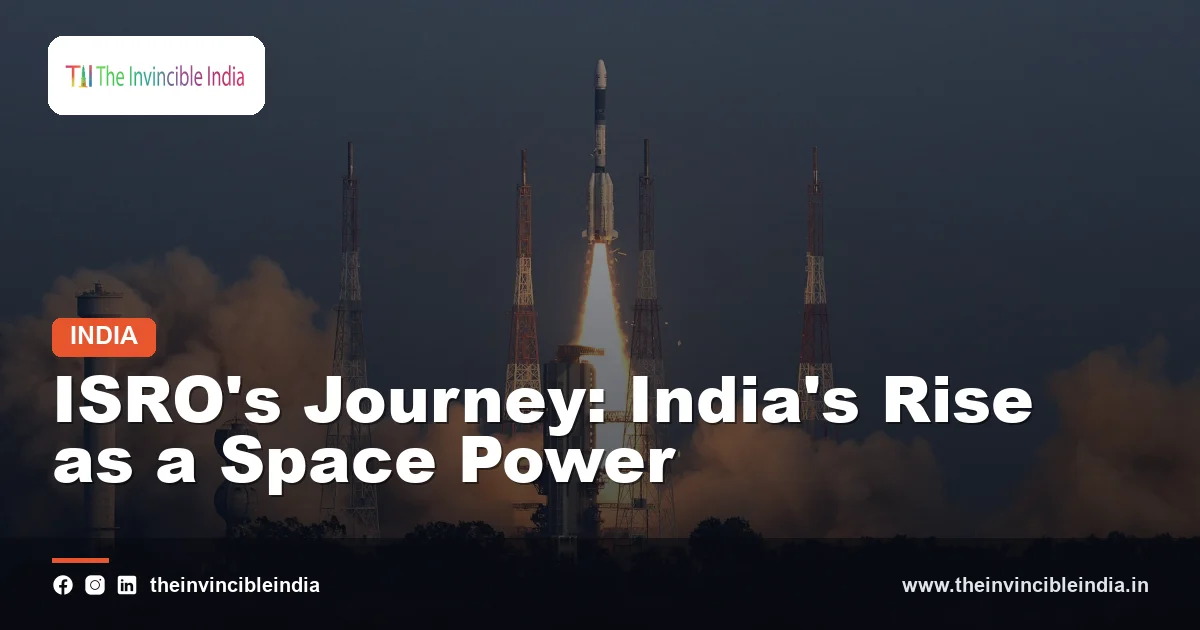
The Indian Space Research Organisation (ISRO) has transformed India into a global space power, achieving a remarkable series of milestones on a famously modest budget. From humble beginnings, when rocket parts were transported on bicycles, to landing a spacecraft near the Moon’s south pole, ISRO’s story is one of vision, ingenuity, perseverance and self-reliance. This detailed guide traces the inspiring journey of ISRO and India’s rise as a spacefaring nation.
Quick Facts
| Founded | 1969 |
| Founder | Dr Vikram Sarabhai |
| Headquarters | Bengaluru |
| Workhorse rocket | PSLV (Polar Satellite Launch Vehicle) |
| Historic landing | Chandrayaan-3, Moon’s south pole (2023) |
Humble Beginnings
ISRO was formed in 1969 under the visionary leadership of Dr Vikram Sarabhai, widely regarded as the father of the Indian space programme. In the early days, resources were scarce, and rocket components were famously transported on bicycles and bullock carts to a modest launch site at Thumba, a small fishing village in Kerala. From these unassuming origins grew one of the most respected space agencies in the world, driven by the belief that space technology could directly serve the development needs of a young nation.
Building Self-Reliance
India launched its first satellite, Aryabhata, in 1975 with Soviet assistance, but the goal was always self-reliance. Over the following decades, ISRO developed its own family of launch vehicles. The Polar Satellite Launch Vehicle (PSLV) became its dependable workhorse, launching hundreds of satellites into orbit, including many for other countries. The more powerful Geosynchronous Satellite Launch Vehicle (GSLV) and the heavy-lift LVM3 followed, giving India the capability to launch heavier payloads and ambitious interplanetary missions.
A World Record in Space
In 2017, ISRO captured global attention by launching a record 104 satellites into orbit in a single mission aboard a PSLV rocket — a feat that demonstrated both its technical prowess and its cost-effectiveness. This achievement cemented India’s reputation as a reliable and affordable partner for launching satellites, and its commercial launch services now serve customers around the world.
Chandrayaan: India on the Moon
India’s lunar programme has produced some of its proudest moments. Chandrayaan-1, launched in 2008, helped confirm the presence of water molecules on the Moon, a discovery of major scientific significance. Chandrayaan-2 in 2019 reached lunar orbit, though its lander did not achieve a soft landing. Then, in August 2023, Chandrayaan-3 made history by achieving a successful soft landing near the lunar south pole, making India the first country ever to land in that region and only the fourth nation to achieve a soft landing on the Moon.
Mangalyaan: The Mars Mission
One of ISRO’s most celebrated achievements is the Mars Orbiter Mission, popularly known as Mangalyaan. Launched in 2013 and entering Mars orbit in 2014, it made India the first country in the world to reach Mars on its very first attempt — and did so at a remarkably low cost, drawing worldwide admiration for the efficiency and skill of its engineers. Mangalyaan became a symbol of what focused, frugal innovation can accomplish.
Reaching for the Sun and Human Spaceflight
ISRO continues to push the boundaries of exploration. The Aditya-L1 mission, India’s first dedicated solar observatory, was launched to study the Sun from a special vantage point in space. The agency is also preparing for Gaganyaan, its ambitious human spaceflight programme, which aims to send Indian astronauts into space aboard an indigenously developed spacecraft — a landmark step that would place India among a small group of nations with independent human spaceflight capability.
Serving the Nation
Beyond exploration, ISRO’s work has a profound and practical impact on the lives of ordinary Indians. Its satellites support weather forecasting and cyclone warnings that save lives, telecommunications and television broadcasting, and the NavIC navigation system that provides positioning services for the region. Satellite data aids agriculture, water and forest management, urban planning and disaster response, making space technology a powerful tool for national development.
Cost-Effectiveness and Commercial Growth
ISRO is renowned around the world for delivering complex missions at a fraction of the cost of other space agencies, a result of frugal engineering, indigenous development and dedicated teams. Its commercial arm markets India’s launch and satellite services globally, and in recent years the government has opened up the space sector to private companies and startups, spurring a fast-growing “NewSpace” ecosystem that promises to accelerate India’s space ambitions further.
A Source of National Pride
ISRO’s achievements — delivered efficiently, affordably and largely through indigenous effort — stand as a powerful testament to Indian scientific talent and determination. Each milestone, from Mangalyaan to Chandrayaan-3, has united and inspired the nation and captured global headlines. For millions of young Indians, ISRO is proof that ambition, hard work and ingenuity can take a country all the way to the Moon and beyond, and it continues to inspire dreams of a future among the stars.
The Scientists Behind ISRO
ISRO’s achievements are the work of generations of dedicated scientists and engineers. Its foundations were laid by visionaries such as Dr Vikram Sarabhai, often called the father of the Indian space programme, and Dr Satish Dhawan, after whom the Sriharikota launch centre is named. Dr A. P. J. Abdul Kalam, later the President of India, played a key role in developing launch vehicles. In recent years, teams of scientists — including a growing number of women in leading roles — have carried this legacy forward, embodying a culture of excellence, frugality and national service.
Satellites in Everyday Life
The practical benefits of ISRO’s work touch the lives of ordinary Indians every day, often without their realising it. Communication satellites carry television, telephone and internet signals across the country; remote-sensing satellites monitor crops, water resources, forests and urban growth; meteorological satellites provide the weather forecasts and cyclone warnings that save countless lives; and the NavIC navigation system offers accurate positioning for transport, fishing and emergency services. Space technology has become an invisible but essential part of India’s development.
The Deep Space Network and Ground Infrastructure
Behind every mission lies a vast network of ground infrastructure. ISRO operates launch facilities at Sriharikota on the east coast, satellite-building and control centres, and the Indian Deep Space Network near Bengaluru, which tracks and communicates with distant spacecraft on their journeys to the Moon and Mars. This sophisticated infrastructure, built up over decades, enables India to plan, launch, control and receive data from increasingly ambitious missions.
International Collaboration
While self-reliance has been central to ISRO’s ethos, the agency also collaborates internationally. It has launched satellites for dozens of countries, partnered on scientific missions, and works with other space agencies on shared goals. These collaborations enhance India’s capabilities, strengthen its diplomatic ties, and position it as a valued and trusted partner in the global space community, while its low costs make it an attractive choice for nations seeking affordable access to space.
The Rise of Private Space in India
In recent years, the Indian government has opened up the space sector to private companies, sparking the rapid growth of a “NewSpace” ecosystem of startups building rockets, satellites and space-based services. Supported by reforms and by ISRO’s willingness to share facilities and expertise, these private ventures are set to accelerate innovation, create jobs and expand India’s share of the global space economy, marking an exciting new chapter in the country’s space story.
Future Missions and Inspiring the Next Generation
ISRO’s ambitions for the future are bold. The Gaganyaan human spaceflight programme aims to send Indian astronauts into space aboard an indigenous spacecraft; plans are being drawn up for a space station and future lunar and interplanetary missions, including a mission to Venus. Perhaps most importantly, ISRO’s triumphs have ignited the imagination of millions of young Indians, inspiring a new generation to pursue science, engineering and space exploration, and ensuring that India’s journey to the stars will continue for decades to come.
A Timeline of ISRO Milestones
ISRO’s journey can be traced through landmark achievements: its founding in 1969; the launch of India’s first satellite, Aryabhata, in 1975; the development of the reliable PSLV in the 1990s; the Chandrayaan-1 lunar mission of 2008 that helped detect water on the Moon; the Mars Orbiter Mission (Mangalyaan) of 2013–14 that reached Mars on the first attempt; the record launch of 104 satellites in 2017; the Chandrayaan-3 south-pole landing in 2023; and the Aditya-L1 solar mission. Each milestone built on the last, steadily advancing India’s capabilities and confidence in space.
Efficiency That Amazes the World
One of the most remarkable aspects of ISRO is its ability to accomplish complex missions at a fraction of the cost of other space agencies. The Mars Orbiter Mission, for example, was famously accomplished for a budget lower than that of some Hollywood space films, and India’s lunar and launch missions are similarly cost-effective. This frugal engineering — achieving world-class results with limited resources through indigenous development and ingenuity — has become a hallmark of ISRO and a model admired by space programmes around the globe.
Reaching for the Stars
From transporting rocket parts on bicycles to landing near the Moon’s south pole, ISRO’s journey embodies the aspirations of a nation. Its achievements have delivered practical benefits to millions of Indians, elevated India’s standing in the world, and, above all, inspired generations to believe that no dream is too big. As ISRO prepares to send humans into space, explore new worlds and support a thriving private space sector, India’s adventure among the stars is only just beginning — a source of enduring pride and boundless inspiration.
Space Education and Outreach
ISRO has increasingly focused on nurturing the next generation of scientists and engineers. Through student satellite programmes, space tutorials, visits to its centres, and initiatives that involve schools and universities in real missions, it is inspiring young Indians to take up careers in science and technology. The excitement generated by missions like Chandrayaan-3, watched live by millions of students across the country, has done more to spark interest in space and science than any textbook could, seeding the dreams of future explorers.
The Legacy Continues
ISRO’s story is ultimately one of what a determined nation can achieve through vision, talent and perseverance. Built on the foundations laid by its pioneers and carried forward by dedicated teams, it has turned India into a respected spacefaring power that explores the Moon and Mars, serves its citizens through satellites, and dreams of sending its own astronauts into space. As it embarks on ever more ambitious missions, ISRO continues to write a proud chapter in India’s history and to inspire the world with its blend of ambition and ingenuity.
India Among the Stars
From its earliest days to its latest triumphs, ISRO has proven that ambition and ingenuity can carry a nation to the very frontiers of human achievement. As India continues to explore space, launch new missions and inspire its people, ISRO stands as one of the country’s proudest institutions and a beacon of what is possible through science, dedication and belief in a shared dream.
Frequently Asked Questions
When was ISRO founded?
ISRO was founded in 1969 under the leadership of Dr Vikram Sarabhai.
What did Chandrayaan-3 achieve?
In 2023, Chandrayaan-3 achieved a historic soft landing near the Moon’s south pole, a world first.
Why is the Mangalyaan mission famous?
India became the first country to reach Mars orbit on its very first attempt, at a remarkably low cost.
What is PSLV?
The PSLV is ISRO’s reliable workhorse launch vehicle, which once launched a record 104 satellites in a single mission.
How does ISRO help ordinary Indians?
ISRO’s satellites support weather forecasting, communications, navigation, agriculture and disaster management.


