

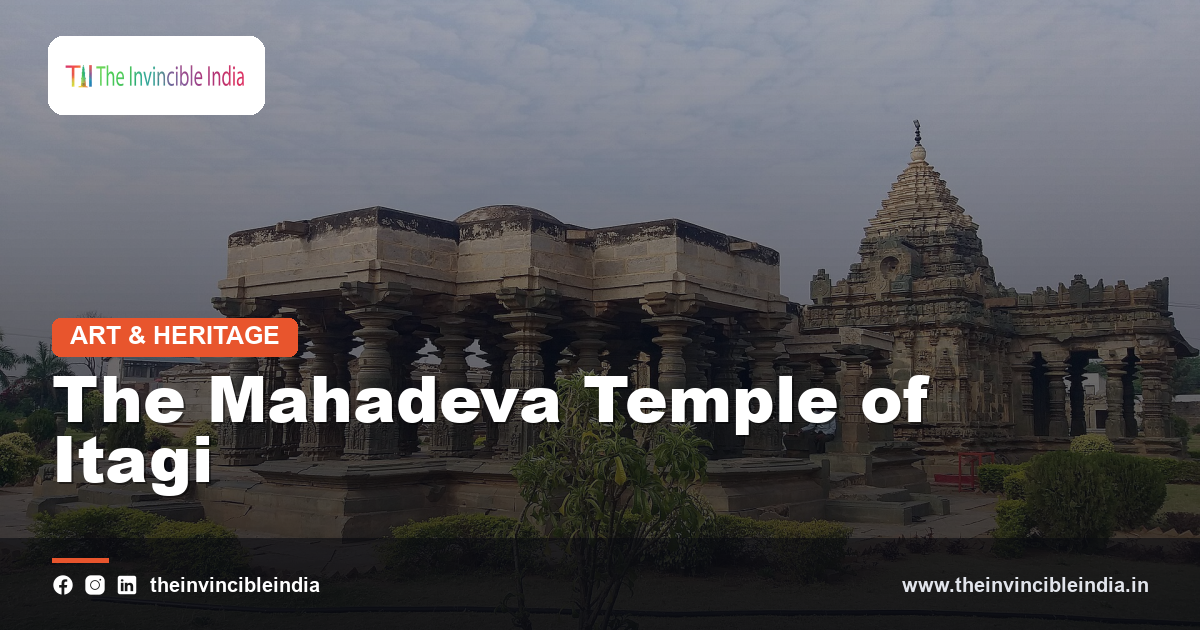
The Mahadeva Temple of Itagi, also known as the Mahadeva Devalaya or the Itagi Mahadeva Temple, is a Shiva temple of the Western Chalukya period standing in the village of Itagi in Koppal district of northern Karnataka. Raised in the early twelfth century, it is widely counted among the most elegant temples of the Chalukyan school, which is often called the Karnata Dravida style and which developed alongside the traditions described in the guide to Dravidian temple architecture. The temple is admired for its richly carved doorways, perforated windows and polished pillars. This article explains its history, layout and artistic meaning.
Quick answer: The Mahadeva Temple of Itagi is a twelfth-century Hindu temple dedicated to Shiva in Itagi village, Koppal district, Karnataka, India. It was built under the Western Chalukyas of Kalyani and is celebrated for its pillared halls, carved ceilings and delicate stonework. It is regarded as one of the finest examples of the Western Chalukya style, sometimes called the Karnata Dravida tradition.
Key Takeaways
- The Mahadeva Temple is a Shiva temple of the Western Chalukya period at Itagi in Koppal district, Karnataka.
- It was raised in the early twelfth century and is associated with a high official of the Western Chalukya king Vikramaditya VI.
- The temple is built in the Karnata Dravida manner, with a stepped tower above the sanctum and a series of pillared halls in front.
- Its lathe-turned pillars, perforated stone screens and deeply carved ceilings are among the most admired features of the building.
- An inscription at the site is traditionally cited as praising the temple as an emperor among temples.
- The temple is a protected monument and forms part of the group of Chalukyan sites of north Karnataka, which includes Pattadakal, Aihole and Lakkundi.
The sections below describe where the temple is, who built it, how it is arranged and what makes its sculpture so highly regarded.
Quick Facts
| Detail | Information |
|---|---|
| Location | Itagi village, Yelburga taluk, Koppal district, Karnataka |
| Also known as | Mahadeva Devalaya, Itagi Mahadeva Temple |
| Dynasty | Western Chalukyas of Kalyani |
| Approximate era | Early twelfth century CE |
| Deity | Shiva (as Mahadeva) |
| Style | Karnata Dravida (Western Chalukya) |
| Material | Local stone, finely dressed and carved |
| Protection | Protected monument |
What Is the Mahadeva Temple of Itagi?
The Mahadeva Temple of Itagi is a stone temple of Shiva built in the early twelfth century under the Western Chalukyas of Kalyani. It stands in a small village of northern Karnataka and consists of a sanctum, a vestibule and a series of pillared halls that open onto porches. Visitors and scholars often praise it for the density and polish of its carving, which covers doorways, pillars, ceilings and windows with intricate patterns. Although it is not as large as some royal temples, it is admired for the balance between its parts and for the quality of its workmanship. The temple shows the Western Chalukya style at a moment of confidence and maturity. It therefore serves as a clear introduction to the architecture of the Kalyani Chalukyas and their craftsmen.
Where Is Itagi Located?
Itagi is a village in Yelburga taluk of Koppal district, in the northern interior of Karnataka. The region lies on the dry Deccan plateau, with open plains, low rocky hills and scattered boulders typical of the landscape between the Tungabhadra and Krishna rivers. Koppal district also contains other celebrated monuments, including Kuknur with its group of temples and the fortified hill of Koppal itself, and it lies close to the Vijayanagara ruins of Hampi. This part of Karnataka was an important region for several dynasties, including the Badami Chalukyas, the Rashtrakutas and the Western Chalukyas. The location of Itagi therefore places the temple within a landscape rich in history, where many temple traditions met and developed.
Who Were the Western Chalukyas?
The Western Chalukyas, also called the Chalukyas of Kalyani or the Later Chalukyas, were a dynasty that ruled much of the Deccan from the late tenth century until the late twelfth century, with their capital at Kalyani in present-day Karnataka. They are distinguished from the earlier Chalukyas of Badami, whom they claimed as ancestors. The dynasty is remembered for its patronage of temple building, literature in Kannada and Sanskrit, and religious and social thought. Their reign saw the creation of a distinctive architectural idiom that scholars call the Karnata Dravida or Western Chalukya style. Temples such as those at Lakkundi, Dambal and Itagi belong to this tradition. The Western Chalukyas therefore form the historical background without which the temple at Itagi cannot be fully understood.
Who Built the Itagi Temple and When?
The Itagi temple is traditionally credited to a high official of the Western Chalukya king Vikramaditya VI, named Mahadeva, who served as a commander and administrator, and the deity and the temple are linked to his name. An inscription connected with the temple records its construction and is dated to the early twelfth century, which fits the stylistic evidence of the building. Details of the dedication and the exact date are best taken from the inscription and the studies of epigraphists rather than repeated loosely. The pattern of an official or noble sponsoring a major temple was common in the Chalukyan world, where wealth and religious merit were closely linked. The temple thus reflects the cooperation of royal authority, personal devotion and skilled craftsmanship.
Why Is Itagi Called the Emperor Among Temples?
An inscription associated with the temple is traditionally cited as describing it as the emperor among temples, a phrase that records the admiration felt by its contemporaries. The phrase reflects the high standing of the building in its own age and suggests that patrons and craftsmen considered it a model of excellence. Praise of this kind appears in other medieval inscriptions, but the case of Itagi is remembered because the surviving monument seems to justify the claim. The temple does not rely on great size, but rather on proportion, ornament and technical skill. Because the exact wording and interpretation of inscriptions can be debated, it is sensible to treat the title as a mark of admiration. The title therefore expresses a judgement of quality that later visitors have often shared.
What Is the Karnata Dravida Style?
The Karnata Dravida style, sometimes called the Western Chalukya or Later Chalukya style, is a regional form of temple architecture that developed in northern Karnataka between the Badami Chalukya period and the rise of the Hoysalas. It combines elements of the southern Dravida tradition, such as the stepped pyramidal tower over the sanctum, with local features such as elaborate pillars, ornate doorways and richly carved ceilings. Temples in this style often have a series of halls leading to the sanctum, with porches that admit light and air. Its architects favoured crisp mouldings and a sense of precise geometry. The Mahadeva Temple of Itagi is among the best examples of the style, and its details show how Western Chalukya builders refined it into an art of great elegance.
How Is the Temple Laid Out?
The temple is laid out along an east-west axis, with a main sanctum at one end, a smaller vestibule in front and a series of pillared halls leading to porches. The sanctum houses the Shiva linga and is surmounted by a stepped tower of the Dravida type, built in tiers that diminish as they rise. In front of the vestibule is the larger hall, known as the mandapa, where worshippers gather, and there are porches that open to the outside through carved doorways. The plan balances closed and open spaces, so that the interior is partly lit by daylight and partly shaded. This arrangement is common in Chalukyan temples, but at Itagi it is carried out with exceptional precision. The layout thus guides visitors in a gradual movement from open air to inner sanctum.
What Are the Pillars and Ceilings Like?
The pillars and ceilings of the Itagi temple are among its most admired features. Many pillars were shaped on a lathe-like process, which gave them rounded, polished and ringed profiles that gleam when the light catches them. The ceilings above are divided into bays, each carrying a deep, finely carved panel with concentric rings, lotus forms and sometimes small figures of deities or celestial beings. The surfaces show a mastery of stone carving, with sharp edges and crisp detail that have survived the centuries. These elements create a rhythm of vertical and horizontal lines inside the hall that is both orderly and rich. The interior of the temple therefore shows that the Chalukyan craftsmen cared as much about the experience of space as about the outer form.
What Are the Perforated Screens and Windows?
The perforated screens and windows of the temple are stone panels pierced with delicate patterns that allow light and air to pass into the hall while filtering the glare. These jali-like panels are carved with floral designs, geometric shapes and sometimes small sculpted figures, and they cast shifting patterns of shadow across the interior as the sun moves. In temple architecture, such screens serve both a practical and an artistic purpose, since they ventilate the space and decorate the walls at the same time. At Itagi the screens are cut with great fineness and set in frames that match the surrounding mouldings. They help to give the temple a lightness that contrasts with the solidity of its masonry. The windows thus show how Chalukyan builders joined function and beauty.
What Do the Doorways and Sculptures Show?
The doorways of the Itagi temple are richly carved with several bands of ornament, including scrolls, beaded motifs, small figures and guardian images at the sides. A lintel above often carries a figure associated with the deity of the shrine, together with attendants or mythical creatures. The sculptures on the walls and brackets depict deities, celestial beings and decorative creatures, carved with a sense of movement and refined detail. Such ornament was meant to bless the threshold and to prepare the worshipper for entry into the sacred space. Different doorways in the temple show different degrees of elaboration, which indicates the importance of each part of the building. The doorways and sculptures therefore form a visual introduction to the meaning of the sanctuary.
What Is the Religious Meaning of the Temple?
The Mahadeva Temple is a place of worship dedicated to Shiva, who is known as Mahadeva, the great god, and in the sanctum the deity is represented by a linga, the aniconic symbol of Shiva. The plan of the temple follows the principles of temple building described in traditional Sanskrit texts, with the sanctum as the sacred centre and the halls as spaces of approach and assembly. Worship in such temples includes daily offerings, rituals and festivals that connect the community with the divine. The sculptures around the walls contribute to the sacred atmosphere by showing deities and auspicious symbols. The temple is therefore both a work of art and a living focus of devotion, and its meaning can be understood only by considering both aspects together.
How Does Itagi Compare With Other Chalukyan Temples?
The temple at Itagi is often compared with other Western Chalukya temples such as the Kasivisvesvara Temple at Lakkundi, the Doddabasappa Temple at Dambal and the Saraswati Temple at Gadag. Each of these buildings shows the same general principles of plan and ornament, but with differences in scale, proportion and detail. Itagi is notable for the quality and variety of its carving, especially in the ceilings, pillars and perforated screens. It is generally considered a sister monument to these famous temples rather than a lesser one. Comparison with the earlier Badami Chalukya temples of Pattadakal and Aihole shows how the style evolved from simpler forms to richer ones. The temple at Itagi therefore deserves a place in the first rank of Chalukyan architecture.
How Did the Temple Influence Later Architecture?
The Western Chalukya style influenced the temple architecture of the Hoysalas, who inherited the artistic traditions of northern Karnataka and developed them into their own more elaborate style. The lathe-turned pillars, richly carved ceilings and stepped towers seen at Itagi are early expressions of ideas that appear in later Hoysala buildings. Historians therefore regard the Chalukya of Kalyani as a bridge between the early temples of Badami and the great temples of Belur and Halebidu. The influence spread through craftsmen who moved between workshops and patrons. This process of transmission is one of the central themes in the history of South Indian art. The temple at Itagi therefore belongs to a chain of ideas that connects earlier and later achievements.
How Is the Temple Protected Today?
The Mahadeva Temple is a protected monument, and its care involves regular maintenance, structural repair and monitoring by heritage authorities. Conservation work on such a temple includes cleaning the stone, repairing damaged portions, controlling vegetation and managing visitor access so that carved surfaces are not harmed. Documentation by drawing and photography is also an important part of protection, since it provides a record for future repair. The temple is set in a quiet village, and this setting gives it a calm and authentic atmosphere. Local communities also play a role in its care by treating it as part of their living heritage. Protection of this kind ensures that the temple can be studied and enjoyed by future generations.
How Can Visitors Appreciate the Temple?
Visitors can appreciate the temple best by walking slowly around the outside before entering, noticing the proportions of the tower, the mouldings of the walls and the carved doorways. Inside, it is worth looking up at the ceilings and along the pillars to see the details of the lathe-turned shafts and the carved bays. Morning and late afternoon provide softer light that brings out the relief of the carving. Because the temple is a place of worship and a protected monument, visitors should remove footwear where required, avoid touching carved surfaces and respect the rules of the site. Itagi can be combined with a visit to other monuments in Koppal district and nearby Hampi. A thoughtful visit rewards the traveller with a close view of Chalukyan craftsmanship.
Itagi Mahadeva Temple Today
The Mahadeva Temple of Itagi today stands as one of the finest surviving monuments of the Western Chalukya dynasty, admired by scholars, architects and travellers. Its pillared halls, carved ceilings and perforated screens continue to demonstrate the skill of medieval craftsmen, and its sanctum remains a place where the memory of devotion is kept alive. The temple belongs to a wide landscape of heritage in northern Karnataka that includes Pattadakal, Aihole, Lakkundi and Hampi. As it is studied, photographed and cared for, it continues to teach how stone can be shaped into a language of beauty and faith. The Mahadeva Temple of Itagi remains an enduring symbol of the artistic achievement of the Deccan.
Sources & Further Reading
- Archaeological Survey of India (asi.nic.in).
- Ministry of Culture, Government of India (indiaculture.gov.in).
Frequently Asked Questions
What is the Mahadeva Temple at Itagi?
The Mahadeva Temple at Itagi is a twelfth-century Hindu temple of Shiva in Koppal district, Karnataka. It was built under the Western Chalukyas of Kalyani and is celebrated for its carved pillars, ceilings and screens. It is regarded as one of the finest temples of the Karnata Dravida style.
Where is the Itagi Mahadeva temple located?
The temple is located in Itagi village, in Yelburga taluk of Koppal district in northern Karnataka. The area lies on the Deccan plateau near other Chalukyan and Vijayanagara monuments. Hampi is a short distance away by road.
Who built the Mahadeva temple at Itagi?
The temple was built in the early twelfth century and is traditionally credited to Mahadeva, a high official of the Western Chalukya king Vikramaditya VI. An inscription connected with the temple records its construction. The building belongs to the late Western Chalukya period.
Why is the Itagi temple called the emperor among temples?
The title comes from an inscription associated with the temple, which is traditionally cited as praising it as the emperor among temples. The phrase expresses the admiration felt for its design and craftsmanship. Later visitors have often agreed with this judgement.
What is the Karnata Dravida style of architecture?
The Karnata Dravida style is the regional temple style of northern Karnataka under the Western Chalukyas. It combines the stepped pyramidal tower of the Dravida tradition with local features such as lathe-turned pillars and ornate carved ceilings. Itagi is a leading example.
What is the Itagi temple famous for?
The Itagi temple is famous for its polished lathe-turned pillars, finely carved ceilings, perforated stone screens and ornate doorways. It is also remembered for the title emperor among temples. These features make it a highlight of Chalukyan art.


