

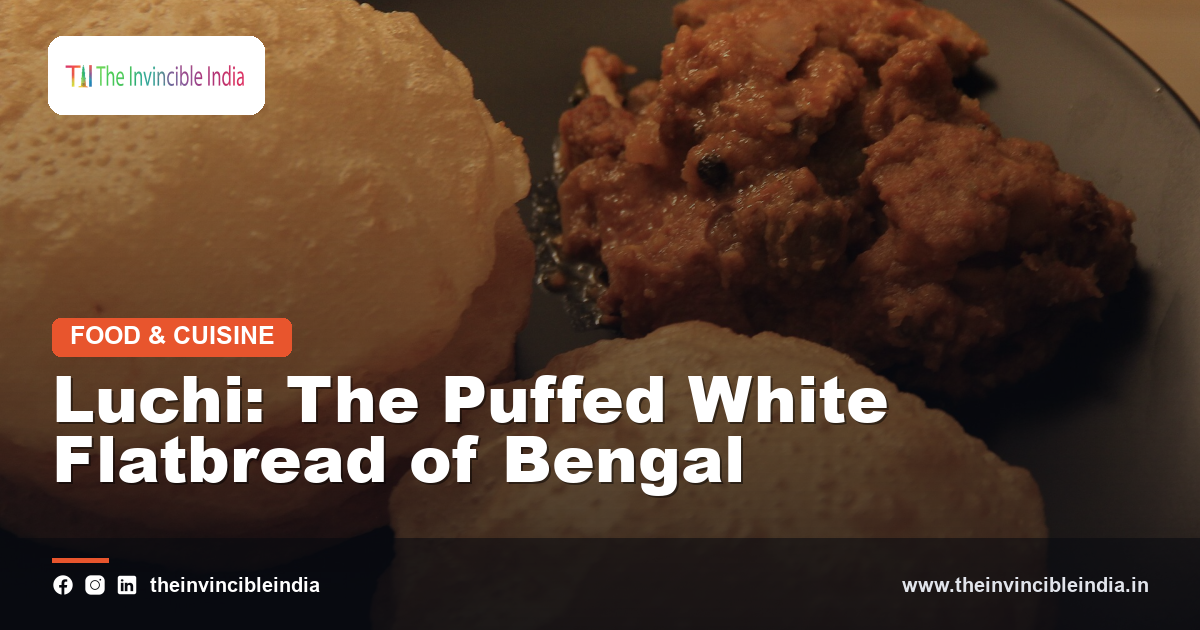
Luchi, also spelled loochi and sometimes called Bengali puri, is a small, round and softly puffed deep-fried flatbread made from refined wheat flour, and it is one of the best-loved breads of Bengal. Pale, light and delicately blistered, it is rolled thin, dropped into hot oil and eaten straight from the pan with potato curry, lentils or sweets. The bread appears at festive feasts, Sunday breakfasts and family celebrations, and the guide to Bengali cuisine places it among the pleasures that define the region’s table. This guide explains what luchi is, how it differs from similar breads, how it is made and why it holds such a special place in Bengali food culture.
Quick answer: Luchi is a deep-fried, puffed flatbread of Bengal made from refined wheat flour (maida), water, salt and a little ghee or oil. It is also spelled loochi and is often compared with puri, though luchi is smaller, paler and softer. It is traditionally eaten hot with dishes such as aloor dom, cholar dal or kosha mangsho, and it is a favourite at festivals, weddings and Sunday breakfasts.
Key Takeaways
- Luchi is a puffed, deep-fried flatbread from Bengal, eastern India, and is also spelled loochi.
- It is made from refined wheat flour (maida) rather than whole-wheat flour, which gives it a pale colour and soft texture.
- The dough is kneaded with a little ghee or oil, called moyan, which keeps the bread tender.
- Luchi is smaller, thinner and softer than puri, and it is meant to be eaten hot soon after frying.
- Classic partners include aloor dom, cholar dal, begun bhaja and kosha mangsho, as well as sugar and sweets.
- Stuffed relatives such as kochuri and radhaballabhi extend the luchi family of Bengali fried breads.
Read on for the ingredients, method, serving customs, and cultural role in detail.
Quick Facts
| Detail | Information |
|---|---|
| Dish | Luchi (loochi, Bengali puffed bread) |
| Region | Bengal, eastern India and Bangladesh |
| Type | Deep-fried flatbread |
| Main ingredient | Refined wheat flour (maida) |
| Dough additions | Water, salt and a little ghee or oil |
| Texture | Pale, soft, light and puffed |
| Classic accompaniments | Aloor dom, cholar dal, begun bhaja, kosha mangsho, sugar |
| Cultural role | Festive meals, Sunday breakfast, weddings and offerings |
What is luchi?
Luchi is a small, round, deep-fried bread of Bengal that puffs into a pale, airy ball when it meets hot oil. It is made from refined wheat flour, kneaded into a smooth dough, rolled into thin discs and fried quickly until lightly blistered but not browned. The finished bread is soft, slightly chewy and mildly rich, with a subtle flavour that lets the accompanying dish take centre stage. Unlike many everyday Indian breads cooked on a griddle, luchi is a special-occasion food in many households, reserved for weekends, festivals and guests. The bread is typically served in a stack, with each piece torn and used to scoop curry or dal. Luchi therefore stands as a defining bread of the Bengali kitchen, combining simplicity of ingredients with a delightful texture.
What are the other names and spellings of luchi?
Luchi is also spelled loochi and is often described in English as Bengali puri or Bengali puffed bread. In Odisha and other eastern regions, closely related fried breads appear under names that sound similar, and in Hindi-speaking regions the nearest equivalent is the puri or poori. In Bangladesh the bread is known by the same name, as part of the shared food heritage of the Bengali-speaking world. The common modern forms are luchi and loochi. These variations help readers connect the bread across menus, cookbooks and travel writing. Whatever the spelling, the name refers to the same pale, thin, refined-flour bread fried until it puffs, a staple of Bengali celebratory eating.
How is luchi different from puri?
Luchi differs from puri mainly in its flour, size and colour: luchi is made of refined flour and is smaller, paler and softer, while puri is usually made of whole-wheat flour and is larger and darker. The two breads share the technique of deep-frying a rolled disc of dough until it puffs, which is why luchi is often called the Bengali puri. Puri dough is typically firmer, giving a slightly crisper and more substantial bread, whereas luchi dough is kneaded softly and enriched with ghee or oil, giving a tender result. Regional taste also plays a part, since northern and western India favour puri with spiced potato or halwa, and Bengal favours luchi with its own curries and sweets. The contrast shows how a similar method yields distinct breads across regions.
Where does luchi come from?
Luchi comes from Bengal, the Bengali-speaking region of eastern India and present-day Bangladesh, where it has long been part of festive and household cooking. Deep-fried breads made from wheat flour are found across the Indian subcontinent, and luchi represents the Bengali form of this wider tradition. Its history is not precisely documented, and any claim about an exact date or inventor should be treated cautiously. What is clear is that the bread became closely tied to Bengali hospitality, appearing in descriptions of feasts, picnics and family gatherings. Because refined flour and generous frying fat were once markers of special meals, luchi acquired a celebratory image that persists. The bread thus reflects the region’s fondness for rich, carefully prepared food served to honour guests and occasions.
What is luchi made from?
Luchi is made from refined wheat flour, water, salt and a small amount of ghee or oil, with oil or ghee for deep frying. The flour, known as maida, is a fine white wheat flour that creates the characteristic pale colour and smooth texture. The ghee or oil mixed into the flour, called moyan in Bengali kitchens, shortens the gluten and keeps the bread tender. Some cooks add a pinch of sugar to encourage light browning and a hint of sweetness. Fresh, clean frying oil is important because the bread is fried quickly and absorbs the flavour of whatever it is cooked in. The very short ingredient list is part of luchi’s appeal, since quality and technique matter far more than any complicated recipe.
Making and Resting the Dough
Luchi dough is made by rubbing ghee or oil into the flour, adding water gradually and kneading until the dough is smooth, firm and elastic. The dough is usually stiffer than that of chapati, because a soft, sticky dough would absorb too much oil when fried. After kneading, it is covered with a damp cloth and allowed to rest for a short time so that the gluten relaxes and the rolling becomes easier. Small, equal-sized balls are then pinched off and kept covered to prevent drying. A well-rested dough rolls out evenly without tearing and is more likely to puff. This careful preparation is the quiet foundation of good luchi, showing that the final bread depends on patient work long before the oil is heated.
How is luchi rolled and fried?
Luchi is rolled into small, thin and even discs and fried one or two at a time in hot oil or ghee until it puffs and turns very pale gold. Each ball of dough is lightly dusted or oiled and rolled into a circle of uniform thickness, since uneven rolling prevents a proper puff. The oil must be hot enough to make the dough rise immediately but not so hot that the bread browns too quickly. Cooks gently press the luchi under the oil with a slotted spoon to encourage it to inflate, then flip it briefly and lift it out. Draining on a cloth or paper keeps the bread light rather than greasy. This quick, attentive frying yields the soft, airy luchi that Bengali households prize.
Why does luchi puff up?
Luchi puffs up because the moisture inside the rolled dough turns to steam in the hot oil and is trapped between two firm, evenly rolled layers. The surface of the disc sets rapidly in the heat, forming a thin skin, and the expanding steam pushes the layers apart into a hollow ball. This explains why even rolling, a properly rested dough and correct oil temperature are so important. If the dough has cracks, is rolled too thick on one side or is fried in oil that is not hot enough, the steam escapes and the bread stays flat. A perfectly puffed luchi collapses gently once it leaves the oil, yet remains tender inside. The puff is therefore both a visual delight and a sign of skilled technique.
What is luchi eaten with?
Luchi is eaten with a wide range of Bengali dishes, most famously aloor dom, cholar dal, begun bhaja and kosha mangsho. Aloor dom is a spiced potato curry with a rich gravy, and cholar dal is a sweetish, coconut-flavoured Bengal gram dal, both of which pair well with the neutral softness of the bread. Begun bhaja, slices of fried aubergine, adds a crisp and savoury contrast, while kosha mangsho, slow-cooked spicy mutton, makes a more indulgent meal. Many people also enjoy luchi with a sprinkle of sugar or with sweets such as sandesh and payesh at festive times. Each pairing shows how the mild bread acts as a neutral canvas for stronger flavours, rounding out a satisfying Bengali meal.
Luchi for Breakfast and Weekend Meals
Luchi is a classic Bengali breakfast and weekend treat, often prepared on Sunday mornings or on holidays when families have time to cook and eat together. The combination of hot luchi and a simple potato curry is among the most familiar morning meals in Bengali homes and local sweet shops. Because frying fresh bread takes time, luchi tends to be associated with leisure and togetherness rather than rushed weekday eating. Many Bengalis recall the sound and smell of luchi being fried as the signal of a special day. Small roadside shops and traditional sweet-shop counters often sell hot luchi with curry in the morning. This everyday pleasure shows how luchi is woven into the rhythm of ordinary family life as well as festivals.
Luchi at Festivals, Weddings and Offerings
Luchi is a staple of Bengali festive feasts, including Durga Puja gatherings, weddings, religious ceremonies and family celebrations. During large events, cooks fry luchi in great numbers and serve them hot with vegetarian curries and dals. In many ritual contexts, food prepared without onion and garlic is favoured, and luchi with simple vegetable dishes suits those customs well. The bread also features in the offering of food to deities and in community meals associated with temples. Because it signals abundance and generosity, a plate piled with luchi has long been a gesture of hospitality towards guests. These roles demonstrate that luchi is more than everyday food, serving also as a marker of joy and togetherness during the Bengali festive calendar.
What are the stuffed cousins of luchi?
The stuffed cousins of luchi include kochuri, radhaballabhi and similar fried breads filled with spiced lentils, peas or other fillings. Kochuri is a deep-fried bread stuffed with a seasoned filling, commonly of peas or dal, and is slightly crisper and more flavourful than plain luchi. Radhaballabhi is a luchi-like bread filled with a spiced urad dal mixture and is often served with a gravy of potatoes or cauliflower. These breads share the frying method and refined-flour dough with luchi, yet they offer more complex flavour. They are served on similar occasions, particularly on festive mornings and at special meals. Seen together, plain luchi and its stuffed relatives form a family of fried breads that gives Bengali cuisine a delicious range of textures and tastes.
Luchi Beyond Bengal
Luchi is closely related to fried breads of eastern and wider India, and communities across Odisha, Assam, Bihar and beyond make breads of a similar kind. In Odisha, for instance, the neighbouring tradition includes its own fried breads and puffed puris served with local curries. Bengali migrants have carried luchi with them to cities across India and overseas, where it appears at community gatherings and restaurants. In Bangladesh the bread remains an important part of the shared Bengali food culture. Across these regions the details of flour, size and accompaniment change, but the idea of a freshly fried, puffed bread served hot remains constant. Luchi is therefore a regional speciality that also connects to a larger family of Indian breads.
Tips for Making Soft and Pale Luchi
Soft, pale luchi depends on a well-kneaded dough, thin even rolling and oil at the right temperature. Cooks advise keeping the dough covered at all times, using only a very light dusting of flour so that the oil stays clean, and frying a test piece to check the heat. If the luchi darkens quickly the oil is too hot, and if it stays flat and absorbs oil the oil is too cool. Frying only one or two pieces at a time prevents crowding and keeps the temperature steady. Serving the bread immediately, while it is still warm and tender, gives the best texture because it softens and loses its puff as it cools. These small points reflect the experience of generations of Bengali cooks.
Luchi Today
Luchi today remains one of the most cherished foods of Bengal, served in homes, sweet shops, restaurants and at community celebrations in India and abroad. Restaurants featuring Bengali menus almost always include luchi with aloor dom, and many food lovers regard it as a must-try when exploring Bengal. Some cooks now experiment with whole-wheat versions, smaller sizes or lighter frying, but the classic pale luchi retains its place. Packaged frozen versions and ready-to-fry dough have also appeared, making the bread easier to prepare. Food writers often describe luchi as a symbol of Bengali hospitality and nostalgia. Luchi continues to connect festive tradition, family routine and the joy of freshly fried bread in modern Bengali life.
Sources & Further Reading
- Ministry of Culture, Government of India (indiaculture.gov.in).
- Ministry of Tourism, Government of India (tourism.gov.in).
Frequently Asked Questions
What is luchi?
Luchi is a small, deep-fried, puffed flatbread of Bengal made from refined wheat flour, water, salt and a little ghee or oil. It is also spelled loochi and is often called the Bengali puri.
What is the difference between luchi and puri?
Luchi is made with refined flour (maida) and is smaller, paler and softer, while puri is usually made with whole-wheat flour and is larger and darker. Both are deep-fried and puff up, but luchi has a more tender, delicate texture.
What is luchi eaten with?
Luchi is eaten with dishes such as aloor dom, cholar dal, begun bhaja and kosha mangsho. It is also enjoyed with sugar or with sweets at festive meals.
Why does luchi not puff up sometimes?
Luchi may stay flat when the dough is rolled unevenly, has cracks, is too soft or is fried in oil that is not hot enough. Even rolling, a rested stiff dough and properly heated oil help it puff.
Is luchi made with whole-wheat flour?
Traditional luchi is made with refined flour (maida), which gives it its pale colour and soft texture. Some modern cooks make versions with whole-wheat flour, though these are closer to puri.
When is luchi usually eaten in Bengal?
Luchi is usually eaten at Sunday breakfasts, festivals such as Durga Puja, weddings and special family meals. It is considered a celebratory food rather than an everyday bread.


