

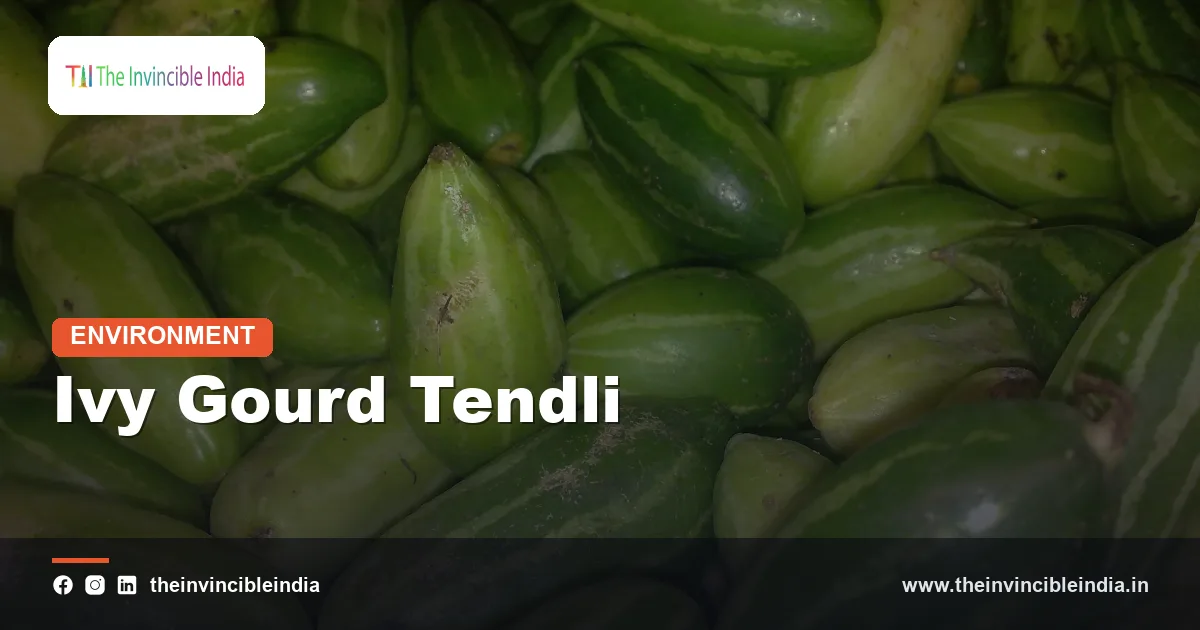
The ivy gourd (Coccinia grandis), called tendli or tondli in Marathi and Gujarati and kundru in Hindi, is a perennial climbing vine of the cucumber family that produces small, crisp, finger-shaped green fruits eaten as a vegetable across India. The plant is a fast-growing creeper that clings to fences, trellises and shrubs with thin tendrils, and it is one of the most common climbers in Indian kitchen gardens and village backyards.
Because the ivy gourd grows from simple stem cuttings, tolerates heat and keeps fruiting for many months, it has become a dependable household vegetable from Gujarat and Maharashtra to Tamil Nadu, West Bengal and Assam. This explainer covers the plant’s identity, regional names, cultivation, cooking, nutrition, traditional uses and its darker side as an invasive weed outside its native range.
Quick Facts
| Attribute | Detail |
|---|---|
| Scientific name | Coccinia grandis (also listed as Coccinia cordifolia and Coccinia indica) |
| Family | Cucurbitaceae (the gourd, cucumber and pumpkin family) |
| Common names | Ivy gourd, tendli, tondli, kundru, kovakkai, dondakaya, tondekayi, kovai, telakucha, scarlet gourd |
| Plant type | Perennial herbaceous climbing vine with tendrils and a tuberous root |
| Sex of plants | Dioecious: separate male and female plants |
| Edible parts | Unripe green fruits, tender shoots and young leaves |
| Main propagation method | Stem cuttings |
| Native range | Tropical Africa and Asia, including the Indian subcontinent |
| Status elsewhere | Invasive weed in parts of Hawaii, Australia and several Pacific islands |
Key Takeaways
- The ivy gourd (Coccinia grandis) is a perennial climber in the cucumber family whose unripe green fruits, known as tendli or kundru, are a staple vegetable in many Indian households.
- Ivy gourd plants are either male or female, so a gardener must grow cuttings from a known fruiting female plant, plus one male plant nearby, to get fruit.
- Tendli is grown from stem cuttings rather than seed, and a healthy vine can start fruiting within roughly two to three months of planting in warm weather.
- Tendli fruit is low in calories and mostly water, and it supplies modest amounts of dietary fibre, vitamin C and carotenoids.
- A bitter-tasting ivy gourd fruit should be discarded, because bitterness in cucurbit vegetables signals cucurbitacin compounds that can cause stomach upset.
- Outside its native range, the ivy gourd smothers trees and shrubs and is classed as an invasive weed in Hawaii, northern Australia and some Pacific islands.
What is the ivy gourd and where does it come from?
The ivy gourd is a tropical climbing vine, Coccinia grandis, grown mainly for its small green fruits and native to tropical Africa and Asia, including India. It belongs to the family Cucurbitaceae, which also includes cucumber, bottle gourd, bitter gourd, ridge gourd and pumpkin.
Botanists have used several names for the plant over time, and older Indian floras often list it as Coccinia indica or Coccinia cordifolia. These are now generally treated as synonyms of Coccinia grandis. The genus name Coccinia comes from a Latin word for scarlet, a reference to the bright red colour that the fruits take on when they ripen fully.
The plant has been eaten in India for a very long time and is mentioned in traditional medical texts under Sanskrit names such as bimba and bimbi. Today it is grown in the wild, in homestead gardens and increasingly as a commercial vegetable crop supplying city markets.
What does the ivy gourd plant look like?
The ivy gourd is a slender, branching climber with five-lobed, heart-shaped leaves, white star-like flowers and small oval fruits, and it climbs using unbranched tendrils. The leaves are glossy, dark green and about the size of a human palm, and they resemble those of true ivy, which explains part of the English common name.
Flowers
The flowers are white, with five petals joined at the base into a short bell, and they open in the morning. Male and female flowers are borne on different plants. Bees and other small insects carry pollen from male to female flowers, and the female flowers carry a tiny swollen ovary at the base that develops into the fruit.
Fruits and roots
The fruits are oval to cylindrical, usually about 2.5 to 6 centimetres long, with pale green stripes along the length when young. Unripe fruit is firm and crisp, while ripe fruit turns bright red and soft. Below ground the plant forms a tuberous root, which lets the vine regrow after dry spells or after being cut back.
What are the names of the ivy gourd in different Indian languages?
The ivy gourd has a distinct local name in almost every major Indian language, and kundru and tendli are the two most widely recognised. Because the same vegetable travels under many names, shoppers moving between states often do not realise that they are buying the same crop.
| Language or region | Common name |
|---|---|
| Hindi | Kundru |
| Marathi and Gujarati | Tondli or tendli |
| Tamil | Kovakkai |
| Telugu | Dondakaya |
| Kannada | Tondekayi |
| Malayalam | Kovakka |
| Bengali | Telakucha |
| English | Ivy gourd, scarlet gourd |
How is tendli grown in an Indian kitchen garden?
Tendli is grown by planting stem cuttings of a mature vine in well-drained soil and giving the creeper something to climb, such as a trellis, fence or arbour. The crop does best in warm, humid weather and is usually planted at the start of the monsoon or in spring, although in frost-free regions it can be planted through much of the year.
Propagation by cuttings
Gardeners cut healthy stems about 15 to 20 centimetres long, each carrying several nodes, and push them into moist soil or pots. Roots form quickly at the nodes. Since each plant is either male or female, growers take cuttings from a vine that has already borne fruit and keep roughly one male plant for every ten or so females to ensure pollination.
Soil, water and support
The vine prefers loose, fertile, well-drained soil with a neutral to slightly acidic reaction and full sun. Regular but moderate watering keeps the fruit tender, while waterlogged roots lead to rot. A trellis or overhead frame keeps the fruits off the ground, so they stay clean and straight.
Harvest
Fruits are picked while still green and firm, usually when they are about the size of a thumb. Harvesting every few days keeps the plant producing, because fruits left to turn red slow further flowering. In good conditions a single vine can yield for several months, and a perennial plant can keep producing for years if it is cut back and fed after each season.
How is tendli cooked and eaten in India?
Tendli is cooked mainly as a dry stir-fried vegetable, sliced into rounds or lengths and tempered with mustard seeds, turmeric and chilli. Its crisp texture and mild, slightly tangy flavour hold up well to frying, which is why it suits quick, spiced preparations.
- Maharashtra and Gujarat: tondli bhaat, a spiced rice cooked with sliced tendli, and tendli sabzi, often seasoned with grated coconut or peanuts.
- North India: kundru ki sabzi, a dry fry with onion, cumin and dry mango powder, often eaten with roti.
- Tamil Nadu and Kerala: kovakkai poriyal, a stir-fry with coconut, and kovakka mezhukkupuratti, a Kerala-style dry fry.
- Andhra Pradesh and Telangana: dondakaya fry and dondakaya pachadi, a coarse chutney.
- Bengal: telakucha bhaja, thinly sliced and fried, sometimes added to mixed vegetable dishes.
Tender shoots and young leaves are also eaten in some regions as a cooked green. Raw slices may be added to salads or pickled in oil and spices. Cooks generally trim both ends of the fruit and slice it before cooking, and many prefer firm young fruit because older fruit turns seedy and soft.
What is the nutritional value of tendli?
Tendli is a low-calorie vegetable that is mostly water and provides modest amounts of dietary fibre, vitamin C, carotenoids, calcium and iron. Exact values vary with variety, maturity and soil, so figures differ between food composition tables.
The fruit’s fibre helps digestion, and its low energy content makes it a light accompaniment to rice or roti. The leaves and ripe fruit are richer in beta-carotene, a pigment the body converts into vitamin A, which explains the red colour of ripe fruit. Tendli is not a significant source of protein or fat, so it works best as one of several vegetables in a varied diet rather than as a nutritional centrepiece.
Does the ivy gourd have medicinal uses?
The ivy gourd has a long history in traditional Indian and other Asian folk medicine, but scientific evidence for its health effects remains limited and inconclusive. Practitioners have used extracts of the leaves, roots and fruit for conditions such as skin complaints, fever and, most commonly, high blood sugar.
Laboratory studies and a few small human trials have reported that Coccinia grandis extracts may lower blood glucose, but the trials were small, short and varied in method, so researchers do not regard the effect as proven. The vegetable is therefore best understood as a nutritious food, not as a treatment. People managing diabetes or taking medicines for it should not substitute ivy gourd preparations for prescribed care and should consult a doctor before using concentrated extracts.
What pests and problems affect ivy gourd?
Ivy gourd is a hardy crop, but it is attacked by fruit flies, leaf-eating beetles, aphids and fungal and viral diseases that are common to the cucumber family. Healthy cuttings, good spacing and regular inspection reduce most problems in a home garden.
- Fruit flies: lay eggs inside young fruit, causing it to rot and drop; collecting and destroying infested fruit limits spread.
- Epilachna beetles: chew the leaves into a lace-like pattern; hand-picking beetles and grubs helps on small plots.
- Aphids and whiteflies: suck sap and can carry plant viruses; spraying with plain soap solution or neem-based sprays is a common low-cost response.
- Powdery mildew and leaf spots: appear in humid or crowded growth; pruning improves airflow.
- Root rot: follows waterlogging; raised beds and good drainage prevent it.
Is the ivy gourd an invasive weed?
Yes, the ivy gourd is considered an invasive weed in several regions outside its native range, including Hawaii, northern Australia and some Pacific and Caribbean islands. In these places the vine grows rapidly in warm, wet conditions and climbs over trees, shrubs and fences, blocking sunlight.
Its tuberous roots regrow after cutting, and birds and other animals spread the seeds after eating the red fruits, which makes control difficult. Because the plant can regrow from small stem fragments, discarded cuttings can also start new infestations. In India, where the plant is native, it is not regarded as a serious invader, but gardeners in other countries are advised to check local rules before planting it. Anyone who grows the vine outside its native range should keep it contained and dispose of cuttings carefully.
How do you choose and store tendli?
The best tendli is small, firm, bright green and glossy, with no soft spots or red patches. Fruit that has begun to turn red or yellow is overripe and tends to be seedy, soft and less pleasant to eat.
Fresh tendli keeps well for several days when stored unwashed in a paper bag or a perforated container in the refrigerator crisper. Washing just before cooking prevents the surface from turning slimy. Before cooking, cooks usually taste a small raw piece or cut the fruit and check the flesh. Fruit that tastes distinctly bitter should be discarded, since bitterness in cucurbits is caused by cucurbitacins, which can irritate the stomach and, in large amounts, cause illness.
Bottom Line
The ivy gourd is an easy, productive, native Indian vegetable that rewards even a beginner gardener with months of fruit from a few cuttings. It is a light, versatile ingredient in regional cooking, but it should be eaten fresh and non-bitter, treated as food rather than medicine, and kept under control in countries where it can run wild.
Frequently Asked Questions
What is the ivy gourd called in Hindi?
The ivy gourd is called kundru in Hindi. In Marathi and Gujarati it is tendli or tondli, in Tamil kovakkai, and in Telugu dondakaya.
Is tendli the same as kundru?
Yes, tendli and kundru are two regional names for the same vegetable, Coccinia grandis. The names differ by language, but the fruit, the plant and the cooking uses are the same.
How long does ivy gourd take to fruit?
An ivy gourd cutting usually begins to fruit within about two to three months of planting in warm weather. Fruiting continues for many months, and a perennial vine can produce for several years.
Can ivy gourd be grown from seed?
Ivy gourd can grow from seed, but gardeners almost always use stem cuttings instead. Cuttings let growers choose a fruiting female plant, while seedlings may turn out to be male and never bear fruit.
Is ivy gourd good for diabetes?
Ivy gourd is a low-calorie, fibre-containing vegetable, but there is no firm proof that it treats diabetes. Some small studies suggest extracts may lower blood sugar, yet the evidence is limited, so it should not replace medical treatment.
Why does some tendli taste bitter?
Some tendli tastes bitter because the fruit contains cucurbitacins, natural compounds found in many cucurbit plants. Bitter fruit should be discarded because it can cause stomach upset.
{“@context”:”https://schema.org”,”@graph”:[{“@type”:”FAQPage”,”mainEntity”:[{“@type”:”Question”,”name”:”What is the ivy gourd called in Hindi?”,”acceptedAnswer”:{“@type”:”Answer”,”text”:”The ivy gourd is called kundru in Hindi. In Marathi and Gujarati it is tendli or tondli, in Tamil kovakkai, and in Telugu dondakaya.”}},{“@type”:”Question”,”name”:”Is tendli the same as kundru?”,”acceptedAnswer”:{“@type”:”Answer”,”text”:”Yes, tendli and kundru are two regional names for the same vegetable, Coccinia grandis. The names differ by language, but the fruit, the plant and the cooking uses are the same.”}},{“@type”:”Question”,”name”:”How long does ivy gourd take to fruit?”,”acceptedAnswer”:{“@type”:”Answer”,”text”:”An ivy gourd cutting usually begins to fruit within about two to three months of planting in warm weather. Fruiting continues for many months, and a perennial vine can produce for several years.”}},{“@type”:”Question”,”name”:”Can ivy gourd be grown from seed?”,”acceptedAnswer”:{“@type”:”Answer”,”text”:”Ivy gourd can grow from seed, but gardeners almost always use stem cuttings instead. Cuttings let growers choose a fruiting female plant, while seedlings may turn out to be male and never bear fruit.”}},{“@type”:”Question”,”name”:”Is ivy gourd good for diabetes?”,”acceptedAnswer”:{“@type”:”Answer”,”text”:”Ivy gourd is a low-calorie, fibre-containing vegetable, but there is no firm proof that it treats diabetes. Some small studies suggest extracts may lower blood sugar, yet the evidence is limited, so it should not replace medical treatment.”}},{“@type”:”Question”,”name”:”Why does some tendli taste bitter?”,”acceptedAnswer”:{“@type”:”Answer”,”text”:”Some tendli tastes bitter because the fruit contains cucurbitacins, natural compounds found in many cucurbit plants. Bitter fruit should be discarded because it can cause stomach upset.”}}]}]}


