

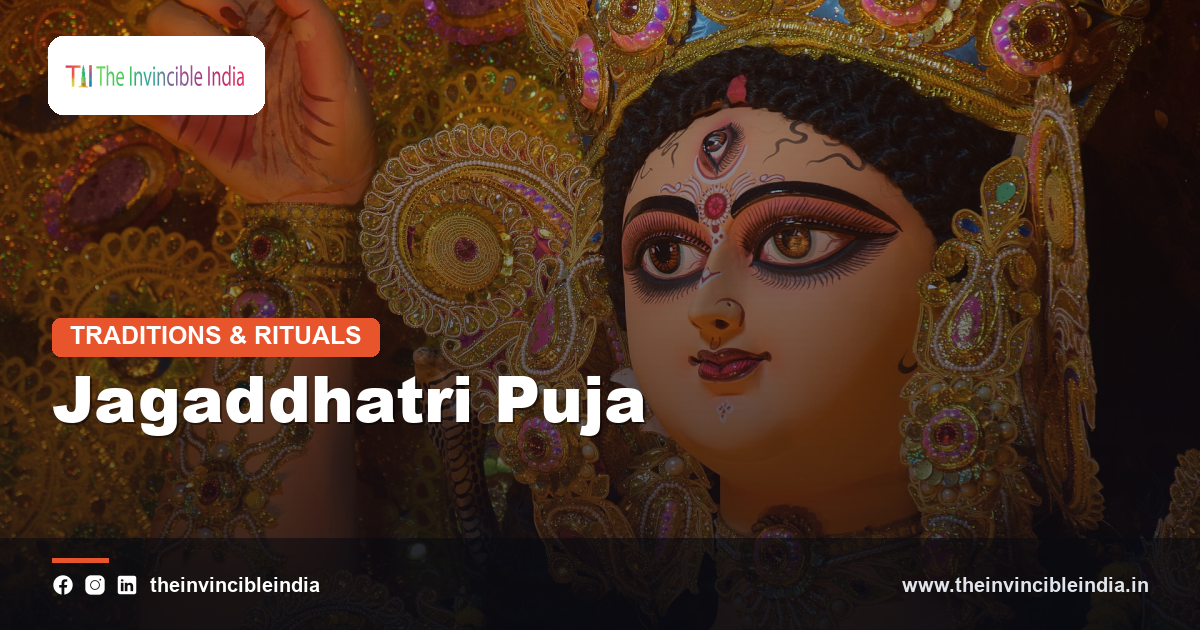
Jagaddhatri Puja is the worship of Jagaddhatri, whose name means the one who sustains or bears the world, and it is among the best loved festivals of West Bengal. Held in the autumn season, a few weeks after the great festival described in the guide to Durga Puja, it features tall clay idols of the goddess seated on a lion, elaborate pandals, devotional music and nights of procession through illuminated streets. The festival is celebrated across the Hooghly region and in many towns of Bengal, but it is most famous at Chandannagar, where entire neighbourhoods compete in creating spectacular light displays. Although it is closely related in spirit to Durga worship, Jagaddhatri Puja has its own iconography, stories and character. It remains one of the great community festivals of eastern India, joining devotion, craft and civic pride.
Quick Facts
| Detail | Information |
|---|---|
| Festival Type | Hindu goddess festival |
| Primary Region | West Bengal, especially Chandannagar and the Hooghly region |
| Deity | Goddess Jagaddhatri, the bearer of the world |
| Timing | Autumn month of Kartik, in the bright fortnight |
| Duration | Three days of worship followed by immersion |
| Signature Features | Lion mounted idols, lighting displays and processions |
Who Is Goddess Jagaddhatri
Jagaddhatri is a form of the Divine Mother worshipped in Bengal, and her name is usually interpreted as the one who holds or sustains the world. She is regarded as a manifestation of Shakti, the feminine creative power that Hindu tradition places at the heart of the universe, and she is closely associated with Durga and with the goddess Parvati. Unlike Durga, who is shown in the act of slaying the buffalo demon, Jagaddhatri is portrayed in a calm, regal and sustaining aspect, seated upon a lion that stands over a subdued elephant. Devotees see her as the force that supports creation, maintains order and protects those who seek refuge. Her worship is particularly cherished in homes and neighbourhoods across the Hooghly region. This distinct identity gives the festival its own tone, in which strength is expressed through steady support and sovereign grace.
The Story from the Upanishad
A teaching often connected with Jagaddhatri comes from the Kena Upanishad, which describes how the gods, after gaining a victory, grew proud and believed the triumph to be their own. A mysterious radiant being appeared before them and placed a blade of grass before the fire god and the wind god, asking each to burn or carry it away, and neither could. The being vanished, and the goddess Uma, in the form of a radiant woman, appeared to reveal that the power behind their victory was the supreme divine reality. In popular devotion this story is associated with Jagaddhatri, who is understood as the goddess who humbles pride and restores true understanding. The tale teaches that all strength comes from a higher source, and it presents the goddess as both teacher and sustainer. This meaning lends the worship a thoughtful and philosophical depth.
The Elephant Demon Karindrasura
The iconography of Jagaddhatri includes a story about an elephant-headed demon, called Karindrasura in local tradition. The tale recounts how this demon became arrogant, harassed the gods and boasted of his invincibility, until the goddess appeared in her sustaining form, seated on her lion, and subdued him. The idol therefore shows the lion standing over a fallen elephant, a vivid image of the triumph of disciplined strength over blind pride. The story is told in local retellings and handed down by priests and families, and details vary from place to place. The image makes the festival’s central theme easy to see, since the idol itself is a visual lesson. The elephant demon represents ego and brute force, and the lion represents the controlled and righteous power of the goddess, which is the quality celebrated in the festival.
The Iconography of the Idol
The idol of Jagaddhatri follows a well established pattern that is recognised throughout Bengal. The goddess is shown with four arms, holding a conch, a discus, a bow and an arrow in her hands, and she wears a serpent across her chest as a sacred thread. She is richly dressed in red, with jewellery, a crown and flowers, and her complexion is often a warm saffron or golden hue. She is seated on a lion, which in turn stands upon the body of an elephant, and the whole composition is placed upon a raised platform. The weapons recall those of Vishnu and Durga, linking the goddess to wider devotional traditions. The balanced and serene pose of the figure is part of its appeal. Studying the iconography reveals how each element, from the weapons to the animals, contributes to the meaning of the festival.
Timing and Duration of the Festival
Jagaddhatri Puja is held in the Hindu month of Kartik, in the bright fortnight of the moon, and the principal days of worship are the seventh, eighth and ninth days, in a manner that parallels the structure of Durga Puja. It typically occurs about a month after Durga Puja and is therefore seen as a continuation of the autumn festive season in Bengal. On the first day, the idol is installed and consecrated, and on the following days worship, offerings and cultural programmes take place. The festival closes with the immersion of the idol in a river or pond on the day after the ninth. Because the Hindu calendar is lunar, the dates shift from year to year, and local committees publish the schedule. The three day rhythm of installation, worship and farewell gives the festival a clear and familiar shape.
Chandannagar as the Centre of the Festival
Chandannagar, a town on the western bank of the Hooghly river, is the place most closely identified with Jagaddhatri Puja, and the festival there is a major civic event. The town was once a French settlement, and its historic character is visible in its architecture and riverfront. During the festival, hundreds of community committees install idols in neighbourhood pandals, and the entire town takes on a festive air. Residents decorate their lanes, receive guests from Kolkata and beyond, and take part in processions that continue deep into the night. The celebration is organised by clubs and neighbourhood groups, and it brings together people of many backgrounds. For many in Bengal, a visit to Chandannagar during the festival is an annual custom. The town’s association with the puja is a source of local pride and a reminder of the festival’s deep roots in the Hooghly region.
The Art of Chandannagar Lighting
Chandannagar is famous for its elaborate lighting, which turns the town’s streets into corridors of coloured light during the festival. Skilled artisans construct large frames and structures decorated with thousands of small lamps, and these are assembled into gateways, panoramas and moving scenes that depict mythological stories, historic events and contemporary themes. The craft has developed over generations and is regarded as a distinctive local art form, sometimes presented with synchronised movement and music. Visitors walk through the streets in the evening to see the displays, and the work of the lighting artists is as much a draw as the idols themselves. The craft supports a community of electricians, carpenters and designers who prepare for months. The lighting tradition shows how a religious festival can nurture a living and evolving folk art within its community.
Idol Making and the Role of Artisans
The idols of Jagaddhatri are made by traditional artisans who work with clay from the river, straw and bamboo frames, and natural colours. The process begins weeks before the festival, with the building of the structure, the layering of clay, the sculpting of the figures and the painting and decoration of the finished form. The lion and elephant, with their detailed musculature and expression, require special skill. Many artisans belong to families who have practised the craft for generations, and their work is celebrated for its fine finish and presence. The tallest idols can rise to considerable heights and require careful engineering. Local committees commission the idols months ahead, and the workshops become busy places in the weeks before the festival. The craft of idol making is therefore central to the festival, and its practitioners preserve a heritage of skill passed down within families.
The Rituals of Worship
The ritual worship of Jagaddhatri follows the pattern of Shakta worship in Bengal, led by priests who recite Sanskrit mantras and perform the prescribed offerings. The ceremonies begin with the invocation of the goddess into the idol, called pranapratishtha, followed by daily worship with flowers, fruits, incense, lamps and sacred water. On the eighth day, a special offering, the sandhi puja, is made at the junction of two lunar days, when the presence of the goddess is said to be strongest. Devotees offer flowers with the chant of the goddess’s name, and a communal prayer called anjali is recited with folded hands. The sacred meal, or bhog, is prepared and offered, then distributed among the visitors. The disciplined sequence of rites maintains continuity with older tradition and gives the festival its devotional centre.
Bhog and Festive Food
Food is an essential part of the festival, and the bhog offered to the goddess is shared among devotees as prasad. A typical meal may include khichuri, a mixed preparation of rice and lentils, along with seasonal vegetable dishes, chutney and sweets, though the menu varies by committee and household. Bengali sweets such as sandesh, rasgulla and payesh, the rice pudding, are prepared and offered. Many neighbourhood committees organise communal meals so that all visitors, regardless of background, may eat together. The sharing of food underlines the festival’s inclusive character and the sense of hospitality that marks Bengali culture. Street vendors, sweet shops and restaurants also see a rise in activity during the days of the festival. The food of Jagaddhatri Puja is both an offering and a gift, and it illustrates how devotion, fellowship and cuisine meet in Bengali life.
The Immersion Procession
The festival ends with the immersion of the idols, known as bisarjan, which is carried out in a grand procession. In Chandannagar, the idols are placed on decorated carriages and taken through the streets accompanied by drummers, bands, dancers and crowds of onlookers, and the processions continue into the night before the idols are carried to the river. The procession is one of the highlights of the festival and an occasion of high emotion, as people bid farewell to the goddess with songs and shouts of devotion. The immersion expresses the Hindu idea of the impermanence of the physical form and the return of the goddess to her eternal abode. Local authorities arrange safety measures, traffic control and clean-up. The immersion gives the festival its poignant conclusion, in which celebration and farewell are felt together.
Household and Neighbourhood Pujas
Besides the large public pujas, Jagaddhatri is worshipped in many homes, especially in the old families of the Hooghly region and in towns such as Krishnanagar, where the festival is also celebrated with great enthusiasm. Household pujas are quieter and more intimate, with a small idol installed in the family hall and rituals performed by a priest with the participation of relatives. Neighbourhood committees organise pujas in their own lanes, collecting contributions from residents and arranging pandals, music and cultural events. These smaller observances preserve the personal side of the festival and keep alive the habit of community participation. They also help pass the tradition to children, who watch and assist in the preparations. Household and neighbourhood pujas together make the festival a layered experience, from the grand and public to the quiet and domestic.
Women, Families and Community Life
Jagaddhatri Puja, like other Bengali festivals, is a time when families gather and communities renew their bonds. Women play an important part in preparing offerings, decorating the pandals and the home, and leading devotional singing, while men and young people often manage the work of the committees. Relatives travel to the festival towns to stay with family, and the exchange of visits and greetings is a major social pleasure. Cultural programmes of music, drama and recitation provide entertainment in the evenings and give local artists an audience. Because the festival is organised by volunteers, it fosters cooperation and a sense of shared ownership across the neighbourhood. The social life of the festival is as significant as its ritual life, and it remains an important opportunity for families and communities to come together.
Relationship to Durga Puja and Other Goddess Festivals
Jagaddhatri Puja belongs to the broad family of goddess festivals in Bengal and is often compared with Durga Puja, since both feature clay idols, a three day structure, communal worship and immersion. It differs in scale, iconography and tone. Durga Puja is a vast festival whose central image is the goddess in battle, whereas Jagaddhatri Puja is more compact and focuses on a serene and sustaining image. Kali Puja, held on the new moon of the same season, and Lakshmi Puja, observed on the full moon after Durga Puja, complete a cycle of goddess worship across the autumn. Together these festivals show the many faces of Shakti in Bengali devotion. Seen in this context, Jagaddhatri Puja is both an independent festival and a part of a larger devotional calendar, and it helps extend the festive mood of the year.
Visiting the Festival Respectfully
Visitors to Chandannagar and other festival towns should plan ahead, as the streets can be extremely crowded, especially in the evenings and on the night of the processions. Travelling by train and walking between pandals are common ways to see the festival, and many people stay overnight or return on the following day. Visitors are advised to dress modestly, remove their shoes where required, follow the guidance of volunteers and police, and be careful with belongings in the crowd. Photography is generally welcome in public areas but should be done with courtesy near rituals. Respecting the local residents, keeping the streets clean and following traffic arrangements make the festival safer and more pleasant for all. Treating the occasion as an act of worship as well as a spectacle helps visitors to appreciate its meaning, and it ensures that the hospitality of the hosts is returned with respect.
Jagaddhatri Puja Today
Jagaddhatri Puja today remains a vibrant festival of West Bengal, especially in Chandannagar, where its idols, lighting and processions draw large numbers of visitors each year. It supports artisans, craftspeople and small businesses, and it keeps alive a rich tradition of clay sculpture and decorative lighting. At the same time, communities are paying more attention to environmental care, using natural colours and clay idols and managing immersion with greater consideration for rivers. The festival continues to link neighbourhoods, families and generations through shared work and devotion. For many Bengalis, it is a cherished part of the autumn calendar, bringing the festive season to a graceful close. Jagaddhatri Puja endures as a tradition in which devotion to the sustaining goddess is expressed through art, light and community, and its spirit remains welcoming to all who come to witness it.
Sources & Further Reading
- Ministry of Culture, Government of India (indiaculture.gov.in).
- Government of West Bengal Department of Tourism (wbtourism.gov.in).
Frequently Asked Questions
What is Jagaddhatri Puja?
Jagaddhatri Puja is a Bengali festival honouring the goddess Jagaddhatri, whose name means the one who sustains the world. It is celebrated with idols, communal worship and processions, especially in Chandannagar.
When is Jagaddhatri Puja celebrated?
It is held in the Hindu month of Kartik, in the bright fortnight, usually about a month after Durga Puja. The principal days of worship are the seventh, eighth and ninth, with immersion following.
Why is Chandannagar famous for Jagaddhatri Puja?
Chandannagar, on the Hooghly river, hosts hundreds of neighbourhood pujas and is renowned for its elaborate lighting displays and grand immersion processions. The festival is a major civic event for the town.
How does Jagaddhatri differ from Durga?
Both are forms of the Divine Mother, but Durga is typically shown slaying the buffalo demon, while Jagaddhatri is shown in a calm, sustaining aspect seated on a lion over a subdued elephant. The festivals also differ in scale and tone.
What is the significance of the elephant in the idol?
In local tradition, the elephant represents the demon Karindrasura, whom the goddess subdued. It symbolises the defeat of arrogance and brute force by disciplined and righteous power.


