

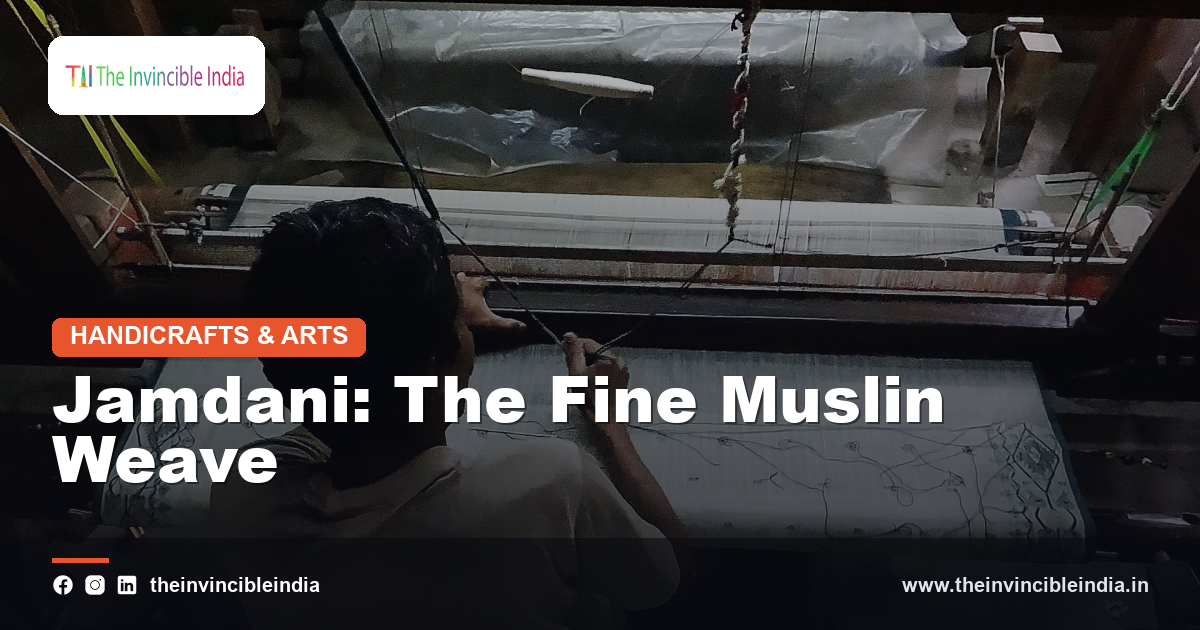
Jamdani is a fine, handwoven fabric long associated with the muslin weaving traditions of Bengal, distinguished by delicate motifs worked directly into the cloth using a discontinuous weft technique. Woven predominantly in cotton, sometimes combined with a touch of silk for added detail, Jamdani is prized for its lightweight texture and the intricate, almost embroidered appearance of its patterns, which are created entirely on the loom rather than added afterward. The craft shares its handloom heritage with other fine Indian weaves such as Muga silk from the eastern region, both reflecting a broader tradition of exceptional textile craftsmanship. This guide explores the history, technique and continuing legacy of Jamdani weaving in India.
Quick Facts
| Detail | Information |
|---|---|
| Region | West Bengal (Bengal muslin tradition) |
| Material | Fine cotton, sometimes with silk motifs |
| Known For | Discontinuous-weft, hand-worked motifs |
| Weave Type | Supplementary weft on a plain weave base |
| Recognition | Geographical Indication (GI) tag in India |
| Typical Use | Fine sarees for formal and festive wear |
Origins and Historical Roots
Jamdani weaving traces its roots to the historic muslin traditions of the Bengal region, an area long celebrated across the Indian subcontinent for producing exceptionally fine cotton cloth. Skilled weavers in this region developed techniques for creating delicate, patterned fabric that came to be recognised for its refinement well beyond its immediate area of production. The craft flourished under sustained local patronage and trade networks that valued the fabric’s combination of lightness and intricate detailing. Over centuries, distinct regional weaving centres developed their own variations on the core technique, contributing to a rich and varied Jamdani tradition across the wider Bengal region, including areas within present-day West Bengal. This long history has given Jamdani a reputation as one of the more technically demanding handloom traditions in the subcontinent. Its continued practice today reflects an unbroken thread of craftsmanship passed down across many generations of weavers.
The Meaning of Jamdani
The name Jamdani is generally understood to describe a style of ornamented, figured muslin in which patterns are woven directly into the fabric rather than printed or embroidered afterward. This distinguishes it from many other decorated textiles, where surface embellishment is applied as a separate step after weaving is complete. The term has come to represent not just a specific pattern style but an entire weaving tradition built around the discontinuous weft technique used to create these motifs. Understanding this terminology helps clarify why Jamdani is considered a distinct category within India’s broader handloom heritage rather than simply a decorative variant of plain muslin. The name itself has become closely associated with fine, hand-worked textile craftsmanship across South Asia. This linguistic and cultural association continues to shape how the fabric is marketed and understood by buyers today.
The Weaving Technique
Jamdani is woven using a discontinuous supplementary weft technique, in which additional threads are inserted by hand into specific sections of the fabric to create motifs, while the base plain weave continues uninterrupted beneath. This requires the weaver to work with small bobbins or spools of extra thread, inserting them precisely according to a pattern that is often memorised rather than drawn out in advance. The technique demands exceptional concentration and manual dexterity, since even small errors in thread placement can disrupt the intended design. Because the additional threads are not carried across the entire width of the fabric, the reverse side of a Jamdani textile often appears nearly as clean as the front, a hallmark of skilled execution. This labour-intensive process typically requires two weavers working together at the loom, coordinating their movements to manage the complex thread insertion. The result is a fabric whose motifs appear almost embroidered despite being entirely woven.
Discontinuous Weft Motifs
The motifs created through Jamdani’s discontinuous weft technique are typically small, delicate and evenly distributed across the fabric, often appearing as scattered floral, geometric or paisley forms rather than large, continuous patterns. This distribution reflects the practical requirements of the technique, since inserting extra threads across the entire width of the fabric for a single large motif would be far more time-consuming than repeating smaller motifs at intervals. The resulting visual effect is a fabric that appears delicately sprinkled with pattern, allowing the sheer, lightweight base cloth to remain visible between motifs. This restrained approach to patterning is part of what gives Jamdani its distinctive, understated elegance compared to more densely patterned textiles. Skilled weavers can vary motif density and placement to create different visual effects, from sparse, minimal patterning to more elaborate arrangements. This flexibility within a consistent technical framework is a hallmark of accomplished Jamdani craftsmanship.
The Fineness of the Muslin
Jamdani is woven from extremely fine cotton yarn, a quality that has historically been central to the fabric’s reputation for delicacy and lightness. Producing yarn fine enough for genuine Jamdani weaving requires careful spinning, and the resulting fabric is often so light that a full saree can be folded into a remarkably compact size. This fineness also makes the weaving process considerably more demanding, since thinner threads are more prone to breaking and require greater care in handling throughout production. The combination of fine base cloth and hand-inserted decorative threads makes Jamdani one of the more technically exacting handloom traditions to master. Buyers and collectors often use the fineness of the weave as one indicator of quality when evaluating genuine handwoven Jamdani textiles. This emphasis on fineness has remained a defining characteristic of the craft since its earliest historical origins.
Traditional Motifs and Patterns
Jamdani motifs commonly include small floral sprigs, paisley forms, geometric shapes and occasionally more elaborate botanical patterns arranged across the body, border and pallu of the fabric. These motifs are often inspired by natural forms such as flowers and vines, reflecting a broader decorative vocabulary shared across many South Asian textile traditions. The placement and density of motifs can vary considerably between different weaving centres and individual workshops, allowing for a wide range of visual styles within the broader Jamdani tradition. Some designs concentrate decoration primarily along the border and pallu, while others distribute smaller motifs more evenly across the entire body of the fabric. This variation reflects both regional preferences and the individual skill and creativity of specific weavers. The enduring popularity of these traditional motifs speaks to their timeless appeal within Indian textile design.
Regional Centres in West Bengal
Within India, Jamdani weaving continues to be practised in specific centres in West Bengal, where weaving families have maintained the tradition across generations despite the technique’s considerable demands. These centres represent an important continuation of the historic Bengal muslin weaving tradition, adapted and sustained within the modern Indian handloom sector. Local weaving communities in these areas often maintain close ties to cooperative societies that help coordinate production, quality standards and market access for their textiles. The concentration of skilled weavers within specific geographic clusters has helped preserve specialised knowledge that might otherwise be lost if practitioners were more widely dispersed. Government and cooperative support for these centres has periodically focused on sustaining traditional skills alongside efforts to improve weaver livelihoods. These regional centres remain essential to the continued practice of authentic, handwoven Jamdani within India.
Community of Weavers
Jamdani weaving is sustained by specialised communities of artisans whose skills are typically passed down within families through years of hands-on apprenticeship rather than formal classroom instruction. Given the technical demands of the discontinuous weft technique, becoming a proficient Jamdani weaver often requires many years of practice before a weaver can execute complex motifs with consistent precision. Many weavers work in pairs at a single loom, a collaborative arrangement necessitated by the technique itself, which further reinforces close working relationships within these communities. The specialised nature of this skill means that experienced Jamdani weavers are held in particularly high regard within the broader handloom sector. As with many traditional textile crafts, sustaining these communities depends on fair compensation that reflects the considerable time and skill involved in producing each piece. The continuity of Jamdani as a living craft rests directly on the continued engagement of these dedicated artisan communities.
Natural Fibres and Yarn Preparation
The preparation of yarn for Jamdani weaving begins with the careful selection and spinning of fine cotton fibres, a process that directly determines the eventual quality and delicacy of the finished fabric. Historically, this preparation involved considerable manual skill, with spinners working to achieve threads fine enough to support the intricate discontinuous weft technique without excessive breakage. Modern production may combine traditional hand-spinning methods with more mechanised yarn preparation for certain grades of fabric, though the finest Jamdani continues to rely on carefully selected fine yarn regardless of spinning method. Proper yarn preparation also involves sizing and strengthening threads sufficiently to withstand the considerable handling involved in the weaving process, particularly given the fineness required. This foundational stage, though largely invisible in the finished product, is essential to achieving the fabric’s characteristic lightness and durability. Attention to yarn quality remains a critical factor distinguishing fine Jamdani from lesser imitations.
Colour and Dyeing Traditions
Traditional Jamdani is often woven in white or off-white cotton, allowing the subtle, hand-worked motifs to stand out through texture and pattern rather than strong colour contrast. Contemporary Jamdani production has expanded considerably beyond this traditional palette, incorporating a wide range of colours for both the base fabric and the motifs themselves, often using coloured silk or cotton threads for the supplementary weft. This expansion has allowed Jamdani to appeal to a broader range of contemporary tastes while retaining the essential hand-weaving technique that defines the tradition. Dyeing, whether for the base fabric or decorative threads, must be carried out with care to maintain the fine, delicate quality of the yarn used throughout. Colour choices often reflect current fashion trends alongside more traditional preferences associated with formal and festive wear. This flexibility in colour and design has helped Jamdani remain relevant to changing consumer preferences over time.
The Loom and Tools
Jamdani is traditionally woven on pit looms or frame looms specifically set up to accommodate the discontinuous weft technique, often requiring two weavers to work together at a single loom. Small bobbins or spools holding the supplementary threads used for motifs are arranged within easy reach, allowing weavers to insert them precisely as the pattern requires. Setting up the loom for a Jamdani piece, including planning the placement of motifs across the fabric’s length, can itself take considerable time before actual weaving begins. The physical arrangement of the loom and tools reflects the collaborative, highly coordinated nature of the weaving process itself, distinguishing it from many single-weaver handloom traditions. These specialised tools and setups, refined over generations, remain essential to producing authentic, finely detailed Jamdani textiles. The continued use of these traditional methods underscores the craft’s deep connection to historical weaving practices.
Occasions and Cultural Significance
Jamdani sarees, particularly finer examples, are closely associated with formal and festive occasions, valued for their delicate elegance and the evident skill involved in their production. The fabric’s lightweight, breathable quality also makes it suitable for wear in warm climates, extending its use beyond purely ceremonial contexts into more general formal wear. In many households, a fine Jamdani saree is considered a valuable textile heirloom, passed down across generations as a symbol of both aesthetic refinement and cultural heritage. Its association with historic Bengal muslin traditions gives Jamdani a particular cultural resonance among communities connected to that broader textile heritage. Cultural events celebrating regional handloom traditions frequently showcase Jamdani as an example of exceptional Indian textile craftsmanship. This continued cultural significance helps sustain both appreciation for the craft and demand for genuine, hand-woven pieces.
GI Tag and Recognition in India
Jamdani weaving in India has received a Geographical Indication tag associated with production in West Bengal, formally recognising the region’s historic connection to this style of fine muslin weaving. This recognition helps distinguish authentic, regionally produced Jamdani from imitations and supports broader efforts to maintain quality standards within the tradition. Government schemes focused on handloom development have periodically extended support to Jamdani weaving communities in West Bengal, covering training, raw material access and market promotion. Such institutional recognition plays an important role in sustaining interest in and demand for genuine handwoven Jamdani, particularly given the considerable skill and time required to produce each piece. The GI tag also contributes to greater consumer awareness regarding the origins and authenticity of Jamdani products sold in wider markets. These recognition efforts form an important part of the broader ecosystem supporting the craft’s continuity in India.
Contemporary Fashion and Designers
In recent decades, Jamdani has attracted significant interest from contemporary fashion designers, who have incorporated the fabric into modern garment forms while continuing to rely on traditional hand-weaving techniques for its distinctive motifs. This interest has helped introduce Jamdani to broader audiences, including younger consumers exploring fine handloom textiles for the first time through contemporary retail channels. Designers have experimented with new colour combinations and motif arrangements while preserving the essential discontinuous weft technique that defines authentic Jamdani. Online platforms dedicated to handloom promotion have further expanded market access for Jamdani weavers, connecting them directly with buyers across India and internationally. At the same time, demand for classic, traditionally styled Jamdani sarees remains strong among those who value the fabric’s historic craftsmanship. This combination of contemporary interest and sustained traditional demand continues to support the craft commercially.
Challenges of Sustaining Fine Handloom
Jamdani weaving faces significant challenges tied to the considerable time and skill required to produce each piece, which makes genuine handwoven Jamdani inherently more expensive than machine-made or less intricately patterned alternatives. This price difference can limit market reach, even as buyers increasingly seek authentic, ethically produced textiles. Attracting new weavers to a craft that demands years of apprenticeship before achieving proficiency remains an ongoing concern, particularly as younger generations weigh the physical demands and financial uncertainty of handloom work against other livelihood options. Fluctuations in the cost of fine cotton yarn add further pressure on weavers already operating with limited financial margins. Ensuring fair compensation that reflects the genuine skill and time invested in each Jamdani piece is essential to sustaining the craft over the long term. Addressing these interconnected economic and generational challenges remains central to preserving Jamdani weaving as a living tradition.
Jamdani Today
Today, Jamdani remains one of India’s most technically admired handloom traditions, valued for its delicate, hand-worked motifs and the exceptional skill required to produce genuine pieces. The craft continues to be sustained by dedicated weaving communities in West Bengal, supported by cooperative structures, GI recognition and growing interest from contemporary fashion markets. While the tradition faces ongoing challenges related to cost, market competition and the long apprenticeship required to master its techniques, its distinctive aesthetic and historical significance continue to sustain demand among discerning buyers. Jamdani’s continued association with formal and festive occasions reflects its enduring cultural value within Bengali and broader Indian textile heritage. Ongoing efforts to document, promote and support the craft aim to ensure its survival for future generations of weavers and wearers alike. Jamdani stands today as a remarkable testament to the heights of skill achievable within India’s handloom weaving traditions.
Sources & Further Reading
- Ministry of Textiles, Government of India (texmin.nic.in).
- Development Commissioner for Handlooms, Government of India (handlooms.nic.in).
Frequently Asked Questions
What makes Jamdani weaving distinctive?
Jamdani is distinguished by its discontinuous supplementary weft technique, in which delicate motifs are hand-inserted into the fabric during weaving, giving it an almost embroidered appearance despite being entirely woven.
What material is Jamdani traditionally made from?
Jamdani is traditionally woven from fine cotton yarn, sometimes combined with silk threads used specifically for the decorative motifs, resulting in a lightweight, breathable fabric.
Why does Jamdani weaving often require two weavers?
Because motifs are inserted by hand at specific points across the fabric’s width, two weavers commonly work together at the loom to coordinate the precise placement of supplementary threads.
Is Jamdani weaving recognised with a GI tag in India?
Yes, Jamdani produced in West Bengal has received Geographical Indication recognition, which helps protect the name and supports quality assurance for authentic, regionally woven textiles.
What occasions are Jamdani sarees typically worn for?
Jamdani sarees are commonly worn for formal and festive occasions, valued for their delicate craftsmanship, though lighter versions are also suited to general warm-weather wear.


