

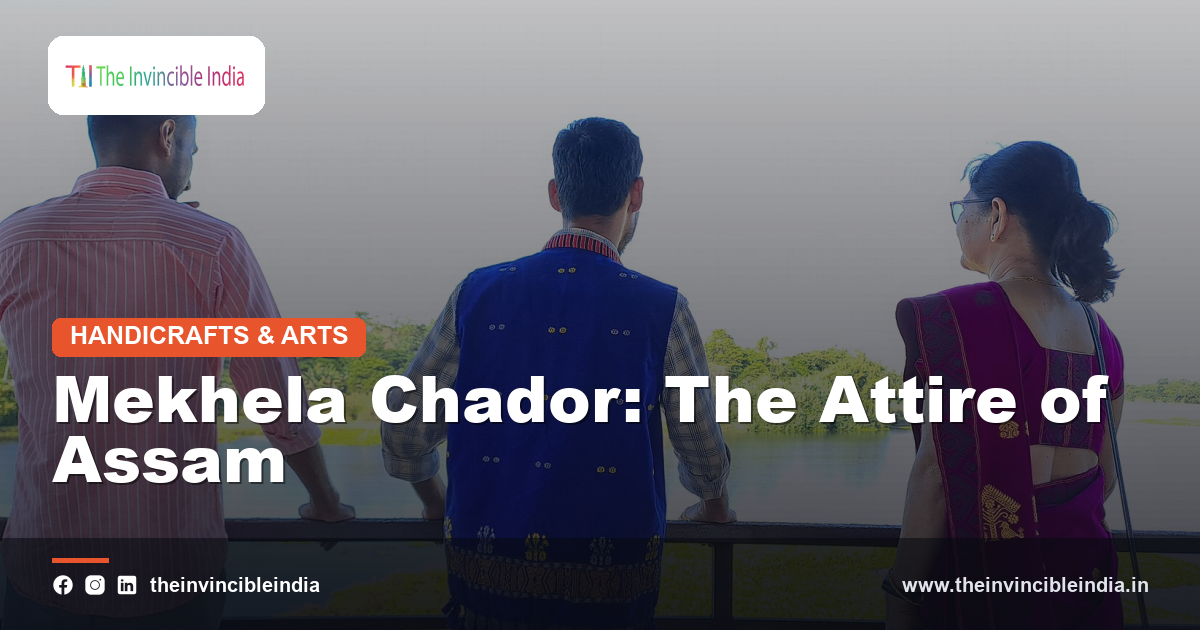
The Mekhela Chador is the traditional two-piece garment worn by Assamese women, consisting of a wraparound lower piece called the mekhela and an upper drape known as the chador, together forming one of the most recognisable regional dress traditions in India. Woven from silks such as muga, paat, and eri, or from cotton for everyday wear, the garment shares a place among India’s distinguished regional silk weaving traditions alongside crafts such as Banarasi silk weaving from Varanasi, though its two-piece draped structure and Assamese weaving techniques set it clearly apart. Deeply tied to festivals such as Bihu and to everyday cultural identity, the Mekhela Chador remains central to how Assamese women express both tradition and personal style.
Quick Facts
| Detail | Information |
|---|---|
| Also Known As | Assamese two-piece attire |
| Primary Region | Assam |
| Garment Pieces | Mekhela (lower), Chador (upper), Riha (optional) |
| Common Fabrics | Muga, paat, eri silk, cotton |
| Key Weaving Centre | Sualkuchi |
| Cultural Occasions | Bihu, weddings, religious ceremonies |
Origins of the Two-Piece Garment
The Mekhela Chador developed as a distinctly Assamese form of women’s dress, evolving over a long period alongside the region’s broader textile traditions and its access to locally produced silks. Its structure as two separate draped pieces, rather than a single continuous cloth, distinguishes it clearly from sarees worn in most other parts of India.
This two-piece format is understood to reflect both practical considerations of movement and comfort in Assam’s climate and the availability of regionally woven silk fabric suited to draping in this particular style. The garment’s distinct construction has remained remarkably consistent over generations even as decorative details have evolved.
Structure: Mekhela, Chador, and Riha
The mekhela is a wide cylindrical piece of fabric wrapped around the lower body and folded into pleats at the waist, secured without stitching or fastening other than careful tucking of the fabric itself. The chador is a separate length of cloth draped over the upper body and tucked into the mekhela at the waist, often arranged so that its decorative border falls visibly across the front and shoulder.
A third piece, known as the riha, is sometimes worn as an additional narrow wrap, particularly in more traditional or ceremonial styling, adding an extra decorative layer to the overall ensemble. Together, these pieces form a complete garment that is assembled anew through draping each time it is worn, requiring practised familiarity with folding and tucking to achieve a neat, secure fit.
Silk Varieties Used in Weaving
Assam’s distinctive silk varieties, including golden muga, fine white paat, and warm-toned eri, are all used in weaving Mekhela Chador garments, each offering different textures, sheens, and price points suited to different occasions. Muga in particular is associated with the most prestigious and ceremonial versions of the garment, while eri is often favoured for its warmth during cooler months.
Cotton versions of the Mekhela Chador are also common for everyday wear, offering greater comfort and affordability while retaining the same fundamental two-piece structure. This range of fabric choices allows the garment to serve both special occasions and daily life across different economic circumstances, from students and office workers to brides preparing for elaborate wedding ceremonies.
Sualkuchi and the Weaving Tradition
Sualkuchi, a town on the banks of the Brahmaputra river, stands as the most prominent centre for weaving fine silk Mekhela Chador sets, home to generations of weaving families specialising in Assam’s various silk varieties. The town’s economy and identity are deeply intertwined with this weaving tradition.
Skilled weavers in Sualkuchi and surrounding areas produce garments ranging from relatively simple everyday pieces to elaborately bordered sets intended for weddings and major festivals, maintaining consistent quality through closely guarded traditional techniques passed down within families.
Border Designs and Motifs
Mekhela Chador garments are typically distinguished by decorative woven borders along the edges of both pieces, featuring traditional Assamese motifs such as stylised floral forms, geometric patterns, and occasionally depictions inspired by local flora and fauna. These borders often represent the most labour-intensive part of the weaving process.
The complexity of border designs can vary considerably, with simpler patterns suited to everyday cotton garments and more elaborate, densely worked borders reserved for silk pieces intended for weddings and significant ceremonies. This range allows weavers to cater to a broad spectrum of occasions and budgets.
Draping Technique and Styling
Wearing a Mekhela Chador involves a specific draping sequence, beginning with wrapping and pleating the mekhela around the waist before draping the chador over the upper body and securing it, often with pins in contemporary practice for added stability. This process differs meaningfully from single-cloth saree draping styles used elsewhere in India.
Regional and personal variations in draping style exist, with some wearers favouring particular pleat arrangements or chador positioning, reflecting both practical preference and subtle markers of local custom. This flexibility within a defined structure allows for individual expression within the broader tradition.
Role in the Bihu Festival
The Mekhela Chador holds particular prominence during Bihu, the major Assamese festival cycle marking key points in the agricultural calendar, when new or specially chosen garments are commonly worn as part of the celebrations. The festival is closely associated with traditional dress as an expression of cultural identity.
Bihu dance performances, in particular, often feature performers wearing Mekhela Chador sets in vibrant colours and detailed borders, reinforcing the garment’s visual association with celebration, music, and community gathering throughout the festival period.
Weddings and Ceremonial Wear
Assamese brides traditionally wear elaborately woven silk Mekhela Chador sets, often in muga silk with intricate borders, as part of wedding ceremonies, reflecting both family tradition and regional cultural expectations. Such garments are frequently preserved as valued family heirlooms after the occasion, sometimes passed on to daughters or granddaughters for their own weddings.
Female guests and family members at weddings and other significant ceremonies also commonly wear Mekhela Chador sets, making the garment a consistent visual marker of formal and celebratory occasions across Assamese social life, with colour and border choice often reflecting the formality of the specific event.
Everyday and Contemporary Use
Beyond festivals and weddings, simpler cotton Mekhela Chador sets remain part of everyday and workplace attire for many Assamese women, particularly in more traditional households and in institutional settings such as schools and government offices. This everyday use has helped sustain the garment’s relevance across generations.
Contemporary designers have also experimented with modern prints, cuts, and pairing the traditional two-piece structure with updated blouse styles, helping the Mekhela Chador remain appealing to younger wearers while preserving its essential form.
Colour Traditions and Symbolism
Traditional Mekhela Chador sets are often woven in cream, white, or naturally toned silk, particularly when using undyed muga or paat silk, reflecting a preference for understated elegance rather than heavily saturated colour. Contrasting coloured borders provide visual definition against these lighter grounds.
More contemporary versions of the garment increasingly experiment with a wider range of colours and printed patterns, expanding the visual vocabulary of the Mekhela Chador while generally retaining its traditional two-piece structure and border-focused design approach.
Artisan Communities and Livelihoods
Weaving Mekhela Chador garments supports a substantial artisan community across Assam, with many households, particularly in and around Sualkuchi, depending on silk weaving as a primary or significant source of income. Women play a central role in many stages of production, from thread preparation to weaving and finishing.
This household-based production model has helped preserve traditional weaving knowledge across generations, though it also means the craft’s economic wellbeing is closely tied to broader market demand for handwoven silk garments, making fair pricing and steady buyer interest important concerns for weaving families.
Government Support and Recognition
State and central government bodies have supported Assam’s silk weaving traditions, including Mekhela Chador production, through sericulture development programmes, weaver training initiatives, and market promotion efforts aimed at both domestic and international buyers. Such support helps sustain traditional weaving livelihoods across generations of household-based weaving families.
Recognition of Assam’s silk varieties, including formal Geographical Indication status for fabrics such as muga silk, indirectly supports the broader Mekhela Chador tradition by protecting the authenticity and reputation of the materials from which these garments are made, giving genuine handwoven pieces a clear market advantage over imitations.
Modern Fashion Adaptations
Contemporary fashion designers have increasingly drawn on the Mekhela Chador as inspiration for modern garments, incorporating its draping principles, border motifs, or silk fabrics into fusion clothing aimed at wider Indian and international markets. This has introduced the garment’s aesthetic to audiences beyond Assam, including through appearances at national fashion showcases and craft exhibitions.
At the same time, many Assamese women continue to favour the traditional two-piece format for significant occasions, valuing its cultural specificity even as fashion more broadly explores adaptations and reinterpretations of its core elements. This coexistence of tradition and experimentation reflects a broader pattern seen across many of India’s regional dress traditions.
Accessories and Complementary Jewellery
A Mekhela Chador ensemble is often completed with traditional Assamese jewellery, including pieces such as the gam kharu bangle and various gold ornaments worked in distinctive regional designs, chosen to complement the garment’s silk texture and border patterns. These accessories play an important role in formal and ceremonial styling.
The pairing of specific jewellery styles with particular occasions, such as more elaborate sets for weddings and simpler pieces for everyday wear, reflects a broader Assamese sense of coordinated traditional dress. This attention to accessorising helps reinforce the Mekhela Chador’s role as part of a complete cultural presentation rather than an isolated garment.
Regional Variations Within Assam
While the core structure of the Mekhela Chador remains consistent across Assam, subtle regional variations exist in border styles, preferred colour combinations, and draping conventions between different districts and communities within the state. These variations often reflect local weaving traditions and available materials.
Such distinctions are generally well understood within Assamese communities, allowing observers familiar with the tradition to recognise regional or community-specific styling cues within an otherwise shared garment format. This capacity for local variation within a unified overall structure illustrates the flexibility of the Mekhela Chador as a living cultural tradition.
Mekhela Chador Today
The Mekhela Chador today remains one of the clearest visual markers of Assamese cultural identity, worn across generations for both everyday life and significant ceremonial occasions. Its continued production depends on the skilled weaving communities that sustain Assam’s distinctive silk traditions.
As long as weaving families in Sualkuchi and beyond continue to produce muga, paat, and eri silk garments in this traditional two-piece form, the Mekhela Chador is likely to remain central to how Assamese women express both heritage and personal identity.
Sources & Further Reading
- Ministry of Textiles, Government of India (texmin.nic.in).
- Ministry of Culture, Government of India (indiaculture.gov.in).
Frequently Asked Questions
What are the two main pieces of a Mekhela Chador?
The mekhela is a wraparound lower garment pleated at the waist, and the chador is a separate upper drape tucked into the mekhela, together forming the complete traditional Assamese attire.
What silks are used for a Mekhela Chador?
Mekhela Chador garments are commonly woven from Assam’s own silk varieties, including golden muga, fine white paat, and warm-toned eri, alongside cotton versions for everyday wear.
When is the Mekhela Chador typically worn?
It is worn during the Bihu festival, weddings, religious ceremonies, and other significant occasions, as well as in simpler cotton versions for everyday and workplace wear.
Where are fine Mekhela Chador sets traditionally woven?
Sualkuchi, a town on the Brahmaputra river, is the most prominent centre for weaving fine silk Mekhela Chador sets in Assam.
Is a riha always worn with a Mekhela Chador?
No, the riha is an optional third piece sometimes added for a more traditional or ceremonial look, but the core garment consists of just the mekhela and chador.


