

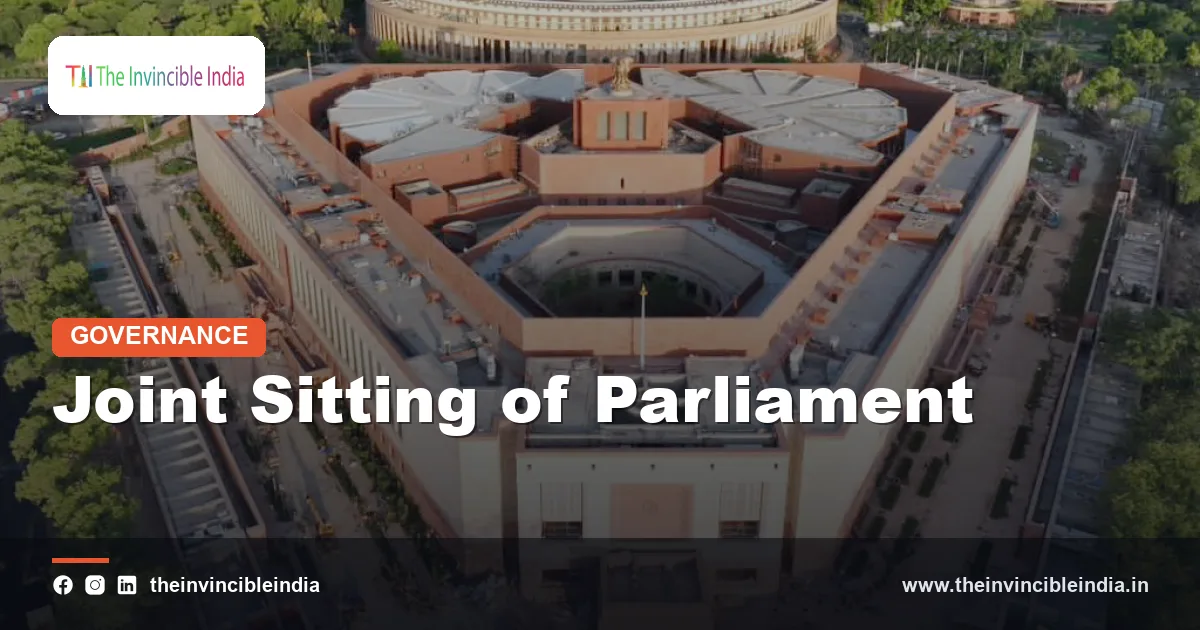
A joint sitting of Parliament is an extraordinary meeting of the Lok Sabha and the Rajya Sabha, held together in one chamber, to resolve a deadlock over an ordinary bill. It is provided for in Article 108 of the Constitution of India and is one of the very few occasions on which members of both Houses vote together as a single body. Since the Constitution came into force, the device has been used only three times.
The rarity of the procedure makes it a favourite topic in civics and competitive examinations, but it also reveals something deeper about the Indian parliamentary system. Parliament is bicameral, yet the two Houses are not equal. The framers built a mechanism that allows the directly elected Lok Sabha, with its larger membership, to prevail over the Rajya Sabha in the end, but only for certain kinds of legislation. This article explains how the provision works, where it does not apply, and the three famous instances.
Quick Facts
| Feature | Details |
|---|---|
| Constitutional provision | Article 108 |
| Purpose | To resolve a deadlock between the two Houses over an ordinary bill |
| Summoned by | The President of India |
| Presiding officer | The Speaker of the Lok Sabha |
| Decision rule | Majority of the total members of both Houses present and voting |
| Not applicable to | Money Bills and Constitution Amendment Bills |
| Times held so far | Three: 1961, 1978 and 2002 |
| Bills passed this way | Dowry Prohibition Bill, Banking Service Commission (Repeal) Bill, Prevention of Terrorism Bill |
The Bicameral Structure Behind the Provision
Parliament of India consists of the President, the Lok Sabha and the Rajya Sabha. The Lok Sabha, the House of the People, is directly elected and can have up to 550 members under the Constitution, of whom 530 represent States and up to 20 represent Union Territories; its actual strength has been 543 for several decades. The Rajya Sabha, the Council of States, can have up to 250 members, of whom up to 12 are nominated by the President for their expertise in literature, science, art and social service, while the rest are chosen by elected members of State Legislative Assemblies. The Rajya Sabha is a permanent House and is not dissolved, with one-third of its members retiring every two years.
A bill other than a Money Bill generally needs to pass both Houses before it goes to the President for assent. This creates the possibility of disagreement, especially when the government of the day commands a majority in the Lok Sabha but not in the Rajya Sabha. The Constituent Assembly was aware of this and borrowed the idea of a joint sitting for deadlock-breaking from the Constitution of Australia, which has a comparable provision. Article 108 is the Indian adaptation.
What Article 108 Says
Article 108 applies when a bill has been passed by one House and transmitted to the other. It lays down three situations in which the President may step in:
- The bill is rejected by the other House.
- The Houses have finally disagreed as to the amendments to be made in the bill.
- More than six months have elapsed from the date of the receipt of the bill by the other House without the bill being passed by it.
In any of these cases, the President may, unless the bill has already lapsed because of a dissolution of the Lok Sabha, notify the Houses by message, if they are in session, or by public notification, if they are not, of his intention to summon them to meet in a joint sitting for the purpose of deliberating and voting on the bill.
How the Six Months Are Counted
In calculating the period of six months mentioned above, no account is taken of any period during which the other House is prorogued or adjourned for more than four consecutive days. This prevents a House from being penalised for time during which it could not have considered the bill at all.
The Role of the President
The President acts on the advice of the Council of Ministers in this matter, as in most others. In practice, therefore, it is the government that decides whether to seek a joint sitting. The notification is the formal trigger, and once the notice is given, neither House may proceed further with the bill.
Who Presides and How the Sitting Is Run
The presiding officer of a joint sitting is the Speaker of the Lok Sabha. Article 118(4) provides that if the Speaker is absent, the Deputy Speaker of the Lok Sabha presides. If the Deputy Speaker is also absent, the Deputy Chairman of the Rajya Sabha takes the chair, and failing him, such other person as may be determined by the members present at the sitting. Importantly, the Chairman of the Rajya Sabha, who is the Vice-President of India, does not preside over a joint sitting.
The procedure follows the rules of procedure of the Lok Sabha, with such adaptations and modifications as the Speaker may make. The sitting is normally held in the Central Hall of Parliament House or in the Lok Sabha chamber, since the combined membership of the two Houses runs well beyond what the Rajya Sabha chamber can hold. Article 118 empowers the President, after consulting the Chairman and the Speaker, to make rules for the joint sitting.
A key restriction applies to the business at a joint sitting. No new amendments may be proposed except those that have become necessary due to the delay in the passage of the bill, and amendments that were the subject of disagreement between the Houses. The Speaker decides what amendments are admissible, and that decision is final. The joint sitting thus deals only with the particular bill and not with general legislative business.
How the Decision Is Made
Article 108(4) states that at the joint sitting, the bill, with such amendments, if any, as are agreed to, shall be deemed to be passed by both Houses if it is passed by a majority of the total number of members of both Houses present and voting. This is a simple majority of those present and voting. There is no requirement for a special majority such as two-thirds.
The arithmetic matters. At a joint sitting, the combined strength of both Houses is a little over 780 members. Since the Lok Sabha accounts for roughly two-thirds of that figure, a government or coalition that commands a clear majority in the Lok Sabha is placed to win a joint sitting, even when it lacks a majority in the Rajya Sabha. Critics sometimes describe the mechanism as a conditional supremacy of the Lok Sabha. Supporters argue that this is consistent with the principle that the House directly elected by the people should have the last word on ordinary legislation.
Another provision, Article 108(5), is notable: a joint sitting may be held and the bill may be passed at it, even after the Lok Sabha has been dissolved, provided the President had already notified his intention to summon the joint sitting before the dissolution. Without this saving clause, a pending dispute might disappear merely because of an election.
Bills Where a Joint Sitting Is Not Available
The joint sitting is limited to ordinary bills, and, by interpretation, financial bills that are not Money Bills. Two categories are excluded by the Constitution itself.
Money Bills
Under Article 109, a Money Bill can be introduced only in the Lok Sabha. After the Lok Sabha passes it, the Bill is sent to the Rajya Sabha, which may only make recommendations. The Rajya Sabha has fourteen days to return the Bill. If it does not return it within that time, the Bill is deemed to have been passed by both Houses in the form in which the Lok Sabha passed it. The Lok Sabha may accept or reject any recommendation. There is no possibility of deadlock, so there is no need for a joint sitting. Article 110 defines what counts as a Money Bill, and the Speaker’s certificate on this question is final.
Constitution Amendment Bills
A Bill to amend the Constitution under Article 368 must be passed by each House separately, by a majority of the total membership of that House and by a majority of not less than two-thirds of the members of that House present and voting. Where an amendment affects the federal structure, ratification by at least half of the State legislatures is also needed. Because the Constitution requires each House to pass such a Bill in its own right, the joint sitting cannot be used. This ensures that the Rajya Sabha, as the representative of the States, retains a real veto over constitutional changes.
Bills That Have Lapsed
If a bill has lapsed on the dissolution of the Lok Sabha, the joint sitting cannot be used for it, unless the President has already notified the sitting, as explained above.
Why the Framers Included Article 108
The Constituent Assembly considered the role of a second chamber with great care. Some members feared that a Council of States with equal powers would obstruct reform, while others feared that a weak second chamber would not give the States a meaningful voice. The compromise was an arrangement that distinguishes between the types of legislation.
- For Money Bills, the Lok Sabha has overwhelming authority.
- For ordinary bills, the two Houses are, in principle, equal, but an ultimate resolution of deadlock is available through the joint sitting.
- For Constitution Amendment Bills, the Houses are equal and there is no deadlock-breaking device, so the consent of both is indispensable.
The system reflects the principle of responsible government. The Council of Ministers is collectively responsible to the Lok Sabha, not to the Rajya Sabha, so it is logical that the Lok Sabha’s view should in the end prevail on ordinary legislation, where the government’s programme is at stake.
The First Joint Sitting: Dowry Prohibition Bill, 1961
The first joint sitting was held on 6 May 1961 over the Dowry Prohibition Bill. The Bill sought to prohibit the giving and taking of dowry, an important social reform measure. The Lok Sabha and the Rajya Sabha disagreed on amendments to the Bill, and the dispute could not be settled through the usual process of messages between the Houses. The President summoned a joint sitting under Article 108.
At the sitting, the amendments on which the Houses had disagreed were discussed and put to the vote, and the Bill, as finally agreed, was passed. It received the President’s assent and became the Dowry Prohibition Act, 1961. The Act has since been amended in later years to strengthen its provisions, and later provisions of criminal law have also addressed dowry-related offences.
The 1961 episode is useful as a model of a joint sitting called not because the Rajya Sabha rejected a Bill outright, but because the Houses differed on amendments. It also shows that the mechanism is not inherently confrontational: the issue was social reform rather than a partisan fight.
The Second Joint Sitting: Banking Service Commission (Repeal) Bill, 1978
The second joint sitting took place on 16 May 1978. It concerned the Banking Service Commission (Repeal) Bill, which sought to repeal the Banking Service Commission Act, 1975, under which a central commission had been set up to handle recruitment to the public sector banks. The Janata Party government of the time wished to repeal that Act, and the Bill was passed by the Lok Sabha but was not agreed to by the Rajya Sabha.
After the Rajya Sabha rejected the Bill, the President summoned the Houses to a joint sitting. At that sitting, the Bill was passed by a majority, and it became law. The incident illustrates the intended function of Article 108: a government commanding a majority in the Lok Sabha but facing a hostile majority in the Rajya Sabha can still legislate on ordinary matters if it chooses to go through the joint sitting procedure.
The Third Joint Sitting: Prevention of Terrorism Bill, 2002
The most widely remembered joint sitting was held on 26 March 2002 for the Prevention of Terrorism Bill, 2002, which became the Prevention of Terrorism Act, commonly known as POTA. The Bill was introduced in the wake of concerns about terrorism and was passed by the Lok Sabha. The Rajya Sabha rejected it, and the government sought a joint sitting.
The Bill was passed by a majority of the members present and voting at the joint sitting. It was a contentious measure, because the provisions on detention, admissibility of certain confessions and the burden of proof drew criticism from civil liberties groups and opposition parties. The Act was subsequently repealed in 2004 by Parliament, after a change of government, which illustrates a general point: a law passed through a joint sitting is as valid as any other law, but it can be repealed through ordinary legislative procedure.
Summary of the Three Instances
| Year | Bill | Reason for Deadlock | Outcome |
|---|---|---|---|
| 1961 | Dowry Prohibition Bill | Disagreement over amendments | Passed; became the Dowry Prohibition Act, 1961 |
| 1978 | Banking Service Commission (Repeal) Bill | Rajya Sabha did not agree to the Bill | Passed at joint sitting |
| 2002 | Prevention of Terrorism Bill | Rajya Sabha rejected the Bill | Passed; the Act was later repealed in 2004 |
Joint Sitting versus Joint Session and Other Terms
The term joint sitting is sometimes confused with other occasions on which both Houses meet together. Careful distinction is needed.
- Address by the President. Under Article 87, the President addresses both Houses assembled together at the commencement of the first session after each general election to the Lok Sabha and at the commencement of the first session of each year. This is a ceremonial address and not a legislative sitting.
- Joint sitting under Article 108. This is a legislative device for resolving a deadlock on a bill.
- Election of the President. The members of both Houses and of State Legislative Assemblies form the Electoral College, but they do not meet together. They vote in separate locations.
- Election of the Vice-President. Members of both Houses vote at a single election, but it is an election, not a sitting for the transaction of legislative business.
States with two Houses have no equivalent mechanism. In a State Legislature, the Legislative Assembly has the upper hand in the end, and the Legislative Council can delay a bill but cannot block it permanently, so a joint sitting is unnecessary.
Significance and Limitations
The joint sitting is a safety valve. Its existence discourages obstruction, since a determined government can eventually legislate. Yet, it has been used only three times in more than seven decades, which suggests that governments have preferred negotiation, compromise and committee consideration to a confrontational showdown.
There are limitations as well. The procedure is available only for ordinary bills. It can be used only when the government commands a clear majority in the Lok Sabha, since otherwise the outcome would be uncertain. It requires time and political capital, and it can attract public criticism if the measure is controversial. Finally, the Rajya Sabha’s role as a forum for deliberation, where members with experience and expertise can scrutinise bills, may be diluted when a bill is pushed through a joint sitting, as the full Rajya Sabha debate is not repeated in the same manner.
Conclusion
Article 108 shows how the Constitution tried to reconcile two aims: giving the States a voice through the Rajya Sabha, and ensuring that the elected government can enact its programme. The joint sitting is a rare procedure, summoned by the President, presided over by the Speaker and decided by a simple majority of members present and voting. It does not apply to Money Bills or Constitution Amendment Bills. Its three uses in 1961, 1978 and 2002 remain landmarks in the working of Indian Parliament.
Frequently Asked Questions
What is a joint sitting of Parliament?
It is a meeting of the Lok Sabha and the Rajya Sabha held together to resolve a deadlock over an ordinary bill, as provided in Article 108 of the Constitution. The President summons it, and members of both Houses deliberate and vote on the bill together.
Who presides over a joint sitting?
The Speaker of the Lok Sabha presides. In the Speaker’s absence, the Deputy Speaker presides, followed by the Deputy Chairman of the Rajya Sabha. The Chairman of the Rajya Sabha, who is the Vice-President, does not preside over a joint sitting.
How is a bill decided at a joint sitting?
The bill is deemed passed if it is approved by a majority of the total number of members of both Houses present and voting. Because the Lok Sabha has far more members than the Rajya Sabha, a government with a clear Lok Sabha majority is well placed to carry the vote.
Which bills cannot be taken to a joint sitting?
Money Bills and Bills to amend the Constitution cannot be taken to a joint sitting. A Money Bill is deemed passed after fourteen days if the Rajya Sabha does not return it, and a Constitution Amendment Bill must be passed by each House separately by the special majority required under Article 368.
How many times has a joint sitting been held in India?
A joint sitting has been held three times. These were for the Dowry Prohibition Bill in 1961, the Banking Service Commission (Repeal) Bill in 1978, and the Prevention of Terrorism Bill in 2002.
Can a joint sitting be held after the Lok Sabha is dissolved?
Yes, but only if the President had notified his intention to summon the joint sitting before the dissolution. Article 108(5) allows the sitting to proceed and the bill to be passed in such a case. Otherwise, a bill pending in the Lok Sabha would lapse on dissolution.
{“@context”:”https://schema.org”,”@graph”:[{“@type”:”FAQPage”,”mainEntity”:[{“@type”:”Question”,”name”:”What is a joint sitting of Parliament?”,”acceptedAnswer”:{“@type”:”Answer”,”text”:”It is a meeting of the Lok Sabha and the Rajya Sabha held together to resolve a deadlock over an ordinary bill, as provided in Article 108 of the Constitution. The President summons it, and members of both Houses deliberate and vote on the bill together.”}},{“@type”:”Question”,”name”:”Who presides over a joint sitting?”,”acceptedAnswer”:{“@type”:”Answer”,”text”:”The Speaker of the Lok Sabha presides. In the Speaker’s absence, the Deputy Speaker presides, followed by the Deputy Chairman of the Rajya Sabha. The Chairman of the Rajya Sabha, who is the Vice-President, does not preside over a joint sitting.”}},{“@type”:”Question”,”name”:”How is a bill decided at a joint sitting?”,”acceptedAnswer”:{“@type”:”Answer”,”text”:”The bill is deemed passed if it is approved by a majority of the total number of members of both Houses present and voting. Because the Lok Sabha has far more members than the Rajya Sabha, a government with a clear Lok Sabha majority is well placed to carry the vote.”}},{“@type”:”Question”,”name”:”Which bills cannot be taken to a joint sitting?”,”acceptedAnswer”:{“@type”:”Answer”,”text”:”Money Bills and Bills to amend the Constitution cannot be taken to a joint sitting. A Money Bill is deemed passed after fourteen days if the Rajya Sabha does not return it, and a Constitution Amendment Bill must be passed by each House separately by the special majority required under Article 368.”}},{“@type”:”Question”,”name”:”How many times has a joint sitting been held in India?”,”acceptedAnswer”:{“@type”:”Answer”,”text”:”A joint sitting has been held three times. These were for the Dowry Prohibition Bill in 1961, the Banking Service Commission (Repeal) Bill in 1978, and the Prevention of Terrorism Bill in 2002.”}},{“@type”:”Question”,”name”:”Can a joint sitting be held after the Lok Sabha is dissolved?”,”acceptedAnswer”:{“@type”:”Answer”,”text”:”Yes, but only if the President had notified his intention to summon the joint sitting before the dissolution. Article 108(5) allows the sitting to proceed and the bill to be passed in such a case. Otherwise, a bill pending in the Lok Sabha would lapse on dissolution.”}}]}]}


