

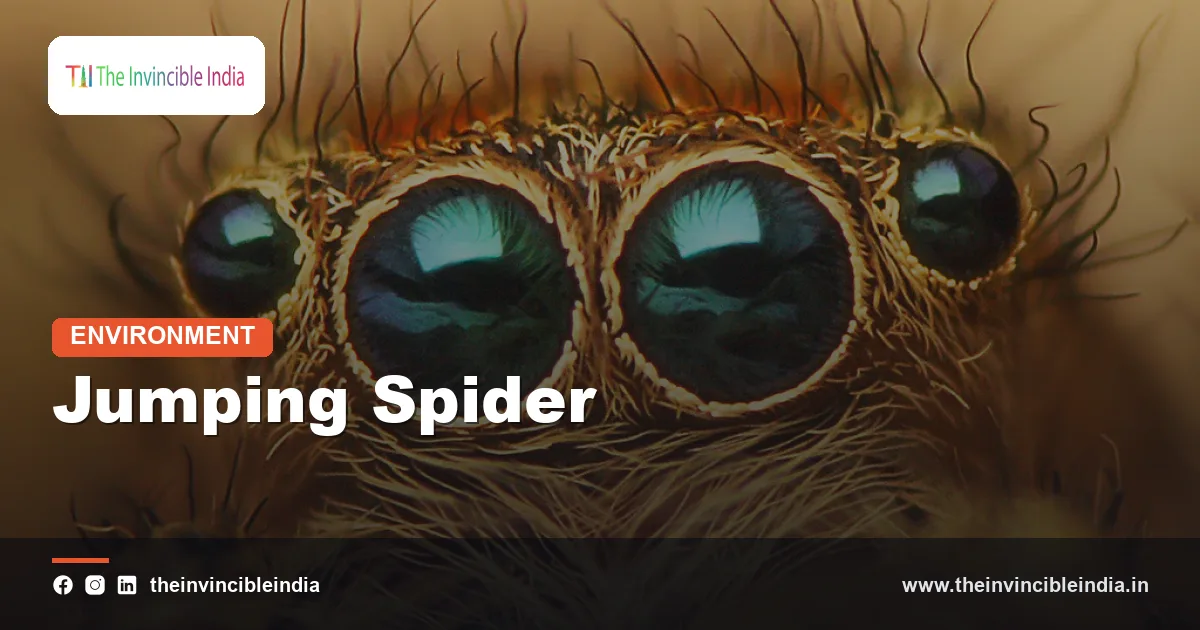
A jumping spider is a small, big-eyed spider of the family Salticidae that hunts by stalking its prey and pouncing on it, rather than trapping it in a web. Jumping spiders are found across India, from city flats and garden walls to forest leaf litter and mountain slopes, and they are harmless to people.
These compact, curious spiders have the sharpest eyesight of any spider group, perform elaborate courtship dances and quietly keep household insects in check. This explainer describes what jumping spiders in India are, how they see and jump, what they eat, how they breed and why a bite is not a concern. It was last reviewed on 23 October 2026.
| Quick Fact | Detail |
|---|---|
| Scientific family | Salticidae (order Araneae, class Arachnida) |
| Place in the spider world | The largest spider family, with well over 6,000 described species worldwide |
| Typical body length | Roughly 3 to 15 millimetres for most Indian species; a few reach about 20 millimetres |
| Number of eyes | Eight, with two very large forward-facing principal eyes |
| Hunting style | Active, visual stalking and pouncing; no capture web |
| Common Indian examples | Plexippus paykulli, Hasarius adansoni, Menemerus bivittatus, Hyllus semicupreus, Telamonia dimidiata, ant-mimicking Myrmarachne species |
| Danger to humans | Not medically significant; bites are rare and mild |
| Typical lifespan | About one year for most small species |
| Habitat in India | Walls, windows, gardens, trees, crops, forests and grasslands |
Key Takeaways
- Jumping spiders belong to the family Salticidae, the largest family of spiders in the world, and many species live across India.
- A jumping spider catches prey by sight, creeping close and leaping, and does not use a web to trap insects.
- The two large front eyes of a jumping spider give it the sharpest vision among spiders, including colour vision.
- Jumping spiders jump by suddenly raising the blood pressure in their legs and also trail a silk safety line, called a dragline, when they leap.
- Jumping spiders are harmless to humans, as bites are rare, mild and not medically significant.
- Jumping spiders help control flies, mosquitoes, moths and other small insects in homes and gardens.
What is a jumping spider?
A jumping spider is any member of the spider family Salticidae, a group defined by its distinctive eye arrangement and its habit of leaping onto prey. Like all spiders, jumping spiders are arachnids, so they have eight legs and two main body parts, not the three of an insect. Their front part, the cephalothorax, carries the legs and eyes, while the rear abdomen holds the silk glands.
The family is enormous. Scientists have described several hundred genera and thousands of species worldwide, and new ones are still being named. India hosts a large and still-studied jumping spider fauna, with numerous species recorded from the Western Ghats, the Himalayan foothills, the north-east and the plains. The exact Indian count keeps changing as surveys continue, so it is safest to say that India has many species rather than quoting a fixed number.
Most jumping spiders are small and hairy, with a stocky body and short legs. Many are patterned in brown, grey and black, while some have iridescent scales that flash green, blue or copper in the light.
How well can a jumping spider see?
A jumping spider sees far better than any other spider, with vision sharp enough to recognise prey, rivals and mates from several body lengths away. Its eight eyes are arranged in a pattern that gives almost all-round awareness. Two big principal eyes face forward and provide detailed, high-resolution images, while the other six smaller eyes sit on the sides and top of the head and mainly detect movement.
The principal eyes have long internal tubes with a narrow field of view, and tiny muscles move the retina behind the lens, so the spider can scan a scene without turning its whole body. Researchers have shown that jumping spiders can distinguish colours, and some species also respond to ultraviolet light. This helps them judge whether a moving shape is food, a threat or a potential partner.
Because the vision is so central to their lifestyle, jumping spiders are active mostly in daylight. At night they rest in small silk retreats.
How does a jumping spider jump?
A jumping spider jumps mainly by hydraulic pressure, rapidly forcing blood fluid (haemolymph) into its hind legs so that they straighten like tiny springs. Spiders have muscles that bend their legs but weak extensor muscles for straightening them, so they use fluid pressure to do the extending. The result is a powerful, fast leap that carries the spider many times its own body length.
Before leaping, the spider usually fixes a silk dragline to the surface it is standing on. This thread works like a climbing safety rope. If the spider misses its target or falls, it simply dangles on the line and climbs back up.
The jump is also precise. The spider lines up its principal eyes on the target first, judges the distance by comparing the images, then launches. Researchers have found that jumping spiders judge distance partly by the blur patterns formed in their retina, an unusual way of measuring depth.
What does a jumping spider eat?
A jumping spider eats small living animals, mostly insects such as flies, mosquitoes, small moths, ants, aphids and other spiders. It does not wait in a web. Instead it spots a target, turns to face it, slowly approaches and makes a final short leap to seize it with its front legs and fangs.
After the catch, the spider injects venom through its fangs that quickly immobilises the victim, then digests it externally and sucks up the liquefied contents. The venom is adapted for small insects and has no meaningful effect on people.
Some jumping spiders have unusual diets. Certain species are ant mimics that avoid ants and eat other small prey, and a few jumping spiders worldwide hunt other spiders. Many also drink nectar, so their role in an ecosystem is wider than predation alone.
What do jumping spiders look like in India?
Jumping spiders in India vary widely in colour and form, but they are nearly all recognisable by their boxy front, large forward-facing eyes and short, strong legs. Common species include the following.
- Plexippus paykulli: a grey-and-white striped jumping spider often seen on walls and ceilings in houses across tropical regions, including India.
- Hasarius adansoni: a small dark spider whose males have bright white markings on the front legs, commonly found indoors and in greenhouses.
- Menemerus bivittatus: a flat, grey wall-dwelling species that rests in cracks and window frames.
- Hyllus semicupreus: a larger, boldly marked species of gardens and tree trunks, among the more conspicuous Indian jumpers.
- Telamonia dimidiata: a striking species with bold stripes, found on foliage.
- Myrmarachne species: slender ant mimics that walk and wave their front legs to resemble ants.
Species identification usually needs a close look or a photograph, so common names vary by region and are not always consistent.
How do jumping spiders mate and raise young?
Jumping spiders mate after a courtship display in which the male uses movement and, in many species, bright colours to show a female that he is a suitable partner and not prey. Males wave their legs, raise their front appendages, zigzag and may produce tiny vibrations in the surface they stand on. Females watch these dances closely and either accept or reject the male.
The dances matter because females are often larger than males and may attack a suitor who gets the signal wrong. In many species the quality of the display tells the female about the male’s health and fitness.
After mating, the female lays eggs in a small silk nest, often hidden in a rolled leaf, behind a picture frame or in a crevice. She usually guards the nest until the spiderlings hatch. The young look like miniature adults and grow by moulting their skeleton several times. Most small species live about a year, though larger ones can live longer.
Is a jumping spider dangerous to humans?
A jumping spider is not dangerous to humans, and its bite is rare, mild and not medically significant. Jumping spiders are shy and tend to run, jump away or hide when approached. They bite only if they are squeezed or trapped against the skin.
Their fangs are small, and any bite is usually described as a slight pinprick, sometimes with minor local redness that fades quickly. No Indian jumping spider is known to cause serious illness.
If a bite does occur, the usual advice for minor bites applies.
- Wash the area with soap and water.
- Apply a cold compress if there is any swelling.
- Seek medical advice if redness spreads, pain grows or an allergic reaction appears.
It is best to gently guide a spider outdoors with a cup and a piece of card rather than crush it.
What role do jumping spiders play in the ecosystem?
Jumping spiders play a useful role as predators of small insects, which helps keep populations of flies, mosquitoes, moths and plant pests in balance. Because they hunt individually and in daylight, they act as a natural pest-control service in homes, kitchen gardens and farmland. They in turn become food for birds, lizards such as geckos and wasps that hunt spiders.
Spiders as a group are valued in agriculture because they eat many crop-damaging insects. Salticids are not the main drivers of pest control in a field, but they add to the diversity of predators that limit outbreaks.
Their presence also signals a reasonably healthy habitat. A garden with many jumping spiders usually has a mix of plants and insects for them to live on. Overuse of insecticides can reduce spider numbers.
How are jumping spiders different from other Indian spiders?
Jumping spiders differ from other Indian spiders in how they hunt, how they see and how they move. The table compares them with two other familiar groups.
| Feature | Jumping spider | Wolf spider | Orb-weaver |
|---|---|---|---|
| Family | Salticidae | Lycosidae | Araneidae |
| Hunting method | Stalks and pounces by day | Chases prey on the ground | Waits in a wheel-shaped web |
| Eyes | Two very large front eyes plus six small ones | Two large eyes among eight, in three rows | Eight small eyes with weak sight |
| Web for prey | None | None, though some species use silk | Large, built daily or regularly |
| Usual activity | Daytime | Mostly night, some day | Day and night |
| Bite risk to people | Negligible | Mild, painful only locally | Negligible |
Jumping spiders also tend to be much smaller than wolf spiders and are notable for the way they turn their heads and look at an observer, which gives them an almost curious appearance.
How can you live with jumping spiders at home?
Living with jumping spiders at home is easy because they stay small, avoid people and eat household insects. The simplest approach is to leave them alone, since they do not damage property or food.
If a spider is in an unwanted spot, a few harmless steps work well.
- Cover it with a transparent cup, slide a card underneath and release it on a plant outdoors.
- Seal gaps in window frames and doors if entry points need to be limited.
- Reduce the insects that attract spiders by keeping lights off near open windows at night and by managing waste.
- Avoid broad insecticide sprays, which can harm helpful insects and spiders alike.
Children can learn a great deal by watching a jumping spider, since it will often turn and look back at the observer. Photography enthusiasts in India also enjoy macro images of their large, shiny eyes.
Why do jumping spiders matter to researchers and photographers?
Jumping spiders matter to researchers because their small brains handle surprisingly complex visual tasks, such as recognising prey, judging distance and planning a route around obstacles. Scientists study them to understand how a tiny nervous system can produce flexible, almost cognitive behaviour.
They are also favourites of macro photographers. Their large, forward-facing eyes, expressive postures and habit of turning to face the camera make them easy subjects to photograph with a simple close-up lens. Citizen-science platforms in India regularly receive jumping spider photographs, which helps experts record where different species occur and how they vary in colour and pattern.
Careful observation is the best contribution a non-specialist can make. Note the place, the date and the host plant or surface, and take clear photographs from above and from the front.
Bottom Line
The jumping spider is among the most capable and charming small predators in Indian homes and gardens. It hunts with sharp vision and a precise leap, uses silk only for safety lines and shelters, and poses no real risk to people. Leaving it in place is usually the best choice, since it quietly removes the insects that people often want gone.
Frequently Asked Questions
Are jumping spiders poisonous or dangerous in India?
No, jumping spiders in India are not dangerous to people. Their venom is tuned to subdue tiny insects, and a bite from a human-handled spider is rare and mild. At most it causes slight redness or a pinprick sensation that fades quickly.
How far can a jumping spider jump?
A jumping spider can leap many times its own body length, depending on the species and the surface. The jump is powered by sudden fluid pressure in the legs rather than strong muscles. The spider also attaches a silk dragline so it can catch itself if it misses.
Do jumping spiders make webs?
No, jumping spiders do not make webs to catch prey. They hunt actively by sight and use silk only for draglines, resting retreats and egg nests. This is the main difference between them and web-building spiders such as orb-weavers.
Why do jumping spiders look at you?
Jumping spiders turn to look at people because their large forward-facing eyes are built to track moving objects, and a human is a large moving shape to examine. The spider is judging whether you are a threat, not showing affection. Most simply flee or hide if you approach too close.
What do jumping spiders eat?
Jumping spiders eat small insects and other spiders, including flies, mosquitoes, moths, ants and aphids. They stalk the prey, leap onto it and use a fast-acting venom to subdue it. Many species also take nectar from flowers.
How long do jumping spiders live?
Most small jumping spiders live for about a year, although lifespan varies with species and conditions. They grow through several moults, mature, mate and lay eggs during that time. Larger species may live somewhat longer.
{“@context”:”https://schema.org”,”@graph”:[{“@type”:”FAQPage”,”mainEntity”:[{“@type”:”Question”,”name”:”Are jumping spiders poisonous or dangerous in India?”,”acceptedAnswer”:{“@type”:”Answer”,”text”:”No, jumping spiders in India are not dangerous to people. Their venom is tuned to subdue tiny insects, and a bite from a human-handled spider is rare and mild. At most it causes slight redness or a pinprick sensation that fades quickly.”}},{“@type”:”Question”,”name”:”How far can a jumping spider jump?”,”acceptedAnswer”:{“@type”:”Answer”,”text”:”A jumping spider can leap many times its own body length, depending on the species and the surface. The jump is powered by sudden fluid pressure in the legs rather than strong muscles. The spider also attaches a silk dragline so it can catch itself if it misses.”}},{“@type”:”Question”,”name”:”Do jumping spiders make webs?”,”acceptedAnswer”:{“@type”:”Answer”,”text”:”No, jumping spiders do not make webs to catch prey. They hunt actively by sight and use silk only for draglines, resting retreats and egg nests. This is the main difference between them and web-building spiders such as orb-weavers.”}},{“@type”:”Question”,”name”:”Why do jumping spiders look at you?”,”acceptedAnswer”:{“@type”:”Answer”,”text”:”Jumping spiders turn to look at people because their large forward-facing eyes are built to track moving objects, and a human is a large moving shape to examine. The spider is judging whether you are a threat, not showing affection. Most simply flee or hide if you approach too close.”}},{“@type”:”Question”,”name”:”What do jumping spiders eat?”,”acceptedAnswer”:{“@type”:”Answer”,”text”:”Jumping spiders eat small insects and other spiders, including flies, mosquitoes, moths, ants and aphids. They stalk the prey, leap onto it and use a fast-acting venom to subdue it. Many species also take nectar from flowers.”}},{“@type”:”Question”,”name”:”How long do jumping spiders live?”,”acceptedAnswer”:{“@type”:”Answer”,”text”:”Most small jumping spiders live for about a year, although lifespan varies with species and conditions. They grow through several moults, mature, mate and lay eggs during that time. Larger species may live somewhat longer.”}}]}]}


