

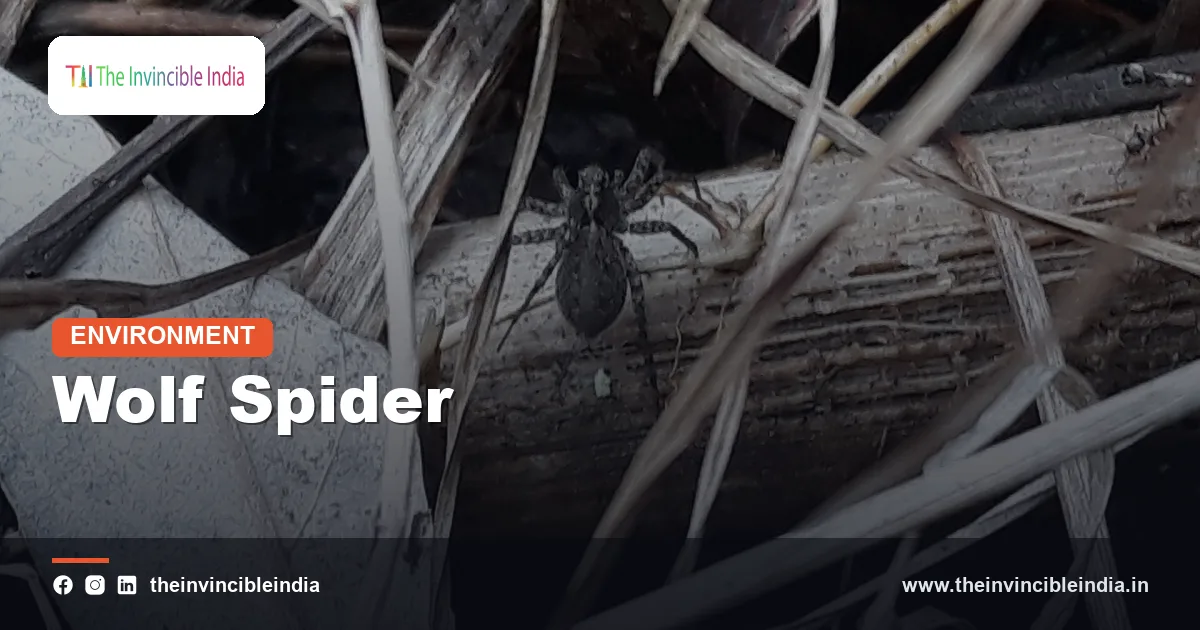
A wolf spider is a robust, fast-moving ground spider of the family Lycosidae that hunts by chasing and ambushing prey instead of spinning a web to snare it. Wolf spiders live throughout India in fields, gardens, grasslands, forest floors and the edges of rice paddies, and they are not dangerous to people.
The family is best known for its mothers, which carry their egg sacs and later their newly hatched babies on their own bodies. This explainer covers what wolf spiders in India are, how they hunt, how they look, how they raise their young, how they differ from similar-looking spiders and what to do if one bites. It was last reviewed on 23 October 2026.
| Quick Fact | Detail |
|---|---|
| Scientific family | Lycosidae (order Araneae, class Arachnida) |
| Worldwide diversity | Over 2,000 described species, found on every continent except Antarctica |
| Typical body length | About 5 to 30 millimetres, depending on species |
| Eye pattern | Eight eyes in three rows: four small below, two large in the middle, two medium on top |
| Hunting style | Active ground hunter; chases or ambushes prey, mostly at night |
| Notable maternal behaviour | Female carries the egg sac on her spinnerets, then carries spiderlings on her abdomen |
| Common Indian genera | Hogna, Pardosa, Lycosa, Hippasa, Arctosa and others |
| Danger to humans | Not medically significant; a bite can be locally painful but is not dangerous |
| Typical lifespan | Around one to two years for many species |
Key Takeaways
- Wolf spiders belong to the family Lycosidae, which has more than 2,000 described species worldwide and many representatives in India.
- A wolf spider hunts on the ground by chasing or pouncing on prey and does not rely on a capture web.
- A female wolf spider carries her egg sac attached to her spinnerets and, after hatching, carries the spiderlings on her back.
- Wolf spiders have eyes that reflect torchlight, so the spiders appear as tiny glowing dots in a garden at night.
- Wolf spiders are not dangerous to humans, and their bites cause only local pain or mild swelling in most cases.
- Wolf spiders eat many crop and household insects and are valued as predators in Asian rice fields.
What is a wolf spider?
A wolf spider is a member of the family Lycosidae, a large group of ground-dwelling hunting spiders named for the old idea that they pursue prey like a wolf pack. Wolf spiders are arachnids with eight legs and two body segments, and most are brown, grey or black with striped or mottled patterns that blend into soil, bark and dry leaves.
The family is found almost worldwide, from deserts to wetlands and cold mountains. In India, wolf spiders occur from Himalayan meadows to coastal plains and from desert scrub to rainforest floor. Taxonomists keep revising the Indian list, so the number of species recorded in the country changes as new surveys appear.
The term "wolf spider" covers many species, and the common name does not point to a single animal. Size ranges from the small Pardosa species that dart through grass to large Hogna and Lycosa species that sit near burrow entrances.
How does a wolf spider hunt?
A wolf spider hunts by using speed, good eyesight and sensitivity to vibration to catch insects on the ground, usually by chasing them or ambushing them from a hiding spot. It does not build a snare web to trap prey. Many species hunt mainly at night, although small Pardosa species are often active in daylight.
Wolf spiders have well-developed eyesight compared with most web-building spiders, and their large middle eyes can detect movement and shape. Hairs on the legs sense ground vibrations, so the spider can detect approaching prey even in the dark.
Once close, the wolf spider rushes forward, grips the prey with its legs and bites with its fangs. The venom is meant for small animals. The spider then liquefies the meal with digestive fluid and drinks it.
Some species live in silk-lined burrows and wait near the entrance. Others wander freely and rest in leaf litter or under stones during the day.
What does a wolf spider look like?
A wolf spider has a sturdy, hairy body, fairly long legs and a distinctive arrangement of eyes that sets it apart from most other spiders. The eyes form three rows: a bottom row of four small eyes, a middle row of two very large eyes facing forward, and a top row of two medium eyes looking up and to the sides.
Colouring is usually dull. Brown, grey, tan and black stripes or blotches help the spider hide against the ground. A pale stripe often runs down the centre of the front body part, called the carapace.
Size varies. Adult females are generally larger than males, and some Indian species have a body length of two to three centimetres, which can look intimidating to people who are unfamiliar with them. Despite their size, they are shy and normally avoid humans.
One useful test is the eyes. Under torchlight, wolf spiders show a bright green or blue-white reflection because of a mirror-like layer behind the eyes, which makes them easy to spot at night.
How do wolf spiders raise their young?
A female wolf spider raises her young by carrying the egg sac with her and then carrying the newly hatched spiderlings on her back until they can fend for themselves. This is among the most distinctive parental behaviours in spiders.
Egg sac
After mating, the female spins a round silk egg sac and attaches it to her spinnerets, the silk-spinning organs at the tip of her abdomen. She drags the sac behind her as she moves and may bask in a sunny spot to keep the eggs warm. If she loses the sac, she will often search for it persistently.
Spiderlings on the abdomen
When the eggs hatch, the female helps open the sac. The spiderlings climb onto her abdomen and hold on to special hairs. They may remain there for days or a couple of weeks, living off stored yolk and waiting for their first moult.
Eventually the young drop off and disperse. Some use silk threads to drift on the wind, a method called ballooning, to reach new habitats. Most wolf spiders live one to two years, although some larger species can live longer.
Where do wolf spiders live in India?
Wolf spiders live in many open and ground-level habitats across India, including gardens, farmland, grasslands, forest floors, riverbanks and the edges of houses. Moist soil, dry leaf litter and tall grass offer shelter and hunting grounds.
The type of habitat tends to depend on the species.
- Grass and field species: small Pardosa spiders run across open ground and low vegetation.
- Burrowing species: some larger Hogna and Lycosa spiders dig tunnels and sit near the entrance.
- Wetland and paddy species: several Pardosa species are common along the bunds and water edges of rice fields.
- Grass-web species: Hippasa species build sheet-like silk retreats with a funnel in grass, an exception to the idea that wolf spiders make no silk structures.
Wolf spiders sometimes enter homes, usually through gaps under doors or while chasing insects. They are not a household infestation, and they rarely stay long.
Are wolf spiders dangerous to humans?
Wolf spiders are not dangerous to humans, and their venom is not considered medically significant. They are shy, avoid contact and bite mainly when they are trapped, squeezed or handled. If a bite does occur, it may feel like a sharp pinch followed by redness, mild swelling and some soreness, similar to a bee sting for many people.
A basic response is usually enough.
- Wash the bite area with soap and clean water.
- Apply a cold pack to reduce swelling and pain.
- Avoid scratching, which can cause infection.
- See a doctor if swelling spreads, pain worsens, a fever appears or the person shows signs of an allergic reaction such as breathing difficulty.
Serious reactions are uncommon. The old notion that large hairy spiders are deadly does not hold for wolf spiders. Gently covering the spider with a cup and releasing it outdoors is the safest way to remove it.
Why are wolf spiders useful in farms and gardens?
Wolf spiders are useful because they eat large numbers of insects, including many that damage crops or annoy people. Because they live on the ground and hunt actively, they catch pests that web-building spiders miss.
Agricultural studies in Asia have identified wolf spiders as important predators in rice ecosystems. Species such as Pardosa pseudoannulata feed on planthoppers, leafhoppers and other pests, and they are among the more common spider predators in irrigated paddies. Their presence helps reduce the need for chemical sprays.
Wolf spiders also feed on flies, beetles, caterpillars, crickets and other spiders. In turn they are eaten by birds, lizards, frogs, centipedes and some wasps, so they form an important link in the food chain.
Heavy pesticide use can eliminate wolf spiders and other natural enemies, which sometimes leads to pest outbreaks. Preserving field margins, grass strips and mulch helps these spiders survive.
How can you tell a wolf spider from other spiders?
You can tell a wolf spider from other spiders mainly by its eye pattern, its ground-hunting behaviour and the way a mother carries her egg sac. Several other spiders are often mistaken for it, so a side-by-side comparison is useful.
| Feature | Wolf spider | Huntsman spider | Fishing or nursery web spider |
|---|---|---|---|
| Family | Lycosidae | Sparassidae | Pisauridae |
| Leg posture | Legs held low and forward | Legs spread sideways like a crab | Legs long and spread |
| Egg sac | Attached to spinnerets at the rear | Carried under the body with the jaws or legs, depending on species | Held in the jaws |
| Typical habitat | Ground, burrows, grass | Walls, bark, ceilings | Vegetation near water |
| Eye arrangement | Three rows of 4, 2 and 2 | Two rows of 4 and 4 | Two rows of 4 and 4 |
| Risk to people | Low | Low | Low |
The egg-sac position is the most reliable clue. A female wolf spider with a round white or grey sac dragging at the tip of her abdomen is almost certainly a lycosid.
What is the difference between a wolf spider and a tarantula?
A wolf spider is not a tarantula, although the two names have been confused for centuries. The word "tarantula" was originally linked to a wolf spider of southern Italy, but in modern usage tarantulas are large, long-lived, hairy spiders of the family Theraphosidae.
Several differences stand out. True tarantulas are generally much bigger and heavier, they have fangs that strike downward, they live many years and females can survive for decades in some species. Wolf spiders are smaller, have fangs that move more sideways, live a year or two and have their distinctive eye arrangement.
India has its own tarantula species in the family Theraphosidae, such as ornamental tree-dwelling forms found in parts of the Eastern Ghats, but wolf spiders are far more widely seen. Most large brown spiders on the ground in an Indian garden are wolf spiders, not tarantulas.
How should you coexist with wolf spiders?
Coexisting with wolf spiders is straightforward because they prefer to avoid people and are most useful when left in gardens and fields. The main guidance is to avoid handling them and to be careful where you place hands and feet.
- Shake out shoes and gloves that were left outside, especially in the monsoon.
- Wear gloves when moving wood, stones or compost.
- Seal gaps under doors if you want to limit indoor entry.
- Release trapped spiders outdoors with a cup and card.
- Reduce unnecessary pesticide spraying in gardens.
Mother spiders carrying egg sacs or babies are best left undisturbed, since they are guarding the next generation and the babies will soon disperse.
Do wolf spiders have any unusual courtship behaviour?
Yes, male wolf spiders use courtship signals such as leg waving and vibrations to show a female that he is a suitor and not a meal. Many species drum their palps or tap their bodies against dry leaves or soil, producing vibrations that a female can sense through the ground.
Some species combine these vibrations with visual displays. Males raise and wave their front legs in a pattern that females can see. Because females are usually larger and are natural hunters, a clear and correct signal is essential for the male’s survival.
After mating, males typically die within weeks or months, while females survive to care for the egg sac and the spiderlings. This life cycle is one reason why late monsoon and post-monsoon months often show more mothers carrying egg sacs.
Bottom Line
The wolf spider is a harmless, hardworking ground hunter that is common across India and valuable in farms and gardens. Its devoted mothers, glowing eyes and fast chases make it one of the most interesting spiders to watch. It poses little threat to people, and leaving it undisturbed is nearly always the wise choice.
Frequently Asked Questions
Are wolf spiders poisonous to humans in India?
No, wolf spiders in India are not dangerous to humans. Their venom is meant for insects, and a bite usually causes only brief pain and mild swelling. Medical help is needed only if an allergic reaction or infection develops.
Do wolf spiders build webs?
Most wolf spiders do not build webs to catch prey. They chase or ambush food on the ground, and use silk mainly for burrow linings, egg sacs and safety lines. A few groups, such as Hippasa, make sheet-like silk retreats in grass.
Why do wolf spiders carry babies on their backs?
Wolf spiders carry babies on their backs to protect them while they are small and vulnerable. The spiderlings cling to the mother’s abdomen for days after hatching, living on stored yolk. They then drop off and begin hunting by themselves.
Why do a wolf spider’s eyes glow at night?
A wolf spider’s eyes glow because they have a reflective layer behind the retina that bounces light back toward its source. When a torch beam hits the eyes, they show up as bright greenish or bluish dots. This layer improves night vision and makes the spiders easy to spot.
Is a wolf spider the same as a tarantula?
No, a wolf spider is not a tarantula. Wolf spiders belong to the family Lycosidae and are usually smaller and shorter-lived, while true tarantulas belong to the family Theraphosidae. The names were confused historically in Europe.
What should I do if a wolf spider bites me?
If a wolf spider bites you, wash the area with soap and water and apply a cold pack. Most bites cause only mild pain and swelling that settle within days. See a doctor if swelling spreads, if you develop fever or if you have trouble breathing.
{“@context”:”https://schema.org”,”@graph”:[{“@type”:”FAQPage”,”mainEntity”:[{“@type”:”Question”,”name”:”Are wolf spiders poisonous to humans in India?”,”acceptedAnswer”:{“@type”:”Answer”,”text”:”No, wolf spiders in India are not dangerous to humans. Their venom is meant for insects, and a bite usually causes only brief pain and mild swelling. Medical help is needed only if an allergic reaction or infection develops.”}},{“@type”:”Question”,”name”:”Do wolf spiders build webs?”,”acceptedAnswer”:{“@type”:”Answer”,”text”:”Most wolf spiders do not build webs to catch prey. They chase or ambush food on the ground, and use silk mainly for burrow linings, egg sacs and safety lines. A few groups, such as Hippasa, make sheet-like silk retreats in grass.”}},{“@type”:”Question”,”name”:”Why do wolf spiders carry babies on their backs?”,”acceptedAnswer”:{“@type”:”Answer”,”text”:”Wolf spiders carry babies on their backs to protect them while they are small and vulnerable. The spiderlings cling to the mother’s abdomen for days after hatching, living on stored yolk. They then drop off and begin hunting by themselves.”}},{“@type”:”Question”,”name”:”Why do a wolf spider’s eyes glow at night?”,”acceptedAnswer”:{“@type”:”Answer”,”text”:”A wolf spider’s eyes glow because they have a reflective layer behind the retina that bounces light back toward its source. When a torch beam hits the eyes, they show up as bright greenish or bluish dots. This layer improves night vision and makes the spiders easy to spot.”}},{“@type”:”Question”,”name”:”Is a wolf spider the same as a tarantula?”,”acceptedAnswer”:{“@type”:”Answer”,”text”:”No, a wolf spider is not a tarantula. Wolf spiders belong to the family Lycosidae and are usually smaller and shorter-lived, while true tarantulas belong to the family Theraphosidae. The names were confused historically in Europe.”}},{“@type”:”Question”,”name”:”What should I do if a wolf spider bites me?”,”acceptedAnswer”:{“@type”:”Answer”,”text”:”If a wolf spider bites you, wash the area with soap and water and apply a cold pack. Most bites cause only mild pain and swelling that settle within days. See a doctor if swelling spreads, if you develop fever or if you have trouble breathing.”}}]}]}


