

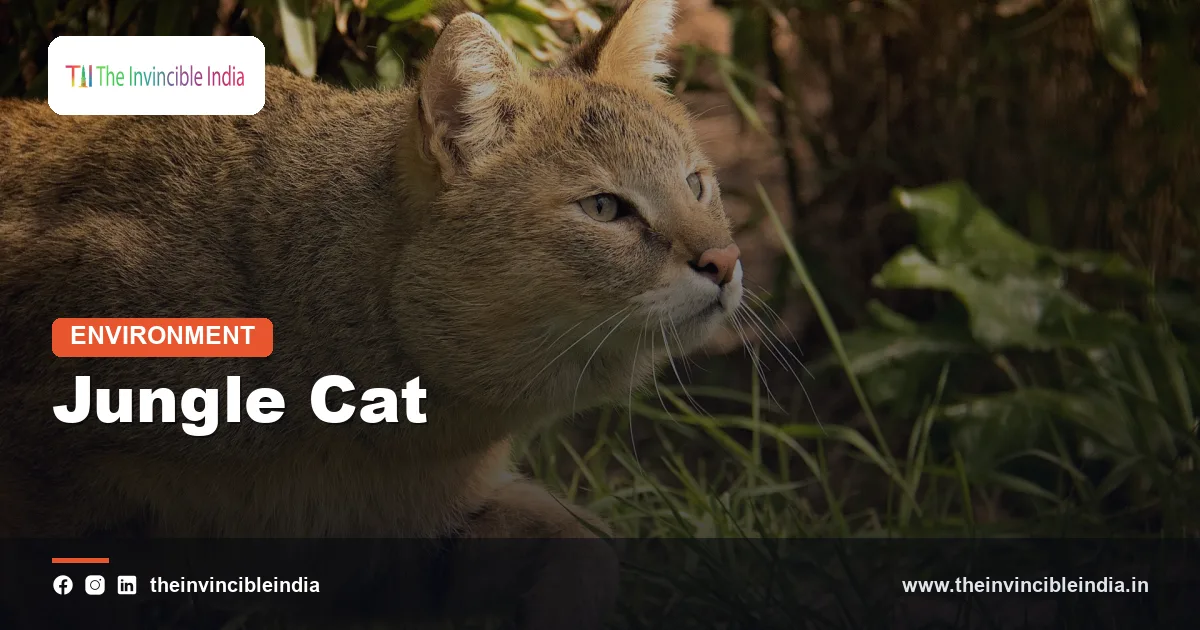
The jungle cat (Felis chaus), also called the reed cat or swamp cat, is a medium-sized, long-legged wild cat that is India’s most widespread and commonly seen small wild cat, living in wetlands, reed beds, grasslands, scrub and farmland across most of the country. Despite its name, the jungle cat prefers open, watery and grassy habitats rather than deep forest, and it is often active in daylight, which makes it easier to spot than most small cats.
Jungle cat conservation in India is a story of an adaptable species facing quiet pressures. The IUCN lists the animal as Least Concern worldwide, but wetland loss, road traffic, persecution and trade are reducing local populations. This explainer covers its biology, range in India, diet, threats and legal protection.
| Attribute | Detail |
|---|---|
| Common names | Jungle cat, reed cat, swamp cat; jangli billi in Hindi |
| Scientific name | Felis chaus |
| Family and genus | Felidae; genus Felis (the same genus as the domestic cat and the wildcats) |
| Size | Head-and-body about 50 to 80 cm; weight commonly around 3 to 10 kg, with large males heavier |
| Coat | Plain sandy, reddish-brown or grey; short black-ringed tail; black ear tips with small tufts |
| Range | Egypt and the Middle East through Central and South Asia to Southeast Asia and southern China |
| Habitat in India | Wetlands, reed beds, tall grassland, scrub, forest edges and irrigated farmland |
| IUCN status | Least Concern, with a population trend that is generally regarded as stable but locally declining |
| Trade regulation | CITES Appendix II; protected under India’s Wild Life (Protection) Act, 1972 |
Key Takeaways
- The jungle cat is India’s most widespread small wild cat and occurs in most Indian states outside high mountains and the driest deserts.
- The jungle cat prefers wetlands, reed beds, tall grass and farmland to dense forest, and its scientific name is Felis chaus.
- The jungle cat is largely carnivorous, feeding mainly on rodents, birds, frogs, reptiles and fish, and it is often active during the day.
- The IUCN lists the jungle cat as Least Concern globally, but local populations are declining where wetlands are drained and roads multiply.
- The jungle cat is legally protected in India, and international trade in the species is controlled under CITES Appendix II.
- Protecting wetlands, grassland and farmland corridors benefits the jungle cat and many other species that depend on the same habitats.
What is the jungle cat?
The jungle cat is a medium-sized wild cat in the genus Felis that is easily recognised by its plain, sandy coat, long legs, small dark ear tufts and short, ringed tail. It is bigger than a typical domestic cat, with a more slender, athletic frame, and it is the largest member of the genus Felis.
The coat colour varies with region and season, from pale sandy and yellowish-grey to reddish-brown, with little or no spotting in adults. Kittens, by contrast, are born with faint stripes and spots that fade as they grow. The tail usually has dark rings near the tip and ends in a black tip. A pale underside, white patches around the muzzle and dark marks on the forelegs are common features.
The animal is known by several names in India, including jangli billi in Hindi and various local terms across languages, and it is sometimes called the swamp cat in English because of its fondness for marshy ground. The species was described scientifically in the eighteenth century from a specimen from the Caucasus region, and several subspecies are recognised across its large range.
Where is the jungle cat found in India?
The jungle cat is found throughout most of India, from the Himalayan foothills and the Gangetic plains to the peninsula and the Western Ghats, wherever suitable wetland, grassland or scrub exists. It is considered the most common small wild cat in the country and is regularly recorded in both protected areas and human-dominated landscapes.
The cat is recorded in:
- Wetlands and marshes: including famous bird sanctuaries such as Keoladeo National Park in Rajasthan, where the cat is a well-known resident.
- Tiger and forest reserves: such as Ranthambore, Corbett and Kanha, particularly along streams, meadows and forest edges.
- Floodplain grasslands: including those of Kaziranga and the Terai grasslands of the Himalayan foothills.
- Coastal and delta habitats: including parts of the Sundarbans and coastal marshes.
- Farmland: especially irrigated fields of sugarcane, rice and wheat, where tall crops mimic natural reed beds.
Outside India, the jungle cat occurs from Egypt and the Levant through the Caucasus, Central Asia and South Asia to parts of Southeast Asia and southern China. Its wide range explains why it is categorised as a species of lower global concern.
The cat generally avoids dense evergreen forest, very high mountains and the driest deserts, though it can be found at moderate altitudes in the Himalayan foothills.
How does the jungle cat live and hunt?
The jungle cat lives mostly alone, hunts both by day and at night, and spends much of its time in dense cover such as reed beds, tall grass and thickets. Unlike many small cats that are strictly nocturnal, the jungle cat is often active in the early morning and late afternoon, and sometimes in the middle of the day.
Its hunting style combines patience and speed:
- It stalks slowly through grass, then pounces on rodents or birds from close range.
- It can leap to catch birds flushed from grass, a skill shown in the way it jumps vertically to take off-ground prey.
- It readily enters shallow water to catch fish, frogs and crabs, and is a good swimmer.
- It sometimes follows farmers or grazing animals to pick up flushed rodents and insects.
Jungle cats rest in abandoned burrows, dense grass clumps, hollow logs and thickets. They mark territories by spraying scent and scratching trees, and males typically have home ranges that overlap those of several females.
Breeding
Jungle cats breed in most seasons in warmer regions, with peaks in winter and early spring. Gestation lasts about two months, and a litter usually has two to four kittens born in a secure den. Kittens open their eyes within about two weeks, begin to eat meat at around a month and become independent after several months. The cats can live around a dozen years in captivity but usually fewer in the wild.
What does the jungle cat eat?
The jungle cat eats mainly small mammals, especially rodents, supplemented by birds, reptiles, amphibians, fish and insects. Studies from Indian wetlands and farmland show that rats, mice, gerbils and voles are the staple food, which gives the cat a valuable role in controlling pests.
- Mammals: rodents, hares and young of larger small mammals.
- Birds: ground-nesting birds, waterfowl, and the eggs and chicks of wetland species.
- Reptiles and amphibians: snakes, lizards and frogs.
- Fish and invertebrates: small fish, crabs and large insects.
Occasionally, jungle cats take poultry from village yards, which can cause conflict with farmers. However, farmers often benefit from the cat’s appetite for crop-raiding rodents. This dual role is central to attitudes toward the animal in rural areas.
How is the jungle cat different from other Indian small cats?
The jungle cat differs from other Indian small cats by being larger than a rusty-spotted cat, plain-coated unlike the spotted leopard cat and slimmer and longer-legged than a fishing cat. The table below compares the main identification features.
| Species | Coat | Size | Typical habitat |
|---|---|---|---|
| Jungle cat | Plain sandy-grey or reddish; ear tufts; ringed tail | Medium; long-legged | Wetlands, reeds, grassland, farmland |
| Fishing cat | Olive-grey with dark spots and lines | Stockier and heavier | Mangroves, marshes, swamps |
| Leopard cat | Yellowish with dark spots | Smaller than a jungle cat | Forests of the Himalaya and Northeast |
| Rusty-spotted cat | Grey with rusty spots | Tiny; world’s smallest wild cat | Dry forest, scrub |
| Caracal | Plain reddish with long black ear tufts | Larger, taller | Dry scrub and semi-desert |
The jungle cat is sometimes mistaken for a young caracal or a feral domestic cat. The best clues are the plain coat, the proportionally long legs, the short ringed tail and the tendency to hunt in open, wet or grassy settings.
What are the main threats to the jungle cat?
The main threats to the jungle cat in India are the loss and degradation of wetlands and grasslands, road mortality, persecution, poisoning and illegal trade. Because the species is adaptable, it is not at immediate risk of national extinction, but its habitat is shrinking quickly, and local disappearances are possible.
- Wetland loss: Draining, filling, pollution and encroachment on marshes, ponds and floodplains remove the reed beds on which the cat depends.
- Grassland conversion: Plantations, mining, infrastructure and agriculture replace the open grassland and scrub that provide cover and prey.
- Road and rail mortality: Jungle cats cross roads near wetlands and farmland and are frequently killed by vehicles, especially at dawn and dusk.
- Poisoning and snaring: Rodenticides and poisons set for pests or predators can kill cats directly or through contaminated prey. Snares set for wild boar, deer or hares sometimes catch them by accident.
- Retaliation: The cat is sometimes killed after attacking poultry.
- Trade and hunting: Skins, claws and live animals have been seized in wildlife trade cases, and historically the pelts were traded in large numbers.
- Hybridisation and dogs: Interbreeding with domestic cats has been reported, which can affect genetic purity, and free-ranging dogs may attack them.
Because the jungle cat lives close to people, it is frequently exposed to many of these pressures at once. It is also less studied than large carnivores, so population trends are hard to measure precisely.
What is the conservation status of the jungle cat?
The conservation status of the jungle cat is Least Concern on the IUCN Red List, because the species has a very wide range and a presumed large population. This global rating can mask regional decline, and several range countries have recorded losses where wetlands have vanished.
| Framework | Status or coverage |
|---|---|
| IUCN Red List | Least Concern globally |
| CITES | Appendix II, meaning international trade is regulated through permits |
| Wild Life (Protection) Act, 1972 | Protected under a schedule of the Act; hunting and trade are offences |
| Habitat coverage | Found in many national parks, sanctuaries and wetland reserves; large populations also live outside protected areas |
Being rated Least Concern does not mean the cat needs no attention. Conservationists point out that common species can decline unnoticed, and that monitoring jungle cats provides a useful signal of the health of wetlands and agricultural landscapes.
How is the jungle cat protected in India?
The jungle cat is protected in India under the Wild Life (Protection) Act, 1972, which prohibits hunting, capture and trade, and by CITES regulations that control international trade in the species. The Act is administered by the Ministry of Environment, Forest and Climate Change and enforced by state forest departments and the Wildlife Crime Control Bureau.
- Legal protection: Killing, trapping or possessing a jungle cat or its parts without authorisation is a punishable offence under Indian wildlife law.
- Protected areas: Parks, sanctuaries and Ramsar-listed wetlands safeguard core habitat where jungle cats breed and hunt.
- Wetland policy: India’s wetland rules and its list of Ramsar sites, including bird sanctuaries and floodplain lakes, indirectly protect the cat’s habitat.
- Enforcement against trade: Customs and wildlife crime agencies monitor seizures of skins and live animals.
- Research and monitoring: Camera-trap surveys and diet studies give scientists baseline data on the species.
The practical challenge is that most jungle cats live outside formal reserves, in village ponds, irrigation canals, sugarcane fields and roadside scrub, where laws are difficult to enforce and public awareness of small wild cats is low.
Why does the jungle cat matter to ecosystems and farmers?
The jungle cat matters because it is a mid-level predator that controls rodents, sustains food chains in wetlands and signals the health of reed and grassland habitats. As a common and visible small cat, it also acts as an ambassador for the wider cause of conserving unprotected landscapes.
- Rodent control: By eating large numbers of rats and mice, jungle cats reduce crop losses and the spread of rodent-borne disease.
- Food web link: They are prey for leopards, wolves, large raptors and pythons, and they compete with foxes and mongooses.
- Indicator species: The presence of jungle cats suggests that a wetland still has intact cover and prey.
- Cultural presence: Jungle cats have been known to humanity since antiquity, and mummified jungle cats have been found in ancient Egyptian cat burials.
What can be done to conserve the jungle cat?
Conserving the jungle cat requires protecting wetlands and grasslands, reducing road deaths, limiting poisoning and building tolerance among farmers. Because the cat is adaptable, relatively modest changes in land management can have large benefits.
- Wetland restoration: Safeguarding ponds, marshes and floodplains keeps reed bed habitat available.
- Safer infrastructure: Wildlife crossings, reduced speed zones and fencing near known habitat reduce collisions.
- Responsible pest control: Limiting indiscriminate rodenticide use protects cats and other predators.
- Predator-proof poultry sheds: Secure henhouses reduce retaliation killings.
- Community awareness: Educating villagers about the role of the cat in controlling rodents encourages coexistence.
- Better data: Monitoring through camera traps and citizen science identifies where populations are shrinking.
Bottom Line
The jungle cat is India’s common, adaptable wetland cat, and its Least Concern rating should not hide the steady loss of the marshes, reed beds and grasslands it needs. Protecting those habitats, reducing road mortality and encouraging coexistence on farmland will keep this familiar predator widespread.
Frequently Asked Questions
What is a jungle cat?
The jungle cat is a medium-sized wild cat, scientifically named Felis chaus, that lives in wetlands, reed beds, grasslands and farmland across India and much of Asia. It has a plain sandy or grey coat, long legs, small ear tufts and a short ringed tail. It is also known as the reed cat or swamp cat.
Is the jungle cat endangered in India?
No, the jungle cat is not endangered and is rated Least Concern by the IUCN, reflecting its wide range and adaptability. Even so, it is declining locally where wetlands and grasslands are lost or heavily disturbed. It remains legally protected under India’s Wild Life (Protection) Act, 1972.
Where do jungle cats live in India?
Jungle cats live in most parts of India, particularly near wetlands, tall grass, scrub and irrigated farmland. They are recorded in places such as Keoladeo National Park, Ranthambore, Corbett and the Terai grasslands. They avoid dense evergreen forest and very dry deserts.
What does a jungle cat eat?
A jungle cat eats mainly rodents such as rats and mice, along with birds, frogs, snakes, lizards, fish and insects. It hunts by stalking and pouncing and may enter shallow water to catch fish and frogs. Occasionally it takes poultry, which can lead to conflict with villagers.
Is the jungle cat dangerous to humans?
No, the jungle cat is not dangerous to humans and usually avoids people. Wild jungle cats may defend themselves if cornered or handled, so they should never be picked up or kept as pets. Attacks on people are extremely rare, and the cat is more likely to flee into cover.
Can jungle cats be kept as pets in India?
No, keeping a jungle cat as a pet is illegal in India because the species is protected under the Wild Life (Protection) Act, 1972. Capturing, keeping or trading wild cats without authorisation can lead to imprisonment and fines. Wild cats also do not adapt well to captivity and can cause injuries.
{“@context”:”https://schema.org”,”@graph”:[{“@type”:”FAQPage”,”mainEntity”:[{“@type”:”Question”,”name”:”What is a jungle cat?”,”acceptedAnswer”:{“@type”:”Answer”,”text”:”The jungle cat is a medium-sized wild cat, scientifically named Felis chaus, that lives in wetlands, reed beds, grasslands and farmland across India and much of Asia. It has a plain sandy or grey coat, long legs, small ear tufts and a short ringed tail. It is also known as the reed cat or swamp cat.”}},{“@type”:”Question”,”name”:”Is the jungle cat endangered in India?”,”acceptedAnswer”:{“@type”:”Answer”,”text”:”No, the jungle cat is not endangered and is rated Least Concern by the IUCN, reflecting its wide range and adaptability. Even so, it is declining locally where wetlands and grasslands are lost or heavily disturbed. It remains legally protected under India’s Wild Life (Protection) Act, 1972.”}},{“@type”:”Question”,”name”:”Where do jungle cats live in India?”,”acceptedAnswer”:{“@type”:”Answer”,”text”:”Jungle cats live in most parts of India, particularly near wetlands, tall grass, scrub and irrigated farmland. They are recorded in places such as Keoladeo National Park, Ranthambore, Corbett and the Terai grasslands. They avoid dense evergreen forest and very dry deserts.”}},{“@type”:”Question”,”name”:”What does a jungle cat eat?”,”acceptedAnswer”:{“@type”:”Answer”,”text”:”A jungle cat eats mainly rodents such as rats and mice, along with birds, frogs, snakes, lizards, fish and insects. It hunts by stalking and pouncing and may enter shallow water to catch fish and frogs. Occasionally it takes poultry, which can lead to conflict with villagers.”}},{“@type”:”Question”,”name”:”Is the jungle cat dangerous to humans?”,”acceptedAnswer”:{“@type”:”Answer”,”text”:”No, the jungle cat is not dangerous to humans and usually avoids people. Wild jungle cats may defend themselves if cornered or handled, so they should never be picked up or kept as pets. Attacks on people are extremely rare, and the cat is more likely to flee into cover.”}},{“@type”:”Question”,”name”:”Can jungle cats be kept as pets in India?”,”acceptedAnswer”:{“@type”:”Answer”,”text”:”No, keeping a jungle cat as a pet is illegal in India because the species is protected under the Wild Life (Protection) Act, 1972. Capturing, keeping or trading wild cats without authorisation can lead to imprisonment and fines. Wild cats also do not adapt well to captivity and can cause injuries.”}}]}]}


