

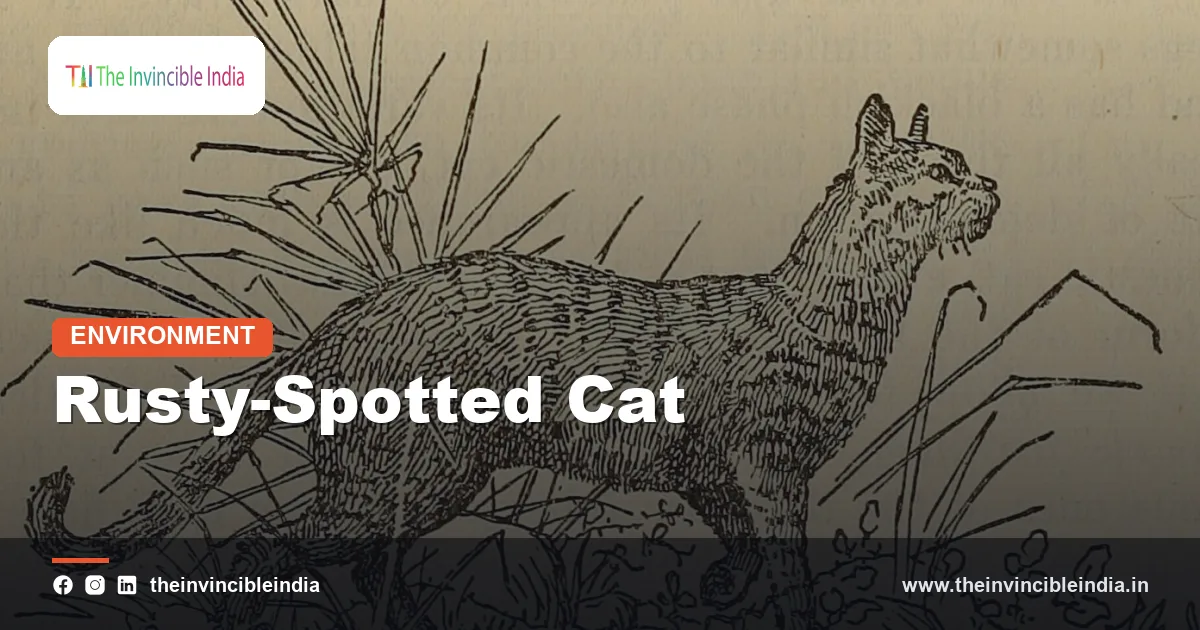
The rusty-spotted cat (Prionailurus rubiginosus) is the smallest wild cat in the world and is found mainly in India and Sri Lanka, where it lives in dry forests, scrub, grasslands and the edges of farmland. Adults weigh only about one to one and a half kilograms, roughly half the size of an average house cat, and they hunt mostly at night, which is why this small predator remains one of the least-studied cats in South Asia.
Rusty-spotted cat conservation matters because the species is classed as Near Threatened by the International Union for Conservation of Nature (IUCN) and is thought to be declining as forests, scrub and farmland are altered or lost. This explainer covers how the cat looks and behaves, where it lives in India, what threatens it and what legal and practical protection it receives.
| Attribute | Detail |
|---|---|
| Common name | Rusty-spotted cat |
| Scientific name | Prionailurus rubiginosus |
| Family and genus | Felidae; genus Prionailurus (the leopard cat lineage) |
| Size | Smallest wild cat; about 35 to 48 cm head-and-body length and roughly 0.9 to 1.6 kg |
| Range | India, Sri Lanka and parts of Nepal’s southern lowlands |
| Habitat | Dry deciduous forest, scrub, grassland, moist forest in Sri Lanka and agricultural edges |
| IUCN status | Near Threatened, with a decreasing population trend |
| Legal protection in India | Strictly protected under the Wild Life (Protection) Act, 1972; trade restricted under CITES Appendix I |
| Activity pattern | Nocturnal and crepuscular; spends the day in dens, hollows and dense cover |
Key Takeaways
- The rusty-spotted cat is the smallest wild cat species in the world, weighing roughly 0.9 to 1.6 kilograms as an adult.
- The rusty-spotted cat is found mainly in India and Sri Lanka, with a mainland Indian form and a separate Sri Lankan subspecies.
- The IUCN lists the rusty-spotted cat as Near Threatened because habitat conversion is believed to be reducing its population.
- The rusty-spotted cat is a mostly nocturnal hunter that feeds on rodents, small birds, lizards, frogs and insects.
- Indian law gives the rusty-spotted cat strict protection, and international commercial trade in the species is prohibited under CITES Appendix I.
- Conservation of the rusty-spotted cat depends on protecting dry forests, scrub and farmland corridors that scientists still know little about.
What is the rusty-spotted cat?
The rusty-spotted cat is a very small, spotted wild cat in the genus Prionailurus, the same lineage that includes the leopard cat and the fishing cat. Its short, dense fur is grey to tawny-grey, marked with rusty-brown spots that merge into streaks along the back and flanks, and its belly is paler.
Several features help to identify the animal:
- a rounded head with large eyes, short ears and a small, fairly broad face;
- two dark lines on each side of the nose running up toward the forehead, with white patches around the eyes;
- a tail about half the length of the body, usually plain or faintly marked;
- relatively long legs for the body size, and a slender build.
The species was described scientifically in the early nineteenth century from a specimen collected in southern India, and the Indian form is regarded as the nominate subspecies. The Sri Lankan population is treated as a separate subspecies, known as Prionailurus rubiginosus phillipsi, which tends to be somewhat larger and darker with bolder spotting.
Why is the rusty-spotted cat called the smallest wild cat?
The rusty-spotted cat is called the smallest wild cat because an adult is smaller and lighter than any other living wild felid, with males typically weighing around 1.5 kilograms and females somewhat less. The black-footed cat of southern Africa is its closest rival for the title, and size ranges can overlap, but the rusty-spotted cat is generally cited as the world’s smallest.
The cat is sometimes compared with a hummingbird because of its restless energy and fast, bold movement relative to its tiny frame. Kittens are born marked with spots and stripes and are small enough to fit in a person’s palm in the first days of life. In captivity, adults have lived for around a decade or longer, but lifespan in the wild is poorly documented.
Where is the rusty-spotted cat found in India?
The rusty-spotted cat is found across a broad band of peninsular and central India, from the dry forests of the Deccan and eastern India to parts of the Western Ghats and the Himalayan foothills. Records and camera-trap photographs have come from states including Gujarat, Maharashtra, Karnataka, Andhra Pradesh, Telangana, Tamil Nadu, Madhya Pradesh, Chhattisgarh, Odisha and Uttar Pradesh, though the exact distribution is patchy and incompletely mapped.
The species is generally associated with:
- Dry deciduous and thorn forest: open woodland with leaf litter, rocky outcrops and tree hollows for shelter.
- Scrub and grassland: brushy country with enough cover to hide from larger predators.
- Agricultural edges: sugarcane, millet and other fields adjoining natural habitat, which attract rodents.
- Protected areas and their buffers: many confirmed records come from tiger reserves, sanctuaries and national parks where camera traps are deployed.
Outside India, the cat occurs in Sri Lanka, where it uses both dry zone forest and wetter highland and rainforest habitats, and in the southern lowlands of Nepal. Its altitudinal range is relatively wide, extending from near sea level to hill country. Because it is small, shy and nocturnal, many areas where it lives are unrecorded, and absence of records does not prove absence of the animal.
How does the rusty-spotted cat behave and live?
The rusty-spotted cat lives mainly alone, is active at night and in the hours around dawn and dusk, and spends the daytime resting in dens, tree hollows, rock crevices or thick undergrowth. Each adult occupies a home range that overlaps with others, and individuals mark their territory with scent.
The species is a capable climber and uses trees to escape predators and sometimes to rest or hunt. It is also agile on the ground, moving quickly through cover with a flexible, low posture. Like other small cats, it communicates with soft vocalisations, scent marks and body language rather than loud calls.
Breeding and life cycle
Breeding information comes largely from captive animals. Gestation lasts about two months, and a litter usually consists of one or two kittens, occasionally three. Kittens are born with their eyes closed, open them within the first two weeks, and begin eating solid food at around a month or so. Young cats reach independence within several months and sexual maturity in their first or second year.
Predators and competitors
The rusty-spotted cat is small enough to be prey for larger carnivores such as leopards, jungle cats, wild dogs and large owls or raptors. Free-ranging domestic dogs are also a risk in areas close to villages. Its survival strategy relies on camouflage, secrecy and quick escape to cover.
What does the rusty-spotted cat eat?
The rusty-spotted cat eats mainly small rodents, along with birds, lizards, frogs, snakes, insects and other small prey. Studies of its diet suggest that rodents form the bulk of its food, which makes it an important natural controller of rats and mice in forest and farmland landscapes.
Typical prey includes:
- field mice, gerbils, bandicoot rats and other rodents;
- ground-nesting and roosting birds and their eggs;
- geckos, skinks and other lizards;
- frogs and large insects such as grasshoppers and beetles.
Because a rusty-spotted cat eats animals that often damage crops, farmers who tolerate it can gain a quiet benefit in pest control. The cat has occasionally been accused of taking poultry, but its small size makes this unusual compared with larger carnivores.
What are the main threats to the rusty-spotted cat?
The main threats to the rusty-spotted cat are loss and degradation of dry forest, scrub and grassland, along with human-caused mortality, even though the cat is protected by law. Because the species depends on habitat that is often classed as wasteland or scrub, the very landscapes where it lives are frequently targeted for conversion.
- Habitat loss: Expansion of agriculture, plantations, quarrying, roads, industrial sites and housing reduces and fragments the cover that the cat needs.
- Intensive farming: Pesticides and rodenticides can poison the cat’s rodent prey and, by extension, the cat itself.
- Persecution and accidents: Cats are sometimes killed as suspected poultry thieves, caught in snares set for other animals, or hit by vehicles on roads that cut through habitat.
- Domestic and stray dogs: Dogs may attack or harass small cats near settlements and farmland.
- Illegal wildlife trade: Occasional capture for the pet trade or for body parts has been reported, though it is believed to be a smaller threat than habitat loss.
- Limited knowledge: Poor survey data means conservation planning often lacks reliable population estimates or clear priority sites.
In Sri Lanka, forest clearing and conversion in the island’s wet and dry zones are cited as a major concern for the local subspecies, and the same pattern of habitat pressure applies in India.
What is the conservation status of the rusty-spotted cat?
The conservation status of the rusty-spotted cat is Near Threatened on the IUCN Red List, an assessment that reflects a suspected decline in population as habitat shrinks. The species was previously assessed as Vulnerable and was moved to the lower category after reassessment, but the population trend is still described as decreasing.
| Framework | Status or coverage |
|---|---|
| IUCN Red List | Near Threatened; population believed to be declining |
| CITES | Appendix I, which prohibits international commercial trade in wild specimens |
| Wild Life (Protection) Act, 1972 (India) | Included among the strictly protected species; hunting and trade are offences |
| Sri Lanka | Protected under national fauna and flora legislation |
| Habitat protection | Recorded in various national parks, sanctuaries and tiger reserves, but much habitat lies outside protected areas |
Conservation biologists often point out that the status label is based on limited evidence. Many wild cat species in South Asia have been assessed using sparse data, and as survey effort improves, the rusty-spotted cat’s real range, density and risks may become clearer.
How is the rusty-spotted cat protected in India?
The rusty-spotted cat is protected in India mainly through the Wild Life (Protection) Act, 1972, which treats it as a strictly protected species whose hunting, capture and trade are punishable offences. The Act is administered by the Ministry of Environment, Forest and Climate Change and enforced through state forest departments and wildlife crime control agencies.
Protection works at several levels:
- Legal protection: The Act prohibits hunting, trapping, possession of skins or body parts and trade, with penalties that include imprisonment and fines.
- Protected areas: National parks, wildlife sanctuaries and tiger reserves conserve dry forests and scrub where the cat has been recorded, even though they were not created for it.
- Camera-trap monitoring: Monitoring for tigers, leopards and prey now also detects small cats, adding records of rusty-spotted cats from many reserves.
- International regulation: CITES Appendix I listing places the species under the strictest trade controls, which India implements through its customs and wildlife crime authorities.
- Zoos and captive breeding: The Central Zoo Authority regulates zoos that keep the species and coordinates conservation breeding policy for selected small cats.
The weakness in this system is that the cat is often found on private land, farmland edges and revenue scrubland that is not formally protected, where legal protection exists on paper but habitat can still be cleared.
What can be done to conserve the rusty-spotted cat?
Conserving the rusty-spotted cat requires protecting scrub and dry forest habitat outside reserves, improving survey knowledge, reducing conflict and encouraging wildlife-friendly farming. The cat is a good example of a species that cannot be saved by reserves alone because much of its range lies in working landscapes.
- Systematic surveys: Camera trapping, scat analysis and community reports can map where the cat lives and identify priority habitats.
- Recognising scrub and grassland: Policies that treat scrub, dry grassland and open natural ecosystems as valuable habitat, rather than wasteland, would reduce conversion.
- Community engagement: Farmers who understand that small cats help control rodents are less likely to kill them, and local volunteers can report sightings.
- Safer roads and railways: Underpasses and speed controls in known habitat reduce road deaths.
- Dog management: Vaccination and sterilisation of free-ranging dogs near habitat reduce disease and predation risk.
- Research on genetics and ecology: Studies of diet, home range and genetic diversity would help managers judge whether populations are isolated.
Public awareness also matters, since the rusty-spotted cat is often mistaken for a juvenile leopard cat, a stray domestic kitten or even a small leopard cub, and misidentification can lead to accidental harm or missed records.
How does the rusty-spotted cat compare with other small Indian cats?
The rusty-spotted cat is the smallest and most elusive of India’s small wild cats, differing from the jungle cat, leopard cat and fishing cat in size, coat pattern and habitat. The table below compares the features that most often help in identification.
| Species | Approximate size | Coat | Typical habitat |
|---|---|---|---|
| Rusty-spotted cat | About 1 to 1.6 kg | Grey-tawny with rusty spots and streaks | Dry forest, scrub, farmland edges |
| Leopard cat | Around 3 to 5 kg | Yellowish with dark spots | Forests of the Himalayas and Northeast |
| Jungle cat | Around 4 to 10 kg | Plain sandy-grey, ear tufts | Wetlands, reeds, farmland |
| Fishing cat | Around 6 to 12 kg | Olive-grey with dark lines and spots | Marshes, mangroves, swamps |
Bottom Line
The rusty-spotted cat is a tiny, secretive predator whose future depends on how India treats dry forests, scrub and farmland edges. Legal protection is strong, but practical conservation needs better surveys, habitat safeguards beyond reserves and local tolerance for a small cat that quietly controls rodents.
Frequently Asked Questions
Is the rusty-spotted cat the smallest wild cat in the world?
Yes, the rusty-spotted cat is generally considered the smallest wild cat in the world. Adults weigh roughly 0.9 to 1.6 kilograms and measure about 35 to 48 centimetres from head to the base of the tail. The black-footed cat of southern Africa is similar in size, but the rusty-spotted cat is most often cited as the smallest.
Where does the rusty-spotted cat live in India?
The rusty-spotted cat lives in dry forests, scrub, grasslands and farmland edges across peninsular and central India, with records from states such as Gujarat, Maharashtra, Karnataka, Andhra Pradesh, Tamil Nadu, Madhya Pradesh and Odisha. It is also found in Sri Lanka and in the southern lowlands of Nepal. Its distribution is patchy and not fully mapped.
Is the rusty-spotted cat endangered?
The rusty-spotted cat is not classed as Endangered but is listed as Near Threatened by the IUCN, with a population believed to be decreasing. Habitat loss and fragmentation are the main causes of concern. The species is also listed on CITES Appendix I, which bans international commercial trade.
What does the rusty-spotted cat eat?
The rusty-spotted cat eats mainly small rodents such as mice and rats. It also feeds on birds, lizards, frogs and insects, and it hunts at night using sharp hearing and eyesight. By eating rodents, the cat helps limit crop-damaging pests.
Is the rusty-spotted cat protected by law in India?
Yes, the rusty-spotted cat receives strict protection under India’s Wild Life (Protection) Act, 1972, which makes hunting, capture and trade offences. It is also covered by CITES Appendix I, which restricts international trade. Enforcement is carried out by state forest departments and wildlife crime authorities.
Is the rusty-spotted cat dangerous to people or livestock?
No, the rusty-spotted cat is not dangerous to people and poses little threat to livestock. It is shy, is smaller than most house cats and avoids human contact. Occasionally it may take a chicken or a small bird near farms, but this is uncommon compared with damage caused by larger carnivores.
{“@context”:”https://schema.org”,”@graph”:[{“@type”:”FAQPage”,”mainEntity”:[{“@type”:”Question”,”name”:”Is the rusty-spotted cat the smallest wild cat in the world?”,”acceptedAnswer”:{“@type”:”Answer”,”text”:”Yes, the rusty-spotted cat is generally considered the smallest wild cat in the world. Adults weigh roughly 0.9 to 1.6 kilograms and measure about 35 to 48 centimetres from head to the base of the tail. The black-footed cat of southern Africa is similar in size, but the rusty-spotted cat is most often cited as the smallest.”}},{“@type”:”Question”,”name”:”Where does the rusty-spotted cat live in India?”,”acceptedAnswer”:{“@type”:”Answer”,”text”:”The rusty-spotted cat lives in dry forests, scrub, grasslands and farmland edges across peninsular and central India, with records from states such as Gujarat, Maharashtra, Karnataka, Andhra Pradesh, Tamil Nadu, Madhya Pradesh and Odisha. It is also found in Sri Lanka and in the southern lowlands of Nepal. Its distribution is patchy and not fully mapped.”}},{“@type”:”Question”,”name”:”Is the rusty-spotted cat endangered?”,”acceptedAnswer”:{“@type”:”Answer”,”text”:”The rusty-spotted cat is not classed as Endangered but is listed as Near Threatened by the IUCN, with a population believed to be decreasing. Habitat loss and fragmentation are the main causes of concern. The species is also listed on CITES Appendix I, which bans international commercial trade.”}},{“@type”:”Question”,”name”:”What does the rusty-spotted cat eat?”,”acceptedAnswer”:{“@type”:”Answer”,”text”:”The rusty-spotted cat eats mainly small rodents such as mice and rats. It also feeds on birds, lizards, frogs and insects, and it hunts at night using sharp hearing and eyesight. By eating rodents, the cat helps limit crop-damaging pests.”}},{“@type”:”Question”,”name”:”Is the rusty-spotted cat protected by law in India?”,”acceptedAnswer”:{“@type”:”Answer”,”text”:”Yes, the rusty-spotted cat receives strict protection under India’s Wild Life (Protection) Act, 1972, which makes hunting, capture and trade offences. It is also covered by CITES Appendix I, which restricts international trade. Enforcement is carried out by state forest departments and wildlife crime authorities.”}},{“@type”:”Question”,”name”:”Is the rusty-spotted cat dangerous to people or livestock?”,”acceptedAnswer”:{“@type”:”Answer”,”text”:”No, the rusty-spotted cat is not dangerous to people and poses little threat to livestock. It is shy, is smaller than most house cats and avoids human contact. Occasionally it may take a chicken or a small bird near farms, but this is uncommon compared with damage caused by larger carnivores.”}}]}]}


