

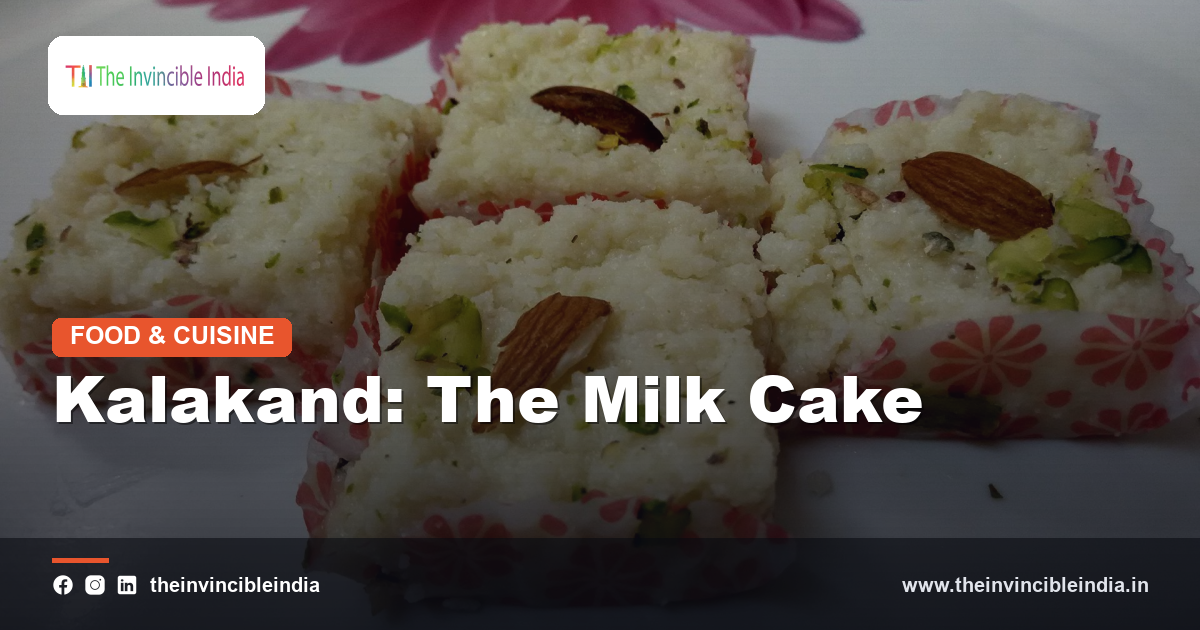
Milk has been at the heart of Indian sweet-making for centuries, and few sweets showcase its flavour as directly as kalakand, a soft, moist, lightly grainy confection often introduced in English as the Indian milk cake. Among the many treats counted among the famous sweets of India, kalakand is notable for its simplicity: it is made by curdling and slowly reducing milk, sweetening it with sugar, and setting the result into a block that is cut into squares or diamonds. Its flavour is milky and gently sweet, often perfumed with cardamom and topped with chopped pistachios or almonds. Closely associated in popular memory with northern and western India, and especially with Rajasthan, kalakand appears at festivals, weddings, and everyday sweet-shop counters. This guide examines its identity, method, regional associations, and enduring cultural place.
Quick Facts
| Detail | Information |
|---|---|
| Type | Milk-based sweet |
| Main Ingredients | Milk or chhena, sugar, cardamom |
| Texture | Soft, moist and lightly grainy |
| Typical Garnish | Pistachios and almonds |
| Regional Association | Rajasthan and northern India |
| Festive Association | Diwali, Holi and weddings |
What Is Kalakand
Kalakand is a traditional Indian sweet made from milk solids, sugar, and flavourings, shaped into soft, sliceable pieces. It is frequently described as a milk cake, a name that captures its dense, tender character, although it is not a cake in the baked sense. The sweet is usually pale cream or light golden in colour, with a moist, slightly grainy texture that comes from the way the milk is curdled and reduced. Its taste is clean and milky, with sweetness restrained enough to let the dairy flavour come through, and a fragrant lift from cardamom. Chopped pistachios and almonds are often scattered over the top, and thin silver leaf is sometimes added for festive occasions. Kalakand is typically cut into squares or diamond shapes and served at room temperature or slightly chilled. In essence, kalakand is the Indian milk cake, a simple sweet that celebrates the natural richness of milk.
Origins and History
The beginnings of kalakand are not recorded with precision, and its history is best presented in general terms. India has an ancient dairy tradition, and sweets built on thickened milk have long been a hallmark of its confectionery. Kalakand belongs to this family, and it is widely associated in popular tradition with the sweet-making culture of Rajasthan, particularly the town of Alwar, whose milk sweets have a lasting reputation. Local lore offers various accounts of how the sweet first arose, but these stories vary and cannot be confirmed. What is clear is that kalakand developed from the practical art of reducing milk and curdling it with a mild acid, a technique known across the subcontinent. Over time it spread through northern and western India and beyond, becoming a standard offering at sweet shops. Kalakand thus stands as a product of long-standing regional craft rather than a creation of one documented moment.
The Foundation: Milk
Everything about kalakand begins with milk, and the quality of the milk shapes the quality of the sweet. Full-cream milk, rich in fat and solids, is preferred, since it yields a richer and more flavourful result. Traditionally the milk is brought to a boil and then simmered, with a souring agent such as lemon juice, vinegar, or a little alum added to encourage the milk to curdle partially. The curdled milk solids are then cooked down further in the whey, a slow process that concentrates their flavour and gives them their characteristic texture. Some preparations begin instead with fresh chhena or with khoya, the milk solids obtained by prolonged boiling. Whatever the starting point, the aim is the same: to capture the natural sweetness and richness of milk in a dense, tender form. Kalakand shows that with good milk and careful cooking, very little else is needed to make an exceptional sweet.
The Method of Preparation
The preparation of kalakand is a slow, attentive process. Milk is boiled and gently curdled, and the resulting solids are simmered with frequent stirring so that they do not stick or scorch. Sugar is then added, which loosens the mixture briefly before it thickens again as the moisture evaporates. The cooking continues until the mixture becomes a soft, cohesive mass that begins to leave the sides of the pan. Cardamom is stirred in near the end, and the mixture is spread into a greased tray, smoothed, and allowed to cool and set. Once firm, it is cut into pieces and garnished. Timing is crucial, because undercooking leaves the sweet too wet and soft, while overcooking makes it dry and hard. Experienced cooks judge readiness by the texture and the way the mass moves in the pan. Making kalakand is, above all, an exercise in patience, steady heat, and careful observation.
The Signature Grainy Texture
The texture of kalakand is its most distinctive attribute. Unlike the smooth, fudge-like consistency of some milk sweets, kalakand has a soft, slightly grainy character that results from the partially curdled milk solids. This granularity is not a flaw but the sweet’s hallmark, giving it a pleasant crumble and a moist mouthfeel that melts gradually on the tongue. The moisture is important too: a good kalakand is tender and juicy rather than dry, with enough softness to yield easily to a spoon or a bite. Achieving this balance depends on how the milk is curdled, how long it is cooked, and when the sugar is added. If the milk is cooked too long, the sweet becomes dense and firm, while if it is cooked too little, it may be loose and sticky. The grainy yet moist texture is what makes kalakand instantly recognizable and sets it apart from other milk-based sweets.
Flavourings and Garnishes
Kalakand relies on a light touch of flavouring. Ground cardamom is the most common aromatic, valued for its warm, floral scent that complements the sweetness of milk without overpowering it. Some cooks add a hint of saffron for colour and a subtle, luxurious fragrance, and rose water may be used in small amounts. On top, chopped pistachios and almonds provide colour contrast and a gentle crunch, and silver leaf is sometimes applied for weddings and festivals. Certain regional or modern versions add other flavours, such as chocolate or fruit, but the classic expression remains the one that places the milk itself in the foreground. The restrained use of flavourings reflects a broader principle in Indian confectionery, in which the best sweets let their principal ingredient speak. Cardamom, nuts, and saffron enhance kalakand without disguising its essential character as a pure and delicate celebration of milk.
Kalakand and Milk Cake
Kalakand and milk cake are often mentioned together, and the relationship between them can cause confusion. In common usage, both names describe milk-based sweets made by reducing milk and sugar, and in many places the terms are used almost interchangeably. Some regions, however, distinguish them. Milk cake is often described as a more deeply caramelised, brownish, and sometimes slightly firmer sweet, made by cooking milk with sugar for a long time until it takes on a toasty colour and flavour. Kalakand, in contrast, is generally paler, softer, and moister, with a lighter flavour and a more pronounced grainy texture. These differences depend on local custom and on the individual maker, so the line between the two is not rigid. What unites them is the shared goal of transforming milk into a rich, sliceable sweet. Whether called kalakand or milk cake, the sweet reflects the same deep tradition of dairy craft.
Kalakand Among Indian Milk Sweets
India’s milk sweets form one of the most diverse families in world confectionery. They include fresh cheese sweets such as rasgulla and sandesh, thickened-milk sweets such as peda and barfi, and syrup-based preparations such as gulab jamun. Within this broad family, kalakand holds a middle position: it is made from partially curdled and reduced milk, which gives it a texture between that of fresh chhena sweets and fully reduced khoya sweets. It is softer than most barfis and less syrupy than rasgulla, offering a distinctive moist, crumbly bite. Its relationship to these other sweets shows how small variations in technique, such as the degree of curdling, the length of cooking, and the stage of adding sugar, can produce very different results from the same basic ingredient. Kalakand is therefore a valuable example of the variety that Indian cooks have drawn from milk, and its place in the milk-sweet family is secure.
Rajasthan and the Alwar Connection
Kalakand is strongly associated in popular imagination with Rajasthan, and above all with the city of Alwar, whose milk-based sweets enjoy a long-standing reputation. The region’s dairying culture and its tradition of making sweets for festivals and royal courts are often cited as part of this heritage. Sweets from this part of the country are known for their richness and their careful craft, and visitors frequently take boxes of them home as gifts. The details of how and when kalakand first became linked to the region are subject to local tradition and cannot be precisely verified, but the association is widely recognized and celebrated. Rajasthan’s culinary identity, which also includes famous sweets such as ghevar and mawa kachori, shows a deep love of dairy-rich preparations. In that setting, kalakand stands as one of the region’s well-loved milk specialties, associated with hospitality and festive tradition.
Kalakand at Festivals and Weddings
Like most Indian sweets, kalakand is closely tied to celebration. During Diwali, boxes of sweets are exchanged among families, friends, and neighbours, and kalakand is a frequent presence in these assortments. It is also common during Holi, Raksha Bandhan, and other festivals, and it features at weddings, naming ceremonies, and other family gatherings. Its pale colour and soft sweetness make it suitable as an offering as well, and milk sweets of this kind are often used in religious observances. Because kalakand is a fresh milk sweet, it is typically made close to the day of consumption, which gives it a sense of freshness and occasion. The act of offering a sweet to guests is an important expression of welcome in India, and kalakand serves that purpose gracefully. Its place at festivals and weddings underscores how deeply it is woven into the social and religious fabric of Indian life.
The Craft of the Halwai
The halwai, or traditional sweet-maker, is the custodian of kalakand as a craft. In a well-established sweet shop, preparing kalakand means tending wide, heavy pans of simmering milk for long periods, adjusting the heat, stirring constantly, and judging by sight, smell, and touch when the mixture has reached the right consistency. This knowledge is rarely written down; it is learned through years of apprenticeship, often within families that have run their shops for generations. A skilled halwai can tell from the sound of the bubbling milk and the feel of the mixture on the spoon exactly when to add the sugar and when to remove the pan from the fire. The craft also demands physical stamina and patience. Through these practices, techniques developed over many generations continue to live. The halwai ensures that kalakand remains not just a recipe but a skilled tradition passed from teacher to student.
Regional and Modern Variations
Kalakand varies from region to region and from maker to maker. Some versions are quite pale and soft, while others are baked or cooked longer for a golden-brown surface and a firmer body. Certain cooks begin with chhena, while others use a mixture of milk and khoya, and some prefer to flavour with saffron rather than cardamom alone. In recent years, creative variations have appeared, including versions made with chocolate, fruit, or additional nuts, and some bakers have adapted the sweet into cakes or desserts that echo its flavour. Home cooks also make quick versions using condensed milk or milk powder, which offer convenience at the cost of some traditional character. These variations show the sweet’s adaptability, but the traditional form, made from carefully reduced milk, remains the benchmark. Kalakand continues to evolve while retaining its identity as the soft, milky, grainy sweet that generations have enjoyed.
Common Challenges in Making Kalakand
Though its ingredients are few, kalakand can be challenging to make well. The most common difficulty is texture: if the milk is cooked too long, the sweet turns hard and dry, while insufficient cooking leaves it wet and sticky. Curdling the milk too aggressively can produce overly large, rubbery curds, whereas too little curdling yields a smooth fudge rather than the characteristic grainy cake. Scorching is another risk, since milk solids burn easily if the heat is too high or the stirring is neglected, and a burnt flavour cannot be corrected. Adding sugar too early or too late can also affect the final texture. Experienced cooks manage these challenges through steady heat, constant stirring, and close observation of the mixture’s consistency. Learning from such challenges is part of the craft, and success with kalakand depends on patience, attention, and respect for the delicate nature of milk.
Serving, Pairing and Storage
Kalakand is generally served in squares or diamonds, at room temperature or lightly chilled, as a dessert, a snack, or a festive offering. It pairs naturally with a cup of hot tea or coffee, and it is often included on a platter with other sweets such as balushahi and barfi. Because it is made from fresh milk and has a high moisture content, it should be refrigerated and eaten within a few days, kept covered to prevent drying and the absorption of other odours. Taking it out of the refrigerator a little before serving restores its softness and brings out the aroma of cardamom. Presentation is usually simple, with a nut garnish or a touch of silver leaf for special occasions. By storing and serving it with care, one preserves what defines kalakand: a tender, moist crumb and a clean, milky sweetness that lingers pleasantly.
Kalakand Today
Today kalakand remains one of the most recognizable sweets in India, found in shops of every size, from small neighbourhood stores to renowned confectioners, and packed into gift boxes for festivals and celebrations. It is also made at home by many families, who value its relative simplicity and its link to festive memory. Packaged and ready-made versions have extended its reach to supermarkets and to Indian communities around the world, while professional chefs have reinterpreted its flavour in modern desserts. Even so, the traditional form, made from slowly reduced milk, retains a special place. Its enduring popularity rests on the timeless appeal of milk, sugar, and cardamom, combined with the skill of the sweet-maker. As a dessert that connects the present to a very old dairy tradition, kalakand continues to bring sweetness and tradition to Indian celebrations and everyday enjoyment alike.
Sources & Further Reading
- Ministry of Culture, Government of India (indiaculture.gov.in).
- Ministry of Food Processing Industries, Government of India (mofpi.gov.in).
Frequently Asked Questions
What is kalakand?
Kalakand is a traditional Indian milk sweet made from curdled and reduced milk, sugar, and cardamom, set into a soft, moist block and cut into pieces. It is often called the Indian milk cake.
What gives kalakand its grainy texture?
The grainy texture comes from partially curdling the milk and cooking the solids slowly. This gives the sweet a soft crumble rather than the smooth consistency of fudge-like sweets.
Is kalakand the same as milk cake?
The two names are often used interchangeably, though in some regions milk cake is darker, more caramelised, and firmer. Kalakand is usually paler, softer, and moister.
Which region is kalakand associated with?
Kalakand is widely associated with Rajasthan and the city of Alwar, though it is made and enjoyed across northern and western India and beyond.
How should kalakand be stored?
Because it is made from fresh milk, kalakand should be kept covered in the refrigerator and eaten within a few days. Letting it sit briefly at room temperature before serving restores its softness.


