

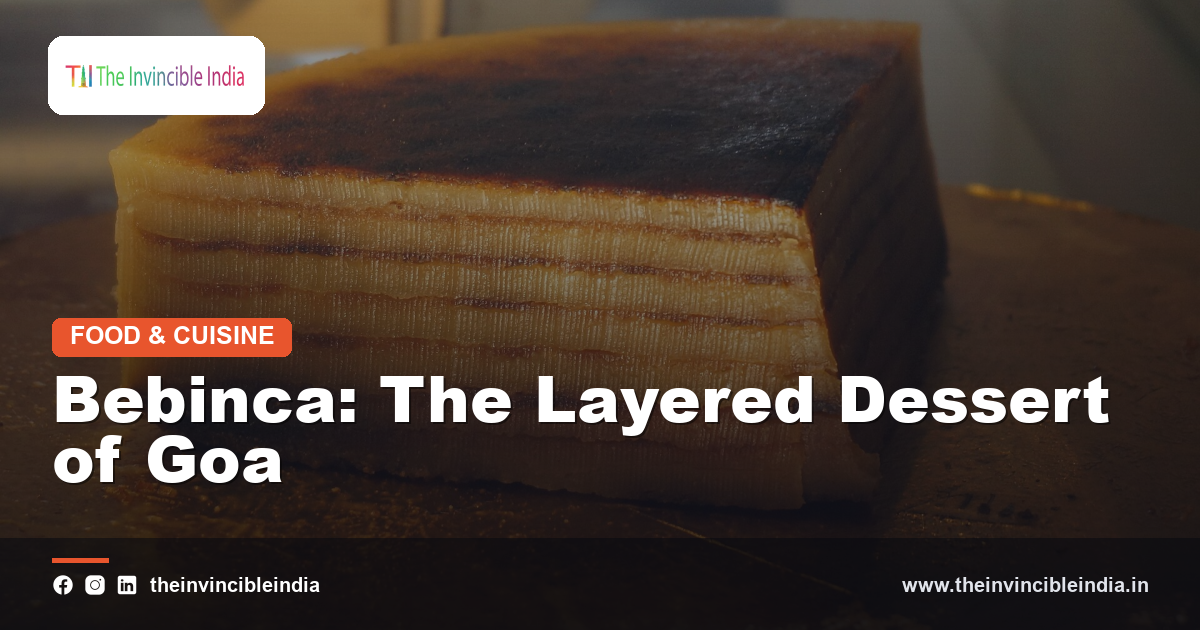
Bebinca is the best-loved dessert of Goa, a dense, fragrant cake built from many slender layers of coconut milk, egg yolk, sugar and ghee, each one baked in turn before the next is added. It is the dish most closely associated with Goan Christmas, when it appears on festive tables alongside other traditional sweets, and it is often described as the queen of Goan desserts. The cake reflects the meeting of Indian ingredients and Portuguese-era sweet-making traditions that shaped the coastal state. Like many of the famous sweets of India, it is as much an expression of patience and ritual as it is a matter of taste.
Quick Facts
| Detail | Information |
|---|---|
| Type | Layered baked dessert or cake |
| Region | Goa |
| Key ingredients | Coconut milk, egg yolks, sugar, flour and ghee |
| Flavourings | Nutmeg and cardamom |
| Associated with | Christmas and Goan festive tables |
| Served | Warm or at room temperature, often with ice cream |
What Bebinca Is
Bebinca is a traditional Goan dessert made of many thin layers of a sweet batter, stacked one on another to form a rich, tightly packed cake with a distinctive striped appearance when cut. The batter is built from coconut milk, egg yolks, sugar, flour and ghee, scented with warm spices, and each layer is cooked separately before the next is poured over it. The finished cake is dense, moist and slightly chewy, with a caramelised sweetness that sets it apart from lighter Western sponge cakes. Its appearance, a pattern of fine, alternating bands, is one of the most recognisable sights in Goan confectionery. Bebinca is therefore both a dessert and a visual signature, valued for the care evident in each layer.
Goa and Its Culinary Meeting of Cultures
Goa’s cuisine is the product of a long encounter between local coastal cooking and the influence of Portuguese rule, which lasted for several centuries and left a deep mark on the region’s food, language and festivals. Indigenous ingredients such as coconut, rice, jaggery and spices met European techniques and tastes, including baking, the use of eggs in sweets and a fondness for rich, sugar-based desserts. The result is a cuisine unlike any other in India, in which Catholic and Hindu traditions coexist and borrow from one another. Bebinca is a fine example of this blending, using local coconut and spice within a style of confectionery shaped by European influence. The dessert thus reflects the larger story of Goa as a place where cultures meet and mingle.
The Convent Tradition of Sweet-Making
Many of Goa’s best-known sweets are linked in popular memory with the kitchens of convents, where nuns and the women around them developed and preserved confectionery recipes, often using egg yolks left over from the practice of using egg whites for clarifying or starching. A frequently told tradition attributes the creation of bebinca to a nun in Old Goa who sought to craft a dessert for her convent, though accounts differ and the details are better regarded as folklore than as settled history. What is clear is that convent and household kitchens played an important role in sustaining Goa’s sweet-making heritage. These recipes were handed down patiently from one generation to the next. The convent tradition remains an important part of the cultural memory surrounding bebinca.
The Ingredients Behind the Cake
The ingredient list of a traditional bebinca is short but demanding in quality. Coconut milk, extracted from freshly grated coconut, gives the cake its characteristic richness and tropical sweetness, while egg yolks add colour, body and a custard-like depth. Sugar sweetens the batter, plain flour gives it structure and ghee, or clarified butter, brings fragrance and moisture to every layer. A modest pinch of nutmeg and sometimes cardamom provides the warm spice that perfumes the finished cake. Because so few ingredients are used, each one must be of good quality for the dessert to taste its best. The simplicity of the list is deceptive, for the skill lies in how these ingredients are combined and cooked rather than in how many there are.
Coconut at the Heart of Goan Cooking
Coconut is the great unifying ingredient of Goan cuisine, appearing in fish curries, rice dishes, vegetable preparations and sweets alike, and bebinca makes particularly generous use of it. Freshly grated coconut is pressed and strained to yield thick milk, which gives the cake its creamy, mellow flavour and a moistness that lasts. In traditional kitchens this was a labour-intensive process, requiring the grating and squeezing of coconut by hand. The use of coconut milk in a dessert in place of dairy milk is a distinctly coastal choice, rooted in the abundance of coconut palms along the Konkan shoreline. Coconut therefore gives bebinca much of its identity, tying the dessert firmly to the landscape of Goa.
The Art of Layering
The defining technique of bebinca is the building of the cake one thin layer at a time. A small ladle of batter is spread across the base of a pan and cooked until set and lightly browned, after which the next layer is poured on top and cooked in the same way. This process is repeated until the cake has reached its full height, a task that can take considerable time and attention. Each layer must be cooked just enough to set without burning, so that the colours alternate between pale and golden bands. Traditionally the number of layers has been a point of pride among cooks, with more layers seen as a sign of greater skill. The layering is thus the heart of the dish, turning a simple batter into a work of patient craft.
Traditional Cooking Methods
Traditional bebinca was cooked in a clay or metal vessel with heat applied from above and below, a method devised in kitchens that lacked modern ovens. Embers or burning coals were placed on a lid over the pan, so that each layer could be browned on top, while a fire beneath cooked the base. This arrangement allowed cooks to grill each layer in turn, achieving the lightly caramelised surface that gives the cake its depth of flavour. Today many households use a conventional oven with a grill, which offers more control but requires the same careful attention between layers. The method may have changed in its tools, yet its logic remains the same. Bebinca still depends on slow, deliberate cooking, whatever the source of heat.
Spices and Fragrance
Though bebinca is above all a sweet dessert, its fragrance is shaped by the gentle use of spice. Nutmeg is the most commonly used, contributing a warm, slightly woody aroma that pairs naturally with coconut and egg, and cardamom is also frequently added for its sweet, floral note. Some cooks include a hint of vanilla or rose essence, although the classic cake relies chiefly on nutmeg and cardamom. The spices are used with restraint, ensuring that they perfume the cake without overwhelming the delicate coconut and caramel flavours. This careful use of spice is a hallmark of Goan sweet-making, echoing the region’s long history as a hub of the spice trade, a subject explored in the guide to Indian spices. Fragrance, in short, completes the character of the cake.
Texture and Flavour
A well-made bebinca is rich and compact, with a texture somewhere between a firm pudding and a dense cake. It is moist and slightly springy, with a pleasing chew, and each bite releases a mellow combination of caramelised sugar, creamy coconut and warm spice. The slightly burnt edges of each layer contribute a gentle bitterness that balances the sweetness, preventing the dessert from becoming cloying. The cake is often cut into thin wedges or slices, since its richness means a small portion is usually satisfying. Texture is as important as taste in judging a bebinca, and a cake that is dry or rubbery is considered a failure of technique. The ideal, by contrast, is a dessert that is dense yet tender, sweet yet balanced.
Bebinca and the Goan Christmas
Bebinca is inseparable from Christmas in Goa, where families prepare an assortment of traditional sweets, known collectively as the kuswar, in the weeks leading up to the festival. The bebinca is the most prestigious item on this platter, and its presence signals that the celebration has truly begun. Neighbours exchange plates of sweets, and visitors to a Goan Catholic household can expect to be offered a slice of bebinca with a cup of tea. The preparation of the cake is often a shared family occasion, with several people helping to grate, strain and stir. Christmas thus gives bebinca much of its emotional weight, linking the dessert to memories of home, hospitality and festive togetherness.
The Kuswar and Other Goan Sweets
Bebinca stands within a broader family of Goan sweets that includes dodol, a sticky, jaggery-and-coconut confection, as well as neureos, which are fried pastries filled with coconut and dry fruit, and the coconut-based doce. Together these treats make up the festive platter known as the kuswar, prepared with care before Christmas. Each has its own method and its own place at the table, but bebinca is generally regarded as the most elaborate and the most demanding to make. The variety of sweets on offer shows how deep the tradition of confectionery runs in Goan households. Placed alongside these companions, bebinca emerges as the crowning dessert of a rich and varied sweet-making culture.
Serving and Enjoying Bebinca
Bebinca may be eaten warm or at room temperature, and each approach has its supporters. Served warm, the cake is soft and aromatic, its ghee and coconut flavours most pronounced, and it is often accompanied by a scoop of vanilla ice cream, which provides a cool contrast to its rich density. Served at room temperature, the layers are firmer and the pattern of bands is easier to appreciate. The cake keeps well for some days when stored properly, which has long made it suitable for gifting and for carrying as a souvenir from a visit to Goa. Slices are traditionally cut thin, in keeping with the intensity of the dessert. Enjoyed either way, bebinca rewards a slow and appreciative approach.
Regional Variations and Modern Twists
Although the classic bebinca has a fixed identity, cooks have long introduced small variations in layer count, sweetness and spicing, and some families treat their own recipe as a closely guarded inheritance. In more recent years bakers and chefs have experimented with new interpretations, producing versions that use jaggery in place of sugar, or smaller individual servings, or adaptations that adjust the richness for modern tastes. Some restaurants present bebinca in deconstructed or plated forms. Purists tend to prefer the traditional cake, but the variety of interpretations reveals the dessert’s continuing vitality. These adaptations show that bebinca remains a living tradition rather than a museum piece, open to change while still rooted in its original character.
The Challenge of Making It
Bebinca has a reputation as one of the more demanding Indian desserts to prepare at home, since it requires time, steady attention and a good sense of timing. Each layer must be cooked at the correct heat, and the cook must work quickly enough to keep the batter from thickening while avoiding the risk of scorching the layer below. The process cannot be hurried, and a full cake may occupy a good part of an afternoon. For this reason bebinca is often made for special occasions rather than for everyday meals, and many families buy it from specialist bakers. The effort involved is part of what gives the cake its value in Goan eyes. Its difficulty is therefore a source of respect, not a drawback.
Gifts, Souvenirs and Shared Memory
Because it keeps well and travels easily, bebinca has become one of the most popular edible souvenirs of Goa, sold in neatly boxed slices and whole cakes in bakeries and markets across the state. Visitors often carry home a box as a taste of their holiday, while Goans living far from home may receive a bebinca from relatives as a reminder of festive seasons past. This gift-giving tradition has helped to spread the reputation of the dessert well beyond the borders of Goa. It also reinforces the idea of bebinca as a food of memory and belonging. The cake, handed over in a box, carries with it a small portion of Goan hospitality and identity.
Bebinca Today
Today bebinca remains the most famous dessert of Goa and a cherished fixture of its festive calendar, made in family kitchens and sold in bakeries throughout the year. It has found admirers across India and abroad, appearing on the menus of Goan restaurants and in the repertoire of pastry chefs who admire its unusual structure. Efforts to preserve and celebrate traditional Goan foods have kept attention on the dessert, ensuring that younger generations continue to learn the patient art of layering. Its blend of coconut, egg, ghee and spice continues to speak of a coastal land shaped by many influences. Bebinca today stands as a delicious reminder that a dessert, made slowly and with care, can carry the story of a whole culture.
Sources & Further Reading
- Ministry of Tourism, Government of India, on the cuisines of India (tourism.gov.in).
- Ministry of Culture, Government of India (indiaculture.gov.in).
Frequently Asked Questions
What is bebinca?
Bebinca is a traditional Goan layered dessert made from coconut milk, egg yolks, sugar, flour and ghee, flavoured with nutmeg and cardamom. Each thin layer is cooked before the next is added, producing a rich, striped cake.
Why is bebinca associated with Christmas?
Bebinca is the most prestigious sweet on the Goan Christmas platter, known as the kuswar. Families prepare it before the festival and share it with neighbours and guests as a sign of hospitality.
How is bebinca made?
A small amount of batter is spread in a pan and cooked until set and lightly browned, then the next layer is poured on top and cooked in the same way. The process is repeated until the cake reaches its full height.
What does bebinca taste like?
Bebinca tastes rich and mellow, with the creaminess of coconut, the caramelised sweetness of browned sugar and the warm fragrance of nutmeg and cardamom. Its texture is dense, moist and slightly chewy.
How is bebinca usually served?
It may be served warm or at room temperature, often cut into thin wedges. A scoop of vanilla ice cream is a popular accompaniment when it is eaten warm.


