

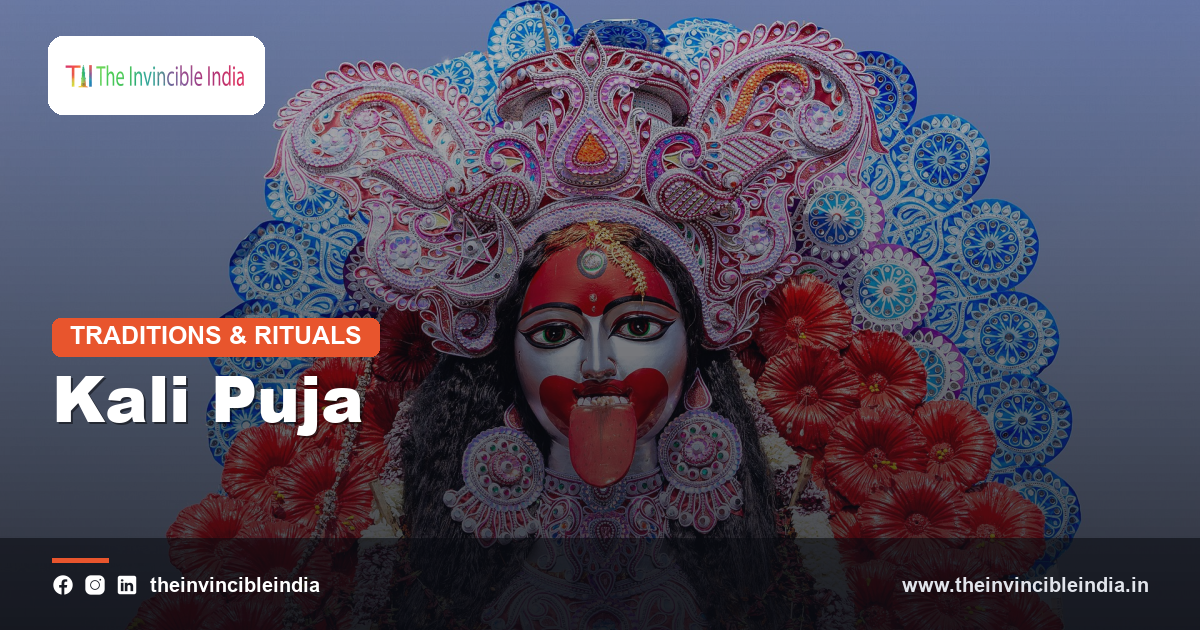
Kali Puja honours Kali, a fierce and powerful manifestation of the divine feminine, worshipped particularly in Bengal, Odisha and Assam on the same new-moon night that much of India celebrates as Diwali. Marked by midnight rituals, elaborate idols and deep devotional intensity, the festival stands apart in tone from the lamps and festivity associated with Diwali elsewhere. Kali’s iconography, striking and unconventional by comparison with many other deities, is understood as representing the destruction of evil and ignorance rather than fear for its own sake. This guide explores the festival’s meaning, rituals and regional character.
Quick Facts
| Detail | Information |
|---|---|
| Also Known As | Shyama Puja |
| Dedicated To | Goddess Kali |
| Type of Observance | Hindu festival honouring the fierce divine feminine |
| General Timing | Amavasya of Kartik, coinciding with Diwali night |
| Key Practices | Midnight worship, idol immersion, devotional singing |
| Region of Prominence | Bengal, Odisha, Assam |
Meaning and Significance
Kali Puja is dedicated to the goddess Kali, worshipped as a fierce and formidable manifestation of divine energy associated with the destruction of evil, ignorance and ego. The festival’s tone is generally more intense and solemn than many other Hindu celebrations, reflecting the distinct character of the goddess it honours.
Devotees approach Kali with a mixture of awe and deep affection, often regarding her simultaneously as a terrifying cosmic force and as a nurturing mother figure. This dual perception, at once fearsome and protective, lies at the heart of how the goddess is understood and worshipped during the festival.
Kali as a Fierce Manifestation of the Divine Feminine
Kali is typically depicted with dark or blue-black skin, a garland suggestive of severed forces of evil, and a fierce, protruding tongue, an iconography intended to convey the overpowering of destructive and negative forces. She is often shown standing upon the god Shiva, an image interpreted in various symbolic ways by different traditions.
Rather than being understood literally, this striking imagery is generally read as expressing the triumph of divine energy over chaos and ignorance. Devotional literature frequently emphasises that beneath her fearsome exterior, Kali is regarded by her worshippers as an ultimately compassionate and protective mother figure.
Position in the Hindu Calendar: Amavasya of Kartik
Kali Puja is observed on Amavasya, the new-moon night, of the lunar month of Kartik, the same night widely celebrated elsewhere in India as the main day of Diwali. This shared timing situates two distinct devotional traditions, one centred on Kali and the other on Lakshmi and Ganesha, on the same auspicious night.
As with other festivals following the lunar calendar, the precise Gregorian date varies from year to year. The choice of a moonless night for Kali’s worship is often understood as fitting, given her association with darkness as a domain over which she holds power rather than one she fears.
Relationship to Diwali
While much of India marks the main night of Diwali with the worship of Lakshmi and Ganesha, Bengal, Odisha and Assam observe the same night primarily through Kali Puja, reflecting a distinct regional devotional emphasis within the broader Diwali festival period. Lamps and fireworks associated with Diwali are still very much part of the occasion in these regions.
This regional variation illustrates how a shared festival calendar across India can nonetheless accommodate different devotional focuses, with Kali’s worship taking precedence over Lakshmi’s in the areas where her puja is most prominent, without diminishing the broader festive atmosphere of the season.
Mythological Associations
Several traditional narratives describe Kali’s emergence in moments of cosmic crisis, generally as a powerful force summoned to combat demonic threats that other deities could not overcome. These accounts, drawn from Puranic literature, present her as an embodiment of unrestrained, victorious divine energy.
As with other mythological traditions, these stories are best approached as symbolic teachings about the triumph of righteous power over chaos, rather than as literal historical events. Their persistence in devotional literature and popular retelling reflects their enduring symbolic resonance across generations.
Idol Iconography and Symbolism
Idols crafted for Kali Puja follow the goddess’s distinctive traditional iconography, including her dark complexion, multiple arms holding various symbolic implements, and her stance atop Shiva. Artisans pay close attention to capturing both the fierce power and the underlying benevolence attributed to the goddess.
The craftsmanship involved in creating these idols, often on a grand scale for larger community celebrations, reflects the same skilled traditions used for other major festival idols in Bengal and neighbouring states. The finished image becomes the central focus of the night’s elaborate worship.
Idol-Making and Pandals
In the weeks before Kali Puja, artisans, particularly in areas such as Kolkata’s Kumartuli, craft clay idols of the goddess for both household and community worship. Elaborately decorated pandals are erected in neighbourhoods and towns to house these larger community idols for public viewing and worship.
These pandals, often illuminated with lights in keeping with the broader Diwali season, draw visitors for both devotional and cultural purposes. The scale and artistry of pandal decoration have grown considerably over time, turning Kali Puja into a significant occasion for public celebration as well as private devotion.
Midnight Worship Traditions
Kali Puja is distinctive for being centred on midnight worship, with the principal rituals conducted late into the night rather than during the day. Devotees and priests gather at temples and pandals as the night deepens, offering prayers, flowers and other items at the hour considered most auspicious for the goddess.
This nocturnal structure sets Kali Puja apart from many daytime Hindu festivals and is closely tied to the goddess’s association with the night and the new moon. The hushed, lantern-lit atmosphere of midnight worship is often described by devotees as adding a particular intensity to the occasion.
Tantric Elements in Kali Puja
Kali holds a especially prominent place within Tantric traditions of worship, and some Kali Puja observances, particularly at certain temples and among specific devotional lineages, incorporate ritual elements drawn from this tradition. These practices vary considerably between locations and are generally conducted under the guidance of trained priests.
It should be noted that such specialised ritual practices are not universal, and the great majority of Kali Puja observance, whether in homes or larger community pandals, follows conventional devotional worship involving prayer, offerings and hymns rather than specialised tantric ritual.
Offerings and Ritual Practices
Offerings during Kali Puja typically include flowers, particularly red hibiscus, along with sweets, fruits and other items placed before the goddess’s image as part of the night’s worship. Priests recite hymns and mantras associated with Kali, guiding the ritual sequence through the late hours of the night.
Many households also prepare special dishes as part of the festival’s observance, shared among family after the principal rituals conclude. The combination of solemn ritual and communal sharing reflects the broader pattern found across many Hindu festivals, in which devotion and family gathering go hand in hand.
Kalighat and Dakshineswar Temples
Among the most prominent sites associated with Kali worship are the Kalighat temple and the Dakshineswar Kali temple, both in Kolkata, which draw very large numbers of devotees during Kali Puja. These temples hold long-standing significance within Bengali religious life well beyond the festival period.
During Kali Puja, these temples see especially elaborate rituals and heavy footfall, with devotees queuing for extended periods to offer prayers. Their prominence has made them closely associated with Kali worship in the popular imagination, both within Bengal and among visitors from other parts of India.
Regional Prominence in Bengal, Odisha and Assam
Kali Puja holds its greatest cultural prominence in Bengal, where it is observed with particular intensity alongside the region’s broader Diwali celebrations. In Odisha and Assam, the festival is likewise observed, often alongside local variations in ritual detail and community custom.
This regional concentration reflects the deep historical association between Kali worship and Bengali religious and cultural life in particular, even as devotion to the goddess extends, in various forms, to communities across other parts of eastern and northeastern India.
Community Celebrations and Immersion
Following the night of worship, community idols of Kali are taken in procession for immersion in rivers or other water bodies, typically within a day or two of the festival. These immersion processions are often accompanied by drumming, chanting and a festive, though still devotional, atmosphere.
As with other clay-idol festivals in the region, this immersion marks the ritual conclusion of that year’s worship, symbolically returning the material image to nature once its devotional purpose has been served, while devotion to the goddess herself continues without interruption.
Kali in Art and Devotional Literature
Kali has long been a significant subject in Bengali devotional poetry and song, with numerous compositions exploring her fierce yet maternal character. Such devotional literature has played an important role in shaping popular understanding of the goddess as both formidable and deeply compassionate.
Visual art and sculpture depicting Kali are similarly widespread, found in temples, household shrines and public pandals alike. This rich artistic and literary tradition surrounding the goddess continues to inform how she is portrayed and understood during Kali Puja each year.
Kali Puja and Shyama Sangeet
A distinctive body of devotional songs known as Shyama Sangeet, composed in praise of Kali under her epithet Shyama, is closely associated with the festival. These songs, developed over a long tradition of Bengali devotional music, are performed in homes, temples and cultural gatherings during the festival period.
Shyama Sangeet occupies an important place within Bengali musical heritage more broadly, appreciated both for its devotional content and its artistic quality. Its performance during Kali Puja reinforces the close connection between religious devotion and musical tradition that characterises much of Bengali cultural life.
The Interplay of Darkness and Light
Because Kali Puja falls on the same moonless night as Diwali, the festival unfolds against a striking visual contrast, with brightly illuminated pandals, lamps and fireworks set against the deep darkness of the new-moon sky that the goddess herself is traditionally associated with. This juxtaposition is often noted as fitting, given Kali’s role as a force that presides over darkness rather than one overcome by it.
Devotees frequently describe this combination of surrounding festive light and the goddess’s own fearsome, dark iconography as heightening the emotional intensity of the night’s worship, blending the wider Diwali season’s spirit of illumination with Kali Puja’s own distinct devotional character.
Kali Puja Today
In present-day Bengal and neighbouring states, Kali Puja continues to be marked by grand community pandals, midnight worship and devotional music, even as celebrations have grown in scale and public visibility over time. Illuminated pandals and organised crowd arrangements now feature prominently in larger urban celebrations.
Despite these changes in scale, the festival’s essential character, an intense night of devotion to a goddess understood as both fierce protector and compassionate mother, remains consistent with its long-standing tradition, continuing to draw deep reverence from devotees each year.
Sources & Further Reading
- Ministry of Culture, Government of India (indiaculture.gov.in).
- Sangeet Natak Akademi (sangeetnatak.gov.in).
Frequently Asked Questions
What is Kali Puja?
Kali Puja is a Hindu festival honouring the goddess Kali, observed with midnight worship on the same new-moon night widely celebrated as Diwali.
When is Kali Puja celebrated?
It falls on Amavasya, the new-moon night, of the lunar month of Kartik, coinciding with the main night of Diwali.
Why is Kali Puja mainly observed in Bengal?
Bengal, along with Odisha and Assam, has a long-standing regional devotional emphasis on Kali worship during this night, distinct from the Lakshmi worship observed elsewhere.
What is Shyama Sangeet?
Shyama Sangeet is a body of devotional Bengali songs composed in praise of Kali, performed widely during Kali Puja celebrations.
Which temples are important for Kali worship?
The Kalighat temple and the Dakshineswar Kali temple in Kolkata are among the most prominent sites associated with Kali worship.


