

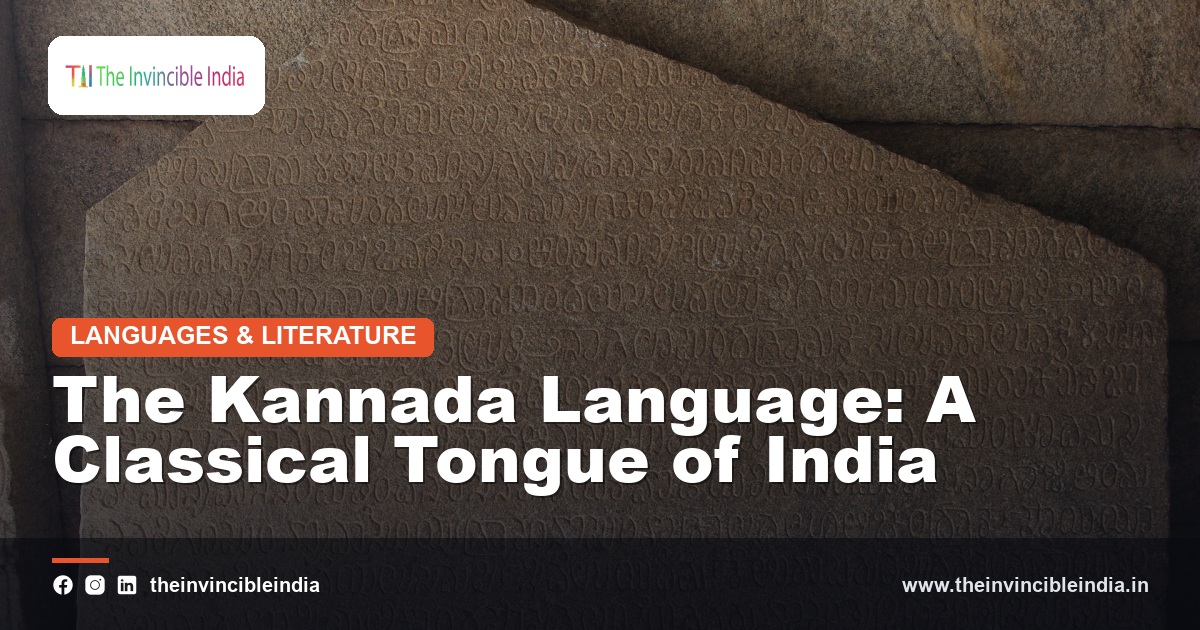
Kannada is one of the major Dravidian languages of India, spoken chiefly across the southern state of Karnataka and by communities in neighbouring regions and abroad. It belongs to a linguistic family distinct from the Indo-Aryan languages of the north, sharing deep structural kinship with other prominent tongues discussed in our overview of the languages of India. Kannada boasts a long literary tradition, attested in inscriptions many centuries old and sustained through poetry, devotional verse and prose that continues into the present day. Recognised by the Government of India as a Classical Language, it remains a living, evolving medium of everyday communication, administration, cinema and literature. This guide surveys its origins, script, literature and continuing role in Indian life.
Quick Facts
| Detail | Information |
|---|---|
| Language Family | Dravidian |
| Primary Region | Karnataka, southern India |
| Script | Kannada script, derived from ancient Brahmi |
| Classical Status | Recognised by the Government of India as a Classical Language |
| Early Inscriptions | Attested in inscriptions many centuries old, including the Halmidi inscription |
| Major Literary Forms | Vachana poetry, campu narrative verse, modern novel and short story |
Origins and Language Family
Kannada belongs to the Dravidian language family, one of the major language families of the Indian subcontinent, alongside other prominent members such as Tamil, Telugu and Malayalam. Linguists trace its development over many centuries from an early common Dravidian source, with Kannada gradually acquiring distinct grammatical and phonological features that set it apart from its sister languages. Its evolution reflects centuries of contact with Sanskrit and Prakrit, from which Kannada absorbed considerable vocabulary while retaining a fundamentally Dravidian grammatical structure.
This layered history, a Dravidian base enriched by long interaction with Indo-Aryan languages, gives Kannada a distinctive vocabulary that draws on both linguistic streams. The result is a language capable of expressing both indigenous idiom and classical learning, a duality reflected clearly in its literary tradition.
The Kannada Script
The Kannada script is a syllabic writing system descended, like most scripts of southern India, from the ancient Brahmi script that spread across the subcontinent in antiquity. Over centuries, the script evolved through intermediate forms shared with Telugu before settling into its present rounded, flowing characters, well suited to being carved into stone and later written on palm leaf and paper.
Each character in the script generally represents a consonant-vowel combination, a feature typical of Brahmic scripts, allowing for compact and precise representation of spoken Kannada. The script’s distinctive curves are often attributed to the practice of writing on palm leaves, where straight lines risked splitting the leaf. Today the script is taught in schools across Karnataka and used in print, digital typography and everyday signage throughout the region.
The Halmidi Inscription
Among the most significant milestones in the documented history of Kannada is the Halmidi inscription, found in Halmidi village in Karnataka, widely regarded as one of the earliest known inscriptions in the Kannada language. Carved on stone, it provides valuable evidence of an early, developed form of Kannada already in administrative and commemorative use many centuries ago.
The inscription is celebrated not only for its linguistic content but also for what it reveals about the antiquity of Kannada as a language of record, distinct from the Sanskrit and Prakrit inscriptions common in earlier periods across India. It remains an important reference point for scholars studying the historical development of the language and is commemorated in Karnataka as a symbol of the language’s long and continuous heritage.
Early and Classical Kannada Literature
Kannada possesses one of the oldest continuous literary traditions among the Dravidian languages, with early works of poetics and courtly literature composed many centuries ago. Among the earliest surviving treatises is a work on poetics that discusses literary composition in Kannada itself, indicating an already mature literary culture capable of critical reflection on its own tradition.
Court poets associated with various royal dynasties that ruled parts of Karnataka contributed to a flourishing tradition of campu literature, a mixed form combining prose and verse, often treating themes from religious epics and court life. This early classical output laid a foundation upon which later centuries of Kannada poetry, both courtly and devotional, would continue to build.
Vachana Literature and the Medieval Period
One of the most distinctive contributions to Kannada literature emerged during the medieval period through the vachana movement, a body of pithy devotional and philosophical sayings composed in accessible, conversational Kannada rather than ornate courtly language. These vachanas, attributed to a wide range of poet-saints including women and people from many social backgrounds, addressed themes of devotion, social equality and ethical conduct.
The movement is notable for its use of everyday language rather than Sanskritised diction, making its ideas widely accessible beyond a narrow literate elite. This body of literature is still read and recited widely in Karnataka today, valued both for its spiritual content and for its role in broadening who could participate in literary and devotional expression.
Geographic Spread and Speaker Communities
Kannada is the principal language of Karnataka, where it serves as the medium of daily life, administration, education and media for the majority of the state’s population. Beyond Karnataka’s borders, significant Kannada-speaking communities exist in neighbouring states such as Maharashtra, Tamil Nadu, Andhra Pradesh and Telangana, reflecting long-standing patterns of regional migration and settlement.
Kannada-speaking communities are also found among the Indian diaspora worldwide, particularly in regions with strong ties to the information technology and professional sectors centred on cities such as Bengaluru. Cultural associations abroad continue to organise Kannada-language events, publications and classes, helping sustain the language among speakers living outside India.
Phonology and Sound System
Kannada possesses a rich phonological inventory typical of Dravidian languages, including a set of retroflex consonants pronounced with the tongue curled back against the roof of the mouth, a feature that distinguishes many South Asian languages from those of Europe. It also maintains a distinction between short and long vowels, which can change the meaning of otherwise similar-sounding words.
Through centuries of contact with Sanskrit, Kannada also absorbed sounds and consonant clusters not originally native to Dravidian speech, particularly in vocabulary borrowed for religious, philosophical and administrative purposes. This blending of native Dravidian phonology with borrowed Sanskritic elements gives spoken Kannada a distinctive texture, audible in both formal and everyday registers of the language.
Grammar and Sentence Structure
Like other Dravidian languages, Kannada follows a subject-object-verb sentence order, placing the verb at the end of a sentence rather than in the middle, as is typical of English. It is an agglutinative language, meaning that grammatical relationships such as tense, case and number are expressed by attaching suffixes to root words rather than through separate function words.
Nouns in Kannada are inflected for case, indicating their grammatical role in a sentence, while verbs carry markers for tense, person and number. This systematic, suffix-based grammar allows for considerable flexibility in word order for emphasis, even while the basic subject-object-verb pattern remains the norm in ordinary speech and writing.
Dialects of Kannada
Kannada exhibits considerable dialectal variation across the regions where it is spoken, shaped by geography, historical kingdoms and social factors. Broadly, scholars distinguish between the standard, literary form used in writing, education and media, and numerous regional and colloquial dialects spoken in everyday life across different parts of Karnataka.
Dialects associated with coastal Karnataka, the northern districts bordering Maharashtra, and the southern region around Mysuru each carry distinct vocabulary, pronunciation and idiom, reflecting the state’s diverse cultural geography. Despite these variations, speakers of different dialects generally understand one another without great difficulty, with the standardised literary form serving as a common reference point across the language community.
Kannada Poetry Traditions
Poetry has occupied a central place in Kannada literary culture from its earliest recorded works through to the present day. Classical court poetry, often composed in elaborate metres and drawing heavily on themes from Puranic and epic literature, coexisted historically with the more accessible devotional verse of the vachana tradition and later bhakti poets.
Modern Kannada poetry, emerging from the nineteenth and twentieth centuries onward, absorbed new influences from social reform movements and contact with other literary traditions, while retaining strong roots in the language’s classical and devotional past. This continuity between old and new forms of verse is often cited as a distinguishing strength of the Kannada literary tradition.
Kannada Prose and the Modern Novel
The rise of the modern Kannada novel and short story in more recent centuries marked a significant expansion of the language’s literary range, moving beyond poetry and courtly narrative into realist depictions of everyday life, social change and individual experience. Writers working in these modern prose forms engaged with themes of caste, gender, rural life and the transformations brought by wider social and economic change.
This body of modern fiction has earned Kannada literature recognition at a national level, with numerous Kannada writers honoured for their contributions to Indian literature more broadly. The strength of this prose tradition continues to be reflected in a steady output of novels, short stories and literary criticism published in the language today.
Kannada Cinema and Performing Arts
Kannada cinema, commonly referred to as Sandalwood, forms a significant part of the broader Indian film industry, producing a steady stream of films across genres each year and serving as a major platform for the language’s continued cultural visibility. Kannada theatre, too, has a long tradition, including folk performance forms as well as modern stage drama.
Beyond cinema and theatre, Kannada is closely associated with classical and folk music traditions performed across Karnataka, from Carnatic vocal music to regional folk forms tied to local festivals and rural life. Together, these performing arts traditions ensure that Kannada continues to reach audiences well beyond the printed page, sustaining the language’s presence in popular culture.
Classical Language Status and Recognition
In recognition of its ancient literary heritage, Kannada has been accorded the status of a Classical Language of India by the Government of India, a designation reserved for languages with a long and independently developed body of ancient literature. This recognition acknowledges the antiquity of Kannada’s written record, stretching back many centuries through inscriptions and early literary works.
The classical status has also supported academic and cultural initiatives aimed at further study and preservation of ancient Kannada texts, including manuscript conservation and dedicated research centres. Such recognition situates Kannada alongside a small group of Indian languages honoured for the depth and continuity of their literary traditions.
Kannada in Education and Administration
Kannada serves as the primary medium of instruction in a large number of schools across Karnataka, alongside its use as a compulsory subject in many others, reflecting its role as the state’s principal language of everyday and institutional life. It is also the official language of the Karnataka state government, used extensively in administration, legislation and public communication.
Universities and research institutions across Karnataka offer advanced study in Kannada language and literature, supporting a continuing tradition of scholarship. This institutional presence, spanning schools, government offices and universities, ensures that Kannada remains deeply embedded in the formal structures of public life within the state.
Preservation and Promotion Efforts
A range of cultural and academic institutions are dedicated to the preservation and promotion of the Kannada language, including bodies focused on literary research, manuscript conservation and public advocacy for the language’s continued use. Annual literary conferences and festivals celebrate Kannada writers and works, drawing scholars, readers and the general public together in recognition of the language’s heritage.
Community organisations, both within Karnataka and among the diaspora, also play a role in promoting Kannada through language classes, publications and cultural events. These combined efforts, spanning formal institutions and grassroots community initiatives, reflect a broad and sustained commitment to ensuring the language’s continued vitality across generations.
Kannada Today
Kannada today remains a vibrant, living language, spoken by a large population across Karnataka and beyond, and actively used in literature, cinema, media, administration and digital communication. Its long historical arc, from ancient inscriptions through medieval devotional poetry to a flourishing modern literary and film culture, illustrates a remarkable continuity rarely matched among the world’s languages.
As Karnataka continues to grow as a centre of education, technology and culture, Kannada adapts alongside it, absorbing new vocabulary and finding new platforms for expression while retaining its distinct grammatical character and deep literary roots. This blend of ancient heritage and contemporary relevance ensures that Kannada continues to hold a secure place among India’s major languages.
Sources & Further Reading
- Sahitya Akademi.
- Ministry of Culture, Government of India (indiaculture.gov.in).
Frequently Asked Questions
What language family does Kannada belong to?
Kannada belongs to the Dravidian language family, sharing deep structural roots with languages such as Tamil, Telugu and Malayalam while having developed its own distinct grammar and vocabulary over many centuries.
What script is used to write Kannada?
Kannada is written in its own script, a syllabic writing system descended from the ancient Brahmi script, featuring rounded characters historically well suited to writing on palm leaves.
What is the Halmidi inscription?
The Halmidi inscription is widely regarded as one of the earliest known inscriptions in the Kannada language, providing important evidence of an early, developed form of the language in administrative use.
Is Kannada a classical language?
Yes, Kannada has been recognised by the Government of India as a Classical Language, in acknowledgement of its ancient and continuously developed literary tradition.
Where is Kannada mainly spoken?
Kannada is the principal language of the southern Indian state of Karnataka, with speaker communities also present in neighbouring states and among the Indian diaspora worldwide.


