

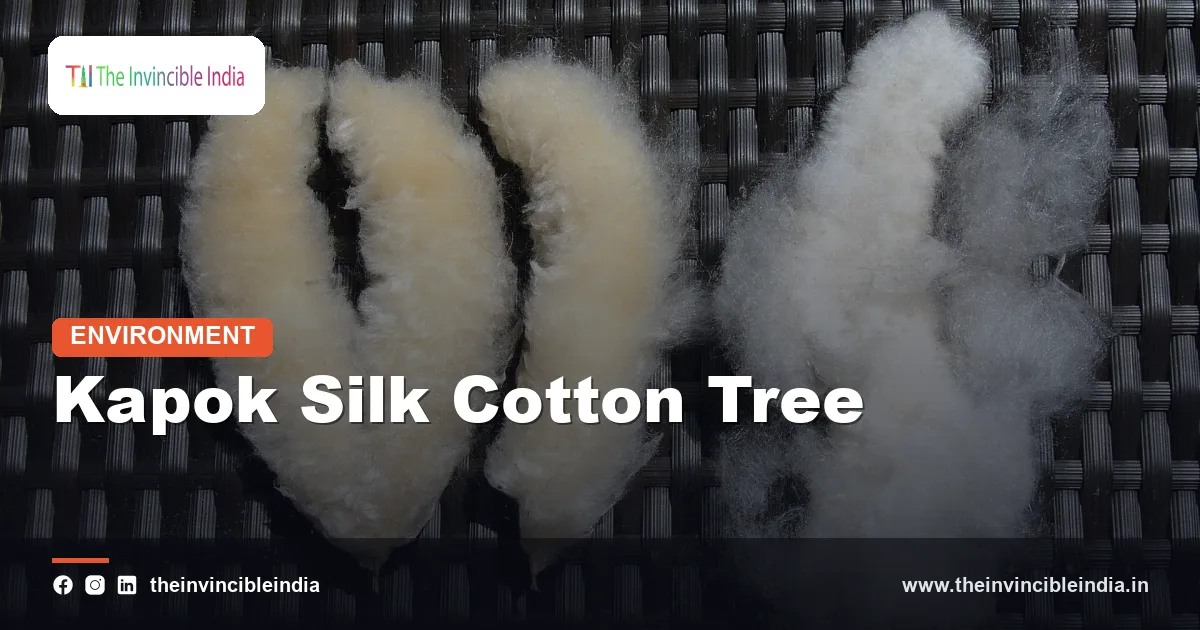
The kapok is the tall tropical tree Ceiba pentandra, also called the white silk cotton tree, whose long pods burst open to release a silky, water-resistant floss that has long been used to stuff pillows, mattresses and life jackets. In India it is a planted and naturalised tree, and it is easily confused with the red silk cotton or semal (Bombax ceiba), a different tree that is native to the country.
This explainer describes the kapok tree, how it differs from the red silk cotton, where it grows, what the floss is and how it has been used, along with the tree’s flowers, wood, seeds and ecological role. Names are given in English and in major Indian languages to help readers identify the right tree.
| Attribute | Details |
|---|---|
| Common names | Kapok, white silk cotton tree, ceiba, Java cotton, safed semal (Hindi) |
| Botanical name | Ceiba pentandra (L.) Gaertn. |
| Family | Malvaceae (formerly placed in Bombacaceae) |
| Tree type | Very tall, fast-growing, deciduous or semi-evergreen tropical tree with a buttressed trunk |
| Part used | Floss from the pods, seed oil, wood, young leaves and gum |
| Native range | Tropical America and West Africa; introduced to Asia, including India |
| Where found in India | Planted and naturalised in the south, coasts and warm humid regions, along roads and in compounds |
| Key product | Kapok floss, a light, buoyant, hollow-celled fibre |
| Notable fact | Not the same tree as the red silk cotton (Bombax ceiba), which is native to India |
Key Takeaways
- Kapok is the common name of Ceiba pentandra, the white silk cotton tree, whose pods contain a silky floss that is light, buoyant and water-resistant.
- Kapok (Ceiba pentandra) is a different tree from the red silk cotton or semal (Bombax ceiba), which is native to India and has bright red flowers and large conical thorns.
- The kapok tree is native to tropical America and West Africa and was introduced to India and Southeast Asia, where it is widely planted and naturalised.
- Kapok floss is made of fine, hollow, air-filled fibres, which is why it has been used in life jackets, pillows, mattresses and insulation.
- The fibre of kapok is too smooth and brittle to spin into thread well, so it is used as a stuffing and not as a textile yarn.
- The kapok tree has palmately compound leaves, small whitish to pale pink flowers that are pollinated mainly by bats, and a broad, buttressed trunk that can grow very large.
What is kapok?
Kapok is both the name of a tree and the name of the fibre it produces. The tree is Ceiba pentandra, a giant of tropical forests, and the fibre is the soft, silky, cotton-like floss that fills its seed pods. The word kapok came into English from Malay, and the fibre was traded across Asia for centuries.
The tree belongs to the Malvaceae family, which also includes cotton, hibiscus, okra and the baobab. Older books place it in the separate family Bombacaceae, and botanists later merged that family into Malvaceae, so both names appear in the literature.
In India the tree is known as safed semal in Hindi, which means “white silk cotton”, and under other names in different regions, such as ilavu in Malayalam, ilavam panju in Tamil and buruga in Telugu. These regional names sometimes also cover the red silk cotton, so the botanical name is the dependable identifier.
Is kapok the same as the red silk cotton tree?
No, kapok is not the same as the red silk cotton tree. Kapok is Ceiba pentandra, the white silk cotton, while the red silk cotton, called semal in Hindi, is Bombax ceiba, a separate tree that is native to India. The two are related members of the same plant family and both produce cotton-like floss, which is why they are often mixed up.
| Feature | Kapok (white silk cotton) | Red silk cotton (semal) |
|---|---|---|
| Botanical name | Ceiba pentandra | Bombax ceiba |
| Origin | Tropical America and West Africa | South and Southeast Asia, including India |
| Flowers | Small, whitish to pale pink, bell-shaped, bat-pollinated | Large, bright red to orange, cup-shaped, bloom on bare branches |
| Leaflets per leaf | Usually 5 to 9, narrow | Usually 5 to 7, broader |
| Thorns | Conical spines on young trunks and branches | Large, conical thorns on the trunk, especially when young |
| Pods | Long, smooth, elongated, green to brown | Shorter, woody, splitting to release white cotton |
| Floss | Kapok, valued as a stuffing | Semal cotton, generally coarser and less valued |
| Typical flowering | Dry season, often on leafless branches | Late winter to early spring (about February to March) |
The two trees are best told apart by their flowers. A tree covered in large, vivid red blossoms in February or March, with no leaves, is the red silk cotton. A tall tree with small, pale, bell-like flowers is more likely to be kapok. The trunks, thorns and pod shape give further clues.
What does the kapok tree look like?
The kapok tree is a very tall, straight-trunked tree, often rising above 30 metres, with a broad crown and horizontal, tiered branches. The trunk is usually grey and smooth, and young trees carry stout conical spines that can fall away as the tree ages. Old trees develop large, plank-like buttresses at the base that help support the great height.
The leaves are palmately compound, meaning that five to nine narrow leaflets spread out like fingers from the end of a long stalk. Many kapok trees shed their leaves in the dry season, and in drier areas the tree may flower while bare.
The flowers are small, about 3 to 5 centimetres long, white to pale pink or yellowish, with a faint, slightly unpleasant smell that attracts bats. The fruit is a smooth, elongated capsule, usually 10 to 20 centimetres long, which turns brown and splits open when ripe to release floss with small round dark seeds embedded in it.
Features that identify kapok
- A very tall tree with tiered, horizontal branches
- Large buttress roots on mature trees
- Leaves with five to nine fingers-like leaflets
- Small pale flowers that open in the dry season
- Smooth, elongated pods that split to show silky white fibre
Where does the kapok tree grow in India?
The kapok tree grows in warm, humid parts of India, mostly as a planted or naturalised tree along roadsides, in village compounds, plantations and temple grounds. It is more common in the south and along the coasts and in regions with plentiful rainfall than in dry or cold areas.
The tree is not native to India. Its original home is the tropics of Central and South America and West Africa, and it spread to Asia through trade and cultivation, with Java and the wider Indonesian region becoming a leading source of commercial kapok. For this reason, the fibre was widely called Java cotton in trade.
It prefers deep, well-drained soil, plenty of sunshine and a warm climate. Frost damages it, and it does not tolerate waterlogging for long. Because of its very fast early growth, it is often planted as a shade, fibre or avenue tree.
What is kapok floss and how is it used?
Kapok floss is the silky fibre inside the pods of Ceiba pentandra, and it is used mainly as a light, buoyant stuffing for pillows, mattresses, cushions, soft toys and life-saving gear. Each fibre is hollow and coated with a waxy layer, so the floss is very light and does not easily absorb water.
These properties explain the traditional uses of the fibre. Because it is largely made of air-filled cells, kapok can keep a person afloat, and it was widely used in life jackets and buoys in the earlier twentieth century, until synthetic foams largely replaced it in marine use. It is also a good thermal and sound insulator and has been used in insulation and in some acoustic applications.
Why kapok is not spun into cloth
Kapok fibres are short, smooth and brittle, and they have little grip on one another, so they cannot be spun into a strong thread the way cotton can. For this reason, kapok stays a stuffing and padding fibre and does not become a woven textile.
Typical uses of the floss
- Pillows, mattresses and quilts
- Cushions, bolsters and soft toys
- Life jackets, life rafts and buoyancy aids (historical and in some niche uses)
- Thermal and sound insulation
- Padding for upholstery and saddles
Kapok is flammable and can pack down over time, so pillows and mattresses of the fibre often need to be fluffed or re-stuffed. Modern synthetic fills are cheaper and more durable, which has reduced the market for kapok, although natural-fibre and eco-friendly bedding still values it.
How is kapok harvested and processed?
Kapok is harvested by collecting the mature pods when they dry and begin to split, then separating the floss from the seeds and husks. The pods are usually collected from the ground after they fall, or knocked from the tree, since climbing very tall trees is difficult and dangerous.
The pods are opened, the floss is pulled out by hand or machine, and the seeds are removed. The fibre is then dried in the sun, cleaned of husk fragments and packed. Because the floss is so light and bulky, it is usually compressed into bales for transport.
The seeds are not wasted. They contain oil, and kapok seed oil is used in soap making and, after refining, as a cooking and industrial oil in some regions. The pressed seed cake is used as animal feed or manure in places where it is permitted.
What other uses does the kapok tree have?
Beyond the floss, the kapok tree provides seed oil, light timber, gum and edible young parts. The wood is soft and light, not strong enough for heavy construction, but it has been used for boxes, packing cases, plywood core, floats and canoes in places where the tree is common.
- Seed oil: used in soap making and as an industrial oil, and edible in some regions after refining
- Wood: soft and light, used for crates, plywood, floats and simple dug-out boats
- Gum: the tree exudes a gum used in traditional preparations
- Leaves and young shoots: eaten in some cultures and used as animal fodder
- Shade and avenue planting: the tall, spreading crown provides large amounts of shade
Traditional medicine in several tropical regions uses parts of the tree, such as the bark and leaves, for various ailments. These uses are folk practices and are not proven medical treatments, and readers should not take them as health advice.
Why is the kapok tree important for wildlife?
The kapok tree is important for wildlife because its night-opening flowers feed bats, its height shelters birds and its branches support epiphytes in its native forests. In the American tropics, the ceiba is a classic emergent tree, rising above the rest of the rainforest canopy.
Bats are the main pollinators of the flowers, visiting at night for nectar and carrying pollen on their fur. Birds, insects and small mammals use the tree for nesting and shelter, and the large flowering display gives food during the dry season, when other sources are scarce. In India, planted kapok trees can similarly help bats, bees and birds, especially where native trees are few.
The tree also holds a deep cultural meaning in some places. In Central America, the ceiba has been treated as a sacred tree by the Maya, and it remains the national tree of Guatemala. This symbolic role belongs to the American home of the tree and is not part of Indian tradition, which has its own cultural associations with the semal.
How is kapok different from cotton?
Kapok is different from cotton in its source, its fibre structure and its use: kapok comes from the pods of a tall tree, while cotton comes from the seed capsules of a low shrub of the genus Gossypium. Both are plant seed fibres in the Malvaceae family, but they behave very differently.
| Feature | Kapok | Cotton |
|---|---|---|
| Source plant | Ceiba pentandra, a tall tree | Gossypium species, a shrub grown as a crop |
| Fibre structure | Hollow, thin-walled, waxy, brittle | Twisted, flat ribbon, strong |
| Spinnable into yarn | No, too smooth and brittle | Yes, the basis of cotton textiles |
| Buoyancy | Very high | Low |
| Main use | Stuffing and insulation | Woven and knitted cloth |
Understanding this difference clears up a common idea that kapok and semal cotton can be spun into cloth in the way that cotton can be. They cannot, and that is why they remain specialist stuffing fibres.
Bottom Line
Kapok, the white silk cotton tree, is a tall tropical tree from the Americas and Africa that is now part of the Indian landscape, valued for a silky, buoyant floss used as stuffing and insulation. Readers in India should remember that it is not the red-flowered semal (Bombax ceiba), which is native to the country and belongs to a different genus.
Frequently Asked Questions
What is kapok?
Kapok is the common name of the tree Ceiba pentandra and also of the silky floss inside its pods. The floss is light, hollow and water-resistant, so it is used to stuff pillows, mattresses and life jackets. The tree is native to tropical America and West Africa and is grown in India.
Is kapok the same as semal?
No, kapok (Ceiba pentandra) is the white silk cotton, while semal is the red silk cotton tree, Bombax ceiba. They are related but belong to different genera, and semal is native to India whereas kapok was introduced. Semal has large red flowers, and kapok has small pale ones.
Is kapok native to India?
No, kapok is not native to India. The tree comes from the tropics of Central and South America and West Africa and was introduced to Asia through trade and cultivation. In India it is planted and naturalised, mainly in warm, humid areas.
Why can kapok not be spun into cloth?
Kapok cannot be spun into cloth because its fibres are short, smooth, brittle and hollow, so they do not grip each other to form strong thread. Cotton fibres are twisted and flat, which lets them be spun. This is why kapok is used as stuffing and insulation.
What is kapok used for?
Kapok is used mainly as a light stuffing for pillows, mattresses, cushions and soft toys, and historically for life jackets and insulation. Its seed oil is used in soap making, and its soft wood is used for packing cases and floats. Synthetic materials have replaced much of its older use.
How can you tell kapok from the red silk cotton tree?
The easiest way to tell kapok from the red silk cotton is by the flowers: kapok has small, pale, bell-shaped flowers, while the red silk cotton has large, bright red flowers that open on bare branches around February and March. The pods and thorns also differ. Kapok pods are long and smooth, and the red silk cotton has shorter, woody pods.
{“@context”:”https://schema.org”,”@graph”:[{“@type”:”FAQPage”,”mainEntity”:[{“@type”:”Question”,”name”:”What is kapok?”,”acceptedAnswer”:{“@type”:”Answer”,”text”:”Kapok is the common name of the tree Ceiba pentandra and also of the silky floss inside its pods. The floss is light, hollow and water-resistant, so it is used to stuff pillows, mattresses and life jackets. The tree is native to tropical America and West Africa and is grown in India.”}},{“@type”:”Question”,”name”:”Is kapok the same as semal?”,”acceptedAnswer”:{“@type”:”Answer”,”text”:”No, kapok (Ceiba pentandra) is the white silk cotton, while semal is the red silk cotton tree, Bombax ceiba. They are related but belong to different genera, and semal is native to India whereas kapok was introduced. Semal has large red flowers, and kapok has small pale ones.”}},{“@type”:”Question”,”name”:”Is kapok native to India?”,”acceptedAnswer”:{“@type”:”Answer”,”text”:”No, kapok is not native to India. The tree comes from the tropics of Central and South America and West Africa and was introduced to Asia through trade and cultivation. In India it is planted and naturalised, mainly in warm, humid areas.”}},{“@type”:”Question”,”name”:”Why can kapok not be spun into cloth?”,”acceptedAnswer”:{“@type”:”Answer”,”text”:”Kapok cannot be spun into cloth because its fibres are short, smooth, brittle and hollow, so they do not grip each other to form strong thread. Cotton fibres are twisted and flat, which lets them be spun. This is why kapok is used as stuffing and insulation.”}},{“@type”:”Question”,”name”:”What is kapok used for?”,”acceptedAnswer”:{“@type”:”Answer”,”text”:”Kapok is used mainly as a light stuffing for pillows, mattresses, cushions and soft toys, and historically for life jackets and insulation. Its seed oil is used in soap making, and its soft wood is used for packing cases and floats. Synthetic materials have replaced much of its older use.”}},{“@type”:”Question”,”name”:”How can you tell kapok from the red silk cotton tree?”,”acceptedAnswer”:{“@type”:”Answer”,”text”:”The easiest way to tell kapok from the red silk cotton is by the flowers: kapok has small, pale, bell-shaped flowers, while the red silk cotton has large, bright red flowers that open on bare branches around February and March. The pods and thorns also differ. Kapok pods are long and smooth, and the red silk cotton has shorter, woody pods.”}}]}]}


