

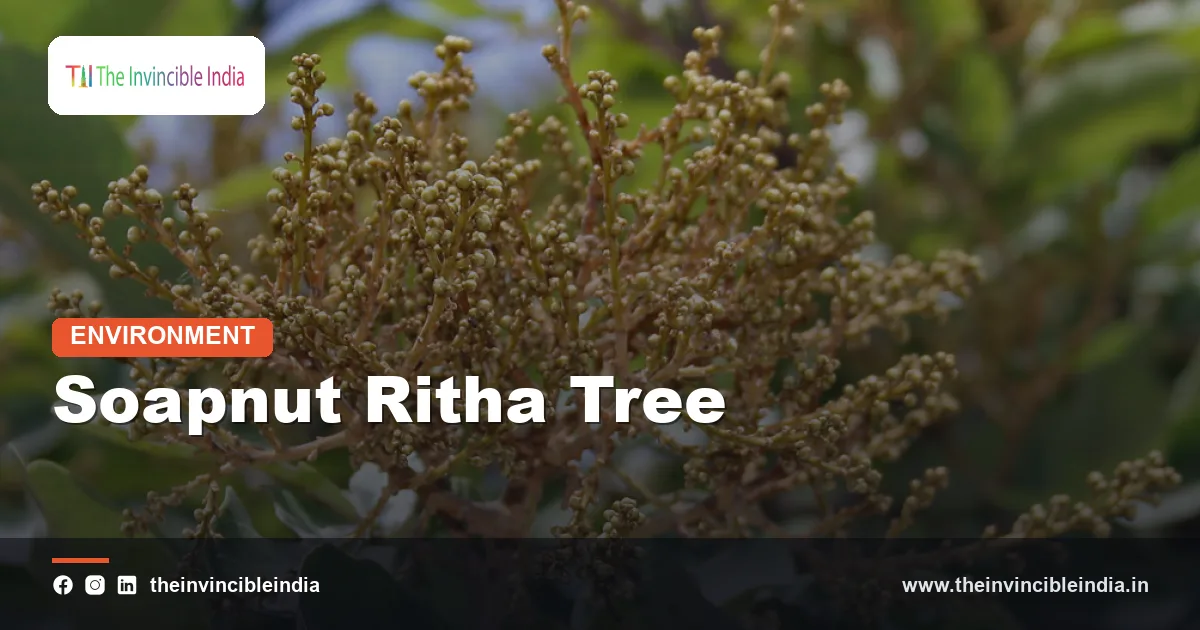
The soapnut, known in Hindi as ritha or reetha, is the fruit of the soapberry tree (genus Sapindus), whose saponin-rich shells foam in water and have been used in India for centuries as a natural soap, shampoo and cleaner. It is the fruit of a large, deciduous tree, and a handful of dried soapnut shells, soaked or boiled in water, produces a mild, slippery lather that washes hair, wool, silver and cloth.
This explainer describes the soapnut tree and its fruit, the species found in India, why the fruit foams, how it is traditionally used for hair and laundry, what care is needed and why this natural cleaner is attracting renewed interest. The traditional uses described here are general information.
| Attribute | Details |
|---|---|
| Common names | Soapnut, soapberry, ritha, reetha, areetha, aritha, arishtaka (Sanskrit) |
| Botanical names | Sapindus mukorossi (northern); Sapindus trifoliatus and Sapindus emarginatus (peninsular) |
| Family | Sapindaceae (the soapberry family, which also includes litchi and rambutan) |
| Tree type | Medium to large deciduous tree with pinnate leaves |
| Part used | Dried fruit shell (pericarp); the black seed is removed |
| Where found in India | Sub-Himalayan foothills and the Himalayan belt for S. mukorossi; Western Ghats, South and central India for the other species |
| Active constituents | Triterpenoid saponins, which are natural foaming agents |
| Key uses | Natural soap, shampoo, laundry cleaner, jewellery cleaner and traditional medicine |
| Notable fact | Saponins in the fruit are toxic to fish, so soapnut wash water should not be poured into ponds or streams |
Key Takeaways
- The soapnut (ritha or reetha) is the dried fruit of trees of the genus Sapindus, and its shell contains saponins that produce a natural foaming lather in water.
- Sapindus mukorossi is the main soapnut tree of northern India and the Himalayan foothills, while Sapindus trifoliatus and Sapindus emarginatus grow in South and central India.
- Soapnut belongs to the family Sapindaceae, the same family as litchi, rambutan and longan.
- Only the dried outer shell of the soapnut fruit is used for washing, and the hard black seed inside is removed and has no cleaning value.
- Soapnut wash water is biodegradable, but its saponins are harmful to fish and should not be discharged directly into ponds and streams.
- Soapnut is traditionally combined with shikakai and amla for hair washing in India, and its Ayurvedic medicinal uses are traditional and not proven medical claims.
What is a soapnut?
A soapnut is the dried fruit of a soapberry tree of the genus Sapindus, and it is called ritha or reetha in Hindi. Despite the name, it is not a true nut but a small, round, fleshy fruit that dries into a wrinkled, sticky, brown shell around a single hard black seed.
The outer shell contains saponins, which are natural soap-like compounds. When the shell is crushed, soaked or boiled in water, the saponins reduce the surface tension of the water, and the liquid foams and cleans without any added chemical detergent. This is the principle behind its long use as a soap.
In Sanskrit the fruit is called arishtaka or phenila, the latter meaning “foamy”. In English the fruit is also called soapberry, washnut or soap nut, and the same name can cover several species that grow in different parts of the world.
Which soapnut trees grow in India?
Three Sapindus species are the most commonly mentioned in India: Sapindus mukorossi in the north, and Sapindus trifoliatus and Sapindus emarginatus in the south and centre. All belong to the same genus and all produce saponin-rich fruits.
| Species | Common names | Main region in India | Notable features |
|---|---|---|---|
| Sapindus mukorossi | Ritha, reetha, Indian soapnut | Sub-Himalayan foothills and lower Himalayan valleys | Large tree, pinnate leaves with several pairs of leaflets, yellowish-brown round fruits |
| Sapindus trifoliatus | South Indian soapnut, poovandikottai (Tamil), antuwala (Kannada) | Western Ghats and southern India | Leaves with three pairs of leaflets, hairy fruit clusters, generally smaller fruits |
| Sapindus emarginatus | Soapnut, soapberry | Peninsular and parts of central India | Leaflets with notched tips, orange-brown fruit |
The northern species, Sapindus mukorossi, is the one most often sold in markets as the standard ritha and the one most widely exported. The species differ in the amount of saponin and the size of the fruit, so strength can vary between sources.
What does the soapnut tree look like?
The soapnut tree is a medium to large deciduous tree, often 10 to 20 metres tall, with a rounded crown and a straight trunk covered in grey to brown bark. In the Himalayan foothills it can grow into a handsome, shady tree, often seen near villages and farm boundaries.
The leaves are pinnate, meaning they have many leaflets arranged in pairs along a central stalk, and the leaflets are lance-shaped with a pointed tip. The tree sheds its leaves for a short period in the cooler months, and the leaves turn yellow before they fall.
Small, whitish to greenish-white flowers appear in large branched clusters at the ends of the twigs, usually around summer. The fruits develop through the rainy season and ripen in autumn and early winter, turning from green to yellowish-brown. Each fruit is round, about 2 to 3 centimetres across, with a thick, translucent, sticky shell that wrinkles on drying and encloses a single glossy black seed.
Features that help identify the tree
- Pinnate leaves with several pairs of lance-shaped leaflets
- Large clusters of small whitish flowers at the branch tips
- Round, fleshy fruits that turn yellowish-brown when ripe
- A single hard, glossy black seed inside each fruit
- A sticky, soapy feel to the crushed fruit when wet
Why does soapnut foam?
Soapnut foams because its shell is rich in saponins, a class of natural compounds whose molecules have a water-loving end and a fat-loving end. This structure lets saponins lower the surface tension of water, trap air to form lather and lift oil and dirt away from fabric or hair.
The name saponin comes from the Latin word sapo, meaning soap, and the Sapindus genus name itself comes from the Latin sapo indicus, meaning “Indian soap”. Saponins are found in many plants, but in soapnut they are present in high quantities in the fruit shell, which is what makes the fruit such a practical cleaner.
The lather of soapnut is mild and low-foaming compared with commercial detergents. This is normal, and a weak lather does not mean that the cleaning has failed. The cleaning effect comes mainly from the saponins loosening grease, and rinsing does the rest.
How is soapnut traditionally used?
Soapnut is traditionally used in India to wash hair, woollen clothes and delicate fabrics, to clean silver and gold jewellery and as a general household cleaner. Its gentle action made it especially valued for fine textiles that harsh alkaline soaps could damage.
For hair
Soapnut shells are soaked or boiled in water, and the strained liquid is used as a shampoo. In traditional hair care, soapnut is often combined with shikakai (Acacia concinna) and amla (Phyllanthus emblica) to make a herbal wash. The liquid is mild but can sting the eyes, so care must be taken while rinsing.
For laundry
For laundry, a few shells are placed in a small cloth bag and added to the wash, or the shell liquid is prepared in advance. Soapnut is traditionally used on woollens, silk and pashmina, which do not take well to strong detergents. Light-coloured and delicate fabrics are the usual choices.
For jewellery and household use
A warm soapnut solution has been used to clean silver, brass and gold ornaments, restoring shine by removing oil and grime. The liquid is also used to wash fruit and vegetables, to clean floors and utensils and, in some homes, to wash pets, although a vet’s advice is sensible for animals.
- Hair: soapnut liquid alone or blended with shikakai and amla
- Delicate fabrics: wool, silk and pashmina
- Everyday laundry: shells in a cloth bag in the wash
- Jewellery: gentle cleaning of silver and gold
- Household cleaning: floors, utensils and surfaces
How do you make soapnut liquid at home?
Soapnut liquid is made by boiling or soaking dried shells in water, straining the mixture and using the resulting soapy extract. The method is simple, and the shells can often be reused for more than one batch.
- Remove any seeds from about 10 to 15 dried soapnut shells and rinse them quickly.
- Boil the shells in about a litre of water for 15 to 20 minutes, or soak them overnight.
- Press or mash the softened shells to release the saponins, and let the mixture cool.
- Strain the liquid into a clean bottle and store it in a cool place or in the refrigerator.
- Use the liquid within a few days, since it has no preservatives and can ferment or spoil.
For machine washing, a handful of whole shells is tied in a muslin bag and placed in the drum, and the same shells can often be reused for several washes until they turn pale, soft and mushy. The shells should be dried afterwards and then discarded or composted when worn out.
Is soapnut safe to use?
Soapnut is generally safe for washing when used as a rinse-off cleaner, but it is not meant to be swallowed and can irritate the eyes and sensitive skin. Its saponins are also harmful to fish and other aquatic animals, which is a significant point for the environment.
- Do not swallow soapnut liquid or the fruit, as saponins can irritate the digestive tract.
- Keep the liquid away from the eyes, and rinse well with clean water if it enters them.
- Test on a small patch of skin first, since some people react to natural products.
- Keep the dried fruit out of reach of small children and pets.
- Avoid pouring large quantities of soapnut wash water directly into ponds, streams or lakes.
- Traditional medicinal uses of the fruit, such as for scalp conditions or as an expectorant, are folk or Ayurvedic practices and are not proven medical treatments, so a qualified professional should be consulted for health concerns.
This article is general information and is not medical advice.
Is soapnut better for the environment than detergent?
Soapnut is generally considered a more environmentally friendly cleaner than many synthetic detergents because it is plant-based, biodegradable and free of phosphates, but it is not environmentally risk-free. Used responsibly, it breaks down in the environment more easily than many petroleum-based surfactants.
The fruit is a renewable crop gathered from trees, and the used shells can be composted. The wash water, however, contains saponins that can harm fish, so it is best used on soil and gardens, where it breaks down, and not poured into water bodies. Commercial harvesting and long-distance trade also have their own environmental costs.
| Factor | Soapnut | Typical synthetic detergent |
|---|---|---|
| Source | Renewable tree fruit | Often petrochemical or palm-based |
| Biodegradability | High | Varies by product |
| Phosphates | None | Present in some products |
| Lather | Mild, low | Strong, high |
| Effect on fish | Saponins are toxic in concentration | Many surfactants are also harmful |
| Cost per wash | Low when shells are reused | Depends on product |
What is the role of the soapnut tree in the ecosystem?
The soapnut tree plays a useful role in the ecosystem as a shade tree, a source of nectar and a food source for some wildlife. Its flowers attract bees and other insects, and the fruits are eaten or handled by birds and small animals despite their saponin content.
The tree is hardy and grows well in the foothills of the Himalaya and on the slopes of the Western Ghats, where it often grows near farms and villages. Planted on farm borders, it can offer shade and a harvestable crop without taking up crop land. Many communities in hill regions gather the fruits in winter and sell them as a supplementary income.
Because the fruit is collected from trees that are often wild or semi-wild, over-harvesting and loss of tree cover can affect supply. Sustainable collection and planting of soapnut trees on private and community land help protect both the tree and the livelihoods connected to it.
How is soapnut harvested and sold?
Soapnut is harvested by collecting ripe fruits from the trees or the ground in the cooler months, then drying them in the sun and removing the seeds. The dried shells are sorted by quality, packed and sold by weight in markets, herbal shops and online.
The quality of dried soapnut is judged mainly by colour and texture: good shells are brownish to reddish-brown, thick and slightly sticky, while very dark, brittle or mouldy shells are of poor quality. Whole shells with the seeds removed are the usual form, although soapnut powder and ready-made liquid are also sold.
Stored in a dry, airtight container away from damp, dried soapnut shells last for a long time. Moisture makes them sticky and can lead to mould, so dry storage matters.
Bottom Line
The soapnut, or ritha, is the saponin-rich fruit of the soapberry tree, and it offers a simple, plant-based way to wash hair, woollens and jewellery. It is gentle and biodegradable, but it should be kept out of the eyes, out of the mouth and away from fish-bearing waters, and its medicinal claims should be treated as traditional only.
Frequently Asked Questions
What is a soapnut?
A soapnut is the dried fruit of the soapberry tree, genus Sapindus, called ritha or reetha in Hindi. Its outer shell contains saponins that foam in water and clean like soap. The hard black seed inside is not used for washing.
What is the botanical name of ritha?
The ritha of northern India is Sapindus mukorossi, a tree of the family Sapindaceae. In South and central India, Sapindus trifoliatus and Sapindus emarginatus are also called soapnut. All of them produce saponin-rich fruits.
Why does soapnut produce foam?
Soapnut produces foam because its shell is rich in saponins, natural compounds that lower the surface tension of water and trap air. The lather is mild and less abundant than detergent foam. The saponins also help loosen oil and dirt from fabric and hair.
Can soapnut be used on hair?
Yes, soapnut liquid is traditionally used as a mild shampoo in India, often with shikakai and amla. It can sting the eyes, so it should be rinsed carefully. People with scalp conditions or sensitive skin should test a small area first or consult a professional.
Is soapnut safe for the environment?
Soapnut is biodegradable and phosphate-free, so it is gentler on the environment than many synthetic detergents. However, its saponins are toxic to fish, so large amounts of wash water should not be poured into ponds or streams. Using the water on garden soil is a better option.
How long can soapnut liquid be stored?
Homemade soapnut liquid keeps for only a few days at room temperature and a little longer in the refrigerator, because it has no preservatives. It can ferment or grow mould if left too long. Dried whole shells, in contrast, store well for a long time in a dry, airtight container.
{“@context”:”https://schema.org”,”@graph”:[{“@type”:”FAQPage”,”mainEntity”:[{“@type”:”Question”,”name”:”What is a soapnut?”,”acceptedAnswer”:{“@type”:”Answer”,”text”:”A soapnut is the dried fruit of the soapberry tree, genus Sapindus, called ritha or reetha in Hindi. Its outer shell contains saponins that foam in water and clean like soap. The hard black seed inside is not used for washing.”}},{“@type”:”Question”,”name”:”What is the botanical name of ritha?”,”acceptedAnswer”:{“@type”:”Answer”,”text”:”The ritha of northern India is Sapindus mukorossi, a tree of the family Sapindaceae. In South and central India, Sapindus trifoliatus and Sapindus emarginatus are also called soapnut. All of them produce saponin-rich fruits.”}},{“@type”:”Question”,”name”:”Why does soapnut produce foam?”,”acceptedAnswer”:{“@type”:”Answer”,”text”:”Soapnut produces foam because its shell is rich in saponins, natural compounds that lower the surface tension of water and trap air. The lather is mild and less abundant than detergent foam. The saponins also help loosen oil and dirt from fabric and hair.”}},{“@type”:”Question”,”name”:”Can soapnut be used on hair?”,”acceptedAnswer”:{“@type”:”Answer”,”text”:”Yes, soapnut liquid is traditionally used as a mild shampoo in India, often with shikakai and amla. It can sting the eyes, so it should be rinsed carefully. People with scalp conditions or sensitive skin should test a small area first or consult a professional.”}},{“@type”:”Question”,”name”:”Is soapnut safe for the environment?”,”acceptedAnswer”:{“@type”:”Answer”,”text”:”Soapnut is biodegradable and phosphate-free, so it is gentler on the environment than many synthetic detergents. However, its saponins are toxic to fish, so large amounts of wash water should not be poured into ponds or streams. Using the water on garden soil is a better option.”}},{“@type”:”Question”,”name”:”How long can soapnut liquid be stored?”,”acceptedAnswer”:{“@type”:”Answer”,”text”:”Homemade soapnut liquid keeps for only a few days at room temperature and a little longer in the refrigerator, because it has no preservatives. It can ferment or grow mould if left too long. Dried whole shells, in contrast, store well for a long time in a dry, airtight container.”}}]}]}


