

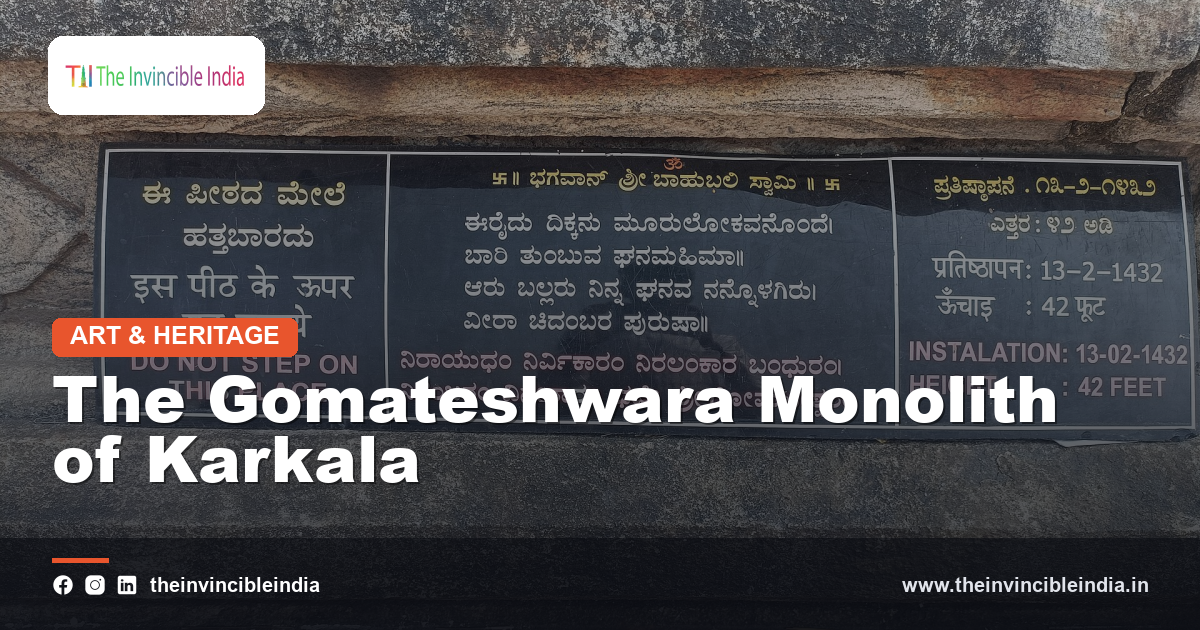
The Gomateshwara of Karkala, also called the Bahubali statue of Karkala or the Gommata monolith, is a colossal granite figure of the Jain saint Bahubali that stands on a rocky hill in the town of Karkala in Udupi district of coastal Karnataka. Carved from a single piece of rock and set in the fifteenth century, it is among the largest free-standing monolithic statues in India, and it forms part of the same Jain tradition of giant sculpture that includes Shravanabelagola, a tradition that belongs within the broader history of Indian sculpture. This article explains the monument, its legend, its making and its place in Jain life.
Quick answer: The Gomateshwara of Karkala is a colossal monolithic granite statue of Bahubali, also called Gommata, a revered figure of Jainism, standing on a hill in Karkala, Udupi district, Karnataka, India. It was erected in the fifteenth century under a local chieftain and is one of the great Jain monolithic statues of South India. The figure stands in a meditation posture known as kayotsarga, with creepers climbing its legs.
Key Takeaways
- The Gomateshwara of Karkala is a monolithic granite statue of Bahubali standing on a rocky hill in Udupi district, Karnataka.
- It is traditionally dated to the fifteenth century and was set up under a local ruler of Karkala named Veera Pandya Bhairarasa.
- Bahubali is revered in Jainism as a figure of deep meditation, renunciation and the conquest of pride.
- The statue stands upright in the kayotsarga posture, with arms hanging beside the body and vines winding around the legs.
- It is one of only a handful of great Jain monoliths in Karnataka, and it is smaller than but comparable to the older Gomateshwara of Shravanabelagola.
- The Karkala monolith is still a living pilgrimage centre where the Mahamastakabhisheka head-anointing ritual is performed at long intervals.
The sections below describe the legend of Bahubali, the construction of the statue and the town and traditions that surround it.
Quick Facts
| Detail | Information |
|---|---|
| Location | Gommata Betta (Gomatagiri), Karkala, Udupi district, Karnataka |
| Also known as | Bahubali statue, Gommata monolith, Gomateshwara of Karkala |
| Subject | Bahubali (Gommata), revered Jain figure |
| Approximate era | Fifteenth century CE |
| Patron | Veera Pandya Bhairarasa of Karkala (traditionally) |
| Material | Single block of granite |
| Pose | Kayotsarga, standing meditation |
| Religion | Jainism |
What Is the Karkala Gomateshwara?
The Karkala Gomateshwara is a monumental statue of Bahubali carved from a single block of granite and set on a rocky hill at the edge of the town of Karkala. The word Gomateshwara means the lord of Gomata, and Gomata is another name of Bahubali. The statue shows him standing upright and naked, a sign of complete renunciation in the Digambara Jain tradition, with a serene and calm expression and long arms hanging at his sides. Climbing vines wind around his legs, indicating the long years he stood in meditation. The monument is revered by Jains as a symbol of the conquest of pride, and it is respected by visitors of all faiths as an extraordinary work of sculpture. The Gomateshwara of Karkala is therefore at once a work of art and an object of deep devotion.
Where Is Karkala Located?
Karkala is a town in Udupi district on the western coast of Karnataka, situated inland from the Arabian Sea at the foot of the Western Ghats. The region is known for its monsoon-fed greenery, rocky outcrops, lakes and tiled-roof temples. Karkala lies a short distance from Moodabidri to the north and from the city of Mangaluru and the temple town of Udupi, which makes it easy to include in a tour of coastal Karnataka. The town has long been a centre of Jain culture and holds several important monuments in addition to the monolith. Its setting among hills and water gives the colossal figure a dramatic backdrop. Karkala is therefore well placed both geographically and culturally as a gateway to the Jain heritage of the coast.
Who Was Bahubali?
Bahubali, also called Gommata, is a revered figure in Jainism who is described as the son of Rishabhanatha, the first tirthankara. According to Jain tradition, Bahubali and his elder brother Bharata contested a kingdom, but at the moment of victory Bahubali felt remorse at the violence and renounced his realm to become an ascetic. He is said to have stood in meditation for an extended period, so still that vines grew around his limbs, and ultimately he attained spiritual knowledge. Bahubali is honoured as a model of renunciation, humility and self-conquest. Because the story combines royal power with spiritual release, it has inspired much Jain art and literature. The figure of Bahubali thus carries a message that real victory lies in mastering the self.
What Is the Legend Behind the Statue?
The legend behind the statue is the story of Bahubali’s renunciation and long meditation, which Jain texts narrate with great feeling. After giving up his kingdom, Bahubali stood motionless in a forest, resolved to attain liberation, and the elements of nature gradually covered him with creepers, anthills and birds. The tradition says that a remnant of pride at having stood on his brother’s land delayed his final enlightenment until it was dispelled. The statue captures this moment in stone, showing Bahubali upright with climbing vines on his limbs. By depicting the legend, the monument turns a story into a visual teaching about humility. The legend gives the Karkala statue its spiritual meaning and explains why devotees come to see it.
When and How Was the Karkala Monolith Made?
The Karkala monolith is traditionally dated to the fifteenth century, when it was commissioned by Veera Pandya Bhairarasa, the local ruler of Karkala, who belonged to a line of chieftains patronising Jainism in the coastal region. An inscription at the site is usually cited as recording the date of its installation, and the traditional date places it in the 1430s. The statue is said to have been carved on the spot or near the site from a massive boulder of granite and then raised on the hill. Details of the process are not fully documented, and it is best to speak in general terms about how medieval craftsmen shaped and moved huge stones. Whatever the exact method, the project required skill, planning and large resources. The monument therefore stands as a testimony to the ambition of its patron.
Who Was Veera Pandya Bhairarasa?
Veera Pandya Bhairarasa was a local chieftain of Karkala in the fifteenth century who is remembered as the patron of the great Bahubali monolith. The Bhairarasa family ruled as feudatories under the kings of Vijayanagara and supported Jain institutions in their territory. By commissioning the statue, the chieftain expressed personal devotion and strengthened the religious prestige of his capital. Such patronage was common in medieval India, where rulers used temples and monuments both to express piety and to display their standing. Details of the chief’s life are known mainly from inscriptions and local tradition, so they are best described in broad outline. The name of Veera Pandya Bhairarasa remains attached to the Karkala monolith as its founder and benefactor.
How Big Is the Statue and What Is It Made Of?
The Karkala statue is made of a single block of granite and is commonly described as being about thirteen metres tall, or roughly forty-two feet, though published measurements differ slightly. This makes it smaller than the older Gomateshwara of Shravanabelagola, but it is still among the largest monolithic statues in India. Granite is a hard and durable stone, and it takes a fine polish, which is why the figure still gleams in sunlight after centuries. The statue stands on a base that is carved into the rock of the hill, so it appears to grow out of the landscape. Its great height makes it visible from a distance, and its solid proportions are adjusted so that it looks balanced when seen from below. The size and material of the monument thus add to its monumental effect.
What Does the Sculptural Style Show?
The sculptural style of the Karkala Gomateshwara is calm, frontal and symmetrical, in keeping with the Jain ideal of serene detachment. The figure stands upright with its feet planted on a lotus-like base, its arms hanging straight beside the body and its hands turned slightly outward. The face is carved with half-closed eyes, a gentle smile and tightly curled hair, features that express inner peace. The body is simplified rather than muscular, so the figure seems to embody stillness rather than action. Vines, small creatures and ant-hills at the base enrich the sculpture with symbolic detail. The style reveals that the craftsmen were more concerned with expressing spiritual calm than with realistic anatomy. The sculpture therefore communicates a message of silence and strength.
What Is the Kayotsarga Posture?
The kayotsarga is a standing posture of meditation in Jainism, in which the practitioner stands upright, arms hanging loosely at the sides and the gaze directed downward, abandoning attachment to the body. The word is often explained as meaning the giving up of the body. In this posture the ascetic is motionless and withdrawn, concentrating on the soul rather than on physical needs. Tirthankaras are often depicted in either kayotsarga or a seated meditation pose, and Bahubali is almost always shown in the standing form. The Karkala monolith is an outstanding example of this posture rendered on a monumental scale. The use of kayotsarga makes the statue a visual lesson in discipline and release, and it distinguishes Jain sculpture from the images of other traditions.
Why Is the Statue Called a Monolith?
The statue is called a monolith because it is carved from a single piece of rock instead of being assembled from separate blocks. The word comes from Greek roots meaning one stone. Monolithic sculpture requires very careful planning, since an error in carving cannot be repaired by replacing a part. At Karkala the figure and its base appear to arise from the hill itself, and the sculpture is distinct from the temple buildings that stand elsewhere in the town. Monoliths of this type are rare and are admired for the confidence and skill of the craftsmen who made them. They also have a symbolic meaning, since a single stone suggests unity and permanence. The monolithic character of the Karkala statue therefore contributes to its strength and its sacred presence.
How Does Karkala Compare With Shravanabelagola?
The Gomateshwara of Karkala is often compared with the older and larger Gomateshwara of Shravanabelagola in Hassan district, which was erected around the tenth century under the patronage associated with Chavundaraya, a minister of the Western Gangas. Both statues show Bahubali in the same standing posture with vines on his limbs, and both are monolithic. The Shravanabelagola statue is taller and stands on a larger hill, while the Karkala statue is smaller but is regarded as exceptionally graceful. Both are important pilgrimage centres and sites of the Mahamastakabhisheka ritual. Together with other monoliths in the region, they form a tradition of colossal Bahubali images in Karnataka. The comparison shows how a single idea was expressed in different centuries and landscapes.
What Is the Mahamastakabhisheka?
The Mahamastakabhisheka is the great head-anointing ceremony of Jain tradition, in which the statue of Bahubali is bathed from the top with large quantities of water, milk, sandalwood paste, turmeric, flowers and other sacred substances. The ceremony is held at long intervals, traditionally once in about every twelve years, and attracts large numbers of pilgrims and visitors. A scaffold is built around the statue so that priests and devotees can pour the offerings over the figure from above. The colours and fragrances of the offerings make the occasion a vivid festival of devotion. The ritual is also a time of community gathering, with processions, music and charitable activities. The Mahamastakabhisheka thus transforms the Karkala monolith into the centre of a grand and living religious event.
What Other Jain Monuments Are in Karkala?
Karkala has several other notable Jain monuments in addition to the Gomateshwara. The Chaturmukha Basadi, a square temple with four identical doorways facing the cardinal directions, stands on a hillock and is admired for its symmetry. The Hiriyangadi Neminatha Basadi and other temples add to the architectural interest of the town, while the Anekere lake and its Padmavati shrine form a picturesque spot nearby. Karkala also has a number of old Hindu temples, which shows the town’s religious diversity. These monuments belong to the same regional tradition of tiled roofs and carved stone that is seen at Moodabidri. A visit that includes these places provides a fuller understanding of the culture around the monolith. The wider monuments of Karkala thus complete the story told by its colossal statue.
How Is the Monument Reached and Visited?
The monolith stands at the top of a rocky hill that is reached by a flight of steps leading up from the town, and the climb is short and manageable for most visitors. A large gateway marks the entrance to the precinct, and the statue can be seen from several points on the way. Because the site is a place of worship, visitors are expected to dress modestly, remove footwear, and behave quietly. Morning and evening are the most pleasant times, with cooler air and softer light, and the view from the top over Karkala and the surrounding countryside is a reward in itself. The cooler months are the most comfortable for travel. A visit to the Gomateshwara is both a pilgrimage and an exploration of art, and it leaves many visitors with an impression of calm.
Karkala Gomateshwara Today
The Gomateshwara of Karkala today remains a monument of devotion, art and regional pride. Jain pilgrims come to venerate Bahubali, scholars study the sculpture and the inscriptions, and visitors of every background admire the calm power of the figure above the town. The statue is maintained by the local community and heritage bodies, who work to protect it from weather, vegetation and the pressures of tourism. Together with the basadis of Moodabidri and other sites of the coast, it forms part of a living Jain heritage that has endured for centuries. The monolith continues to teach that strength can be quiet and that victory over the self is the highest achievement. The Karkala Gomateshwara thus stands as an enduring symbol of renunciation, patience and artistic mastery.
Sources & Further Reading
- Ministry of Culture, Government of India (indiaculture.gov.in).
- Archaeological Survey of India (asi.nic.in).
Frequently Asked Questions
What is the Karkala Gomateshwara?
The Karkala Gomateshwara is a colossal monolithic granite statue of Bahubali, a revered figure of Jainism, standing on a hill in Karkala, Udupi district, Karnataka. It was set up in the fifteenth century. It shows Bahubali in the standing meditation posture called kayotsarga.
Who built the Gomateshwara statue at Karkala?
The statue was commissioned by Veera Pandya Bhairarasa, a local chieftain of Karkala, in the fifteenth century according to tradition. An inscription at the site is usually cited as recording its installation. The sculptors who carved it are not generally known by name.
Who is Bahubali in Jainism?
Bahubali, also called Gommata, is a revered Jain figure and the son of the first tirthankara, Rishabhanatha. He renounced his kingdom after a conflict with his brother Bharata and meditated so long that vines grew around him. He is honoured as a model of humility and renunciation.
How tall is the Karkala Bahubali statue?
The Karkala Bahubali statue is commonly described as about thirteen metres, or roughly forty-two feet, tall, although published measurements differ slightly. It is carved from a single block of granite. It is smaller than the Gomateshwara of Shravanabelagola.
What is the Mahamastakabhisheka at Karkala?
The Mahamastakabhisheka is the great head-anointing ceremony in which the Bahubali statue is bathed with water, milk, sandalwood paste, flowers and other offerings. It is held at long intervals, traditionally about once in twelve years. It draws large numbers of Jain pilgrims.
Where is the Karkala Gomateshwara located?
The Karkala Gomateshwara is located on Gommata Betta, a rocky hill in the town of Karkala in Udupi district, on the western coast of Karnataka. Karkala is near Moodabidri, Udupi and Mangaluru. The hill is reached by a short flight of steps.


