

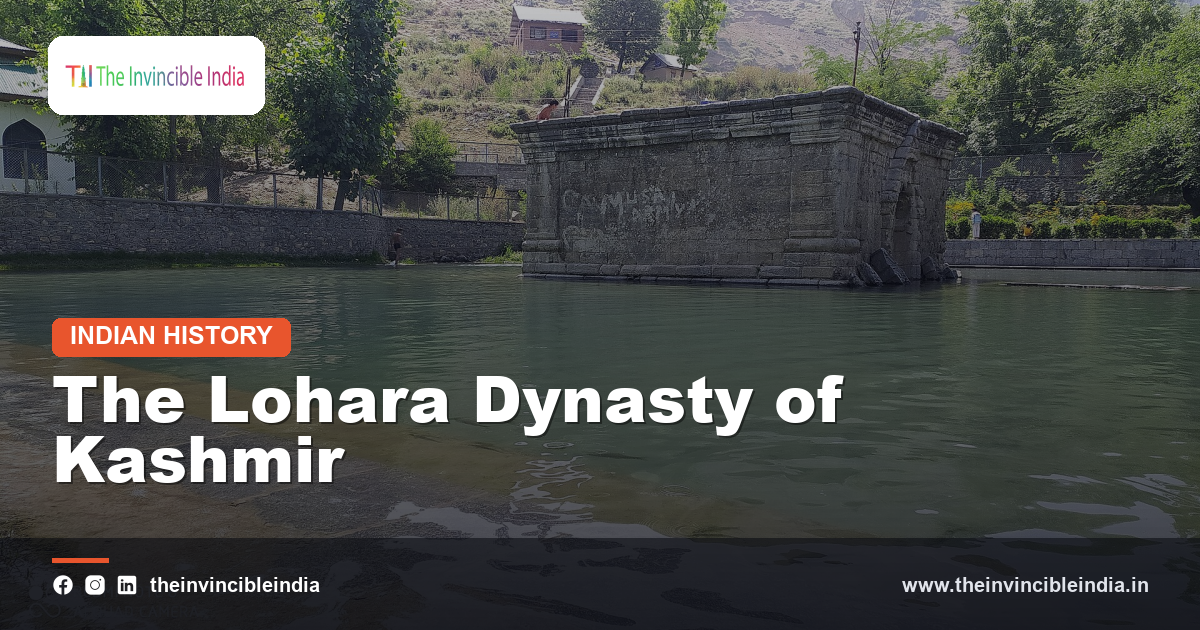
The Lohara dynasty, also called the Loharas or the Lohara line of Kashmir, was a medieval Hindu ruling family that governed the valley of Kashmir in the eleventh and twelfth centuries. The name comes from Lohara, a hill principality in the Pir Panjal range, whose princess Didda became one of the most powerful women in Indian history. Our best source for the dynasty is the Sanskrit chronicle Rajatarangini by the poet Kalhana. Exact dates are conventional and some are debated, so this guide uses general terms. Kashmir later passed through other rulers and eventually the Mughals, introduced in our guide to the Mughal Empire.
Quick answer: The Lohara dynasty was a medieval Hindu ruling family of Kashmir, descended through Queen Didda from the hill principality of Lohara, that governed the valley in the eleventh and twelfth centuries and is described in Kalhana’s Sanskrit chronicle Rajatarangini. It is known for Didda’s rule, resistance to Ghaznavid attacks, a rich court culture and a long record of palace conflict.
Key Takeaways
- The Lohara dynasty ruled Kashmir in the eleventh and twelfth centuries, taking its name from the hill state of Lohara in the Pir Panjal.
- Queen Didda, who ruled first as regent and then in her own right, brought the Lohara line to the throne by placing her nephew Sangramaraja as her heir.
- The main source is the Rajatarangini, a Sanskrit verse chronicle by Kalhana, often regarded as one of the finest works of historical writing in classical India.
- Kashmir under the Loharas was a major centre of Sanskrit literature and Shaiva philosophy, producing works such as Somadeva’s Kathasaritsagara.
- Kings such as Harsha were cultured patrons of the arts yet faced revolt and ruin, a dramatic story told by Kalhana.
- The dynasty weakened through factional strife, and later Hindu and then Muslim dynasties ruled Kashmir.
Read on for the history, culture, and legacy in detail.
Quick Facts
| Detail | Information |
|---|---|
| Dynasty | Lohara (Loharas) of Kashmir |
| Origin | Lohara in the Pir Panjal hills, linked to Queen Didda |
| Era | Roughly the eleventh and twelfth centuries |
| Main source | Rajatarangini by Kalhana |
| Notable rulers | Didda, Sangramaraja, Ananta, Harsha, Jayasimha |
| Legacy | Sanskrit literature, Kashmir Shaivism, historical writing |
Who Were the Lohara Rulers of Kashmir?
The Lohara rulers of Kashmir were a medieval Hindu dynasty that took the throne of the valley after the line of the Utpala and later royal families had weakened. The name derives from Lohara, a hill state in the mountains south-west of the Kashmir valley, ruled by a family allied to the Hindu Shahi kings of the north-west. Through marriage and succession, a princess of this house became queen of Kashmir and later the effective ruler, and her relatives inherited the throne. Historians sometimes speak of two Lohara lines, the first descending from the family of Sangramaraja and the second beginning with Ucchala after the fall of Harsha. The chronology of the dynasty is based mainly on Kalhana, so exact years carry some uncertainty. The Loharas ruled a valley that was both rich and difficult to defend.
Where Was Lohara?
Lohara was a hill principality in the Pir Panjal mountains on the southern side of the Kashmir valley, usually identified with the area around Loharin and the fort of Loharkot near the Poonch region. The place lay on the route that connected Kashmir with the plains of Punjab, and its rulers controlled an important mountain pass. This position made Lohara strategically valuable and gave its family a base of military strength. The exact identification of every site named in the chronicle is discussed by scholars, but the general location is accepted. The geography explains why Lohara could act as a bridge between the valley and the outside world. For the dynasty the highland fort was a place of origin that remained part of the identity of the line even after its members moved to the capital in the valley.
Who Was Queen Didda?
Queen Didda was a daughter of the ruler of Lohara and, through her mother, a granddaughter of a Hindu Shahi king, and she became one of the most powerful rulers in the history of Kashmir. She married King Kshemagupta, who ruled from Srinagar, and the couple became so closely linked that the king was sometimes called Diddakshema. After his death she acted as regent for her young son and then ruled for decades through several successors, using alliance, military force and political skill. Kalhana gives a harsh portrait of her, describing a clever but ruthless leader, and the fairness of this picture is debated since the chronicler wrote long afterwards. Historians generally accept that she held real power for a long period. Her career remains a notable case of a woman who ruled through her own ability.
How Did Didda Choose Her Successor?
Didda chose her successor by selecting her nephew Sangramaraja, the son of her brother at Lohara, to follow her as ruler of Kashmir. As she grew older and the descendants of her marriage had died, she turned to her own birth family to preserve her authority and avoid a struggle among rival nobles. Sangramaraja came from the hill principality to the valley and became king after her, which marked the beginning of the Lohara dynasty on the Kashmir throne. This act linked the two states of Lohara and Kashmir under one family. The succession was not without opposition, since powerful courtiers and troops known as the Tantrins had long played a role in court politics. Didda’s decision thus created a new royal line and set the stage for the next century and a half of Kashmir history.
What Did Sangramaraja Achieve?
Sangramaraja, the first Lohara king of Kashmir, is remembered for consolidating the throne and for facing the military pressure from the Ghaznavid ruler Mahmud, who invaded the lands to the west. He reduced the influence of turbulent court factions, established his family’s authority and defended the mountain approaches to the valley. Persian and Indian sources differ on the details of the encounters, but Mahmud is generally said to have failed to take Kashmir itself, despite attacking the region and the fort at Lohara. The narrow passes and heavy snow of the mountains were a natural defence. Kalhana portrays the reign as a time of limited stability, with ministers and chiefs still capable of troubling the king. Sangramaraja’s work was to give the new dynasty a secure start, and he is therefore seen as its real founder.
Why Is the Rajatarangini Important?
The Rajatarangini is important because it is a long Sanskrit verse chronicle of the kings of Kashmir, written by the poet Kalhana in the twelfth century, and it is often called the most notable work of historical writing from early India. The title is usually translated as River of Kings. Kalhana drew on earlier chronicles, inscriptions, coins and local traditions, and he tried to tell the story with attention to cause and consequence rather than simple praise. His account runs from legendary beginnings down to his own time, and it is most detailed and reliable for the later periods, including the Lohara era. Scholars still debate how far its earlier sections are legendary and how his political views coloured the story. The work remains the key source for Kashmir’s medieval political history and a landmark of Indian literature.
Who Was Kalhana?
Kalhana was a Kashmiri poet and writer of the twelfth century, the author of the Rajatarangini, and he is remembered as a historian who aimed to treat the past with fairness. His father Champaka is said to have served at the court of King Harsha, which gave the author access to court memory and a personal interest in the fate of the dynasty. Kalhana states that a good historian should be free of love and hatred in describing the past, and his work shows an interest in judging kings by their deeds. He wrote in a time of unrest during the reign of King Jayasimha. Little more is known about his life, and some details are debated. His chronicle made him the best-known author of historical writing in Sanskrit, and his methods are still studied by modern scholars.
What Is Harsha Known For?
King Harsha of Kashmir, who reigned at the end of the eleventh century, is known as a ruler of great talent and great misfortune whose story Kalhana tells with sympathy and dismay. Early in his rule he is described as generous, cultured and skilled in music and poetry, and he patronised artists and scholars. Later, according to the chronicle, he suffered from heavy financial pressures and acted harshly, taking wealth from temples and imposing heavy taxes, which led to revolt. He died in the course of a rebellion, abandoned by most followers. Because Kalhana wrote for an audience that valued moral lessons, his portrait of Harsha is a mix of fact and judgement, and modern historians assess it with care. The story of Harsha is one of the most dramatic in Indian historical writing, illustrating the risks of absolute power.
How Did Palace Politics Shape Lohara Rule?
Palace politics shaped Lohara rule through repeated struggles among kings, ministers, military chiefs and rival branches of the family. Kalhana describes powerful groups such as the Damaras, landed lords of the valley who sometimes supported the throne and sometimes rebelled, and the Tantrins, palace troops who could make or unmake kings. Succession disputes often turned violent, and several rulers were deposed or killed. The weak control of kings over the countryside allowed these groups to gain influence, and the monarchy depended on balancing them against each other. Modern historians see these patterns as a sign of the fragile state structure in medieval Kashmir. The chronicle’s frank account of intrigue has made the period famous among readers and researchers. It shows that even a prosperous and cultured kingdom could be unstable.
What Was the Role of Ananta and Suryamati?
Ananta was a Lohara king of the eleventh century who ruled with his queen Suryamati, and the pair are remembered for restoring order and for patronising literature. Suryamati was a capable queen from a hill family who helped to steady the government after a period of disorder, and she is said to have supported temples and religious foundations. Ananta’s reign is also linked to the poet Somadeva, who composed the Kathasaritsagara, a large Sanskrit collection of stories, for the queen’s entertainment. Kalhana praises Suryamati and condemns the weakness of Ananta’s son Kalasha, who followed him. The relationship between the royal couple and the arts reflects the important role of court patronage in Kashmir culture. Their reign remains an example of a more stable period within the generally turbulent record of the dynasty.
How Did Kashmir Culture Flourish Under the Loharas?
Kashmir culture flourished under the Loharas through the continuing work of Sanskrit poets, philosophers and scholars who lived in the valley’s towns and monasteries. The region was famous across India for its learning, and the Sharada script, used to write Sanskrit, was associated with it. Court writers produced epic poetry, story literature and treatises, while temples and Buddhist and Shaiva centres served as places of study. Poets such as Kshemendra, who wrote satire and condensed versions of epics, belonged to this period. Rulers and queens gave land and gifts to scholars and to temples, which kept the intellectual tradition alive despite political trouble. The valley’s isolation helped to preserve its manuscripts and ideas. Kashmir under the Loharas thus remained one of the intellectual capitals of the subcontinent even as its political life was turbulent.
What Is Kashmir Shaivism and How Is It Linked to This Period?
Kashmir Shaivism is a philosophical and religious tradition centred on the worship of Shiva as the supreme reality, and it reached a high point in the valley around the time of the Lohara rulers. The thinker Abhinavagupta, who lived in the late tenth and early eleventh centuries, wrote influential works on philosophy, aesthetics and ritual, including studies of drama and poetic theory. His thought influenced Indian ideas of beauty and consciousness for centuries. Although he was not a court figure, the intellectual atmosphere of the valley supported his work, and the tradition continued in later generations. The exact relationships between kings and philosophers are not always clear from the sources. Kashmir Shaivism remains one of the lasting cultural contributions of the region, and its study helps to explain why Kashmir was known as a land of wisdom.
What Temples and Buildings Belong to This Era?
The temples and buildings of the Lohara era belong to the tradition of Kashmiri stone architecture, which combined sloping roofs, trefoil arches and fluted columns in a style that reflects both local and wider influences. Earlier royal families had built the great temple of Martand and the temples of Avantipur, and many of these monuments were still standing in Lohara times. The kings and queens of the period repaired and endowed sacred sites, and chronicle passages mention foundations of towns, viharas and shrines. Over the centuries, earthquakes, climate and conflict damaged many structures, so what survives today is largely in ruins. These ruins are protected by the Archaeological Survey of India and remain a reminder of the valley’s sacred landscape. They show the lasting skill of Kashmiri builders and the central place of religion in royal life.
Who Was Jayasimha and How Did the Dynasty Decline?
Jayasimha was the last important Lohara king, whose reign is the final period covered in detail by Kalhana, and the dynasty declined after him because of internal division and weak control. His predecessors Ucchala and Sussala had faced revolts and civil wars, and Jayasimha inherited a state in which powerful lords and rival claimants were constantly active. He is credited with restoring a degree of order, building towns and temples and negotiating with enemies, and the chronicle treats him with qualified praise. After his reign the line of rulers weakened, the kingdom suffered from further disorder, and the way was open for new dynasties. The exact details of the final decades are less certain, since the main source stops. The decline shows how a cultured state could fall through lack of strong institutions.
The Lohara Dynasty Today
The Lohara dynasty today is remembered above all through the Rajatarangini, the writings of scholars about medieval Kashmir and the surviving ruins in the valley. Students of history read Kalhana to understand early Indian ideas of kingship, narrative and moral judgement, and translations have made the chronicle available to a wide readership. The story of Queen Didda continues to interest those who study women in power in Indian history. Archaeological sites and museums in Srinagar and the valley preserve stone sculptures, coins and fragments from the age. Debates among historians about the dating of reigns and the reliability of the chronicle continue. The dynasty stands for a time when Kashmir was a political power, a literary centre and a place of intense philosophical activity. Its history remains a significant part of the story of medieval India.
Sources & Further Reading
- Archaeological Survey of India (asi.nic.in).
- Ministry of Culture, Government of India (indiaculture.gov.in).
Frequently Asked Questions
Who were the Loharas of Kashmir?
The Loharas were a medieval Hindu dynasty that ruled Kashmir in the eleventh and twelfth centuries. They took their name from Lohara, a hill principality in the Pir Panjal, and came to the throne through Queen Didda.
Who was Queen Didda?
Queen Didda was a Lohara princess who married the king of Kashmir and later ruled the valley for decades, first as regent and then in her own right. She chose her nephew Sangramaraja as her successor.
What is the Rajatarangini?
The Rajatarangini is a Sanskrit verse chronicle of the kings of Kashmir, written by Kalhana in the twelfth century. The title means River of Kings, and it is the main source for Lohara history.
Did Mahmud of Ghazni conquer Kashmir?
No, Mahmud of Ghazni did not conquer Kashmir. Accounts say he failed to take the valley and its mountain forts, partly because of the difficult terrain, though details vary between sources.
Who was the last great Lohara king?
Jayasimha is regarded as the last important Lohara king, and Kalhana’s chronicle ends with his reign. After him the dynasty declined and new rulers emerged.
Why is the Lohara period important for Indian culture?
The Lohara period is important because Kashmir remained a leading centre of Sanskrit literature and Shaiva philosophy. Works such as the Kathasaritsagara and the Rajatarangini come from this age.


