

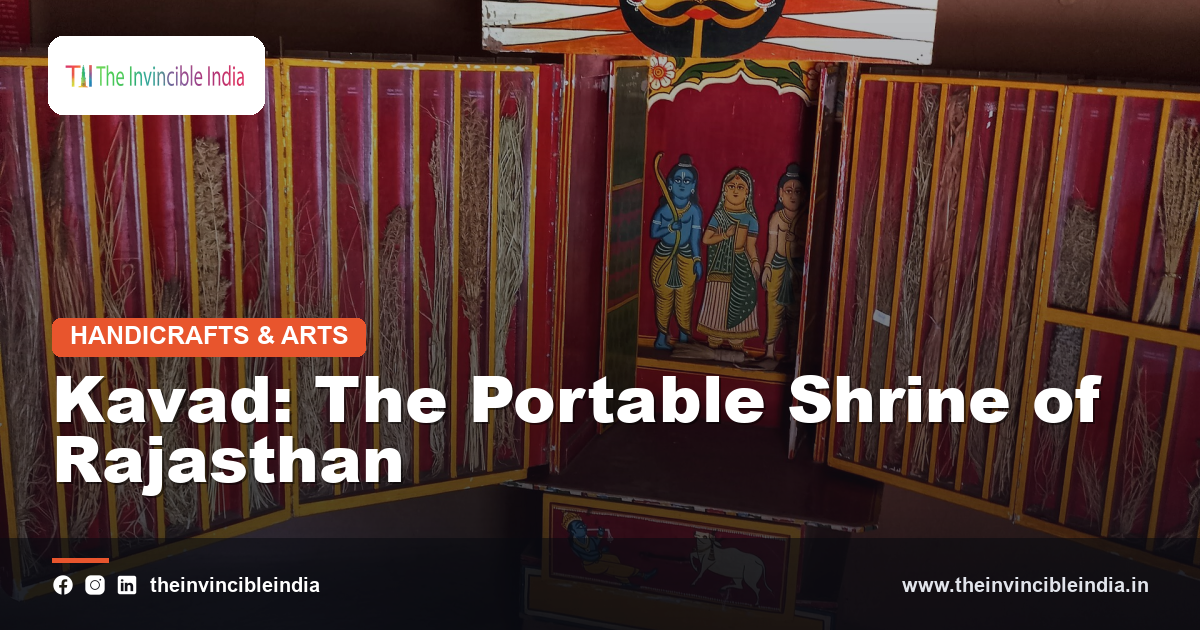
Kavad is a portable wooden shrine from Rajasthan, built as a series of hinged, painted panels that fold shut like a cabinet and open outward, panel by panel, to reveal painted scenes used to narrate stories to an audience. Traditionally carried from village to village by travelling storyteller-priests, the Kavad functions simultaneously as a religious object, a narrative device, and a piece of folk art, occupying a place in Rajasthan’s craft landscape alongside better-known traditions such as the traditional handicrafts of Rajasthan. Centred on the village of Bassi near Chittorgarh, Kavad-making remains a distinctive example of craft created specifically to support an oral storytelling practice.
Quick Facts
| Detail | Information |
|---|---|
| Also Known As | Kavad box, portable shrine |
| Primary Region | Bassi, near Chittorgarh, Rajasthan |
| Material | Wood, natural pigments |
| Form | Hinged, multi-panel folding cabinet |
| Traditional User | Kavadiya bhat storyteller-priests |
| Typical Imagery | Deities, mythological and folk narratives |
Origins of the Kavad Tradition
The Kavad tradition originates in Rajasthan as a craft developed specifically to support an itinerant storytelling practice, in which a travelling narrator would carry a painted wooden shrine from village to village to recount family genealogies and religious tales. The object and the oral performance around it developed together as a single tradition.
This close relationship between craft and performance distinguishes the Kavad from most other Indian decorative art forms, since a Kavad was never intended purely as a static object of display but as an essential tool for a specific storytelling role carried out by designated community members.
Bassi: The Home of Kavad Making
The village of Bassi, located near Chittorgarh in Rajasthan, has long been recognised as the principal centre of Kavad craftsmanship, home to carpenter and painter families who have specialised in producing these shrines for generations. The village’s identity remains closely tied to this craft.
Artisans in Bassi have traditionally combined woodworking and painting skills within the same family workshops, allowing a single household to manage the entire process of constructing and decorating a Kavad from raw timber to finished, painted object.
Structure of a Kavad Shrine
A Kavad is built from a series of wooden panels joined by hinges, allowing the object to fold closed into a compact cabinet-like form or open progressively to reveal successive painted scenes on its inner and outer surfaces. This folding structure is central to both its portability and its storytelling function.
The innermost section of a Kavad typically houses a small image of a deity, positioned so that it is revealed only once all the outer panels have been opened, creating a sense of narrative progression that culminates in a devotional focal point at the shrine’s core.
Woodworking and Construction
Constructing a Kavad begins with selecting and shaping suitable lightweight wood, which is cut into panels of appropriate size and fitted with hinges that allow the finished shrine to open and close smoothly. This carpentry stage requires precision to ensure the panels align correctly once assembled.
Because a Kavad must withstand repeated handling as a travelling narrator opens and closes its panels during storytelling sessions, durability is an important consideration in its construction, balanced against the need to keep the overall object light enough to carry over long distances.
Preparing the Surface for Painting
Once assembled, the wooden panels of a Kavad are prepared for painting with a smooth base coat, traditionally applied to create an even surface capable of holding fine detail and vivid colour. This preparatory stage is essential to achieving the crisp imagery associated with finished Kavads.
Artisans in Bassi have developed specific techniques for preparing and priming wood suited to the humid and dry conditions the shrine may encounter while travelling, helping ensure that the painted surface remains stable and legible through extended use.
Colours and Painting Technique
Kavad panels are traditionally painted in bold, saturated colours, most notably red and yellow grounds, over which figures and scenes are outlined and detailed in contrasting tones. This vivid palette helps ensure the imagery remains visually striking even when viewed in the open air during a village performance.
Painters typically work with a limited but confident colour scheme, prioritising clarity and immediate visual impact over subtle shading, an approach well suited to imagery that must be quickly understood by an audience gathered around a travelling storyteller.
Mythological and Religious Scenes
The painted panels of a Kavad typically depict scenes drawn from Hindu mythology, regional folk narratives, and stories of local deities, arranged so that each panel corresponds to a particular episode within the larger story being told. This structure allows the narrator to move sequentially through the tale.
Because the shrine is designed to accommodate an extended oral narration, its imagery favours clear, recognisable figures and settings over intricate detail, ensuring that each scene functions effectively as a visual prompt for the storyteller’s spoken performance.
The Kavadiya Bhat Storytellers
Traditionally, Kavads were carried and used by a specific community of storyteller-priests known as kavadiya bhats, who travelled between villages to visit patron families, recount their lineage, and narrate religious stories using the shrine as a visual guide. This role combined elements of genealogist, priest, and performer.
The relationship between a kavadiya bhat and the families he visited was often a long-standing one, passed down across generations on both sides, giving the storytelling practice a strong element of personal and familial continuity alongside its religious and narrative functions.
The Performance: Opening the Panels
A Kavad performance unfolds as the narrator opens the shrine’s panels one at a time, pausing at each to narrate the corresponding scene before moving to the next, building toward the final reveal of the deity housed within the innermost section. This structured reveal is central to the storytelling experience.
The physical act of opening the shrine mirrors the unfolding of the narrative itself, giving the audience a tangible, visual sense of progression through the story that would be less immediate in a purely spoken retelling without the accompanying object.
Family Workshops and Skill Transmission
Kavad craftsmanship in Bassi has traditionally been organised around family workshops, with woodworking and painting skills passed down from one generation to the next within the same households. This close family structure has helped maintain consistent quality and technique over time.
Younger family members typically learn the craft through direct participation in workshop tasks from an early age, gradually taking on more complex aspects of construction and painting as their skills develop, ensuring continuity of the tradition within the community.
Decline of the Travelling Narration
The traditional practice of kavadiya bhats travelling between villages to perform Kavad storytelling has declined significantly in recent decades, as changing social patterns and alternative forms of entertainment and information have reduced demand for this particular form of itinerant narration. This shift has affected the craft’s original context of use.
Despite this decline in the traditional performance practice, the physical craft of making Kavads has continued, sustained increasingly by demand from collectors, cultural institutions, and buyers interested in the object itself rather than the accompanying oral tradition.
Kavad as Collectible Folk Art
As the storytelling practice around Kavads has become less common, the shrines themselves have increasingly been valued as standalone pieces of folk art, appreciated for their painted imagery and distinctive folding structure independent of any live performance. This shift has opened new markets for Bassi’s artisans.
Museums, cultural exhibitions, and private collectors have taken an interest in Kavads as representative examples of Rajasthani folk craftsmanship, helping sustain artisan livelihoods even as the object’s original ritual use has become less widespread.
Variations in Size and Design
Kavads are made in a range of sizes, from small versions intended for personal devotional use to larger, more elaborate shrines with multiple panels suited to extended storytelling sessions. This variation allows the craft to serve different purposes and price points.
Larger, more intricately painted Kavads typically require greater skill and time to produce, reflecting a hierarchy of craftsmanship within the tradition that experienced buyers and collectors have learned to recognise when assessing a piece’s quality.
Craft Support and Recognition
Craft development organisations and cultural bodies have taken an interest in supporting Bassi’s Kavad-making families, recognising the tradition’s unusual combination of woodworking, painting, and oral performance heritage. Such support has included promotion at craft fairs and exhibitions.
This institutional attention has helped raise awareness of Kavad craftsmanship beyond Rajasthan, encouraging wider appreciation of a tradition that might otherwise have remained known primarily to the communities directly involved in its practice and use.
Contemporary Adaptations
Some contemporary artists and craftspeople have begun adapting the Kavad format for new purposes, including educational storytelling tools and decorative art pieces that draw on the traditional folding structure while incorporating new subject matter beyond religious narrative. These adaptations extend the form’s relevance.
Such experimentation has helped introduce the Kavad concept to audiences unfamiliar with its traditional religious use, demonstrating the flexibility of its distinctive folding, multi-panel design as a storytelling device suited to a variety of content.
Painting Style and Folk Aesthetics
The painting style used on Kavad panels favours flat, bold figures with minimal shading, an approach shared with several other Rajasthani folk painting traditions and well suited to imagery that must remain legible from a short distance during a live performance. This aesthetic prioritises clarity over naturalistic detail.
Painters typically outline figures in dark tones before filling them with solid colour, a technique that allows even relatively inexperienced viewers to quickly distinguish separate characters and scenes as the narrator moves through the shrine’s opening panels.
Kavad in Cultural Documentation
Researchers and folklorists have documented the Kavad tradition as a notable example of India’s oral storytelling heritage, studying both the physical craft and the performance practices historically associated with it. This documentation has helped preserve knowledge of a tradition that might otherwise have faded from record.
Cultural festivals and heritage events occasionally feature demonstrations of Kavad storytelling, giving contemporary audiences a chance to witness a version of the performance tradition alongside the painted object itself, even as the original travelling practice has become rare.
Colour Sourcing and Preparation
Traditional Kavad painters historically prepared their own pigments from locally available mineral and plant sources, mixing them with a suitable binder to create paint capable of adhering firmly to wood over years of handling. This self-sufficient approach to materials reflects broader patterns in Rajasthani folk painting.
Many artisans today combine traditional pigment knowledge with more readily available commercial paints, balancing authenticity with the practical need for consistent, durable colour across a growing range of finished shrines produced for sale.
Kavad Craft Today
Kavad craft today survives primarily through the continued work of artisan families in Bassi, who produce these painted shrines both as cultural artefacts for collectors and, on occasion, for use in revived or educational storytelling contexts. The tradition’s original travelling performance has become far less common.
As long as Bassi’s woodworking and painting families continue to pass their skills to younger generations, the Kavad is likely to endure as one of Rajasthan’s most distinctive contributions to India’s folk art and storytelling heritage.
Sources & Further Reading
- Ministry of Culture, Government of India (indiaculture.gov.in).
- Sangeet Natak Akademi (sangeetnatak.gov.in).
Frequently Asked Questions
What is a Kavad?
A Kavad is a portable wooden shrine from Rajasthan built from hinged, painted panels that fold shut like a cabinet and open panel by panel to reveal scenes used for storytelling.
Where are Kavads traditionally made?
Kavads are traditionally made in and around the village of Bassi near Chittorgarh in Rajasthan, where artisan families have specialised in the craft for generations.
Who traditionally used a Kavad?
Kavads were traditionally carried and used by kavadiya bhats, travelling storyteller-priests who visited patron families to narrate religious stories and family genealogies using the shrine’s painted panels.
What is depicted on a Kavad's panels?
Kavad panels are typically painted with scenes from Hindu mythology, folk narratives, and local deities, with the innermost section usually holding an image of a deity revealed last.
Is the Kavad storytelling tradition still practised?
The traditional travelling performance has declined significantly, though the craft of making Kavads continues, sustained now largely by collectors, cultural institutions, and craft markets.


