

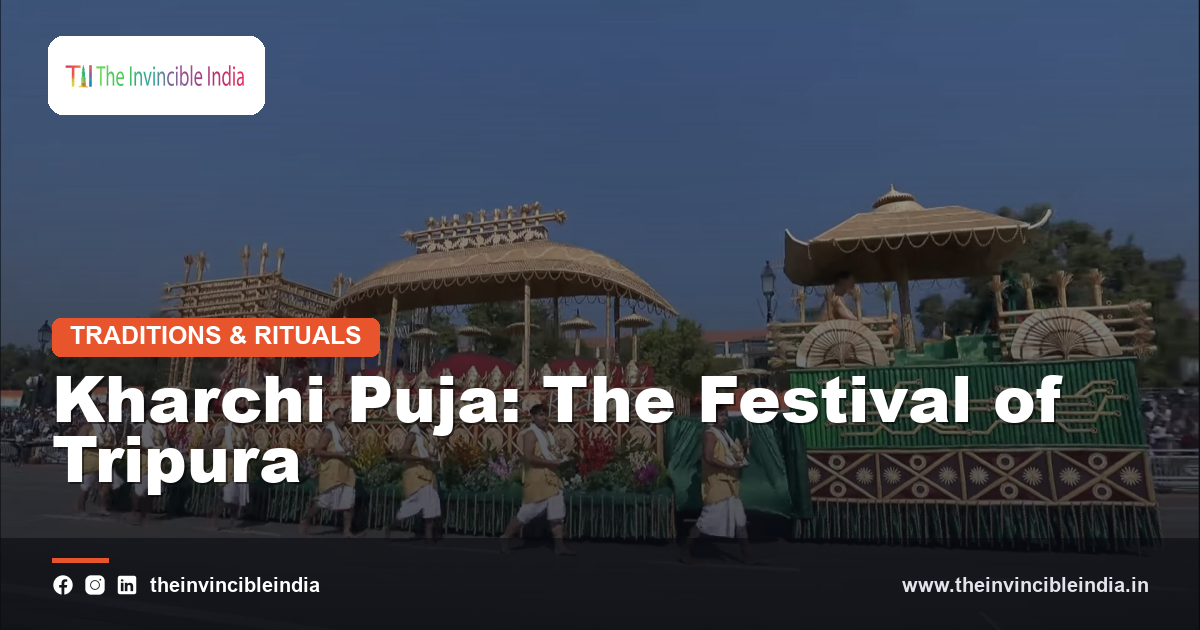
Kharchi Puja is the best-known festival of Tripura, a week-long celebration centred on the worship of the Fourteen Deities, or Chaturdasha Devata, at their ancient temple in Old Agartala. Held during the rainy season, it draws people of tribal and non-tribal communities alike, who gather for rituals, offerings, music and a large fair. The festival is remarkable for the way it brings together tribal customs and Hindu worship within a single shared observance, much as many regional traditions described in guides such as the Bihu festival of Assam blend agrarian life with devotion. This guide explores the meaning, rituals and living traditions of Kharchi Puja.
Quick Facts
| Detail | Information |
|---|---|
| Also Known As | Kharchi Festival, Chaturdasha Devata Puja |
| Type of Observance | Week-long religious and cultural festival |
| Main Deities | The Fourteen Deities of Tripura |
| Principal Venue | Fourteen Gods Temple, Old Agartala |
| General Timing | Rainy season, in the month of Ashadha (July) |
| Region of Prominence | Tripura, northeast India |
What Is Kharchi Puja?
Kharchi Puja is the principal festival of Tripura, observed over about a week each year at the temple of the Fourteen Deities in Old Agartala. The festival is dedicated to a distinctive group of fourteen gods and goddesses who have been worshipped in the state for many generations and who occupy a central place in its religious life. Devotees travel from villages and towns across Tripura and from neighbouring regions to take part.
What sets the festival apart is its atmosphere of shared celebration. Rituals at the temple are accompanied by a large fair, folk performances and the joyful presence of families dressed in their best clothes. Kharchi Puja is therefore understood both as a solemn act of worship and as a communal gathering that expresses the identity of Tripura as a whole.
The Setting of Old Agartala
The festival takes place at Old Agartala, a historic settlement a short distance from the modern capital of Tripura. This area is associated with the earlier phase of the state’s royal history, and its temple compound, set among open grounds and trees, remains the ceremonial heart of the festival. During the week of Kharchi Puja, the quiet locality is transformed into a busy centre of pilgrimage and trade.
Temporary stalls, food vendors and craft sellers line the approaches to the temple, while streams of visitors move toward the sanctum. The contrast between the everyday calm of the place and its festive character during Kharchi shows how strongly the observance is woven into the rhythm of local life, drawing the region together every year.
The Fourteen Deities
The deities worshipped at Kharchi Puja are known collectively as the Chaturdasha Devata, or Fourteen Deities. According to the widely recited traditional list, they include Shiva, Durga, Vishnu, Lakshmi, Saraswati, Kartikeya, Ganesha, Brahma, the Earth, the Ocean, the river Ganga, the god of Fire, Kamadeva and the Himalaya. Together they form a composite pantheon that draws on several strands of belief.
The deities are represented not by full figures but by heads, a striking feature of the temple that distinguishes it from most other shrines in India. Devotees regard the group as the protective guardians of the land and its people, and the festival is understood as a yearly renewal of that relationship between the community and its divine protectors.
Tribal and Hindu Traditions Combined
Kharchi Puja is often described as a meeting point of tribal and Hindu religious traditions. The rites at the temple are conducted by priests drawn from a tribal community known as the Chantai, who are responsible for the daily and festival worship of the Fourteen Deities. Alongside them, Hindu devotees offer prayers using customs familiar from wider Indian worship.
This combination reflects the historical character of Tripura, where several communities have long lived and worshipped in close contact. Rather than separate observances existing side by side, Kharchi Puja offers a common ritual ground on which everyone participates. That inclusiveness is one of the reasons the festival is valued as a symbol of harmony and shared heritage in the state.
Royal Patronage and Historical Background
The worship of the Fourteen Deities is closely connected with the history of the Tripura kingdom, whose rulers, the Manikya dynasty, extended long patronage to the temple and its festival. Under royal support, the rituals were maintained with ceremony, and the temple came to be regarded as a sacred centre of the realm.
Although the kingdom is now part of the modern state of Tripura, the memory of that patronage continues to shape how the festival is understood. The temple’s ritual forms, its priestly arrangements and the sense of collective ownership among the people all carry echoes of an earlier age. In this way Kharchi Puja serves as a living link between the present community and its royal and religious past.
Timing in the Rainy Season
Kharchi Puja is observed during the rainy season, in the month of Ashadha, which usually corresponds to July. The festival begins on a tithi determined by the traditional lunar calendar, and its dates therefore shift slightly from one year to the next in the Gregorian calendar. Local announcements and the temple authorities fix the schedule each year.
The monsoon setting gives the observance a particular character. Rain is central to the agricultural life of Tripura, and the festival is widely associated with the fertility of the earth at a time when fields are being sown and the land is renewed. The seasonal timing thus links a religious festival to the natural cycle on which the community has always depended.
The Meaning of the Name Kharchi
The name Kharchi is explained in different ways, and there is no single account accepted by everyone. One commonly cited view connects it with a word in the local tribal language relating to the earth, which would fit the festival’s association with the land and its fertility. Another view links it with a word in Bengali and Sanskrit-derived speech meaning expenditure, suggesting the offerings and spending that mark a great festival.
Because scholars and local communities offer more than one explanation, the origin of the name is best treated as an open question. What is clear is that the word has become inseparable from the festival itself, and that both interpretations point toward themes of the earth, abundance and generosity.
Rituals of the Opening Day
The festival opens with rites at the temple in which the priests prepare the sanctum and begin the formal worship of the Fourteen Deities. Ceremonial offerings are made, mantras and traditional invocations are recited, and the temple grounds fill with devotees waiting to take part. The opening day sets the tone for the entire week and is marked by both reverence and anticipation.
Worship follows an established sequence handed down within priestly families. The order of rites, the offerings presented and the roles assigned to each participant are treated with care, since continuity is regarded as a form of respect toward the deities. The opening ceremonies thus establish the ritual framework within which the rest of the festival unfolds.
The Sacred Bathing Ritual
One of the most distinctive ceremonies of Kharchi Puja is the ritual bathing of the deities. The heads of the Fourteen Deities are carried in procession to a nearby river, traditionally the Saidra, where they are bathed with ceremony before being returned to the temple. The procession is accompanied by drums, chanting and crowds of onlookers who line the route.
The bathing is understood as an act of purification and renewal, preparing the deities for the days of worship ahead. For devotees, witnessing the procession and the ritual is a moment of special devotion, and many consider it the spiritual high point of the festival. Its combination of movement, sound and reverence makes it among the most memorable scenes of the week.
Offerings and Worship
Throughout the festival, devotees bring offerings to the Fourteen Deities in keeping with their own family customs and personal vows. Flowers, fruit, sweets and other traditional items are commonly presented at the temple, and prayers are offered for health, prosperity and the wellbeing of family and community. Traditional forms of offering in the temple’s ritual life have also historically included animal offerings, in keeping with older local customs.
Devotees queue patiently to reach the sanctum, and the atmosphere is one of quiet devotion mixed with the bustle of a great gathering. The diversity of offerings reflects the varied backgrounds of those who attend, and it underlines the fact that Kharchi Puja is open to everyone who wishes to seek the blessings of the deities.
The Kharchi Fair
Alongside the rituals, Kharchi Puja is renowned for its fair, which grows up around the temple during the week of the festival. Stalls sell handicrafts, cane and bamboo goods, textiles, toys, sweets and household items, and families make an outing of the occasion, often visiting with relatives and friends. The fair is as much a part of the festival as the worship itself.
For many artisans and small traders, the fair is a valued opportunity to reach a large and appreciative audience. It also gives visitors a sense of the material culture of Tripura, from its woven fabrics to its bamboo craft. In this way the commercial and cultural life of the region is celebrated together with its religious devotion.
Music, Dance and Cultural Programmes
Cultural programmes are an important part of the festival atmosphere. Folk songs and dances of the tribal and Bengali communities of Tripura are performed, and the sound of traditional drums and other instruments can be heard around the temple and fairground. Performers, young and old, take pride in presenting the traditions of their communities to the assembled crowds.
These performances are not merely entertainment. They pass on songs, rhythms and movements from one generation to the next, and they give visible expression to the varied cultural heritage of the state. Through music and dance, Kharchi Puja serves as a stage on which the diverse communities of Tripura present and preserve their shared inheritance.
Dress, Food and Community Life
During the festival, families often wear new or traditional clothing, and the fairground becomes a colourful sight. Tribal communities may appear in their distinctive woven attire, while others wear the festive dress of their own traditions. Food stalls offer regional dishes and sweets, and home kitchens prepare special meals for visiting guests.
Hospitality is a strong feature of the occasion. Relatives who live far apart use the festival as a reason to meet, and neighbours from different communities share in the celebrations. This spirit of warmth and generosity, expressed through clothing, food and visiting, gives Kharchi Puja a family character that complements its religious importance and makes it a highlight of the year.
Connection to Earth and Fertility
Many observers link Kharchi Puja with older ideas of reverence for the earth and its fertility, a theme found in agrarian traditions in several parts of India. Occurring at the height of the monsoon, when fields are wet and crops are growing, the festival is widely understood as a moment to acknowledge the land that sustains the community.
Such themes appear across different regional festivals in the country, often expressed through distinctive local rites, as in the harvest thanksgiving of Pongal in the south. Although the specific forms differ, they share the conviction that human wellbeing depends on the generosity of the natural world. Kharchi Puja gives that conviction a festive and devotional expression rooted in Tripura’s own landscape.
Preparations and Temple Management
Preparing for Kharchi Puja involves months of coordination among temple authorities, local administrations and community volunteers. The temple grounds are cleaned and repaired, pathways are arranged for large crowds, and arrangements are made for drinking water, lighting and safety. Volunteers help guide visitors and maintain order at the busiest times.
Behind the scenes, priestly families ready the ritual items and confirm the sequence of ceremonies, while artisans and traders prepare their goods for the fair. This wide cooperation shows that the festival is a collective enterprise, sustained by the goodwill and effort of many people. The care taken over preparation reflects the importance the community attaches to the occasion.
Respect for Diverse Beliefs
Kharchi Puja is celebrated in a spirit of openness, and visitors of different backgrounds are welcomed to observe and enjoy the festival. Those attending the temple are expected to follow local customs, dress modestly, respect the priests and refrain from disrupting the rituals. Photography and movement near the sanctum may be subject to the temple’s own guidelines.
The presence of people from many communities at the same rituals has long been a feature of the festival. Its emphasis on shared participation, rather than separation, is widely admired and reflects an inclusive tradition in which the sacred is open to all. Respectful conduct by visitors helps preserve the dignity of the observance for those who hold it dear.
Kharchi Puja Today
Today, Kharchi Puja continues to be celebrated with devotion and enthusiasm, drawing large gatherings to Old Agartala each year. Modern arrangements for transport, security and public facilities support the crowds, while the essential rituals remain rooted in long-established practice. The festival has also become a significant cultural event for the state, known well beyond its borders.
For the people of Tripura, the festival remains a cherished expression of identity, faith and togetherness, bringing tribal and non-tribal communities into shared celebration. As a living tradition that honours the Fourteen Deities, the earth and the bonds of community, Kharchi Puja stands among the most distinctive and meaningful festivals of northeast India.
Sources & Further Reading
- Ministry of Culture, Government of India (indiaculture.gov.in).
- Department of Tourism, Government of Tripura (tripuratourism.gov.in).
Frequently Asked Questions
What is Kharchi Puja?
Kharchi Puja is the main festival of Tripura, a week-long observance dedicated to the Fourteen Deities at their temple in Old Agartala. It combines temple rituals, a large fair and cultural programmes, and is celebrated by tribal and non-tribal communities together.
Where is Kharchi Puja celebrated?
The principal celebrations take place at the Fourteen Gods Temple, also called the Chaturdasha Devata temple, in Old Agartala. Smaller observances and gatherings may be held in other parts of Tripura, but the temple grounds remain the centre of the festival.
When is Kharchi Puja held?
The festival is held in the rainy season during the month of Ashadha, which generally falls in July. Because it follows the traditional lunar calendar, the exact dates change each year and are announced locally.
Who are the Fourteen Deities worshipped at Kharchi Puja?
They are a group of fourteen gods and goddesses traditionally including Shiva, Durga, Vishnu, Lakshmi, Saraswati, Kartikeya, Ganesha, Brahma, the Earth, the Ocean, Ganga, Fire, Kamadeva and the Himalaya. They are represented in the temple by heads rather than full figures.
Can visitors of all backgrounds attend Kharchi Puja?
Yes, the festival is open to visitors, and people of many communities take part in the celebrations and fair. Visitors are asked to respect local customs, dress modestly and follow the temple’s guidelines.


