

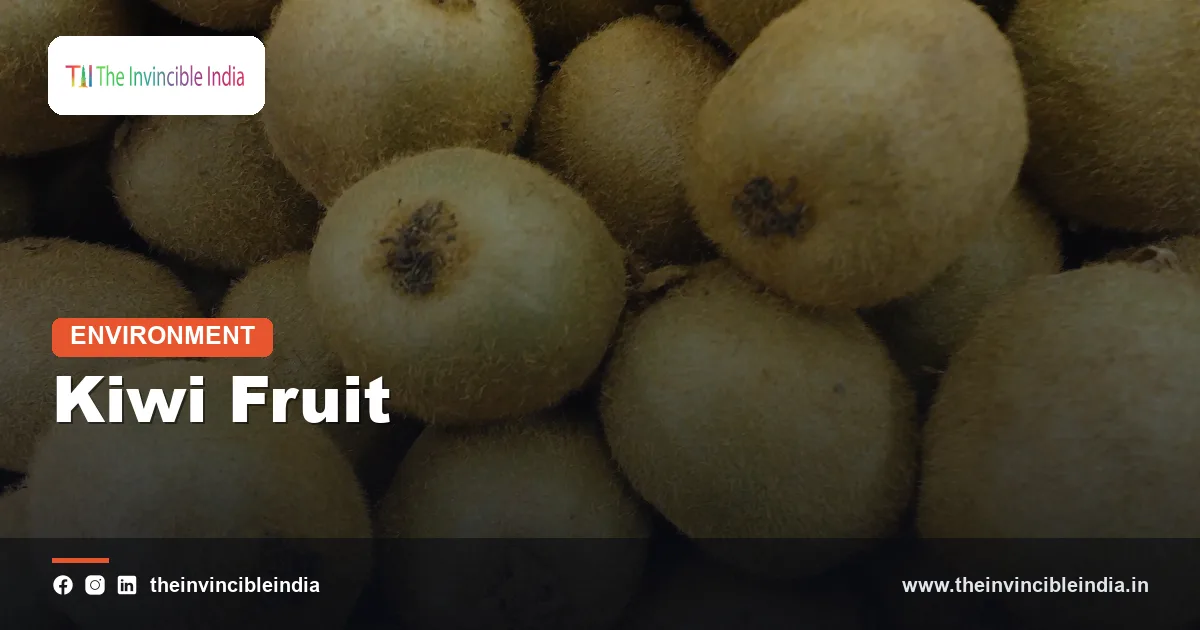
The kiwi, also called kiwifruit, is the fuzzy, brown-skinned, bright green-fleshed berry of a vigorous woody climber, Actinidia deliciosa, and in India it is grown mainly in the cool hills of Arunachal Pradesh, Himachal Pradesh, Sikkim and neighbouring Himalayan states. The plant is a deciduous vine that is native to China, and it became a world fruit crop only in the twentieth century.
The kiwi has found a home in India’s mid-altitude hills, where cool winters give the vine the chilling it needs. This article explains what the kiwi is, where and when it grows in India, how the male and female vines work together, what the fruit contains and how it is eaten.
| Quick Facts | Details |
|---|---|
| Common names | Kiwi, kiwifruit, Chinese gooseberry (older name) |
| Scientific name | Actinidia deliciosa (the common green kiwi) |
| Family | Actinidiaceae |
| Origin | Central and southern China, especially the Yangtze River region |
| Where grown in India | Arunachal Pradesh (notably the Ziro valley), Himachal Pradesh, Sikkim, Nagaland, Mizoram, Uttarakhand and Jammu and Kashmir |
| Season | Fruit is typically harvested in autumn, around October to November, and ripens further in storage |
| Part used | Fruit pulp; the thin skin is also edible |
| Key nutrition | Vitamin C, vitamin K, dietary fibre, potassium and the enzyme actinidin |
| Main uses | Fresh table fruit, salads, smoothies, desserts and meat tenderising |
Key Takeaways
- The kiwi is the fruit of the climbing vine Actinidia deliciosa, which is native to China and was renamed kiwifruit in New Zealand in the twentieth century.
- In India the kiwi is grown mainly in the mid-altitude hills of Arunachal Pradesh, Himachal Pradesh and Sikkim, where winters are cool enough for the vine to rest.
- Kiwi vines are dioecious, meaning separate male and female plants exist, and only female vines produce fruit.
- A kiwi vine usually takes three to five years to begin bearing fruit after planting and is trained over a sturdy overhead frame.
- The kiwi is a rich source of vitamin C and also contains actinidin, an enzyme that breaks down proteins.
- Kiwi fruit is harvested hard in autumn and ripens afterwards, so it can be stored for weeks in cool conditions.
What is a kiwi?
A kiwi is an oval berry, typically about the size of a hen’s egg, that grows on the woody climbing vine Actinidia deliciosa. Its brown skin is covered with short hairs, while the flesh inside is bright green, juicy and dotted with tiny black seeds arranged around a pale central core.
The kiwi vine belongs to the family Actinidiaceae and is deciduous, shedding its large, heart-shaped leaves in winter. The vine can grow several metres a season and, if not trained, climbs over whatever support it finds. Its flowers are creamy white, turning buff-yellow with age, and are borne singly or in small clusters on the new shoots.
The fruit has a sweet and tangy flavour often described as a blend of strawberry, banana and citrus. The ripe pulp is soft and juicy, with a firm core that is edible but often cut away. Because the flavour balances sugar and acid so distinctly, the kiwi is widely used both as a snack and as a garnish.
Where does the kiwi come from, and why is it called kiwi?
The kiwi comes from China, where wild Actinidia vines have grown in the hills for centuries, and the fruit is called kiwi because New Zealand growers and exporters adopted that name in the twentieth century. The earlier name, Chinese gooseberry, referred to the fruit’s origin and its resemblance to a gooseberry.
Seeds of the Chinese vine reached New Zealand early in the twentieth century, and growers there selected improved forms. The Hayward cultivar, raised by a nurseryman named Hayward Wright, became the standard commercial type because of its large fruit and good storage life. In the 1950s and 1960s exporters renamed the fruit kiwifruit after the kiwi, New Zealand’s flightless national bird, which is also brown and fuzzy in appearance.
The name caught on worldwide, and the fruit is now grown in many countries with suitable climates, including Italy, Chile, Greece, France and India. In everyday speech in India the word kiwi is used for the fruit, and the bird is rarely meant.
Where is the kiwi grown in India?
In India the kiwi is grown mainly in the Himalayan and northeastern hill states, with Arunachal Pradesh, Himachal Pradesh, Sikkim, Nagaland and Mizoram among the best-known growing areas. The vine grows best at mid-elevations of roughly 800 to 2,000 metres, where winters are cold enough to give it rest and summers are mild.
- Arunachal Pradesh: the Ziro valley in Lower Subansiri district is the best-known kiwi region of the northeast, and farmers there have promoted organic kiwi cultivation.
- Himachal Pradesh: orchards have been established in several mid-hill districts alongside apple and stone fruit.
- Sikkim: the state has promoted kiwi as a high-value fruit in its hills, in keeping with its organic farming policy.
- Nagaland and Mizoram: smaller plantings exist in the hill districts of these states.
- Uttarakhand and Jammu and Kashmir: trials and orchards have been developed in suitable temperate pockets.
The area under kiwi in India is still small, and the production figures change from year to year. Much of the kiwi on sale in Indian cities has historically been imported, which is one reason that state governments and research institutions have encouraged hill farmers to plant the crop.
How does the kiwi vine grow and fruit?
The kiwi vine grows as a strong, twining climber that needs a permanent frame, and it fruits only when male and female vines are planted close together. Because the plant is dioecious, a female vine bears the fruit, while a male vine supplies the pollen but produces no fruit of its own.
Male and female vines
Growers typically plant one male vine for every five to eight female vines, and they choose male plants whose flowering time overlaps with that of the females. Bees visit the flowers, but the kiwi blossom produces little nectar, so honeybees are not always strong pollinators and some orchards add managed hives or supplement with hand pollination.
Training and pruning
The vine is usually trained over a T-bar or pergola frame made of posts and wires, which carries the heavy canopy at about two metres from the ground. Winter pruning removes old fruiting wood and encourages new canes, since fruit forms on shoots that grow from the previous season’s canes. Regular summer pruning controls the vigorous growth.
Time to bearing
A kiwi vine normally begins to bear in the third to fifth year after planting and reaches full cropping in later years. A well-managed orchard can remain productive for several decades, which makes the crop a long-term investment for hill farmers.
What climate and soil does the kiwi need?
The kiwi needs a temperate to cool subtropical climate with a cold winter, a mild, humid growing season and protected, well-drained soil. The vine needs a period of winter chilling, usually several hundred hours below about 7 degrees Celsius, to break dormancy and flower properly.
Several conditions matter for successful cultivation.
- Chilling: too little winter cold leads to poor and uneven flowering.
- Frost: late spring frost can damage new shoots and flower buds, so frost-prone hollows are avoided.
- Water: the large leaves lose a lot of water, so regular moisture is needed in summer, but waterlogged soil causes root rot.
- Wind: strong wind tears the large leaves and knocks off young fruit, so windbreaks are common.
- Soil: deep, loose, fertile, slightly acidic soil rich in organic matter is preferred.
The northeastern and Himalayan hills largely meet these needs, and that is why the kiwi has become one of the more promising temperate fruits for those regions. In hot plains, the kiwi does not thrive because summer heat is too high and the winter chilling is not met.
What are the types of kiwi?
There are several kinds of kiwi, and the main ones are the green kiwi (Actinidia deliciosa), the gold or yellow kiwi (Actinidia chinensis) and the small, smooth-skinned hardy kiwi (Actinidia arguta). They differ in skin, flesh colour, sweetness and cold tolerance.
| Type | Species | Features |
|---|---|---|
| Green kiwi | Actinidia deliciosa | Hairy brown skin, green flesh, tangy and sweet; the most widely sold kind |
| Gold kiwi | Actinidia chinensis | Smoother skin, yellow flesh, sweeter and less acidic |
| Hardy kiwi | Actinidia arguta | Grape-sized, smooth edible skin, tolerates colder winters |
The most common cultivars in Indian orchards belong to the green kiwi group, and Hayward is the best-known commercial variety, valued for its large fruit and good storage. Other selections such as Allison, Bruno, Monty and Abbott have also been planted in the hill states, and the male pollinator varieties Tomuri and Matua are among those used alongside the female vines in some regions.
When is the kiwi harvested, and how does it ripen?
Kiwi fruit is harvested in autumn while it is still hard, and it softens to eating ripeness afterwards in storage or at home. In the Indian hills the harvest generally falls in October and November, though the exact dates vary with the elevation, the variety and the season.
Growers decide when to pick by measuring the sugar content of sample fruit, because kiwi that is picked too early stays sour and never develops full flavour. After harvest the fruit is cooled and can be stored for many weeks in cold storage, which allows sales to be spread over the winter. Fruit that is hard on purchase softens within days at room temperature, and the process speeds up when the kiwi is placed in a paper bag with an apple or banana, which release ethylene.
A ripe kiwi yields slightly to gentle pressure. Fruit that is very soft or wrinkled is overripe. Whole ripe kiwi kept in a refrigerator generally lasts several days to about a week.
What is inside a kiwi: nutrition and health facts?
A kiwi is a low-fat, fibre-containing fruit that is especially rich in vitamin C, and it also supplies vitamin K, vitamin E, folate and potassium. A single medium fruit provides a substantial share of the vitamin C that an adult needs in a day, and gold kiwi usually contains even more.
- Vitamin C: high; kiwi is often cited as one of the richer fruit sources of the vitamin.
- Dietary fibre: present in both the flesh and the edible skin.
- Potassium and vitamin K: useful amounts in a normal serving.
- Actinidin: a protein-digesting enzyme that is characteristic of the genus.
- Antioxidants: carotenoids and polyphenols in the flesh and skin.
Actinidin has two practical effects. It tenderises meat, which is why kiwi pulp is used in some marinades, and it stops gelatin from setting and can make milk or yoghurt bitter if the raw fruit is mixed in and left to stand. Cooking or canning the fruit deactivates the enzyme. Some people experience itching in the mouth or a more serious allergic reaction to kiwi, and those with known allergies, especially to latex or birch pollen, should be cautious. Nutrient values vary by variety and ripeness.
How is the kiwi eaten and used?
The kiwi is eaten fresh in India, usually peeled and sliced or cut in half and scooped out with a spoon, although the thin skin of a ripe fruit is also edible once the fuzz is rubbed off. The fruit is popular in fruit salads, smoothies, juices, cakes, tarts and as a topping for desserts.
- Eaten as a snack, either halved and scooped or sliced.
- Blended into smoothies and juices, often with banana or yoghurt.
- Used as a garnish on pavlova, cheesecake and fruit tarts.
- Made into jam, chutney, squash and dried fruit slices.
- Pulped for use as a natural meat tenderiser in marinades.
In the northeast, farmers and cooperatives have also begun to make kiwi wine, jam and squash, which lets them sell fruit that is too small or blemished for the fresh market. These processed products help extend the earning season and reduce waste after harvest.
Bottom Line
The kiwi is a Chinese climber that has become a promising hill fruit in India, particularly in Arunachal Pradesh, Himachal Pradesh and Sikkim. The crop depends on cold winters, male and female vines grown together, a strong support frame and patience for the first few years, and it rewards the grower with vitamin C-rich fruit that can be stored through the winter.
Frequently Asked Questions
Is kiwi grown in India?
Yes, kiwi is grown in India, mainly in the cool hill states such as Arunachal Pradesh, Himachal Pradesh, Sikkim and Nagaland. The Ziro valley of Arunachal Pradesh is among the best-known kiwi areas. The area under the crop is still small compared with apple, and many kiwis in city markets are imported.
Why does a kiwi vine not bear fruit?
A kiwi vine often fails to fruit because it is a male plant, because no male vine is nearby to supply pollen, or because it is too young. Only female vines bear fruit, and they usually need a male vine within the same orchard flowering at the same time. A vine can also stay barren if winters are too warm to give the chilling that it needs.
Can the skin of a kiwi be eaten?
Yes, the skin of a kiwi is edible and contains extra fibre and antioxidants. Many people prefer to rub off the fuzz or peel the fruit because the texture can be unpleasant. Gold kiwi and hardy kiwi have smoother skin that is easier to eat.
Why does kiwi make my mouth itch?
Kiwi can make the mouth itch because of the enzyme actinidin and because some people are allergic to proteins in the fruit. A mild tingle is common and usually passes quickly. If swelling, a rash or difficulty breathing occurs, medical help should be sought, and anyone with a known allergy should avoid the fruit.
How long does a kiwi take to ripen?
A hard kiwi usually ripens in about three to seven days at room temperature, and it can be faster if the fruit is stored with an apple or banana. The fruit is ready when it gives slightly under gentle pressure. Ripe kiwi kept in a refrigerator lasts about a week.
Can kiwi be grown in the plains of India?
Kiwi cannot be grown reliably in the hot plains of India because the vine needs a cold winter and a mild summer. Without enough winter chilling it flowers poorly, and extreme summer heat scorches the leaves. The crop is therefore limited to the hills, generally from about 800 to 2,000 metres above sea level.
{“@context”:”https://schema.org”,”@graph”:[{“@type”:”FAQPage”,”mainEntity”:[{“@type”:”Question”,”name”:”Is kiwi grown in India?”,”acceptedAnswer”:{“@type”:”Answer”,”text”:”Yes, kiwi is grown in India, mainly in the cool hill states such as Arunachal Pradesh, Himachal Pradesh, Sikkim and Nagaland. The Ziro valley of Arunachal Pradesh is among the best-known kiwi areas. The area under the crop is still small compared with apple, and many kiwis in city markets are imported.”}},{“@type”:”Question”,”name”:”Why does a kiwi vine not bear fruit?”,”acceptedAnswer”:{“@type”:”Answer”,”text”:”A kiwi vine often fails to fruit because it is a male plant, because no male vine is nearby to supply pollen, or because it is too young. Only female vines bear fruit, and they usually need a male vine within the same orchard flowering at the same time. A vine can also stay barren if winters are too warm to give the chilling that it needs.”}},{“@type”:”Question”,”name”:”Can the skin of a kiwi be eaten?”,”acceptedAnswer”:{“@type”:”Answer”,”text”:”Yes, the skin of a kiwi is edible and contains extra fibre and antioxidants. Many people prefer to rub off the fuzz or peel the fruit because the texture can be unpleasant. Gold kiwi and hardy kiwi have smoother skin that is easier to eat.”}},{“@type”:”Question”,”name”:”Why does kiwi make my mouth itch?”,”acceptedAnswer”:{“@type”:”Answer”,”text”:”Kiwi can make the mouth itch because of the enzyme actinidin and because some people are allergic to proteins in the fruit. A mild tingle is common and usually passes quickly. If swelling, a rash or difficulty breathing occurs, medical help should be sought, and anyone with a known allergy should avoid the fruit.”}},{“@type”:”Question”,”name”:”How long does a kiwi take to ripen?”,”acceptedAnswer”:{“@type”:”Answer”,”text”:”A hard kiwi usually ripens in about three to seven days at room temperature, and it can be faster if the fruit is stored with an apple or banana. The fruit is ready when it gives slightly under gentle pressure. Ripe kiwi kept in a refrigerator lasts about a week.”}},{“@type”:”Question”,”name”:”Can kiwi be grown in the plains of India?”,”acceptedAnswer”:{“@type”:”Answer”,”text”:”Kiwi cannot be grown reliably in the hot plains of India because the vine needs a cold winter and a mild summer. Without enough winter chilling it flowers poorly, and extreme summer heat scorches the leaves. The crop is therefore limited to the hills, generally from about 800 to 2,000 metres above sea level.”}}]}]}


