

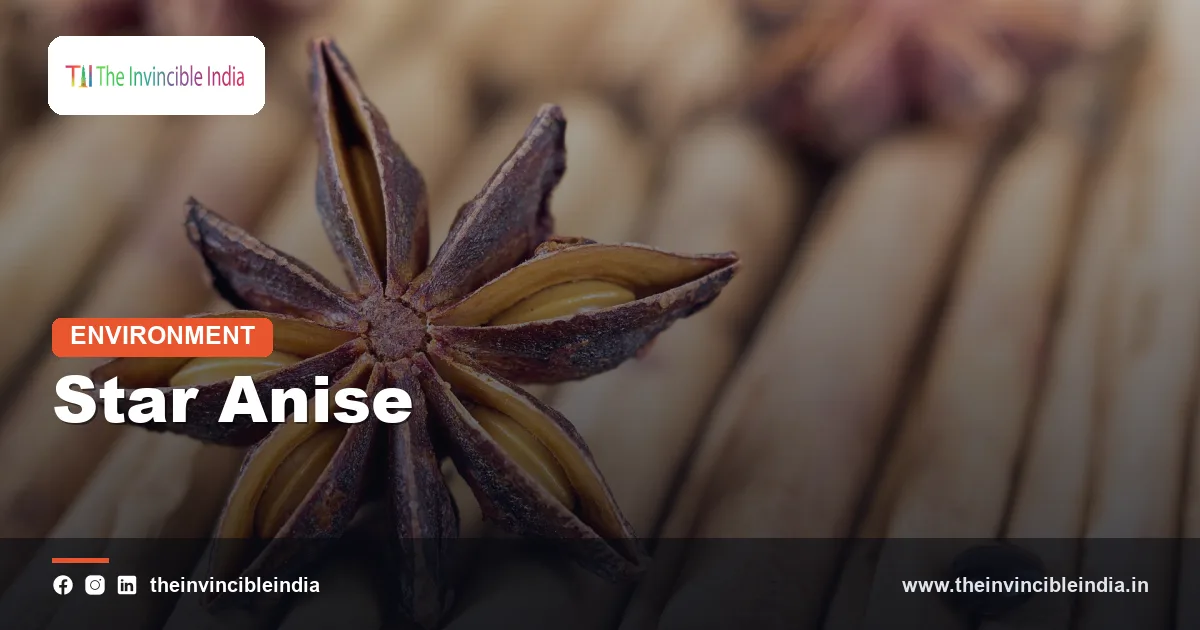
In Indian kitchens, star anise (chakra phool) is the dried, eight-pointed, star-shaped fruit of the evergreen tree Illicium verum, a fragrant spice with a sweet, liquorice-like flavour that is used in biryani, pulao, garam masala and masala chai. The tree is native to southern China and northern Vietnam, and in India the spice has been used for centuries, even though most of the supply has traditionally come from imports.
The star anise is both a spice and a plant, and the two are easy to confuse with anise seed and fennel. This article explains what the star anise tree is, where it grows, how the pods are harvested and dried, what gives the spice its flavour, and how it is used in Indian cooking.
| Quick Facts | Details |
|---|---|
| Common names | Star anise, chakra phool (Hindi), badian (Persian and Urdu usage), Chinese star anise |
| Scientific name | Illicium verum |
| Family | Schisandraceae (earlier placed in Illiciaceae) |
| Origin | Southern China and northern Vietnam |
| Where grown in India | Limited cultivation and trials in the eastern Himalaya and northeastern hills; supply is largely imported |
| Season | Fruits are picked before they split open, typically in autumn, and sun-dried |
| Part used | The dried star-shaped fruit (follicles) and its seeds |
| Key compound | Anethole, the volatile oil that gives the sweet anise aroma |
| Main uses | Whole spice in biryani, garam masala, tea and sweets; also in medicine and perfumery |
Key Takeaways
- Star anise is the dried, star-shaped fruit of the evergreen tree Illicium verum, which is native to southern China and northern Vietnam.
- The sweet, liquorice-like aroma of star anise comes mainly from anethole, the same compound found in anise seed and fennel, even though the three plants are unrelated.
- In India star anise is called chakra phool, and it is a standard whole spice in biryani, pulao, garam masala and masala chai blends.
- Star anise should not be confused with Japanese star anise (Illicium anisatum), a toxic relative that is not safe to eat.
- Star anise is picked unripe, just before the pods split, and dried in the sun until the colour turns reddish-brown.
- Shikimic acid extracted from star anise has been used as a starting material for the manufacture of the antiviral medicine oseltamivir.
What is star anise?
Star anise is a spice made from the dried fruit of Illicium verum, and each fruit is a woody star with usually eight pointed arms, each holding a single glossy seed. The pods are rust-brown to dark brown and hard, and they release a strong sweet fragrance when crushed or warmed.
The tree is a small to medium evergreen that reaches about 8 to 15 metres in suitable conditions. Its leaves are glossy, leathery and aromatic, and its flowers are pale yellow to pinkish with many narrow petals. The botanical family, Schisandraceae, is a small, ancient group of aromatic plants that are unrelated to the carrot family that includes anise and fennel.
The common name has a simple origin. The fruit is shaped like a star, and its smell resembles that of anise seed, so English speakers combined the two. In Hindi and several other Indian languages the spice is called chakra phool, which literally means wheel flower.
Is star anise the same as anise seed or fennel?
No, star anise is not the same as anise seed or fennel, because each comes from a different plant even though all three smell of liquorice. Anise seed comes from Pimpinella anisum and fennel (saunf) from Foeniculum vulgare, both herbs in the carrot family, while star anise comes from a tree.
All three share the aromatic compound anethole, which is why their flavours overlap. Star anise has a stronger, deeper and slightly bitter-sweet taste, and it is used whole in slow-cooked dishes. Anise seed and fennel seed are small and are chewed after meals, ground into masalas or tempered in oil.
| Spice | Plant | Form | Typical use |
|---|---|---|---|
| Star anise | Evergreen tree Illicium verum | Large, woody, eight-armed star pod | Whole in biryani, broths, tea and masalas |
| Anise seed | Herb Pimpinella anisum | Small, grey-green seed | Baking, liqueurs and digestive seeds |
| Fennel (saunf) | Herb Foeniculum vulgare | Slender green seed | Mouth freshener, pickles, panch phoron and curries |
Where does star anise grow, and is it grown in India?
Star anise grows mainly in southern China and northern Vietnam, and in India it is cultivated only on a limited scale in the eastern Himalaya and northeastern hill regions, so most of the spice used in Indian homes is imported. China and Vietnam remain the principal producing countries, with smaller quantities from Laos and a few other places.
Indian researchers and farmers have tried to grow Illicium verum in the cool, humid, forested hills of the northeast, where the climate has some similarity to the tree’s native range. Trials and small plantings have been reported in areas such as Arunachal Pradesh, and the spice is of interest as a high-value crop for hill farmers. The scale of cultivation remains small, and published figures vary, so it is best to treat any claim about Indian production with caution.
The eastern Himalaya is also the home of a wild relative, Illicium griffithii, which grows in the evergreen forests of the region. This species is not the commercial star anise, and its fruits are not used as a regular spice. The presence of a native Illicium in the hills is one reason botanists consider the region ecologically suitable for the genus.
What climate and soil does the star anise tree need?
The star anise tree needs a warm, humid, frost-free to lightly cool climate with plenty of rain and a deep, well-drained, slightly acidic soil. In its native range it grows in hilly, forested country at moderate elevations, often under partial shade when young.
- Temperature: mild conditions, avoiding hard frost and prolonged scorching heat.
- Rainfall: high and well distributed, as is typical of the eastern Himalayan and southern Chinese hills.
- Soil: deep, humus-rich loam on sloping, well-drained land; waterlogging harms the roots.
- Light: young seedlings do better with some shade, while older trees accept more sun.
- Altitude: mid-hill elevations are generally preferred.
The tree is slow to start. It is usually raised from seed in a nursery, and trees begin to bear in about six to ten years, with yields growing as the tree matures. Because of this long wait, the crop is a long-term investment, and it is typically grown in mixed farms and home gardens rather than in a single-crop plantation in many regions.
How is star anise harvested and processed?
Star anise is harvested by hand when the fruits are fully grown but still unripe, and the pods are then sun-dried until they turn hard and reddish-brown. Picking at this stage prevents the fruits from splitting open on the tree and losing seeds.
Harvest
The tree flowers in spring, and the fruit takes many months to develop. The main harvest of the commercial crop usually comes in autumn, and in some regions a smaller harvest is taken earlier in the year. Pickers use long poles or climb the tree, because the trunk is tall.
Drying and grading
The picked fruits are spread in the sun or briefly scalded in hot water and then sun-dried for several days. Drying concentrates the volatile oil, hardens the pods and fixes the colour. After drying the pods are sorted by size, colour and the number of intact arms. Whole, unbroken stars with a strong smell are considered the best grade.
Storage
Dried star anise keeps well in airtight containers kept away from light, heat and moisture. Over many months the aroma slowly fades, so cooks usually buy small quantities and grind the pods only when needed.
What gives star anise its flavour and aroma?
Star anise gets its flavour and aroma mainly from anethole, a volatile oil that makes up the largest share of the essential oil in the pods. Anethole tastes sweet and warm, much like liquorice, and it gives the spice its characteristic fragrance.
The essential oil of star anise also contains smaller amounts of compounds such as limonene, linalool and estragole, which add a slightly woody, citrus-like quality. The pod itself, rather than the seed alone, carries most of the oil, so cooks use the whole star or a piece of it and usually discard the pod after cooking.
A little goes a long way. One or two stars flavour a large pot of rice, stock or tea, and too much makes a dish taste medicinal and bitter. Gentle heat releases the aroma, and frying the whole spice briefly in ghee or oil at the start of cooking is a common technique to bring out the fragrance.
How is star anise used in Indian cooking?
Star anise is used in Indian cooking as a whole spice added to rich rice dishes, meat curries, stocks, tea and some sweets, and it is also ground into spice blends. It is especially common in Mughlai, Hyderabadi and Awadhi cooking, and in the biryanis and pulaos of many regions.
- Biryani and pulao: a single star is tempered with bay leaf, cardamom, cinnamon and cloves for a layered aroma.
- Garam masala: some regional blends include star anise alongside cloves, cardamom and cinnamon.
- Masala chai: a piece of star anise adds sweetness and warmth to spiced tea.
- Meat curries and stocks: the spice pairs well with mutton, chicken and slow-cooked gravies.
- Pickles and syrups: a small amount is used in some pickling mixes and spiced sugar syrups.
Outside India, star anise is a central ingredient in Chinese five-spice powder and in Vietnamese pho broth, which are among the best-known uses worldwide. In Indian homes the spice is usually removed before serving, because biting into a whole pod is unpleasant.
Is star anise safe, and what is Japanese star anise?
Star anise is safe as a culinary spice in normal amounts, but it must never be confused with Japanese star anise (Illicium anisatum), a related plant that is toxic. Japanese star anise contains neurotoxic compounds and is traditionally burned as temple incense, not eaten.
The two fruits look similar, though Japanese star anise usually has a less sweet, more camphor-like smell, and its pods are smaller with more pointed, curled tips. Cases of poisoning have been reported in other countries when herbal teas were contaminated with the wrong species. For this reason buyers should purchase star anise from reputable sellers, avoid unlabelled loose pods of doubtful origin and stop using any batch that smells unlike the usual sweet anise.
Like other spices, star anise is not a substitute for medical treatment. The spice has been used in traditional home remedies for digestion and coughs, but such claims should be treated as folk use, and pregnant women, young children and people with medical conditions should ask a doctor before consuming large or concentrated amounts.
Why does star anise matter for medicine and industry?
Star anise matters for medicine because it is a natural source of shikimic acid, which has been used as a starting material in the production of the antiviral drug oseltamivir. The drug is sold under the brand name Tamiflu and is used against influenza.
The pods also yield star anise essential oil, which is used in flavouring confectionery, liqueurs, toothpaste and cough preparations, and in soaps and perfumery. Some industrial uses have shifted over time as synthetic and fermentation-based routes to shikimic acid have been developed, but the spice remains a valuable agricultural commodity in its producing countries.
Bottom Line
Star anise is the dried star-shaped fruit of Illicium verum, and its flavour comes from anethole, the same compound found in anise seed and fennel. India uses it widely as chakra phool in biryani, masala chai and spice blends, grows it only in limited quantities in the eastern Himalaya, and relies heavily on imports to meet demand.
Frequently Asked Questions
What is chakra phool in English?
Chakra phool is the Hindi name for star anise. The name means wheel flower, and it refers to the star-shaped dried fruit of the tree Illicium verum. It is used as a whole spice in biryani, pulao and masala chai.
Is star anise grown in India?
Star anise is grown in India only on a small scale, mainly in trials and plantings in the eastern Himalaya and northeastern hills. Most of the star anise used in Indian kitchens is imported from countries such as China and Vietnam. The tree takes many years to begin bearing, which limits quick expansion.
What does star anise taste like?
Star anise tastes sweet, warm and slightly bitter, with a strong liquorice-like flavour. This flavour comes from the compound anethole, which is also found in fennel and anise seed. A single pod is enough to flavour a large pot of rice or curry.
Can star anise be substituted with fennel seeds?
Fennel seeds can substitute for star anise in a pinch, because both contain anethole and have a similar sweet aroma. Fennel is milder and less intense, so a larger quantity is needed to match the flavour. Anise seed is a closer match in strength, though it is also slightly different in character.
Is star anise poisonous?
Star anise is not poisonous when used as a spice in normal amounts, but its relative, Japanese star anise, is toxic. The two can look alike, so star anise should be bought from reliable sources. Anyone who has eaten a doubtful pod and feels unwell should seek medical help.
How long does star anise last?
Whole star anise can keep its aroma for about a year or more when stored in an airtight container away from heat, light and moisture. The flavour slowly weakens with time, and ground star anise loses fragrance faster than whole pods. Cooks usually grind the spice only when it is needed.
{“@context”:”https://schema.org”,”@graph”:[{“@type”:”FAQPage”,”mainEntity”:[{“@type”:”Question”,”name”:”What is chakra phool in English?”,”acceptedAnswer”:{“@type”:”Answer”,”text”:”Chakra phool is the Hindi name for star anise. The name means wheel flower, and it refers to the star-shaped dried fruit of the tree Illicium verum. It is used as a whole spice in biryani, pulao and masala chai.”}},{“@type”:”Question”,”name”:”Is star anise grown in India?”,”acceptedAnswer”:{“@type”:”Answer”,”text”:”Star anise is grown in India only on a small scale, mainly in trials and plantings in the eastern Himalaya and northeastern hills. Most of the star anise used in Indian kitchens is imported from countries such as China and Vietnam. The tree takes many years to begin bearing, which limits quick expansion.”}},{“@type”:”Question”,”name”:”What does star anise taste like?”,”acceptedAnswer”:{“@type”:”Answer”,”text”:”Star anise tastes sweet, warm and slightly bitter, with a strong liquorice-like flavour. This flavour comes from the compound anethole, which is also found in fennel and anise seed. A single pod is enough to flavour a large pot of rice or curry.”}},{“@type”:”Question”,”name”:”Can star anise be substituted with fennel seeds?”,”acceptedAnswer”:{“@type”:”Answer”,”text”:”Fennel seeds can substitute for star anise in a pinch, because both contain anethole and have a similar sweet aroma. Fennel is milder and less intense, so a larger quantity is needed to match the flavour. Anise seed is a closer match in strength, though it is also slightly different in character.”}},{“@type”:”Question”,”name”:”Is star anise poisonous?”,”acceptedAnswer”:{“@type”:”Answer”,”text”:”Star anise is not poisonous when used as a spice in normal amounts, but its relative, Japanese star anise, is toxic. The two can look alike, so star anise should be bought from reliable sources. Anyone who has eaten a doubtful pod and feels unwell should seek medical help.”}},{“@type”:”Question”,”name”:”How long does star anise last?”,”acceptedAnswer”:{“@type”:”Answer”,”text”:”Whole star anise can keep its aroma for about a year or more when stored in an airtight container away from heat, light and moisture. The flavour slowly weakens with time, and ground star anise loses fragrance faster than whole pods. Cooks usually grind the spice only when it is needed.”}}]}]}


