

The Koch dynasty, also known as the Koch kings of Kamata or the rulers of Koch Bihar, was the royal house of the Rajbongshi people that built a powerful kingdom in the eastern Himalayan foothills and plains straddling present-day northern West Bengal, western Assam and parts of Bangladesh. Founded in the early sixteenth century by Vishwa Singha and brought to its height under his son Nara Narayan, the Koch kingdom became one of the leading powers of the region, patron of Vaishnava religion and builder of temples. In later centuries it endured as the princely state of Cooch Behar, whose rulers raised the grand palace that still stands today. The kingdom’s history involved dealings with the Ahoms and the Mughal Empire alike. Where dates and details are uncertain, this guide keeps to general terms.
Quick answer: The Koch dynasty was the royal house of the Rajbongshi people that ruled the kingdom of Kamata, later Cooch Behar, in the eastern Himalayan region from the early sixteenth century. Founded by Vishwa Singha and brought to its zenith under his son Nara Narayan, it became a major regional power and a patron of Vaishnava religion, associated with temples such as the Madan Mohan temple. It later endured as the princely state of Cooch Behar, whose nineteenth-century palace remains a famous landmark.
Key Takeaways
- The Koch dynasty was the royal house of the Rajbongshi people, ruling the kingdom of Kamata and later Cooch Behar.
- It was founded in the early sixteenth century by Vishwa Singha.
- The kingdom reached its zenith under his son Nara Narayan, aided by his brother and general Chilarai.
- The Koch were patrons of Vaishnava religion and are associated with the saint tradition of Shankardeva.
- The dynasty later continued as the princely state of Cooch Behar under British paramountcy.
- The nineteenth-century Cooch Behar Palace and the Madan Mohan temple are famous landmarks of the dynasty.
Read on for the history, culture, and legacy in detail.
Quick Facts
| Detail | Information |
|---|---|
| Dynasty | Koch dynasty (rulers of Kamata / Cooch Behar) |
| Period | Early sixteenth century onward |
| Region | Eastern Himalayan foothills and plains; northern Bengal and western Assam |
| Capital | Cooch Behar (Koch Bihar) |
| Founder | Vishwa Singha |
| Notable Ruler | Nara Narayan; general Chilarai |
| Patronage | Vaishnava religion; temples such as Madan Mohan |
| Legacy | Princely state of Cooch Behar; Cooch Behar Palace |
Who Were the Koch?
The Koch were a people of the eastern Himalayan region whose rulers founded a powerful kingdom in the early sixteenth century, giving their name to the dynasty and to the state of Cooch Behar. Closely associated with the Rajbongshi community, the Koch rose from local prominence to establish a royal house that dominated the plains and foothills where Bengal, Assam and the Himalayas meet. The dynasty is known by several names, including the Koch kings, the rulers of Kamata and the rajas of Koch Bihar. They united local chieftaincies under a single crown and built a kingdom that became a major regional power. Their identity blended the martial authority of kingship with deep roots in the culture of the region. The Koch therefore represent the rise of an indigenous dynasty that shaped the history of the northeastern frontier of the subcontinent for centuries.
Where Was the Koch Kingdom Located?
The Koch kingdom was located in the eastern Himalayan foothills and the adjoining plains, a region that today spans northern West Bengal, western Assam and parts of Bangladesh. Its heartland lay around Cooch Behar, in the well-watered lowlands fed by Himalayan rivers, a fertile and strategically placed country between the mountains and the Bengal plains. At its height the kingdom extended its influence over a wide area of the Brahmaputra valley and the surrounding regions. This position placed the Koch between the Ahom kingdom of Assam to the east and the powers of Bengal to the west, making their land a frontier zone of great importance. The rivers, forests and fertile fields of the region sustained its people and its rulers. The geography of the eastern Himalayan borderland therefore shaped both the strength and the challenges of the Koch state.
When Was the Koch Dynasty Founded?
The Koch dynasty was founded in the early sixteenth century, when Vishwa Singha united the local Koch and Rajbongshi chieftaincies and established royal authority over the region of Kamata. Before this, the area had been divided among smaller powers and had seen the decline of the earlier kingdom of Kamata, which the Koch effectively revived and reorganised under a new ruling house. The foundation of the dynasty marked the emergence of a strong, centralised kingdom where previously there had been fragmentation. From this beginning the Koch rapidly rose to become a major regional power within a generation. The precise early chronology is reconstructed from tradition and later records. The founding of the Koch dynasty in the sixteenth century therefore stands as the starting point of a royal line that would endure, in one form or another, into the modern era as the house of Cooch Behar.
Who Was Vishwa Singha, the Founder?
Vishwa Singha is remembered as the founder of the Koch dynasty, the ruler who in the early sixteenth century united the Koch and Rajbongshi people and established the kingdom of Kamata under his authority. Tradition presents him as a capable leader who brought together scattered chieftaincies, organised a state and laid the foundations of its administration and military strength. Under him the kingdom began its rise from local power to regional prominence. He is also remembered for his patronage of religion and for strengthening the institutions of the young kingdom. As with other founders known partly through tradition, the details of his reign are held in general outline rather than precise record. Vishwa Singha nonetheless occupies the central place as the progenitor of the dynasty, the king from whom the later rulers of Cooch Behar traced their descent and their authority.
Who Was Nara Narayan?
Nara Narayan, the son of Vishwa Singha, is remembered as the greatest ruler of the Koch dynasty, the king under whom the kingdom reached its zenith of power, territory and cultural achievement in the sixteenth century. His reign is associated with the expansion of the kingdom, the strengthening of its administration and a flowering of religious and literary patronage. He is especially celebrated for his support of Vaishnava religion and for the building and endowment of temples. Nara Narayan governed with the aid of his brother Chilarai, the famous general whose campaigns extended Koch power. Under this partnership the kingdom became a dominant force in the eastern region. Nara Narayan therefore stands as the symbol of the dynasty’s golden age, a ruler remembered for both the might of his kingdom and the richness of its cultural and religious life.
What Was the Role of Chilarai?
Chilarai, whose given name is traditionally recorded as Shukladhwaj, was the brother of Nara Narayan and the celebrated general whose military leadership extended the power of the Koch kingdom to its greatest reach. Remembered as a brilliant and energetic commander, he led the armies that carried Koch influence across the Brahmaputra valley and the surrounding regions during the sixteenth century. His campaigns are a central part of the story of the dynasty’s rise to dominance under Nara Narayan. Tradition honours him as a heroic figure whose speed and daring earned him his name, often explained as a reference to a kite or hawk. The partnership between the ruling king and his warrior brother was a defining feature of the Koch golden age. Chilarai therefore remains one of the most admired figures of the dynasty, a general whose exploits are woven into the region’s historical memory.
How Was the Kingdom of Kamata Connected to the Koch?
The kingdom of Kamata was the historic state that the Koch dynasty revived and made its own, giving the early Koch rulers the title and legitimacy of Kamata kings. Kamata had been an important kingdom in the region before the rise of the Koch, and its name carried prestige and territorial meaning across the eastern Himalayan borderland. When Vishwa Singha established Koch authority, he and his successors took up the mantle of Kamata, presenting their new kingdom as the continuation of that earlier realm. This connection linked the Koch to the deeper history of the region and strengthened their claim to rule. Over time the kingdom became better known by the name of its ruling house and its capital, Cooch Behar. The link with Kamata therefore gave the Koch dynasty an inheritance of legitimacy, tying their sixteenth-century state to the older political traditions of the land.
How Did the Koch Kingdom Divide?
The Koch kingdom divided after its period of greatest unity, when disputes within the ruling family led to the separation of the realm into branches, a development common in medieval and early modern dynasties. Following the age of Nara Narayan and Chilarai, the kingdom split, with one branch continuing in the western heartland around Cooch Behar and another establishing itself in the eastern territories toward the Brahmaputra valley, an area sometimes called Koch Hajo. This division weakened the once-unified power and shaped the subsequent politics of the region. The two branches pursued different fortunes, with the eastern lands increasingly drawn into the rivalries of Assam and the pressures of larger powers. The western branch endured as the state of Cooch Behar. The division of the kingdom therefore marked the end of the dynasty’s single greatest phase and the beginning of a more complex and contested later history.
How Did the Koch Relate to the Mughals and Ahoms?
The Koch related to the Mughals and the Ahoms through a shifting mixture of warfare, alliance and diplomacy, since both were powerful neighbours pressing on the Koch frontier. To the east lay the Ahom kingdom of the Brahmaputra valley, with which the Koch had both conflict and cooperation as the two powers contested influence in the region. To the west and south lay the expanding Mughal Empire, which extended its reach into Bengal and sought authority over the frontier kingdoms. The Koch rulers used negotiation, tribute and selective alliance to preserve their position between these giants, sometimes siding with one against the other. The division of the kingdom made these relationships still more complex. This frontier diplomacy was essential to the survival of the Koch state. Their dealings with the Mughals and Ahoms illustrate the delicate balancing that a regional kingdom required amid great neighbouring empires.
How Did the Koch Patronise Religion?
The Koch rulers were notable patrons of religion, and the dynasty is especially associated with the flourishing of Vaishnava devotion in the eastern region during the sixteenth century. The reign of Nara Narayan in particular is linked with support for the Vaishnava movement connected to the great saint and reformer Srimanta Shankardeva, who is remembered for spreading a devotional faith centred on Vishnu and Krishna in Assam and the surrounding lands. Royal patronage helped sustain this religious and cultural renewal, which shaped the literature, music and devotional life of the region for generations. The Koch kings also supported the building and endowment of temples and the worship of various deities. This patronage tied the dynasty closely to the spiritual life of its people. The Koch contribution to the Vaishnava tradition remains one of the most important aspects of the dynasty’s cultural legacy.
What Is the Madan Mohan Temple?
The Madan Mohan temple is one of the most famous religious landmarks associated with Cooch Behar and the Koch rulers, a temple dedicated to the deity Madan Mohan, a form of Krishna especially revered in the region. The temple is a centre of devotion and of the religious life of the town, and it is closely tied to the traditions and festivals of the Koch royal house and its people. The structure that stands today reflects the enduring patronage of the dynasty and the strong Vaishnava devotion of the region. Festivals held at the temple, including celebrated annual observances, draw large numbers of devotees and remain an important part of local culture. The temple embodies the religious patronage for which the Koch were known. The Madan Mohan temple therefore stands as a living symbol of the faith and heritage nurtured by the rulers of Cooch Behar.
How Did Cooch Behar Become a Princely State?
Cooch Behar became a princely state as the western branch of the Koch kingdom endured into the modern era and entered into a relationship with the paramount power in India. Over the centuries the kingdom’s independence was increasingly constrained by larger powers, and eventually it came under British paramountcy as one of the princely states that retained their ruling dynasties under overall British authority. As a princely state, Cooch Behar kept its royal house and a measure of internal self-government while acknowledging British supremacy in external affairs. The rulers of this period, bearing the title of maharaja, modernised their capital and administration and built grand public and royal structures. This arrangement preserved the Koch dynasty into the twentieth century. Cooch Behar’s status as a princely state therefore represents the final political chapter of the Koch kingdom before its integration into the modern Indian union.
What Is the Cooch Behar Palace?
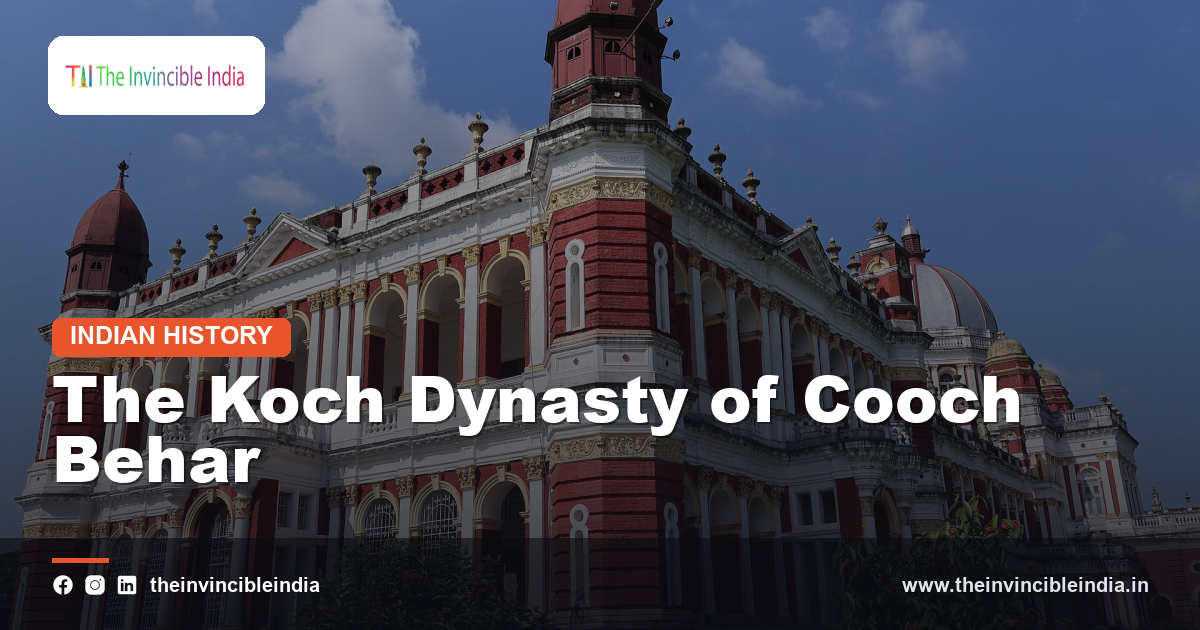
The Cooch Behar Palace, also known as the Victor Jubilee Palace, is a grand nineteenth-century royal residence built by the Koch rulers during the era of the princely state and is the most famous monument associated with the dynasty today. Designed in a European-influenced classical style, the palace reflects the taste of the modernising maharajas of Cooch Behar, who adopted architectural fashions of the age while maintaining their royal traditions. With its imposing facade, domed hall and spacious grounds, the palace stands as a symbol of the wealth and status of the later Koch dynasty. It served as the seat of the ruling house and the centre of court life in the capital. Today it is a protected heritage building and a major attraction for visitors. The Cooch Behar Palace therefore embodies the grandeur of the Koch dynasty in its final princely phase.
What Culture and Language Did the Koch Foster?
The Koch dynasty fostered a distinctive regional culture, closely tied to the Rajbongshi people and to the languages and traditions of the eastern Himalayan borderland. The court and the kingdom supported literature, music and the devotional culture of the Vaishnava movement, which enriched the artistic life of the region. The Rajbongshi language and the local cultural forms flourished under the kingdom, contributing to the identity of the region that persists to this day. Festivals, folk traditions and temple arts were sustained by royal and popular patronage. The blending of courtly and folk elements gave the culture of Cooch Behar its particular character. The Koch kingdom thus served as a focus for the cultural life of a frontier region where the influences of Bengal, Assam and the Himalayas met. This cultural legacy remains a defining feature of the heritage of Cooch Behar and the Rajbongshi people.
Why Is the Koch Dynasty Significant in Indian History?
The Koch dynasty is significant in Indian history as the royal house that built a major kingdom on the northeastern frontier of the subcontinent and sustained it, in one form or another, from the early sixteenth century into the modern era. Their state was a key power in the contested borderland between Bengal, Assam and the Himalayas, and their dealings with the Mughals and the Ahoms shaped the history of the region. Their patronage of Vaishnava religion contributed to one of the great devotional movements of eastern India. The later princely state of Cooch Behar preserved the dynasty and left grand monuments such as its famous palace. For students of Indian history, the Koch illustrate the rise of an indigenous frontier dynasty and its long survival amid powerful neighbours. Their significance lies in both their political achievement and their lasting cultural and religious legacy.
The Koch Dynasty Today
The Koch dynasty lives on today through the heritage of Cooch Behar and the enduring culture of the Rajbongshi people of the region. The grand Cooch Behar Palace is a celebrated heritage site and a major attraction, while the Madan Mohan temple remains a living centre of devotion and festival. The memory of rulers such as Vishwa Singha, Nara Narayan and the general Chilarai is preserved in local tradition, literature and popular history. The Vaishnava religious culture that the dynasty patronised continues to shape the spiritual life of the region. Historians and conservators study and preserve the monuments and records of the kingdom. For readers of Indian history, the Koch dynasty offers a vivid example of a frontier kingdom that endured for centuries and left a rich cultural inheritance. Their legacy endures in the palace, temples and traditions of Cooch Behar.
Sources & Further Reading
- Archaeological Survey of India (asi.nic.in).
- Ministry of Culture, Government of India (indiaculture.gov.in).
- West Bengal Tourism, Government of West Bengal (wbtourism.gov.in).
Frequently Asked Questions
Who were the Koch?
The Koch were a people of the eastern Himalayan region whose rulers founded a powerful kingdom in the early sixteenth century. Closely associated with the Rajbongshi community, they ruled the kingdom of Kamata, later known as Cooch Behar.
Who founded the Koch dynasty?
The Koch dynasty was founded in the early sixteenth century by Vishwa Singha, who united the local Koch and Rajbongshi chieftaincies. He established royal authority over the region of Kamata and laid the foundations of the kingdom.
Who was the greatest Koch ruler?
Nara Narayan, the son of Vishwa Singha, is remembered as the greatest Koch ruler, under whom the kingdom reached its zenith. He governed with the aid of his brother Chilarai, the celebrated general who extended Koch power across the region.
What religion did the Koch rulers patronise?
The Koch rulers were notable patrons of Vaishnava religion, and the reign of Nara Narayan is linked with the devotional movement associated with the saint Srimanta Shankardeva. They also supported temples such as the Madan Mohan temple of Cooch Behar.
How did the Koch kingdom continue in later times?
The western branch of the Koch kingdom endured as the princely state of Cooch Behar, which came under British paramountcy while keeping its ruling dynasty. Its nineteenth-century maharajas built the grand Cooch Behar Palace.
What is the Cooch Behar Palace?
The Cooch Behar Palace, also called the Victor Jubilee Palace, is a grand nineteenth-century royal residence built by the Koch rulers in a European-influenced style. It is the most famous monument associated with the dynasty and a protected heritage site today.


