

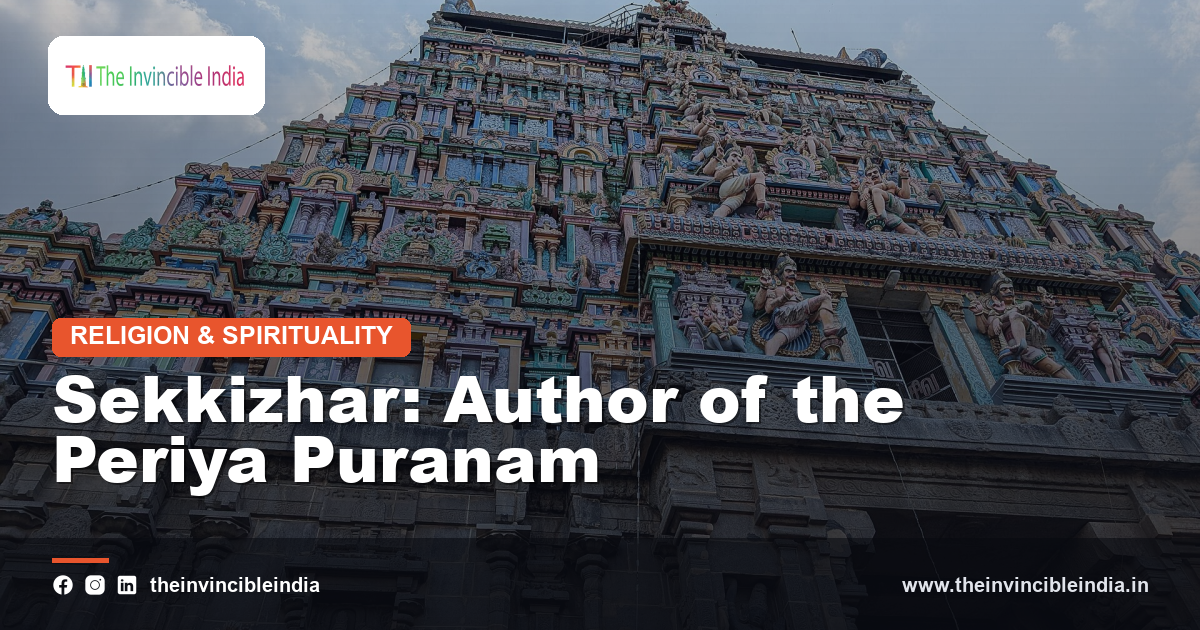
Sekkizhar, also spelled Chekkilar, is the Tamil minister-poet who composed the Periya Puranam, also called the Tiruttondar Puranam, the great hagiography of the sixty-three Nayanar saints of Tamil Shaivism. Generally placed in about the twelfth century, he served as a minister at the Chola court, where tradition links him with the ruler Kulottunga II, and he is associated with Kunrattur and with the great temple of Chidambaram. His work gathered the lives and legends of the Nayanar saints into a single poem that became a foundation of Tamil Shaiva devotion, and it secured for the saints a lasting place in the worship of Shiva and the wider tradition of Shaivism. Many details of his life are known through tradition.
Quick answer: Sekkizhar, also spelled Chekkilar, is the Tamil minister-poet who composed the Periya Puranam, the hagiography of the sixty-three Nayanar saints of Tamil Shaivism. Generally placed in about the twelfth century, he served as a minister at the Chola court and is associated with Kunrattur and Chidambaram. His poem gathered the lives and legends of the Nayanars into a single work that became a foundation of Tamil Shaiva devotion and is honoured as part of the sacred Tirumurai.
Key Takeaways
- Sekkizhar, also spelled Chekkilar, is the author of the Periya Puranam, the hagiography of the sixty-three Nayanars.
- He is generally placed in about the twelfth century according to tradition.
- He served as a minister at the Chola court, which tradition links with Kulottunga II.
- His poem is also called the Tiruttondar Puranam, the account of the holy devotees.
- He is associated with Kunrattur and with the great temple of Chidambaram.
- The Periya Puranam is honoured as part of the Tirumurai, the sacred Tamil Shaiva canon.
The sections below explain his life as told by tradition, the Periya Puranam, his service at the Chola court and his continuing place in Tamil Shaiva devotion.
Quick Facts
| Detail | Information |
|---|---|
| Also known as | Chekkilar, Sekkizhaar |
| Tradition | Tamil Shaivism, Nayanar hagiography |
| Era | About the twelfth century, traditionally dated |
| Region | Tamil country, associated with Kunrattur |
| Language of works | Tamil |
| Principal work | Periya Puranam, Tiruttondar Puranam |
| Role | Minister-poet at the Chola court |
| Principal shrine | Associated with Chidambaram |
Who Was Sekkizhar?
Sekkizhar was a Tamil minister-poet of the medieval period who is honoured as the author of the Periya Puranam, the great hagiography of the sixty-three Nayanar saints of Tamil Shaivism. His work gave lasting form to the memory of the saints and holds a central place in Shaiva devotion.
He is remembered as a man of high office who combined service to a king with deep devotion to Shiva, and who used his learning and his poetic gift to honour the devotees of the Lord. His name is also spelled Chekkilar. Although many details of his life come from tradition rather than documented record, his great poem survives and reveals both his literary skill and the depth of his devotion to the saints whose lives he told.
What Does the Name Sekkizhar Mean?
The poet is known as Sekkizhar, also spelled Chekkilar, a name that readers will meet in both forms across texts and studies. The variation in spelling arises from the different ways of writing the Tamil sounds in other scripts.
In Tamil Shaiva tradition he is honoured above all as the author of the Periya Puranam, and he is sometimes referred to by titles of respect that reflect his standing as a devotee and poet. Keeping the alternate spelling in mind helps a reader recognise him across different sources. The honour attached to his name in the tradition comes entirely from his great work, which secured the memory of the Nayanar saints and became a treasure of Tamil devotional literature for all later generations.
When and Where Did Sekkizhar Live?
Sekkizhar is generally placed in about the twelfth century, though the exact dates are given differently in various accounts, so it is wise to describe his era in general terms rather than fix a precise year. He lived in the Tamil country during the age of the Chola kings.
Tradition associates him with Kunrattur, given as his native place, and with the great temple of Chidambaram, a foremost centre of Shaiva worship. He is remembered as a minister at the Chola court, and tradition links him with the reign of a ruler named Kulottunga. Because his life is handed down chiefly through tradition, careful writers speak of his region, his office and the places of his devotion with confidence while leaving precise chronology open to question.
What Is the Periya Puranam?
The Periya Puranam, also called the Tiruttondar Puranam, is the great Tamil poem composed by Sekkizhar that tells the lives and legends of the sixty-three Nayanar saints of Shaivism. Its name means the great purana, or the account of the holy devotees.
The work gathers the stories of the saints, from kings and scholars to humble workers and hunters, into a single ordered poem of devotion. It became the authoritative account of the Nayanars and a foundation of Tamil Shaiva tradition. The Periya Puranam is honoured as part of the Tirumurai, the sacred Shaiva canon, and is recited and studied with reverence. Through it the memory of the saints was preserved and passed to all later generations of devotees in the Tamil land and beyond.
Why Did Sekkizhar Write the Periya Puranam?
Sekkizhar wrote the Periya Puranam to honour the sixty-three Nayanar saints and to preserve their lives and legends in a single great work of devotion, and tradition connects the undertaking with his service at the Chola court. The purpose was devotional as well as literary.
Tradition relates that he was moved to compose the poem by his love for the saints and by a desire to turn the court and the people toward the devotion of Shiva. He drew on earlier accounts, including the hymn of Sundarar that names the saints, and shaped them into a flowing narrative. The work thus served both to glorify the devotees of the Lord and to spread their example. It became one of the most influential devotional poems in the whole Tamil tradition.
Who Were the Nayanars Described in His Work?
The Nayanars described in the Periya Puranam were the saints of Tamil Shaivism, traditionally numbered as sixty-three, who expressed devotion to Shiva and came from every walk of life. Sekkizhar told the story of each, from the greatest poets to the humblest devotees.
Among them are the three Tevaram poets, Sambandar, Appar and Sundarar, as well as kings, ministers, farmers, potters, hunters and washerfolk, each honoured for a devotion that broke the bounds of rank and learning. By gathering all their stories, Sekkizhar showed the breadth of the Shaiva tradition and its openness to all people. The Periya Puranam remains the chief source through which the lives of these saints are known, and it shaped how the whole tradition remembers them.
How Does the Periya Puranam Tell the Saints' Stories?
The Periya Puranam tells the saints’ stories as flowing devotional narrative, weaving together legend, miracle and moral example to present each Nayanar as a model of love for Shiva. The poem is admired both for its devotion and for its literary craft.
Sekkizhar arranges the lives with care, setting them in the landscape of the Tamil temples and giving each saint a place within the larger fellowship of devotees. The miraculous episodes are told as sacred tradition, meant to inspire love rather than to record documented events. The work combines reverence with a sense of the drama and variety of the saints’ lives. Its skilful blend of story and devotion is one reason it became so loved and so central to the Shaiva tradition.
What Role Did Sekkizhar Play at the Chola Court?
Sekkizhar served as a minister at the Chola court, and tradition links his life with the reign of a ruler named Kulottunga, giving him a place of high office and influence in his time. His position as a statesman is a notable feature of his memory.
Tradition relates that, from this position, he was concerned to turn the court toward the devotion of Shiva and the honouring of the saints, and that the composition of the Periya Puranam was connected with this purpose. The image of a minister who was also a devoted poet and a servant of the Lord is cherished in the tradition. It shows that devotion and worldly responsibility could be joined, and it gives Sekkizhar a distinctive place among the figures of Tamil Shaivism.
What Is the Link Between Sekkizhar and Chidambaram?
Sekkizhar is associated with the great temple of Chidambaram, one of the foremost centres of Shaiva worship in the Tamil land, famous as the shrine of Shiva in his form as the cosmic dancer. The tradition connects the poet and his work with this holy place.
Tradition relates that the Periya Puranam is linked with Chidambaram in its composition and its honouring, and the temple remains a centre where the memory of Sekkizhar and the saints is cherished. Chidambaram holds a special place in Tamil Shaivism, and the association of the great hagiographer with it adds to the honour in which both are held. For devotees the link binds the poet, his work and the saints to one of the most sacred shrines of the tradition.
Why Is the Periya Puranam Part of the Tirumurai?
The Periya Puranam is honoured as part of the Tirumurai, the sacred canon of Tamil Shaiva texts, taking its place among the hymns of the Nayanar saints as the last of the twelve books. This inclusion marks the high esteem in which Sekkizhar’s work is held.
The Tirumurai gathers the devotional literature of Tamil Shaivism into an ordered collection, beginning with the Tevaram hymns and ending with the great hagiography. By placing the Periya Puranam within the canon, the tradition recognised it as a sacred work worthy to stand beside the hymns of the saints it describes. This honour reflects both the devotion of the poem and its central role in preserving the memory of the Nayanars for all later worshippers of Shiva.
How Did Sekkizhar's Work Shape Tamil Shaivism?
Sekkizhar’s work shaped Tamil Shaivism by giving the tradition its authoritative account of the saints and by fixing the memory of the sixty-three Nayanars in a single beloved poem. The Periya Puranam became the lens through which later devotees came to know the saints.
Through it the stories of the Nayanars spread through temples, teaching and festival, inspiring devotion and setting before the people a gallery of models drawn from every walk of life. The work reinforced the ideals of loving service, humility and surrender that lie at the heart of the tradition. Its influence on Tamil Shaiva devotion has been lasting and deep, and much of what is remembered of the saints today comes through the poem that Sekkizhar composed.
How Is Sekkizhar Remembered in the Tradition?
Sekkizhar is remembered in the tradition as a revered devotee and poet, honoured not only for the Periya Puranam but as a saint in his own right, whose love for Shiva and for the Nayanars shaped the devotional life of the Tamil land. His memory is cherished in temple and teaching.
Images and shrines honour him, and his work is recited and studied with reverence. The tradition treats him as one who served the saints by preserving their memory, and so as belonging to their fellowship. His example of combining learning, high office and deep devotion is admired, and his name is spoken with honour wherever the Nayanars are remembered. In this way the hagiographer himself became part of the sacred story he told.
How Does Sekkizhar Compare With the Nayanar Poets?
Sekkizhar differs from the Nayanar poets such as Sambandar and Appar in that he was not one of the saints whose hymns praise Shiva directly, but the later poet who gathered and told the stories of those saints. His gift was narrative and devotional rather than hymnal.
Where the Tevaram poets sang their own love for Shiva, Sekkizhar sang the love of the saints who had gone before, becoming their chronicler and celebrant. This distinct role gives him a special place in the tradition, as the one who preserved the memory of the whole fellowship. Seeing him beside the poet-saints helps readers understand how Tamil Shaivism both produced its devotees and, through Sekkizhar, remembered and honoured them for all later generations.
Why Should His Accounts Be Read as Tradition?
The accounts in the Periya Puranam should be read as devotional tradition rather than documented history, for they are works of sacred biography in which miracle and legend serve to teach the love of God. This is how the tradition itself understands them.
Treating the stories with respect means honouring their meaning for devotees while recognising that they belong to the realm of hagiography. The power of the work lies in the devotion and moral example it conveys rather than in historical precision. Careful readers can appreciate both the beauty of the poem and the reverence with which it is held, without needing to treat its wonders as literal record. In this way Sekkizhar’s great work is honoured for what it truly is, a treasury of devotion.
Why Does Sekkizhar Still Matter Today?
Sekkizhar still matters today because his Periya Puranam remains the authoritative account of the Nayanar saints and a treasure of Tamil devotional literature, through which the memory of the saints continues to live. His work is read, recited and studied across generations.
His example of a minister and poet who used his gifts to honour the devotees of God speaks to all who value the joining of learning and devotion. Scholars prize his poem as a landmark of Tamil literature, while devotees treasure it as a window onto the lives of the saints. Careful readers honour the context of his tradition and treat the sacred stories as devotional belief, while recognising the enduring worth of the great work he left behind.
Sekkizhar Today
Sekkizhar today is remembered as the author of the Periya Puranam, the great hagiography of the sixty-three Nayanar saints, and as a revered devotee and poet of Tamil Shaivism, honoured in connection with Chidambaram and wherever the saints are venerated. His work remains part of the living Shaiva canon.
Through his poem he preserved the memory of the saints and gave the tradition its lasting account of their lives, and through his own devotion he earned a place among those he honoured. Many details of his life are tradition, yet the survival and continued use of the Periya Puranam give a clear portrait of a devoted poet and statesman. His legacy endures as a reminder that to honour the devotees of God is itself a path of devotion.
Sources & Further Reading
- Ministry of Culture, Government of India (indiaculture.gov.in).
- Sahitya Akademi general references on Tamil devotional literature.
Frequently Asked Questions
Who was Sekkizhar?
Sekkizhar, also spelled Chekkilar, was a Tamil minister-poet, generally placed in about the twelfth century, who composed the Periya Puranam, the hagiography of the sixty-three Nayanar saints of Tamil Shaivism. He served at the Chola court.
What is the Periya Puranam?
The Periya Puranam, also called the Tiruttondar Puranam, is the great Tamil poem by Sekkizhar that tells the lives and legends of the sixty-three Nayanar saints. It is honoured as part of the Tirumurai, the sacred Shaiva canon.
Why did Sekkizhar write the Periya Puranam?
Sekkizhar wrote the Periya Puranam to honour the Nayanar saints and preserve their lives in a single work of devotion. Tradition connects the undertaking with his service at the Chola court and his wish to spread the devotion of Shiva.
How is Sekkizhar linked with the Chola court?
Sekkizhar served as a minister at the Chola court, and tradition links his life with a ruler named Kulottunga. He is remembered as a statesman who was also a devoted poet and a servant of Shiva.
Why is the Periya Puranam important?
The Periya Puranam is important because it became the authoritative account of the sixty-three Nayanar saints and a foundation of Tamil Shaiva devotion. Much of what is remembered of the saints today comes through Sekkizhar’s poem.
Who were the Nayanars?
The Nayanars were the saints of Tamil Shaivism, traditionally numbered as sixty-three, who expressed devotion to Shiva and came from every walk of life. Their lives are told in Sekkizhar’s Periya Puranam.


