

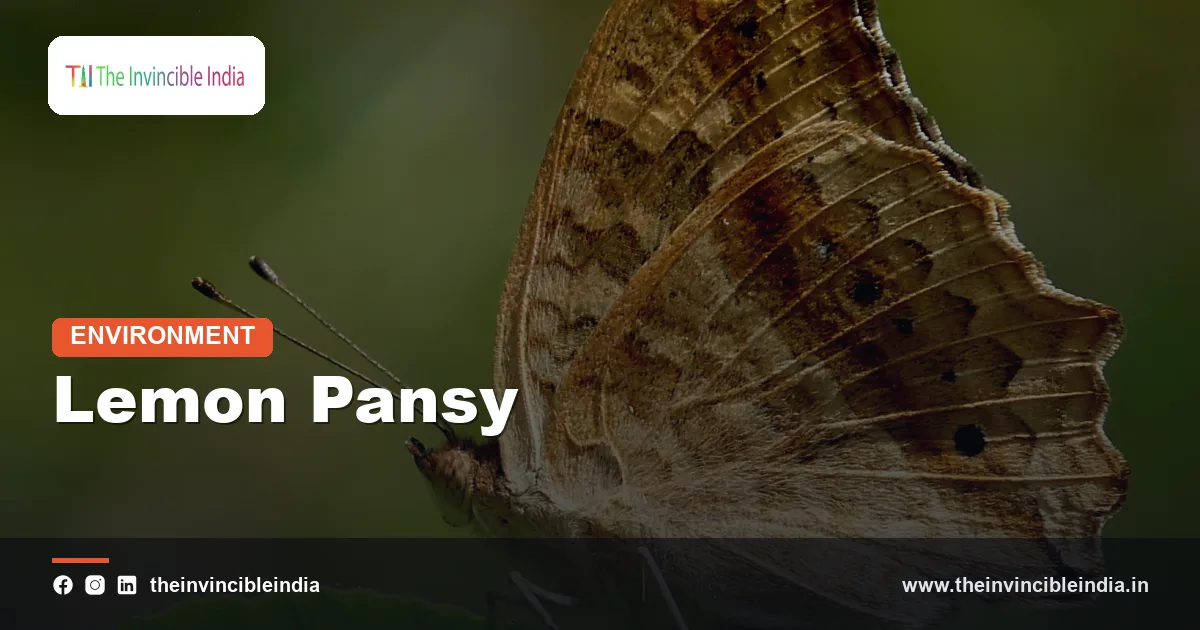
The lemon pansy (Junonia lemonias) is a medium-sized brown-and-yellow brush-footed butterfly with bold eyespots that basks on bare paths, lawns and open ground across India, and whose appearance differs between the wet and dry seasons. A familiar sight in gardens, fallow land and forest clearings, the lemon pansy is one of the commonest members of the pansy group of Indian butterflies.
This guide explains how to recognise the lemon pansy, why its eyespots matter, what its caterpillars eat, how its wet-season and dry-season forms differ, and how it can be told apart from the other Indian pansies.
| Attribute | Detail |
|---|---|
| Scientific name | Junonia lemonias |
| Family | Nymphalidae (brush-footed butterflies), subfamily Nymphalinae |
| Genus | Junonia, the pansies and buckeyes |
| Typical wingspan | Roughly 5.5 to 7 cm |
| Upperside colour | Brown with lemon-yellow to pale orange patches and conspicuous eyespots |
| Seasonal forms | Brighter wet-season form and duller, leaf-like dry-season form |
| Caterpillar food plants | Low herbs of the acanthus family, such as Hygrophila, Asystasia and Barleria |
| Habitat | Gardens, lawns, paths, scrub, fallow land and forest edges |
| Range | India, Sri Lanka and Bangladesh eastwards through South-East Asia to southern China |
Key Takeaways
- The lemon pansy (Junonia lemonias) is a brush-footed butterfly of the family Nymphalidae with a wingspan of roughly 5.5 to 7 centimetres.
- Lemon pansies are brown above with lemon-yellow patches and prominent eyespots on both forewings and hindwings.
- Lemon pansy caterpillars feed on low herbs in the acanthus family, including Hygrophila, Asystasia and Barleria.
- The lemon pansy has a brighter wet-season form and a duller, leaf-like dry-season form produced by seasonal polyphenism.
- Eyespots on a lemon pansy are believed to deflect the attacks of predators away from the vulnerable head and body.
- The lemon pansy is common across India and is often seen basking on bare soil, paths and lawns with its wings open.
What is the lemon pansy butterfly?
The lemon pansy is a medium-sized butterfly named Junonia lemonias, belonging to the pansy genus Junonia within the brush-footed family Nymphalidae. The common name “pansy” comes from the rounded, patterned wings, which loosely recall the markings of the garden pansy flower, while “lemon” refers to the pale yellow patches on the upper wings.
The lemon pansy is widely distributed through South and South-East Asia, and India supports healthy populations across most of the country. Typical of nymphalids, the adult appears to have only four walking legs because the forelegs are small and brush-like.
The lemon pansy is often described as a “ground-loving” butterfly. It spends much of its day on or near the soil, in contrast to canopy species that rarely descend, and this gives observers an unusually good chance to watch the details of its pattern at close range. Because it tolerates human presence, the species is regularly photographed in school grounds, city parks and village outskirts.
Unlike the glossy swallowtails or the large crows, the lemon pansy is a modest butterfly whose charm lies in its eyespots and its habit of settling on bare ground, which makes it a rewarding subject for amateur photographers.
How can you identify a lemon pansy?
A lemon pansy can be identified by its brown wings with lemon-yellow or pale orange patches on the forewing and a series of eyespots, including a large eyespot on the hindwing. When the butterfly basks with open wings, the forewing shows a dark spot in a pale patch and the hindwing displays a ringed eyespot towards the margin.
The underside is subtler: brownish or grey-brown, often finely streaked or mottled, with smaller eyespots, particularly in the dry-season form. This pattern provides camouflage on dry ground and leaf litter when the wings are closed.
Field marks to look for
- Brown ground colour with lemon-yellow to pale orange patches on the upper wings.
- A pair of eyespots on the forewing and an obvious eyespot on the hindwing.
- Rounded, slightly scalloped wing outline.
- Basking on bare ground, paths and low plants, with wings often held flat.
- Quick, low, darting flight over short distances, with frequent returns to the ground.
Why does the lemon pansy have eyespots?
The lemon pansy has eyespots because they act as a defence, drawing the attention of predators to the wing margins rather than to the head and body. Many birds, lizards and mantises strike at conspicuous spots, so a bite taken from an eyespot may leave the butterfly able to fly away with only a torn wing.
Eyespots may also startle a predator when the butterfly suddenly opens its wings. In some butterflies of the pansy and bush-brown groups, the size of eyespots on the underside differs between seasons, and scientists link this to the changing risks of predation and the need for camouflage.
- Deflection: the spot attracts the strike to a non-vital part of the wing.
- Startle: the sudden flash of the eyespots may briefly frighten a predator.
- Camouflage: smaller or hidden eyespots on a leaf-like underside help the butterfly vanish when at rest.
Not every predator is fooled. Birds such as bulbuls, drongos and flycatchers, as well as lizards and spiders, still catch many pansies, and torn or notched wing edges on adult butterflies are common evidence of failed attacks. A lemon pansy with symmetrical notches in both wings has often survived a strike while resting with its wings closed. These marks are also a practical clue for naturalists about how old an individual is and how much predation it has experienced.
Researchers have studied the genes controlling eyespots in several butterflies, and the pansies are a popular group for such work in laboratories around the world.
How do the wet-season and dry-season forms of the lemon pansy differ?
The wet-season and dry-season forms of the lemon pansy differ in brightness, wing outline and the pattern of the underside. In general, the wet-season form is brighter with more distinct yellow patches and clear eyespots, whereas the dry-season form is duller and its underside looks more like a dead leaf.
In practice, an observer in India will notice that lemon pansies seen in the rains look cleaner and more colourful, while those seen in the cool, dry months look drabber and sit tightly against dry soil or leaf litter. The change is gradual and reflects the conditions the caterpillar experienced, not the conditions at the time the adult is seen.
This difference is an example of seasonal polyphenism, a phenomenon in which the same species develops different body patterns depending on environmental cues such as temperature, humidity and day length experienced during development. India’s strong monsoon cycle makes it an ideal region for this adaptation, because the landscape changes from lush green to dry brown within months.
- Wet season: green vegetation is abundant, so a brighter pattern is less risky.
- Dry season: the landscape is brown, so a leaf-like underside offers better concealment.
- Transitional months: intermediate individuals can be seen, so classifying every butterfly is not always possible.
What do lemon pansy caterpillars eat?
Lemon pansy caterpillars eat the leaves of low herbs in the acanthus family (Acanthaceae), with Hygrophila, Asystasia and Barleria among the recorded host plants. These plants occur in damp patches, along field boundaries, on waste ground and in gardens.
The caterpillar is dark with spines running along its body, and often with orange or reddish markings on the sides. The spines are a defence and are not generally harmful, but they make the caterpillar unattractive to small predators. A caterpillar usually rests on the underside of a leaf in the heat of the day and feeds in cooler hours.
Typical host plants
- Hygrophila species, which grow in moist ground and ditches.
- Asystasia gangetica, a spreading garden weed.
- Barleria and related ornamental or wild acanths.
- Other herbs in the acanthus family in some regions.
Because host plants are weeds and hedge plants, gardeners can support the species without special effort. Leaving a patch of damp ground with native herbs is enough.
What is the life cycle of the lemon pansy?
The lemon pansy passes through four stages: egg, caterpillar, pupa and adult, and a complete cycle can take roughly a month in warm weather. In India there are several broods a year, with the largest numbers after the monsoon rains begin.
Egg and caterpillar
The female lays small, rounded eggs on the host plant, usually singly or in small groups. The hatching caterpillar eats the eggshell, then feeds on tender leaves and moults several times as it grows.
Pupa and adult
When fully grown, the caterpillar hangs head-down from a twig or stem and sheds its skin to reveal the pupa, which is brownish and angular, resembling a dead leaf. After about a week or two, the adult emerges, dries its wings and takes flight. Adults feed on nectar from small flowers and on moisture from damp ground.
How does the lemon pansy behave?
The lemon pansy behaves as an open-ground butterfly that basks with wings spread on bare soil, paths and lawns, flies low and short, and often returns to the same spot after being disturbed. This habit makes the butterfly easy to approach, provided the observer moves slowly.
A practical way to watch the lemon pansy is to walk slowly along a sunny garden path or field bund in mid-morning, scanning the bare patches ahead. A pansy flushed from the ground usually flies only a few metres before dropping back down, so patience is rewarded. Photographers often get the best results by approaching from the side with the sun behind them and avoiding a shadow over the butterfly.
Males typically take up a perch on the ground or on a low plant and chase away rivals and other passing butterflies. Basking helps raise the body temperature in the morning, and the butterfly tilts its wings towards the sun.
- Feeding: nectar from low flowers such as tridax and lantana, and moisture from damp soil.
- Resting: wings closed at night and during cloudy weather, relying on the underside for camouflage.
- Territory: males defend a small patch of open ground.
How is the lemon pansy different from other Indian pansies?
The lemon pansy differs from other Indian pansies mainly in its lemon-yellow patches and its pattern of eyespots, while the peacock pansy, chocolate pansy, grey pansy and yellow pansy each have their own distinctive colour or markings. Comparing these species side by side is the easiest way to learn them.
| Pansy | Scientific name | Distinguishing feature |
|---|---|---|
| Lemon pansy | Junonia lemonias | Brown with lemon-yellow patches and bold eyespots |
| Peacock pansy | Junonia almana | Orange-brown with large peacock-like eyespots on both wings |
| Chocolate pansy | Junonia iphita | Darker chocolate-brown with a pale band and a leaf-like underside |
| Grey pansy | Junonia atlites | Greyish with fine dark lines and small eyespots |
| Yellow pansy | Junonia hierta | Bright yellow patches on the forewing and a blue patch on the hindwing |
| Blue pansy | Junonia orithya | Male with bright blue hindwing and orange bands |
The simplest rule for beginners is to look at the upper wing colour: lemon-yellow patches point to the lemon pansy, large orange eyespots to the peacock pansy, and a blue hindwing to the blue or yellow pansy.
Where is the lemon pansy found in India?
The lemon pansy is found in most parts of India, in gardens, farmland edges, scrub, roadsides, forest clearings and lower hills. It is a butterfly of open, sunny places, so dense forest interior is less suitable than the edge or a clearing.
Outside India, the lemon pansy ranges eastward through South-East Asia as far as southern China and neighbouring islands. Its adaptability to disturbed habitat has made it one of the more successful butterflies of the region.
Is the lemon pansy threatened, and how can gardeners help?
The lemon pansy is not considered threatened in India because it is widespread and uses common weedy host plants. Local numbers can decline where open ground is paved, mowed too often or sprayed with insecticides.
Collecting butterflies inside protected areas is prohibited under Indian wildlife law, and photography is the recommended way to enjoy the species. Gardeners can improve their gardens for the lemon pansy with a few steps.
- Leave a patch of bare earth or a sunny path for basking.
- Allow acanthus-family weeds such as Asystasia and Hygrophila to grow in damp corners.
- Avoid pesticide sprays, especially during the monsoon.
- Plant small nectar flowers for adult feeding.
- Report sightings to citizen-science projects so that the butterfly’s seasonal patterns are documented.
Bottom Line
The lemon pansy is a common but rewarding Indian butterfly whose eyespots, seasonal forms and ground-basking habits make it a good teacher for beginners. Recognising it, and separating it from the other pansies, is a first step towards a broader understanding of India’s butterflies.
Frequently Asked Questions
What is the lemon pansy?
The lemon pansy is a medium-sized brown-and-yellow butterfly, Junonia lemonias, in the family Nymphalidae. It has lemon-yellow patches and bold eyespots on its wings. The butterfly is common across India.
Why is it called a pansy?
The butterfly is called a pansy because the rounded, patterned wings resemble the markings of the pansy flower. The name is used for the whole genus Junonia. The word “lemon” refers to the pale yellow patches on this species.
What do lemon pansy caterpillars eat?
Lemon pansy caterpillars eat the leaves of herbs in the acanthus family, such as Hygrophila, Asystasia and Barleria. These plants grow in damp ground and gardens. The caterpillars are dark and spiny.
What is the difference between the lemon pansy and the peacock pansy?
The lemon pansy is brown with lemon-yellow patches, while the peacock pansy is orange-brown with larger peacock-like eyespots on both wings. Both belong to the genus Junonia and often fly in the same habitats. The peacock pansy generally shows a more vivid, orange overall look.
Why does the lemon pansy look different in different seasons?
The lemon pansy looks different because it has a wet-season form and a dry-season form produced by seasonal polyphenism. The wet-season form is brighter, and the dry-season form is duller with a leaf-like underside. Temperature, humidity and day length during development trigger the change.
Where does the lemon pansy usually sit?
The lemon pansy usually sits on bare ground, paths, lawns and low plants, often with its wings spread to bask in the sun. This behaviour helps it warm up and allows males to watch for rivals. It typically flies a short distance when disturbed and settles again nearby.
{“@context”:”https://schema.org”,”@graph”:[{“@type”:”FAQPage”,”mainEntity”:[{“@type”:”Question”,”name”:”What is the lemon pansy?”,”acceptedAnswer”:{“@type”:”Answer”,”text”:”The lemon pansy is a medium-sized brown-and-yellow butterfly, Junonia lemonias, in the family Nymphalidae. It has lemon-yellow patches and bold eyespots on its wings. The butterfly is common across India.”}},{“@type”:”Question”,”name”:”Why is it called a pansy?”,”acceptedAnswer”:{“@type”:”Answer”,”text”:”The butterfly is called a pansy because the rounded, patterned wings resemble the markings of the pansy flower. The name is used for the whole genus Junonia. The word “lemon” refers to the pale yellow patches on this species.”}},{“@type”:”Question”,”name”:”What do lemon pansy caterpillars eat?”,”acceptedAnswer”:{“@type”:”Answer”,”text”:”Lemon pansy caterpillars eat the leaves of herbs in the acanthus family, such as Hygrophila, Asystasia and Barleria. These plants grow in damp ground and gardens. The caterpillars are dark and spiny.”}},{“@type”:”Question”,”name”:”What is the difference between the lemon pansy and the peacock pansy?”,”acceptedAnswer”:{“@type”:”Answer”,”text”:”The lemon pansy is brown with lemon-yellow patches, while the peacock pansy is orange-brown with larger peacock-like eyespots on both wings. Both belong to the genus Junonia and often fly in the same habitats. The peacock pansy generally shows a more vivid, orange overall look.”}},{“@type”:”Question”,”name”:”Why does the lemon pansy look different in different seasons?”,”acceptedAnswer”:{“@type”:”Answer”,”text”:”The lemon pansy looks different because it has a wet-season form and a dry-season form produced by seasonal polyphenism. The wet-season form is brighter, and the dry-season form is duller with a leaf-like underside. Temperature, humidity and day length during development trigger the change.”}},{“@type”:”Question”,”name”:”Where does the lemon pansy usually sit?”,”acceptedAnswer”:{“@type”:”Answer”,”text”:”The lemon pansy usually sits on bare ground, paths, lawns and low plants, often with its wings spread to bask in the sun. This behaviour helps it warm up and allows males to watch for rivals. It typically flies a short distance when disturbed and settles again nearby.”}}]}]}


