

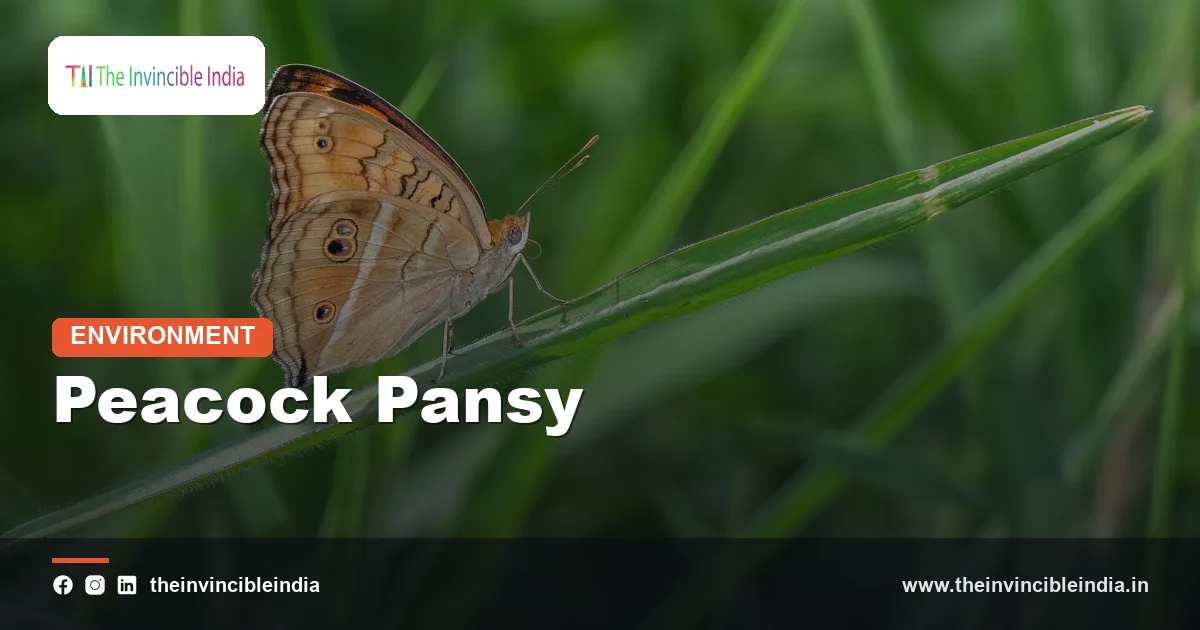
The peacock pansy (Junonia almana) is a pale orange-brown brush-footed butterfly with large, ringed, peacock-like eyespots on its wings, common in Indian gardens, damp grassland and open ground, and recognised by its seasonal forms and sun-basking habit. Few Indian butterflies carry such bold “eyes”, and the peacock pansy is often noticed on lawns, paths and the margins of paddy fields and ponds.
This guide explains how to recognise the peacock pansy, what the eyespots are for, what the caterpillars feed on, how the wet-season and dry-season forms differ, and how to separate the species from the lemon pansy and other pansies.
| Attribute | Detail |
|---|---|
| Scientific name | Junonia almana |
| Family | Nymphalidae (brush-footed butterflies), subfamily Nymphalinae |
| Genus | Junonia, the pansies and buckeyes |
| Typical wingspan | Roughly 5.5 to 7 cm |
| Upperside colour | Pale orange-brown with large ringed eyespots and dark bands |
| Seasonal forms | Brighter wet-season form and duller dry-season form with a leaf-like underside |
| Caterpillar food plants | Low herbs of damp ground, such as Hygrophila, Phyla and Ammannia |
| Habitat | Gardens, lawns, grassland, paddy-field edges and pond margins |
| Range | India, Sri Lanka and Bangladesh through South-East Asia to southern China |
Key Takeaways
- The peacock pansy (Junonia almana) is a brush-footed butterfly of the family Nymphalidae with a wingspan of roughly 5.5 to 7 centimetres.
- Peacock pansies are pale orange-brown above with large ringed eyespots on the wings, resembling the “eyes” on a peacock’s tail feathers.
- Peacock pansy caterpillars feed on low herbs of damp ground, including Hygrophila, Phyla and Ammannia.
- The peacock pansy has a brighter wet-season form and a duller dry-season form whose underside looks like a dead leaf.
- Peacock pansies bask with wings open on lawns, paths and bare soil, and fly low and fast when disturbed.
- The peacock pansy is common across India and prefers open, damp, grassy places such as pond edges and paddy margins.
What is the peacock pansy butterfly?
The peacock pansy is a medium-sized butterfly named Junonia almana, belonging to the pansy genus Junonia of the brush-footed family Nymphalidae. The name “peacock” refers to the large eyespots on the wings, which recall the eyed feathers of the Indian peafowl, and “pansy” to the rounded, patterned wings that suggest the garden flower.
The peacock pansy is widespread in the Indian subcontinent and South-East Asia. It is one of several pansies found in India, along with the lemon, chocolate, grey, yellow and blue pansies. Among these, the peacock pansy is arguably the one with the most striking eyespots.
The peacock pansy is also a good indicator of open, damp, grassy habitat. Where ponds, ditches and paddy bunds survive within a town or village, the butterfly usually survives with them, and its presence suggests that the herbs on which the caterpillars feed are still growing nearby.
As in other nymphalids, the adult appears to have four walking legs, because the forelegs are reduced to small brush-like organs. Naturalists use this feature, among others, to place the butterfly in its family.
How can you identify a peacock pansy?
A peacock pansy can be identified by its pale orange-brown wings with a large ringed eyespot on the hindwing, another prominent eyespot on the forewing and dark transverse lines. The eyespots have a black centre with a bluish highlight and are encircled by rings of orange and darker colours.
The wing margins of the peacock pansy tend to be more angular and irregular than those of many other pansies, and this is especially noticeable in the dry-season form. The underside is paler and finely patterned, with smaller eyespots, which assist in camouflage on dry ground.
Identification becomes easier with practice because the eyespots stay visible even when the rest of the pattern is worn. Old individuals with frayed wing edges can still be recognised by the characteristic ringed spots, which are usually the last part of the pattern to fade. Observers should also note whether the butterfly is bright or dull, because this indicates which seasonal form is present.
Field marks to look for
- Pale orange-brown upper wings with fine dark lines across them.
- A large ringed eyespot on the hindwing and a prominent one on the forewing.
- Angular, slightly toothed wing margins.
- A habit of basking on the ground with open wings.
- A quick, low flight over short distances, with frequent returns to the ground.
Why does the peacock pansy have such large eyespots?
The peacock pansy has large eyespots because they help the butterfly survive attacks by directing predators to the wing edges and by startling them when the wings are suddenly opened. A bird or lizard that strikes an eyespot may tear off a piece of wing while the butterfly escapes with its body unharmed.
The name “peacock” is a fair comparison. A peacock’s eyed tail feathers are used in display, whereas the butterfly’s eyespots are used mostly for defence. This is a good example of how similar patterns can serve different functions in different animals.
- Deflection: strikes aimed at the spots miss vital organs.
- Startle effect: a sudden flash of large eyes may cause a predator to hesitate.
- Seasonal adjustment: the underside eyespots are smaller and the pattern is more leaf-like in the dry season.
It is worth remembering that eyespots do not make a butterfly safe. Birds, lizards, mantises and spiders still catch many peacock pansies, and a common sight in the field is an individual with a neat semicircular notch in the hindwing, probably the result of a failed peck. The butterfly can usually fly on with such damage, which shows why the deflection strategy is effective even when imperfect.
Evolutionary biologists regard eyespots in butterflies as a model system for studying how patterns develop and how natural selection shapes them.
How do the wet-season and dry-season forms of the peacock pansy differ?
The wet-season and dry-season forms of the peacock pansy differ in brightness, wing outline and underside pattern. The wet-season form typically has a brighter orange colour and a cleaner underside, while the dry-season form is duller and its underside resembles a dead leaf, helping it to hide among dry vegetation.
For an observer, the practical point is that the same species can look quite different at different times of year. A bright peacock pansy seen in August and a drab, leaf-like individual seen in February are the same species, and photographs from both seasons are valuable to butterfly-monitoring projects that track how forms change from year to year.
These differences are produced by seasonal polyphenism, in which cues such as temperature, humidity and day length during the caterpillar and pupal stages steer the development of the adult pattern. The two forms were once described as separate species by early collectors, before breeding showed that they were seasonal variants.
- Wet season: lush vegetation, brighter and more contrasting pattern.
- Dry season: sparse vegetation, duller colour and a camouflaged underside.
- Transitional period: intermediates are common, which makes strict classification difficult.
What do peacock pansy caterpillars eat?
Peacock pansy caterpillars eat the leaves of low herbs that grow in damp ground, with recorded host plants including Hygrophila, Phyla (frog fruit) and Ammannia. These plants often grow along ponds, canals, ditches and the bunds of paddy fields, which explains why the butterfly is so often found near water.
The caterpillar is dark and spiny, with markings that help it blend into leaf litter, and it feeds on the leaves while resting on the plant’s lower parts. The spines are protective and the caterpillar is harmless to people, although handling it is best avoided.
The association with damp ground means that the butterfly benefits from conservation of small wetlands, village ponds and traditional paddy cultivation. When ditches are lined with concrete or banks are cleared completely, the host plants disappear and the butterfly moves on, so even a narrow strip of untrimmed vegetation along a channel makes a difference.
Typical host plants
- Hygrophila species of wet ground and shallow ditches.
- Phyla nodiflora, a mat-forming herb of damp lawns and banks.
- Ammannia species, small herbs of paddy fields and pond edges.
- Other low herbs, depending on the region.
What is the life cycle of the peacock pansy?
The peacock pansy goes through four stages: egg, caterpillar, pupa and adult, and the whole cycle takes roughly a month in warm weather. In India, there are multiple broods during the year, with peaks during and soon after the monsoon.
Egg and caterpillar
The female lays small, rounded eggs singly on the host plant. The caterpillar hatches, eats the eggshell and begins feeding on tender leaves, moulting several times as it grows.
Pupa and adult
The caterpillar hangs from a twig or stem and transforms into a brownish, angular pupa that blends with the surroundings. A week or two later, the adult emerges, expands and dries its wings and starts feeding on nectar and damp soil.
How does the peacock pansy behave?
The peacock pansy behaves as an open-ground butterfly that basks with its wings spread on bare soil, grass and low plants, and flies a short distance when approached before settling again nearby. This habit makes the species approachable for photographers who move slowly and avoid casting a shadow on the butterfly.
A good approach for observers is to walk slowly along a sunny path or pond bund in the morning and scan the bare patches ahead. A peacock pansy flushed from the ground usually flies only a short distance and then lands again, so patience is repaid with a closer look at the eyespots.
Males defend small territories and chase rivals, while females search for host plants. Basking helps the butterfly warm up in the morning and is most noticeable on cool, sunny days.
- Feeding: nectar from low flowers and moisture from damp ground.
- Resting: with wings closed so that the camouflaged underside is visible.
- Flight: low, direct and fast, rarely rising far above the vegetation.
How is the peacock pansy different from the lemon pansy?
The peacock pansy differs from the lemon pansy mainly in colour and eyespots: the peacock pansy is orange-brown with larger, more peacock-like eyespots, whereas the lemon pansy is brown with lemon-yellow patches. The comparison below shows the main points.
| Feature | Peacock pansy (Junonia almana) | Lemon pansy (Junonia lemonias) |
|---|---|---|
| Overall colour | Pale orange-brown | Brown with lemon-yellow patches |
| Eyespots | Large, ringed, peacock-like | Bold but less ornate |
| Wing margin | More angular, especially in dry season | Rounded and slightly scalloped |
| Habitat | Damp, grassy open ground, pond and paddy edges | Open ground, paths, lawns, scrub |
| Caterpillar food | Hygrophila, Phyla, Ammannia | Acanthus-family herbs such as Asystasia and Barleria |
The two species often fly together in the same garden, so side-by-side comparison in the field is a good way to learn them. Beginners should look first at the upper wing colour and the size of the eyespots.
Where is the peacock pansy found in India?
The peacock pansy is found in most parts of India, particularly in gardens, grassland, farmland edges, paddy fields, roadsides and the margins of ponds and canals. It is mainly a butterfly of the plains and lower hills, and it is common in both urban and rural areas.
Beyond India, the species ranges through Sri Lanka, Bangladesh and South-East Asia to southern China. It tolerates disturbed habitats, and it is frequently seen in parks and school grounds.
Is the peacock pansy threatened, and how can gardeners help?
The peacock pansy is not considered threatened in India because it is widespread and uses common host plants. Local populations can decline if damp ground is drained, paved or sprayed with pesticides, and populations recover quickly when habitat returns.
Collecting butterflies inside protected areas is prohibited under Indian wildlife law, and observation or photography is the better way to enjoy the species. A few small steps help gardeners support the peacock pansy.
- Leave a sunny patch of bare soil or a lawn edge for basking.
- Allow frog fruit (Phyla) and similar damp-ground herbs to grow in a moist corner.
- Avoid broad-spectrum pesticide sprays.
- Provide small nectar flowers throughout the year.
- Share sightings through citizen-science platforms to help track butterflies across India.
Bottom Line
The peacock pansy is a common, eye-catching butterfly whose large eyespots, seasonal forms and ground-basking habit make it easy to enjoy and study. With a little attention to colour and eyespot size, it can be told apart from the lemon pansy and its other relatives.
Frequently Asked Questions
What is the peacock pansy?
The peacock pansy is a pale orange-brown butterfly, Junonia almana, in the family Nymphalidae. It has large ringed eyespots on its wings that resemble the eyes on a peacock’s tail. The butterfly is common across India.
Why is it called the peacock pansy?
The peacock pansy is called so because its large ringed eyespots resemble the eyed feathers of a peacock. The word pansy refers to the rounded, patterned wings that suggest a pansy flower. The name is shared across the genus Junonia in different forms.
What do peacock pansy caterpillars eat?
Peacock pansy caterpillars eat low herbs of damp ground, such as Hygrophila, Phyla and Ammannia. These plants grow along ponds, ditches and paddy bunds. The caterpillars are dark and spiny.
What is the purpose of the eyespots?
The eyespots help the peacock pansy survive by drawing the attacks of predators to the wing edges rather than the body. A sudden flash of the large spots may also startle a predator. Scientists study them as a model of how butterfly patterns evolve.
How can I tell the peacock pansy from the lemon pansy?
The peacock pansy is orange-brown with large peacock-like eyespots, while the lemon pansy is brown with lemon-yellow patches. The peacock pansy also tends to have more angular wing margins. Both are common in Indian gardens and often fly together.
Does the peacock pansy look different in different seasons?
The peacock pansy does look different, with a brighter wet-season form and a duller dry-season form. The dry-season form has an underside like a dead leaf, which provides camouflage. The difference is produced by temperature, humidity and day length during development.
{“@context”:”https://schema.org”,”@graph”:[{“@type”:”FAQPage”,”mainEntity”:[{“@type”:”Question”,”name”:”What is the peacock pansy?”,”acceptedAnswer”:{“@type”:”Answer”,”text”:”The peacock pansy is a pale orange-brown butterfly, Junonia almana, in the family Nymphalidae. It has large ringed eyespots on its wings that resemble the eyes on a peacock’s tail. The butterfly is common across India.”}},{“@type”:”Question”,”name”:”Why is it called the peacock pansy?”,”acceptedAnswer”:{“@type”:”Answer”,”text”:”The peacock pansy is called so because its large ringed eyespots resemble the eyed feathers of a peacock. The word pansy refers to the rounded, patterned wings that suggest a pansy flower. The name is shared across the genus Junonia in different forms.”}},{“@type”:”Question”,”name”:”What do peacock pansy caterpillars eat?”,”acceptedAnswer”:{“@type”:”Answer”,”text”:”Peacock pansy caterpillars eat low herbs of damp ground, such as Hygrophila, Phyla and Ammannia. These plants grow along ponds, ditches and paddy bunds. The caterpillars are dark and spiny.”}},{“@type”:”Question”,”name”:”What is the purpose of the eyespots?”,”acceptedAnswer”:{“@type”:”Answer”,”text”:”The eyespots help the peacock pansy survive by drawing the attacks of predators to the wing edges rather than the body. A sudden flash of the large spots may also startle a predator. Scientists study them as a model of how butterfly patterns evolve.”}},{“@type”:”Question”,”name”:”How can I tell the peacock pansy from the lemon pansy?”,”acceptedAnswer”:{“@type”:”Answer”,”text”:”The peacock pansy is orange-brown with large peacock-like eyespots, while the lemon pansy is brown with lemon-yellow patches. The peacock pansy also tends to have more angular wing margins. Both are common in Indian gardens and often fly together.”}},{“@type”:”Question”,”name”:”Does the peacock pansy look different in different seasons?”,”acceptedAnswer”:{“@type”:”Answer”,”text”:”The peacock pansy does look different, with a brighter wet-season form and a duller dry-season form. The dry-season form has an underside like a dead leaf, which provides camouflage. The difference is produced by temperature, humidity and day length during development.”}}]}]}


