

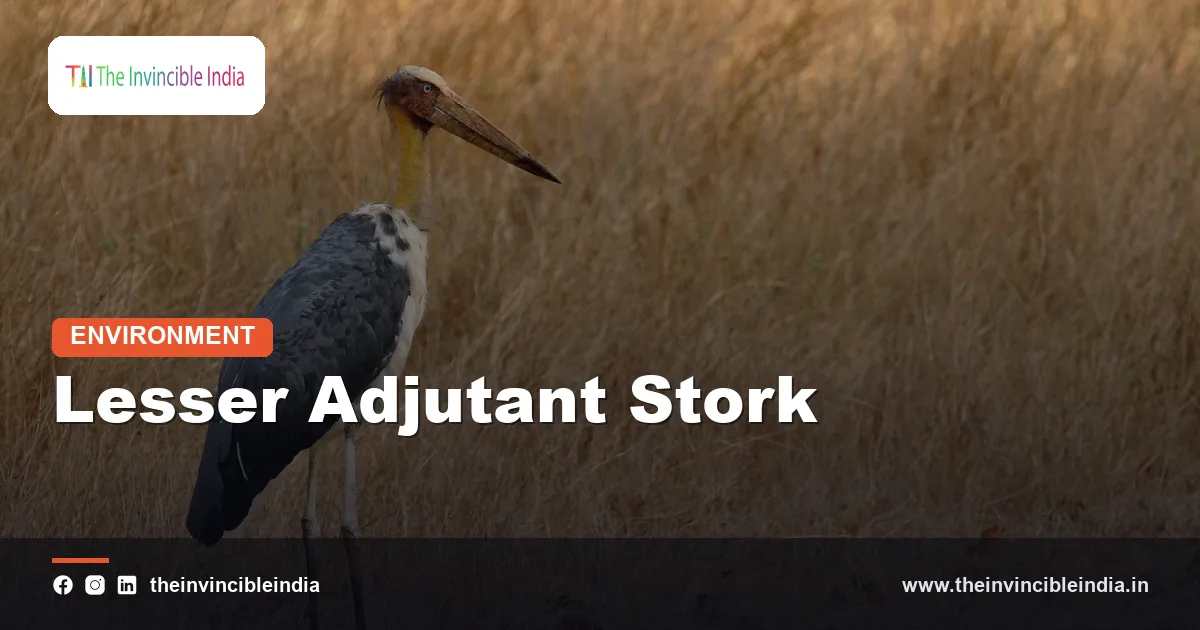
The lesser adjutant (Leptoptilos javanicus) is a tall, bare-headed stork of the family Ciconiidae that lives in wetlands, flooded grasslands, village ponds and river floodplains across the Indian subcontinent and Southeast Asia, where it hunts fish, frogs and other small animals. Standing taller than most other waterbirds, the lesser adjutant is one of the largest storks found in India and is easily recognised by its naked head, heavy wedge-shaped bill and slow, stalking walk.
Although the lesser adjutant is less famous than its larger cousin, the greater adjutant, it is the more widespread of the two and a good indicator of healthy wetlands. The species is listed as Vulnerable by the International Union for Conservation of Nature (IUCN) because its population is small and declining. This explainer describes the bird’s appearance, range, food, breeding, behaviour and conservation in plain terms.
| Common name | Lesser adjutant (lesser adjutant stork) |
|---|---|
| Scientific name | Leptoptilos javanicus |
| Family and order | Ciconiidae (storks), order Ciconiiformes |
| Size | About 110 to 120 cm tall, with a wingspan of roughly two metres |
| Range in India | Mainly the Brahmaputra valley and north-east, the Gangetic plain and Terai, eastern coast and Odisha wetlands, with scattered records elsewhere |
| Habitat | Freshwater marshes, flooded fields, lakes, river banks, mangroves and wooded village ponds |
| Diet | Fish, frogs, reptiles, crabs, large insects, small mammals and occasionally carrion |
| Breeding | Nests in trees, singly or in loose colonies; usually two to four white eggs |
| IUCN status | Vulnerable |
Key Takeaways
- The lesser adjutant (Leptoptilos javanicus) is a large stork of the family Ciconiidae with a bare head and neck and a heavy, pale, wedge-shaped bill.
- The lesser adjutant has no hanging throat pouch, which is the simplest field mark separating it from the larger greater adjutant.
- The lesser adjutant is listed as Vulnerable by the IUCN, mainly because wetland loss, felling of nest trees and disturbance have shrunk its population.
- The lesser adjutant feeds mostly on live prey such as fish, frogs and crabs, and is a hunter of shallow water more than a dedicated scavenger.
- The lesser adjutant builds a large stick nest high in a tree, lays two to four eggs, and both parents share incubation and chick feeding.
- In flight, the lesser adjutant holds its neck pulled back in an S-shape, unlike most storks, which fly with the neck stretched forward.
What Does the Lesser Adjutant Look Like?
The lesser adjutant is a tall, long-legged stork with a bare head and neck, a thick pale bill, dark grey-black upperparts and white underparts. Its head and upper neck are covered with yellowish to dusky skin and only a sparse sprinkling of short, hair-like feathers, which gives the bird a stern, almost vulture-like face.
The upper wings and back are glossy dark grey to blackish, with a faint greenish sheen in good light, while the belly, lower breast and undertail are white. The legs are long and grey to dusky, often looking whitish where the bird has been wading in muddy water and the droppings have dried on them. Adults stand about 110 to 120 cm tall and weigh several kilograms, yet they can look surprisingly slender when walking in shallow water.
The bill is the bird’s most striking tool. It is thick at the base, long, straight and slightly pale or horn-coloured, and it tapers to a firm point. Unlike the greater adjutant, the lesser adjutant lacks the large, dangling gular pouch that hangs from the front of the neck, so its neck looks cleaner and less lumpy.
How can young birds be recognised?
Young lesser adjutants are duller and browner than adults, with a more downy head and a darker bill. Over a few years the plumage becomes cleaner and glossier, and the bare skin of the head takes on the adult colouring. Immature birds are often confused with young greater adjutants, so observers usually check the pouch, the size and the bill shape together.
Where Does the Lesser Adjutant Live in India?
The lesser adjutant lives mainly in the wetlands of eastern and north-eastern India, especially the Brahmaputra floodplain in Assam, the Terai belt along the Himalayan foothills, parts of West Bengal and Odisha, and some coastal areas. Beyond India, the species ranges through Nepal, Bangladesh, Myanmar, Thailand, Cambodia, Malaysia and Indonesia, and the species name javanicus points to Java, where the bird was first described.
In India the bird was once recorded across a much wider part of the peninsula, but it has become patchy and uncommon in many regions. Protected areas with large floodplains and grasslands, such as Kaziranga and Manas in Assam, and the mangrove and creek systems of Bhitarkanika in Odisha, remain important for the species. The bird also turns up on village tanks and paddy fields where large old trees still stand near water.
The lesser adjutant is mostly a lowland species. It prefers shallow, slow or still water with muddy margins, and it avoids deep open water and dense forest. Seasonal movement is common: birds may wander to follow falling water levels, because shrinking pools concentrate fish and frogs and make them easy to catch.
Which habitats does it prefer?
- Freshwater marshes and swamps with tall grass and scattered trees
- Flooded rice fields and the edges of seasonal pools
- River banks, sandbars and the margins of lakes and reservoirs
- Mangrove creeks and tidal mudflats along the coast
- Village ponds fringed by tall trees suitable for nesting
What Does the Lesser Adjutant Eat?
The lesser adjutant eats mainly live animals, including fish, frogs, snakes and lizards, crabs and other crustaceans, large insects such as grasshoppers, and small mammals and nestling birds. Fish form a large part of the diet when water is shrinking, since trapped fish are easy to catch in shallow pools.
The bird hunts by wading slowly and deliberately, scanning the water, and then stabbing or snapping up prey with its strong bill. It may also walk across wet grass or drying mud to catch frogs and insects. Larger prey is thrown into the air and swallowed head first.
The lesser adjutant will take carrion when it finds it, and it is sometimes seen around slaughterhouses, fishing landings or rubbish dumps. However, compared with vultures and with the greater adjutant, it relies more on live hunting. This difference matters for conservation, because the lesser adjutant’s food supply depends directly on living wetlands full of fish and amphibians.
How Does the Lesser Adjutant Differ from the Greater Adjutant?
The lesser adjutant is smaller and slimmer than the greater adjutant (Leptoptilos dubius), has no large hanging throat pouch, and is a more widespread wetland hunter, while the greater adjutant is a heavier, more scavenging stork restricted to a few strongholds. The two species belong to the same genus, Leptoptilos, which also includes the marabou stork of Africa.
| Feature | Lesser adjutant | Greater adjutant |
|---|---|---|
| Scientific name | Leptoptilos javanicus | Leptoptilos dubius |
| Size | Smaller, about 110-120 cm tall | Larger and heavier, taller than the lesser adjutant |
| Throat pouch | Absent | Large, dangling pouch present |
| Bill | Thick but slimmer | Very massive and deep |
| Main feeding | Live prey in shallow water | Live prey plus much more carrion |
| Range | Wider, across South and Southeast Asia | Very restricted, with Assam and Cambodia as strongholds |
| IUCN status | Vulnerable | Endangered |
The two species sometimes occur together in the same floodplains, particularly in the Brahmaputra valley, and mixed groups can be seen at drying wetlands. Observers who see both can compare the sizes directly, which makes the lesser adjutant’s smaller frame and cleaner neck easier to notice.
How Does the Lesser Adjutant Breed and Nest?
The lesser adjutant breeds by building a large platform of sticks high in a tree, laying two to four white eggs, and raising the chicks with both parents sharing the work. Nests are often placed in tall trees near water, sometimes in isolated trees within villages and sometimes in loose colonies together with other large waterbirds.
In much of northern and eastern India nesting takes place mainly in the cooler, drier months, roughly from about November to March, although timing varies between regions and years. The pair repairs the nest and reuses it in later seasons if the tree survives. Both parents incubate the eggs, and the chicks are fed by regurgitation, with the parents bringing fish, frogs and other food in their crops.
During courtship and at the nest, adjutants communicate by bill-clattering, which is a loud rattling made by snapping the bill rapidly, since storks have a very limited voice. Out of the breeding season the bird is generally silent. Chicks stay in the nest for several weeks, grow rapidly, and gradually begin stretching and flapping their wings before they fledge.
Why are nest trees so important?
Nest trees are the lesser adjutant’s most fragile requirement. A large stork needs a tall, strong tree whose branches can bear a heavy stick platform, and these trees are often cut for timber, firewood or road widening. When a traditional nest tree is lost, the pair may fail to breed in that area for years, even if the nearby wetland is still healthy.
Why Is the Lesser Adjutant Called an Adjutant?
The word adjutant comes from the military rank of adjutant, an officer who assists a commanding officer, and early European observers used it for these storks because of their stiff, upright, measured walk that looked like a soldier marching on parade. The common name adjutant stork has preserved that image ever since.
The Latin genus name Leptoptilos combines Greek words meaning slender and feather, a reference to the sparse, thin feathering of the head and neck. The species name javanicus means of Java. In several Indian languages the adjutants have their own local names, and the birds have long been familiar to villagers in the Brahmaputra valley, who sometimes see them around ponds and old trees.
How Does the Lesser Adjutant Behave and Fly?
The lesser adjutant is a quiet, slow-moving bird that spends most of its day wading and hunting in shallow water, resting on trees or on the ground, and soaring on warm air currents. It is usually seen singly, in pairs or in small groups, and larger gatherings form only where food is abundant, such as at a drying pond.
In flight the lesser adjutant has broad wings, long legs trailing behind and, unlike most storks, a retracted neck folded back so that the heavy bill rests on the chest. This retracted posture helps separate adjutants from cranes, herons and ibises at a distance. The bird flaps slowly and soars well on thermals, climbing high and gliding between feeding areas.
On the ground the bird stands motionless for long periods in a hunched stance, then strides forward with deliberate steps. At night and in the hot hours of the day it rests in trees. Like other storks, the lesser adjutant cools itself on hot days by excreting on its own legs, a behaviour that explains why the lower legs often look whitish.
Is the Lesser Adjutant Endangered?
The lesser adjutant is listed as Vulnerable on the IUCN Red List, which means it faces a high risk of extinction in the wild unless its decline is slowed. The global population is generally estimated at only a few thousand to about ten thousand mature birds, with important numbers in Cambodia and parts of India, and it has been shrinking over the long term.
The main threats are well understood:
- Drainage and conversion of wetlands into farmland, roads and settlements
- Felling of large nest trees and loss of mature trees around ponds
- Pollution and pesticide use that reduce fish and frog populations
- Hunting, egg collection and disturbance at nesting sites
- Overfishing and over-use of wetland resources
The species is protected under Indian wildlife law, and it benefits from the protection of floodplain reserves such as Kaziranga, Manas and Bhitarkanika. Community efforts that protect nesting trees and ponds have helped other large storks in the region, and the same approach is useful for the lesser adjutant.
Why Does the Lesser Adjutant Matter to Wetlands?
The lesser adjutant matters because it is a top predator of shallow wetlands and a sign of wetland health: it needs clean water, abundant fish and amphibians, and tall old trees nearby. A pond or marsh that supports adjutants usually supports many other species as well.
By feeding on fish, frogs, rodents and insects, the lesser adjutant helps keep populations of these animals in balance. When it eats stranded fish in drying pools, it also takes up energy that would otherwise be wasted. Because adjutants are large and conspicuous, they also draw attention to the value of village ponds, floodplains and mangroves.
What can people do to help?
- Protect large old trees near wetlands, especially known nesting trees
- Keep village ponds and marshes from being drained or filled
- Reduce chemical runoff into wetlands
- Avoid disturbing nests, particularly in the breeding season
- Support local conservation and bird-watching programmes
How Can the Lesser Adjutant Be Observed?
The lesser adjutant can be observed most easily in Assam’s floodplain reserves, in the Terai wetlands and at coastal sites such as Bhitarkanika, particularly during the dry season when pools shrink and birds gather. A good view usually needs binoculars, patience and a quiet approach from a distance.
Early morning is the best time, when birds hunt in shallow water or fly out from roosts. Observers should look for a tall, dark-backed stork with a naked head standing hunched in water, then check for the absence of a throat pouch. Keeping at a distance from nest trees is essential, because adjutants can abandon a nest if disturbed.
Bottom Line
The lesser adjutant is a large, bare-headed wetland stork that depends on shallow water, abundant small prey and tall nest trees. Its Vulnerable status reflects the loss of those habitats across South and Southeast Asia, and keeping wetlands and old trees intact is the most direct way to secure its future.
Frequently Asked Questions
What is a lesser adjutant?
A lesser adjutant is a large, bare-headed stork of the species Leptoptilos javanicus found in wetlands across South and Southeast Asia. It stands about 110 to 120 cm tall, has dark grey upperparts, white underparts and a thick pale bill. It hunts fish, frogs and other small animals in shallow water.
How can I tell a lesser adjutant from a greater adjutant?
The simplest way is to check for the throat pouch, because the lesser adjutant has none while the greater adjutant has a large dangling pouch. The lesser adjutant is also smaller, with a slimmer bill and a cleaner-looking neck. The greater adjutant is heavier and scavenges more.
Is the lesser adjutant endangered?
The lesser adjutant is listed as Vulnerable by the IUCN, which is one step below Endangered. Its population is small and declining because of wetland drainage, loss of nest trees, pollution and disturbance. It is protected under Indian wildlife law and survives in several reserves.
What does the lesser adjutant eat?
The lesser adjutant eats mostly live animals such as fish, frogs, snakes, lizards, crabs, large insects and small mammals. It wades through shallow water and snaps up prey with its strong bill. It occasionally takes carrion, but it depends far more on live hunting than vultures do.
Where can the lesser adjutant be seen in India?
The lesser adjutant can be seen mainly in the Brahmaputra floodplains of Assam, the Terai wetlands, parts of West Bengal and Odisha, and coastal sites such as Bhitarkanika. It also appears at village ponds with tall trees. The dry season is a good time, as birds gather at shrinking pools.
How does the lesser adjutant breed?
The lesser adjutant breeds by building a large stick nest high in a tree and laying two to four white eggs. Both parents incubate the eggs and feed the chicks by regurgitation. In much of India breeding is concentrated in the cooler, drier months, although timing varies by region.
{“@context”:”https://schema.org”,”@graph”:[{“@type”:”FAQPage”,”mainEntity”:[{“@type”:”Question”,”name”:”What is a lesser adjutant?”,”acceptedAnswer”:{“@type”:”Answer”,”text”:”A lesser adjutant is a large, bare-headed stork of the species Leptoptilos javanicus found in wetlands across South and Southeast Asia. It stands about 110 to 120 cm tall, has dark grey upperparts, white underparts and a thick pale bill. It hunts fish, frogs and other small animals in shallow water.”}},{“@type”:”Question”,”name”:”How can I tell a lesser adjutant from a greater adjutant?”,”acceptedAnswer”:{“@type”:”Answer”,”text”:”The simplest way is to check for the throat pouch, because the lesser adjutant has none while the greater adjutant has a large dangling pouch. The lesser adjutant is also smaller, with a slimmer bill and a cleaner-looking neck. The greater adjutant is heavier and scavenges more.”}},{“@type”:”Question”,”name”:”Is the lesser adjutant endangered?”,”acceptedAnswer”:{“@type”:”Answer”,”text”:”The lesser adjutant is listed as Vulnerable by the IUCN, which is one step below Endangered. Its population is small and declining because of wetland drainage, loss of nest trees, pollution and disturbance. It is protected under Indian wildlife law and survives in several reserves.”}},{“@type”:”Question”,”name”:”What does the lesser adjutant eat?”,”acceptedAnswer”:{“@type”:”Answer”,”text”:”The lesser adjutant eats mostly live animals such as fish, frogs, snakes, lizards, crabs, large insects and small mammals. It wades through shallow water and snaps up prey with its strong bill. It occasionally takes carrion, but it depends far more on live hunting than vultures do.”}},{“@type”:”Question”,”name”:”Where can the lesser adjutant be seen in India?”,”acceptedAnswer”:{“@type”:”Answer”,”text”:”The lesser adjutant can be seen mainly in the Brahmaputra floodplains of Assam, the Terai wetlands, parts of West Bengal and Odisha, and coastal sites such as Bhitarkanika. It also appears at village ponds with tall trees. The dry season is a good time, as birds gather at shrinking pools.”}},{“@type”:”Question”,”name”:”How does the lesser adjutant breed?”,”acceptedAnswer”:{“@type”:”Answer”,”text”:”The lesser adjutant breeds by building a large stick nest high in a tree and laying two to four white eggs. Both parents incubate the eggs and feed the chicks by regurgitation. In much of India breeding is concentrated in the cooler, drier months, although timing varies by region.”}}]}]}


