

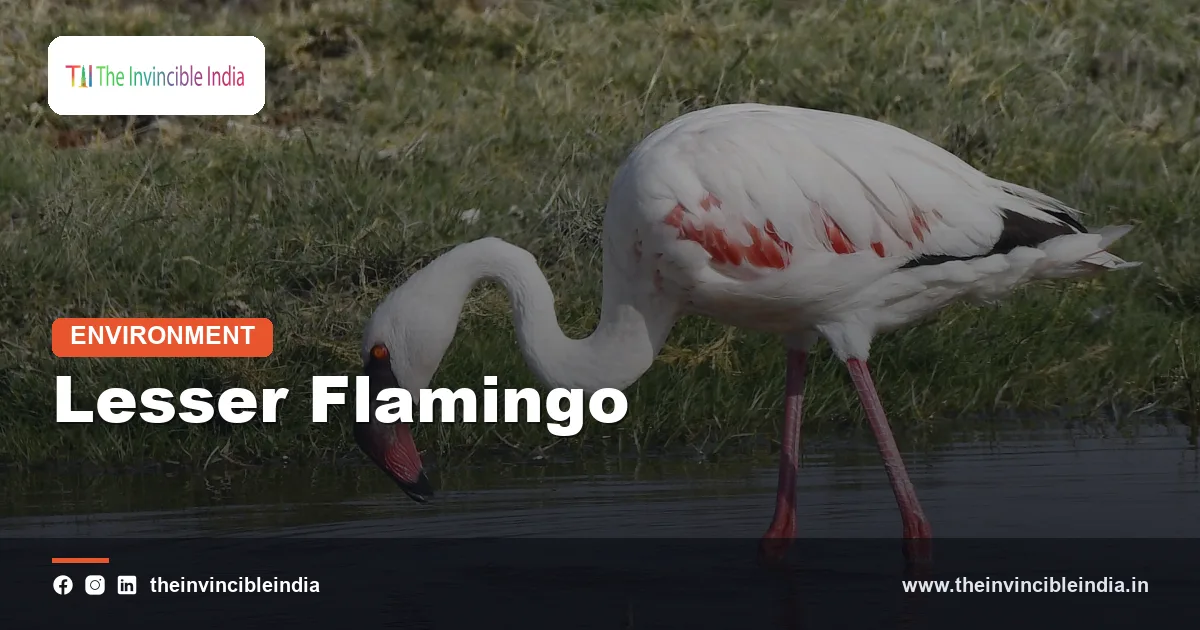
The lesser flamingo (Phoeniconaias minor) is the smallest and most numerous of the world’s flamingos, a deep-pink wading bird with a dark red bill that strains microscopic algae from shallow salty water, and it gathers in large flocks at Indian salt lakes, coastal mudflats and the Rann of Kutch. It is one of the few places outside Africa where the species breeds regularly, which makes Indian wetlands unusually important for it.
The lesser flamingo is listed as Near Threatened because it depends on a small number of alkaline and saline lakes, and it is easily affected when they change. This explainer describes how to identify the lesser flamingo, where it lives in India, what it eats, how it breeds, how it differs from the greater flamingo and what threatens it.
Quick Facts: Lesser Flamingo
| Scientific name | Phoeniconaias minor |
|---|---|
| Family | Phoenicopteridae (flamingos) |
| Size | About 80 to 100 cm tall; weight roughly 1.5 to 2 kg; the smallest flamingo |
| India range and habitat | Salt pans, saline lakes, tidal mudflats and lagoons, mainly in Gujarat, Maharashtra, Rajasthan, Odisha, Andhra Pradesh and Tamil Nadu |
| Diet | Microscopic blue-green algae (such as Arthrospira, or spirulina) and diatoms, filtered from the water surface |
| Breeding | Colonial nesting on mud mounds on flooded salt flats; one egg; breeds in the Rann of Kutch in good rainfall years |
| Movement | Nomadic and partly migratory; moves between wetlands as water and algae change |
| Main global population | The great majority live in eastern and southern Africa; smaller populations in South Asia |
| Conservation status | Near Threatened on the IUCN Red List |
Key Takeaways
- The lesser flamingo is the smallest species of flamingo and is the most numerous flamingo in the world.
- The lesser flamingo has deep pink plumage and a dark red bill with a black tip, which separate it from the paler greater flamingo.
- The lesser flamingo feeds mainly on microscopic blue-green algae and diatoms, which it filters from the water surface with a dense sieve in its bill.
- The lesser flamingo breeds in India mainly in the Great Rann of Kutch in Gujarat, which is the only major breeding area in South Asia.
- The lesser flamingo is rated Near Threatened by the IUCN because it depends on a limited number of saline lakes that are vulnerable to change.
- The lesser flamingo is a regular winter visitor to the mudflats of Mumbai and to Sambhar Lake, Chilika, Pulicat and other Indian wetlands.
What is the lesser flamingo?
The lesser flamingo is a species of flamingo in the family Phoenicopteridae, found in eastern and southern Africa, north-western India and Pakistan, and a few parts of West Asia. It is the smallest of the six flamingo species, and yet it is the most abundant because it can form enormous flocks on rich alkaline lakes.
The scientific name Phoeniconaias minor combines Greek and Latin roots meaning roughly “small purple-red” or “small crimson”. Older books place it in the genus Phoenicopterus along with the greater flamingo, but modern classification puts it in its own genus, Phoeniconaias, with feeding adaptations that differ from those of its larger relative.
Globally, the stronghold of the species is the chain of soda lakes in the East African Rift Valley, such as those in Kenya and Tanzania, where flocks can reach hundreds of thousands of birds. India’s lesser flamingos are a separate and much smaller population, but they are important because they extend the species’ range into South Asia.
How can you identify a lesser flamingo?
The lesser flamingo can be identified by its small size, deep rosy-pink plumage and a dark red to blackish bill with a black tip. It stands about 80 to 100 cm tall, considerably shorter than the greater flamingo, and its neck and legs look proportionally shorter.
Adults are strongly pink, with crimson patches on the wings that show clearly in flight. The bill is deeper and more sharply bent than in other flamingos and is dark red, which stands out from a distance. The eyes are orange-red and the legs are pink to dark red. Juveniles are grey-brown with a dark bill and gradually acquire pink over a few years.
| Feature | Lesser flamingo | Greater flamingo |
|---|---|---|
| Height | About 80 to 100 cm | About 110 to 150 cm |
| Plumage | Deep rosy pink | Pale pink-white |
| Bill | Dark red with black tip | Pink with black tip |
| Main food | Microscopic algae and diatoms | Crustaceans, molluscs, larvae |
| Feeding place | Surface of the water, often while swimming | Mud and shallow water, wading |
| IUCN status | Near Threatened | Least Concern |
Mixed flocks of the two species are common in India. The easiest way to separate them at a distance is to look at the overall colour and size: lesser flamingos look darker pink, stockier and shorter, while greater flamingos appear taller and whiter.
Where does the lesser flamingo live in India?
The lesser flamingo lives on saline and brackish wetlands in India, such as the Rann of Kutch, salt pans, coastal lagoons and tidal flats, with Gujarat the most important state. Its distribution broadly overlaps with that of the greater flamingo, but it tends to prefer more alkaline, algae-rich water.
- Gujarat: the Great Rann and Little Rann of Kutch, Nal Sarovar, the Gulf of Kachchh and Khambhat coasts.
- Maharashtra: Thane Creek and the Sewri mudflats in Mumbai, where large winter flocks gather.
- Rajasthan: Sambhar Salt Lake, one of the largest inland saline lakes in the country.
- Odisha: Chilika Lake and nearby brackish lagoons.
- Andhra Pradesh and Tamil Nadu: Pulicat Lake and salt pans along the Coromandel coast.
The Mumbai mudflats are among the most accessible flamingo sites in the world, since flocks feed within sight of the city’s buildings and bridges. Sambhar Lake, in turn, supports very large numbers of waterbirds in winter.
What does the lesser flamingo eat?
The lesser flamingo eats mainly microscopic blue-green algae (cyanobacteria) and diatoms, which it filters from the water surface using a very fine sieve inside its bill. This diet is more specialised than the greater flamingo’s, and it explains why the species needs particular kinds of lake.
The key food is a spiral-shaped blue-green alga, Arthrospira, widely known by the trade name spirulina. In warm, alkaline, nutrient-rich lakes this alga can grow in dense blooms that turn the water green. A lesser flamingo can filter large volumes of water every day and can feed while swimming or while standing in shallow water. The lamellae along the bill are far more closely spaced than in the greater flamingo, which lets the bird catch particles only a few thousandths of a millimetre across.
The carotenoid pigments in the algae are also the source of the lesser flamingo’s strong pink colour. This is why the species is often the pinkest of all flamingos, and why a flock feeding at a lake with abundant algae looks like a pink carpet.
Why does the lesser flamingo need special lakes?
The lesser flamingo needs lakes where algae grow in very high concentrations, since its filter can only operate efficiently in water rich in microscopic food. Such lakes are usually alkaline or saline, shallow and warm. When rainfall, drainage or pollution changes the chemistry of the water, the algae can decline sharply and the flocks move elsewhere.
How does the lesser flamingo breed?
The lesser flamingo breeds in dense colonies on flooded salt flats, building a small mound of mud and laying a single egg, and the species nests in India mainly in the Great Rann of Kutch during years with sufficient rain. In poor years, the birds may not nest at all.
The breeding colony in the Rann, sometimes called Flamingo City, lies on islands of mud that are surrounded by water and are difficult for land predators to reach. Both parents incubate the egg for about a month. Chicks hatch with grey down and are fed crop milk by both parents. They soon join large crèches of other chicks, where they are watched by adult guards. The young fly at around two to two and a half months, though they remain dependent for a time.
Because breeding is tied to water levels, success varies greatly from year to year. A sudden drop in the water can strand nests and chicks, while an unusually heavy flood can wash nests away. In Africa, large breeding failures have been linked to changes in lake level and food supply.
Does the lesser flamingo migrate?
The lesser flamingo is nomadic and partly migratory, moving between wetlands in response to water levels and algal growth rather than following a fixed calendar. In India, large numbers arrive on the western and eastern coasts in the winter months and leave in spring.
The birds frequently fly at night, in large flocks, and can cover hundreds of kilometres in a few hours. Researchers have used leg rings and satellite tags to show that lesser flamingos travel between sites in Gujarat, Pakistan, the Persian Gulf region and the coasts of western India. This means that the same birds seen at Mumbai in winter may breed in the Rann of Kutch in another year.
Such nomadism makes conservation more complex. Protecting one lake is not enough; the species needs a chain of healthy wetlands across the region, so that the birds can move when conditions change.
How is the lesser flamingo different from the greater flamingo?
The lesser flamingo differs from the greater flamingo in size, colour, bill and diet: it is smaller, deeper pink, has a dark red bill and filters microscopic algae instead of larger invertebrates. These differences allow both species to share the same wetlands without competing for exactly the same food.
The greater flamingo wades in the mud and takes small animals, while the lesser flamingo skims algae from the surface and feeds even while swimming. The two species often feed near each other and fly together, which helps explain why they are sometimes mistaken for one another. In breeding behaviour, both build mud nests and lay a single egg, and both feed their chicks crop milk.
Is the lesser flamingo endangered?
The lesser flamingo is not formally Endangered but is classified as Near Threatened by the International Union for Conservation of Nature (IUCN), because it relies on a small number of lakes and its numbers are thought to be declining. A large global population does not guarantee safety when most birds depend on a few sites.
The main threats are changes in lake water level and chemistry, pollution from industry and sewage, mining and industrial development near key lakes, and disturbance at breeding colonies. Lead poisoning, collisions with power lines and occasional mass die-offs also affect the species. In India, land reclamation and construction on coastal mudflats, changes to salt-pan operations and disturbance from people and vehicles are further concerns.
The species is protected in India under the Wild Life (Protection) Act, 1972. Several of its sites, including parts of the Rann of Kutch, Sambhar Lake and Chilika, are protected areas or Ramsar wetlands, and the Thane Creek area has been declared a flamingo sanctuary. Monitoring by waterbird counts and local wildlife departments helps track numbers.
Why does the lesser flamingo matter?
The lesser flamingo matters because it is a sensitive indicator of the health of saline and alkaline wetlands, and because India hosts one of the few breeding sites of the species outside Africa. Changes in its numbers can warn of problems with water quality, salinity or algal growth.
Flamingos also support nature tourism. Flocks on the Mumbai mudflats and in the Rann of Kutch draw birdwatchers, photographers and school groups, and have turned wetlands that were once overlooked into valued public spaces. Protecting the birds helps protect fish nurseries, mangroves and salt-marsh systems that benefit coastal communities.
How can you watch lesser flamingos?
The best way to watch lesser flamingos is to visit a known flamingo wetland between November and March, use binoculars from a distance and avoid any activity that makes the flock take off. Early morning and the hours around high tide often give the best views.
- Places: Thane Creek and Sewri in Mumbai, Nal Sarovar and the Rann of Kutch in Gujarat, Sambhar Lake, Chilika and Pulicat.
- Identification tip: look for the smaller, darker pink birds with a dark red bill among the taller, paler greater flamingos.
- Conduct: do not use drones, loud noise or flash, and do not enter breeding areas.
- Sustainability: use licensed local guides, who know current rules for sensitive sites.
Bottom Line
The lesser flamingo is a small, deep-pink algae feeder that depends on a handful of saline lakes, and India’s salt flats and mudflats are a valuable part of its range. Keeping those wetlands clean, undisturbed and connected is the most practical way to protect it.
Frequently Asked Questions
How is the lesser flamingo different from the greater flamingo?
The lesser flamingo is smaller, deeper pink and has a dark red bill, while the greater flamingo is taller, paler and has a pink bill with a black tip. The lesser flamingo mainly eats microscopic algae, whereas the greater flamingo eats crustaceans and other invertebrates. The lesser flamingo is also Near Threatened globally.
Where can I see lesser flamingos in India?
Lesser flamingos can be seen at the Thane Creek and Sewri mudflats in Mumbai, the Rann of Kutch and Nal Sarovar in Gujarat, Sambhar Lake in Rajasthan, Chilika in Odisha and Pulicat Lake. The best months are usually November to March, when flocks are present in large numbers.
What does the lesser flamingo eat?
The lesser flamingo eats mainly microscopic blue-green algae, such as Arthrospira (spirulina), along with diatoms. It filters them from the water surface through a very fine sieve in its bill. The algae also give the bird its deep pink colour.
Does the lesser flamingo breed in India?
The lesser flamingo does breed in India, mainly in the Great Rann of Kutch in Gujarat, when rainfall floods the salt flats. Each pair lays a single egg on a mud mound and both parents raise the chick. In dry years, the birds may not nest.
Is the lesser flamingo endangered?
The lesser flamingo is listed as Near Threatened by the IUCN, not Endangered. Its numbers are considered to be declining and it relies on a few vulnerable lakes. It is also protected in India under the Wild Life (Protection) Act, 1972.
Why are lesser flamingos so pink?
Lesser flamingos are very pink because the blue-green algae they eat are rich in carotenoid pigments. These pigments are absorbed and deposited in the feathers, skin and bill. Chicks are grey and turn pink as they grow and feed on pigment-rich food.
{“@context”:”https://schema.org”,”@graph”:[{“@type”:”FAQPage”,”mainEntity”:[{“@type”:”Question”,”name”:”How is the lesser flamingo different from the greater flamingo?”,”acceptedAnswer”:{“@type”:”Answer”,”text”:”The lesser flamingo is smaller, deeper pink and has a dark red bill, while the greater flamingo is taller, paler and has a pink bill with a black tip. The lesser flamingo mainly eats microscopic algae, whereas the greater flamingo eats crustaceans and other invertebrates. The lesser flamingo is also Near Threatened globally.”}},{“@type”:”Question”,”name”:”Where can I see lesser flamingos in India?”,”acceptedAnswer”:{“@type”:”Answer”,”text”:”Lesser flamingos can be seen at the Thane Creek and Sewri mudflats in Mumbai, the Rann of Kutch and Nal Sarovar in Gujarat, Sambhar Lake in Rajasthan, Chilika in Odisha and Pulicat Lake. The best months are usually November to March, when flocks are present in large numbers.”}},{“@type”:”Question”,”name”:”What does the lesser flamingo eat?”,”acceptedAnswer”:{“@type”:”Answer”,”text”:”The lesser flamingo eats mainly microscopic blue-green algae, such as Arthrospira (spirulina), along with diatoms. It filters them from the water surface through a very fine sieve in its bill. The algae also give the bird its deep pink colour.”}},{“@type”:”Question”,”name”:”Does the lesser flamingo breed in India?”,”acceptedAnswer”:{“@type”:”Answer”,”text”:”The lesser flamingo does breed in India, mainly in the Great Rann of Kutch in Gujarat, when rainfall floods the salt flats. Each pair lays a single egg on a mud mound and both parents raise the chick. In dry years, the birds may not nest.”}},{“@type”:”Question”,”name”:”Is the lesser flamingo endangered?”,”acceptedAnswer”:{“@type”:”Answer”,”text”:”The lesser flamingo is listed as Near Threatened by the IUCN, not Endangered. Its numbers are considered to be declining and it relies on a few vulnerable lakes. It is also protected in India under the Wild Life (Protection) Act, 1972.”}},{“@type”:”Question”,”name”:”Why are lesser flamingos so pink?”,”acceptedAnswer”:{“@type”:”Answer”,”text”:”Lesser flamingos are very pink because the blue-green algae they eat are rich in carotenoid pigments. These pigments are absorbed and deposited in the feathers, skin and bill. Chicks are grey and turn pink as they grow and feed on pigment-rich food.”}}]}]}


