

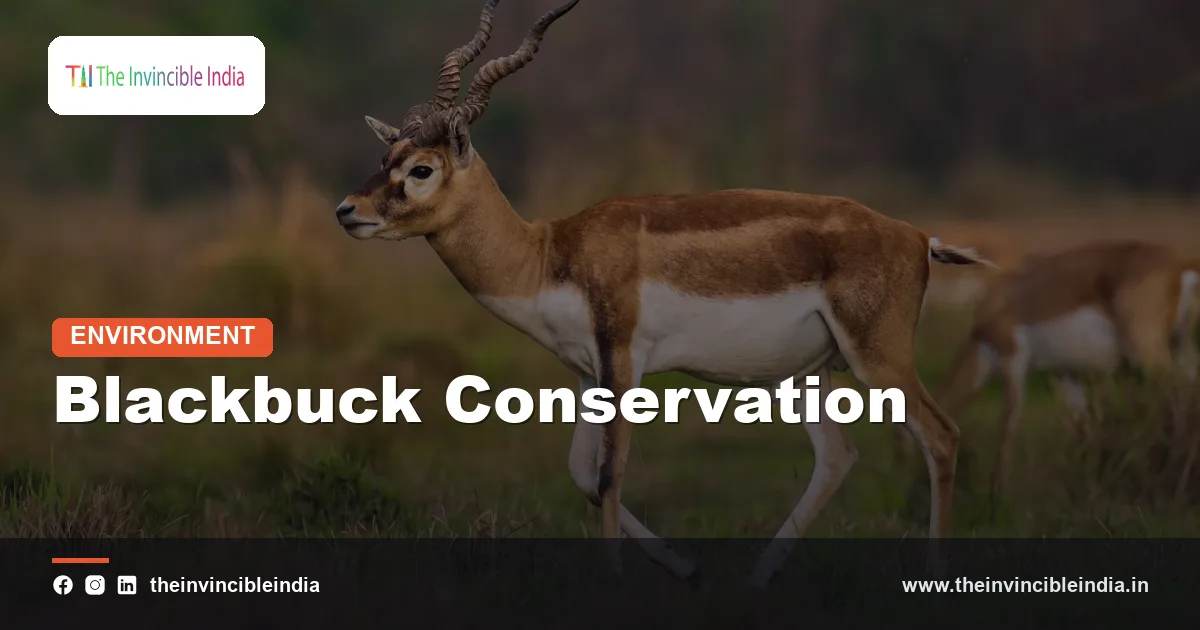
The blackbuck (Antilope cervicapra), also called the Indian antelope, is a medium-sized grassland antelope native to India that is best known for the male’s spiralled horns and dark-and-white coat, and it is protected under Schedule I of the Wildlife (Protection) Act, 1972. Conservation of the blackbuck in India is linked to the survival of the country’s open grasslands, scrublands and semi-arid plains, which are among its least protected habitats.
The species has a place in Indian culture as well as in its ecology, from its role in Hindu iconography to the long-standing protection given by the Bishnoi community of Rajasthan. This explainer describes the animal, its habitats, its cultural importance, the places where it thrives, the threats it faces and the laws that protect it.
Quick Facts
| Attribute | Detail |
|---|---|
| Common names | Blackbuck, Indian antelope |
| Scientific name | Antilope cervicapra |
| Habitat | Open grasslands, scrub and semi-arid plains |
| Diet | Mainly grasses |
| Legal status in India | Schedule I, Wildlife (Protection) Act, 1972 |
| State animal of | Andhra Pradesh, Haryana and Punjab |
| Famous strongholds | Velavadar (Gujarat), Tal Chhapar (Rajasthan) |
| Cultural link | Vehicle of the wind god Vayu; revered by the Bishnoi community |
Key Takeaways
- The blackbuck is a grassland antelope found mainly in India, and it is the only living member of the genus Antilope.
- Adult male blackbuck have dark upper bodies, white underparts and long spiralled horns, while females and young are fawn-coloured and usually hornless.
- The blackbuck is listed under Schedule I of the Wildlife (Protection) Act, 1972, which gives it the highest level of legal protection in India.
- Velavadar Blackbuck National Park in Gujarat and the Tal Chhapar Sanctuary in Rajasthan are two of India’s best-known blackbuck habitats.
- The Bishnoi community of Rajasthan has protected the blackbuck for centuries as a matter of religious principle.
- The main threats to the blackbuck are loss of grassland habitat, poaching and conflict with farmers over crop damage.
What is a blackbuck?
The blackbuck is a medium-sized antelope native to the Indian subcontinent, scientifically named Antilope cervicapra and found chiefly in the open plains of India. It is a graceful, fast-running grazer that is adapted to flat or gently undulating terrain where it can spot predators from a distance.
The animal stands roughly 80 centimetres at the shoulder and is among the fastest antelopes, able to run at high speed over long distances. It lives in herds, which usually include females, young animals and a few adult males. Mature males often establish small territories, particularly in the breeding season.
The blackbuck is a diurnal animal, active mostly during the day, and it feeds primarily on grasses, with occasional additions of leaves, pods and cultivated crops. Its natural predators have included the wolf, the jackal, the dhole and, historically, the cheetah. In the wild, individuals can live for a decade or more.
What does a blackbuck look like?
An adult male blackbuck is easily recognised by its dark brown to black upper body, white underparts, white ring around the eyes and long, corkscrew-shaped horns. Females and juveniles are lighter, with a yellowish-fawn colour and no horns, or, in rare cases, small ones.
The horns of the male are the animal’s most distinctive feature. They spiral in a series of turns, commonly counted as three to five, and can grow to a considerable length. The horns are not shed each year, unlike the antlers of deer, but are a permanent bony growth covered in a keratin sheath.
Males darken as they mature, and young males transition from the pale colour of the females to the dark coat of adulthood. The contrast between the dark back and white belly gives the male its striking appearance, and it is one reason why the species has been so widely depicted in Indian art and hunting traditions.
Male and female compared
| Feature | Male | Female |
|---|---|---|
| Coat colour | Dark brown to black on the back, white belly | Yellowish-fawn with white underparts |
| Horns | Long, spiralled | Usually absent |
| Eye ring | Prominent white | Visible but less contrasting |
| Behaviour | Territorial in breeding season | Moves in herds with young |
Where is the blackbuck found in India?
The blackbuck is found across many parts of India, mainly in the semi-arid and agricultural plains of states such as Gujarat, Rajasthan, Haryana, Punjab, Maharashtra, Karnataka, Andhra Pradesh, Telangana, Tamil Nadu and Odisha. Its distribution is patchy, because suitable grassland habitat has been reduced and broken into fragments.
In the early twentieth century the blackbuck was far more widespread across the Indian plains, and it was a common sight in many regions. Over the decades, expansion of farming, human settlement and hunting caused sharp declines, and the species disappeared from many areas. Populations have since recovered in some places thanks to legal protection and community support.
The species is also found in small numbers in Nepal, and it has been introduced to other countries, including parts of the United States and South America, where it is kept on ranches and reserves. In India, however, the native range remains the core of its conservation.
Which are the main blackbuck habitats in India?
The best-known blackbuck habitats in India are the Velavadar Blackbuck National Park in Gujarat and the Tal Chhapar Sanctuary in Rajasthan, though the animal is also protected in several other reserves and sanctuaries. Both of these sites are open grassland habitats that suit the species well.
Velavadar Blackbuck National Park, Gujarat
Velavadar Blackbuck National Park is located in Bhavnagar district of Gujarat, along the Gulf of Khambhat, and was declared a national park in 1976. It is a small but important grassland reserve known for one of the largest and best-documented blackbuck populations in the country. The park is also known for other grassland species, including the Indian wolf, and for large roosts of harriers in the winter.
Tal Chhapar Sanctuary, Rajasthan
Tal Chhapar Sanctuary lies in Churu district of Rajasthan, on the edge of the Thar desert region. It is a flat, saline, grassy tract that was declared a sanctuary in 1962 and is home to a notable blackbuck population. The sanctuary is also known for birds, particularly in the winter months.
Other significant sites
- Ranibennur Blackbuck Sanctuary, Karnataka: A sanctuary created primarily to protect the blackbuck.
- Point Calimere Wildlife Sanctuary, Tamil Nadu: A coastal sanctuary with a long-standing blackbuck population.
- Rollapadu Wildlife Sanctuary, Andhra Pradesh: A grassland sanctuary known for blackbuck and for grassland birds.
- Agricultural landscapes in Haryana, Punjab and Rajasthan: Many herds live on farmland close to villages, often with local protection.
Why is the blackbuck culturally important in India?
The blackbuck is culturally important in India because it is associated with Hindu tradition, where it is described as the vehicle (vahana) of Vayu, the wind god, and because it is revered by communities such as the Bishnoi. Its speed and elegance have made it a frequent subject in folklore, art and literature.
In Indian history, the blackbuck also appears in royal hunting traditions and in painting and sculpture. Mughal and princely-era court art often depicts blackbuck hunts, and the animal’s skin was historically associated with sages in Sanskrit literature, being considered a sacred seat for meditation. Such associations explain why the antelope has long held a symbolic place in the subcontinent.
Today the blackbuck is the state animal of Andhra Pradesh, Haryana and Punjab. That official recognition reflects the species’ cultural identity as well as the desire of state governments to draw public attention to its protection.
How do the Bishnoi protect the blackbuck?
The Bishnoi community of Rajasthan protects the blackbuck as part of a set of religious principles that forbid harming trees and wildlife. The Bishnoi sect was founded in the fifteenth century by Guru Jambheshwar, and its followers observe 29 tenets, which include compassion for living creatures and protection of green trees.
Villagers in Bishnoi areas have a reputation for treating the blackbuck and other wildlife as members of the community. There are well-known accounts of Bishnoi women caring for orphaned fawns, and herds of blackbuck graze freely near Bishnoi villages. This kind of community conservation is often cited as a model of how culture and religion can protect biodiversity.
The tradition has a historical anchor in the Khejarli episode of 1730, when a large number of Bishnoi villagers, led by Amrita Devi, are remembered to have given their lives to protect khejri trees from being felled. That event is often considered one of the early examples of environmental protest in India, and it is part of why the Bishnoi are associated with conservation.
What are the threats to the blackbuck?
The main threats to the blackbuck are loss and degradation of grassland habitat, poaching, and conflict with people over crops. Grasslands are often wrongly classed as wastelands in land-use records, which makes it easier to convert them to farms, industry or plantations.
- Habitat loss and fragmentation: Conversion of grassland and scrub into agricultural land, roads and settlements reduces the blackbuck’s range and isolates herds.
- Poaching: Illegal hunting for meat, skins and horns has historically reduced populations and remains a concern in some regions.
- Invasive plants: Weeds such as Prosopis juliflora spread across grasslands and crowd out the native grasses on which blackbuck depend.
- Feral and free-ranging dogs: Dogs can harass and kill fawns and adults, especially near villages.
- Crop damage and conflict: Herds can eat standing crops, leading to resentment among farmers and sometimes retaliatory action.
- Livestock pressure: Overgrazing by domestic animals competes with the blackbuck for forage.
Despite these problems, the species is not currently regarded as being as endangered as it once was. The International Union for Conservation of Nature (IUCN) assesses the blackbuck as being of Least Concern globally, although the assessment does not mean that local populations are secure, and many herds remain vulnerable.
What legal protection does the blackbuck have in India?
The blackbuck is legally protected in India under Schedule I of the Wildlife (Protection) Act, 1972, which gives it the highest level of protection under the Act. Hunting, trapping, poisoning or harming a Schedule I animal is a criminal offence, and the penalties are the most severe provided by the law.
The Act enables the creation of national parks, wildlife sanctuaries and other protected areas, and many blackbuck habitats fall within these. State forest departments are responsible for enforcement, and wildlife crime investigation involves the police and other agencies. The law was amended in 2022, restructuring the schedules, and the blackbuck continues to be among the strictly protected species.
Enforcement has been tested in the courts. A high-profile poaching case from 1998 in Rajasthan drew sustained national attention to blackbuck protection and showed how seriously the law treats the species. Beyond the law, protection also depends on community participation and on keeping habitats intact.
Legal and institutional framework
| Instrument or body | Role |
|---|---|
| Wildlife (Protection) Act, 1972 | Primary law listing the blackbuck under Schedule I |
| State forest departments | Management of protected areas and enforcement |
| National parks and sanctuaries | Legally protected habitats such as Velavadar and Tal Chhapar |
| Community conservation | Local protection, notably by the Bishnoi community |
How can grassland conservation help the blackbuck?
Grassland conservation helps the blackbuck by protecting the open habitat on which it depends for food and safety. Grasslands are among the most neglected ecosystems in India, even though they support many specialised species, including the blackbuck, the Indian wolf and several threatened birds.
Conservation approaches include protecting remaining grassland patches, controlling invasive plants, managing grazing and recognising grasslands as valuable ecosystems in land-use planning. Where blackbuck live on private land and farms, working with farmers is essential. Compensation for crop damage and community-based programmes can reduce conflict and build support for the animal.
Maintaining connections between habitat patches also matters, because isolated herds are more vulnerable. As India’s attention to grassland conservation grows, the blackbuck is often described as a flagship species whose protection benefits many other animals living in the same landscape.
Bottom Line
The blackbuck is a graceful and culturally rich antelope of the Indian plains, protected as a Schedule I species under the Wildlife (Protection) Act, 1972. Havens such as Velavadar and Tal Chhapar, along with the long tradition of Bishnoi protection, have helped it survive, but loss of grasslands and poaching remain real pressures. Safeguarding the blackbuck ultimately means safeguarding India’s open grassland ecosystems.
Frequently Asked Questions
What is a blackbuck?
The blackbuck (Antilope cervicapra) is a medium-sized grassland antelope native to India, also called the Indian antelope. Adult males have dark upper bodies, white underparts and long spiralled horns. Females and young are fawn-coloured and usually hornless.
Is the blackbuck protected in India?
Yes, the blackbuck is protected under Schedule I of the Wildlife (Protection) Act, 1972, which is the highest level of protection. Hunting or harming it is a criminal offence. Many of its habitats are also inside national parks and sanctuaries.
Where can you see blackbucks in India?
Blackbucks can be seen at Velavadar Blackbuck National Park in Gujarat, Tal Chhapar Sanctuary in Rajasthan, Ranibennur Blackbuck Sanctuary in Karnataka and Point Calimere in Tamil Nadu, among other sites. Herds also live on farmland in several states. The best time to visit is usually the cooler months.
Why is the blackbuck important to the Bishnoi community?
The blackbuck is important to the Bishnoi community because the sect’s 29 tenets call for compassion towards animals and protection of trees. Bishnoi villagers in Rajasthan treat blackbuck as part of their community and are known to care for orphaned fawns. This tradition dates back to the sect’s founding by Guru Jambheshwar in the fifteenth century.
Which Indian states have the blackbuck as their state animal?
The blackbuck is the state animal of Andhra Pradesh, Haryana and Punjab. This recognition reflects its cultural significance as well as the aim of drawing attention to its conservation. The animal is found in many other states as well.
What are the main threats to the blackbuck?
The main threats to the blackbuck are loss of grassland habitat, poaching and conflict with farmers over crop damage. Invasive plants, free-ranging dogs and overgrazing by livestock add to the pressure. Despite these, the species is assessed as Least Concern globally by the IUCN.
{“@context”:”https://schema.org”,”@graph”:[{“@type”:”FAQPage”,”mainEntity”:[{“@type”:”Question”,”name”:”What is a blackbuck?”,”acceptedAnswer”:{“@type”:”Answer”,”text”:”The blackbuck (Antilope cervicapra) is a medium-sized grassland antelope native to India, also called the Indian antelope. Adult males have dark upper bodies, white underparts and long spiralled horns. Females and young are fawn-coloured and usually hornless.”}},{“@type”:”Question”,”name”:”Is the blackbuck protected in India?”,”acceptedAnswer”:{“@type”:”Answer”,”text”:”Yes, the blackbuck is protected under Schedule I of the Wildlife (Protection) Act, 1972, which is the highest level of protection. Hunting or harming it is a criminal offence. Many of its habitats are also inside national parks and sanctuaries.”}},{“@type”:”Question”,”name”:”Where can you see blackbucks in India?”,”acceptedAnswer”:{“@type”:”Answer”,”text”:”Blackbucks can be seen at Velavadar Blackbuck National Park in Gujarat, Tal Chhapar Sanctuary in Rajasthan, Ranibennur Blackbuck Sanctuary in Karnataka and Point Calimere in Tamil Nadu, among other sites. Herds also live on farmland in several states. The best time to visit is usually the cooler months.”}},{“@type”:”Question”,”name”:”Why is the blackbuck important to the Bishnoi community?”,”acceptedAnswer”:{“@type”:”Answer”,”text”:”The blackbuck is important to the Bishnoi community because the sect’s 29 tenets call for compassion towards animals and protection of trees. Bishnoi villagers in Rajasthan treat blackbuck as part of their community and are known to care for orphaned fawns. This tradition dates back to the sect’s founding by Guru Jambheshwar in the fifteenth century.”}},{“@type”:”Question”,”name”:”Which Indian states have the blackbuck as their state animal?”,”acceptedAnswer”:{“@type”:”Answer”,”text”:”The blackbuck is the state animal of Andhra Pradesh, Haryana and Punjab. This recognition reflects its cultural significance as well as the aim of drawing attention to its conservation. The animal is found in many other states as well.”}},{“@type”:”Question”,”name”:”What are the main threats to the blackbuck?”,”acceptedAnswer”:{“@type”:”Answer”,”text”:”The main threats to the blackbuck are loss of grassland habitat, poaching and conflict with farmers over crop damage. Invasive plants, free-ranging dogs and overgrazing by livestock add to the pressure. Despite these, the species is assessed as Least Concern globally by the IUCN.”}}]}]}


