

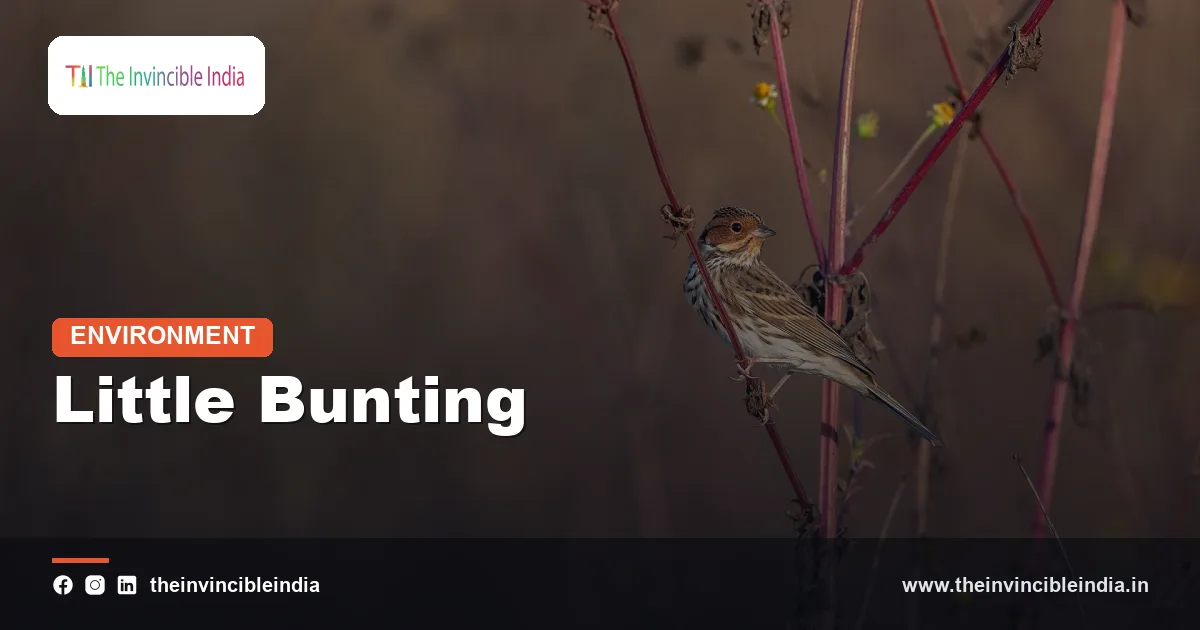
The little bunting (Emberiza pusilla) is a tiny, streaky seed-eating songbird that breeds in the northern forests of Eurasia and spends the winter in India, mainly in the north-east and east, where it feeds in flocks on grassy fields, stubble and scrub. It is easy to overlook, because it is about the size of a sparrow and forages quietly on the ground, but a good view reveals one of the most attractive faces among Indian buntings, with a chestnut-red cheek and crown edged in black.
This guide explains what the little bunting is, how to identify it, where and when it appears in India, what it eats, how it differs from similar buntings and sparrows and why its winter habitats matter. It is written for birdwatchers, students and general readers interested in Indian birdlife. Last updated: 30 October 2026.
| Attribute | Detail |
|---|---|
| Common name | Little bunting |
| Scientific name | Emberiza pusilla |
| Family | Emberizidae (buntings) |
| Approximate length | About 12 to 14 cm |
| Status in India | Winter visitor, most regular in the north-east and east; scarce elsewhere |
| Breeding range | Northern Eurasian taiga and scrub from Fennoscandia across Siberia |
| Typical habitat in India | Grassy fields, stubble, scrub, forest clearings and cultivated edges |
| IUCN Red List category | Least Concern (global assessment) |
Key Takeaways
- The little bunting is one of the smallest buntings in the world and a winter visitor to India after breeding in the northern forests of Europe and Asia.
- The little bunting has a chestnut face and crown bordered by black stripes, a pale ring around the eye and fine dark streaking on a whitish underside.
- In India, the little bunting is most regularly recorded in the north-eastern states and the eastern plains, with fewer sightings in other regions.
- The little bunting is mainly a seed eater in winter, feeding on grass and weed seeds and grain on the ground in flocks.
- The little bunting gives a short, sharp “tik” or “pwik” call, which is often the first clue that a flock is feeding in nearby grass.
- The little bunting is classified as Least Concern globally, although hunting of buntings in parts of Asia and the loss of winter grassland remain concerns for migratory buntings generally.
What is the little bunting?
The little bunting is a small passerine bird in the bunting family, Emberizidae, that migrates between the cold northern forests where it breeds and warmer southern regions where it winters. Buntings are seed-eating birds with short, conical bills, and many species in the group have bold head patterns in the breeding season.
The species name pusilla is a Latin word meaning “very small,” which is an apt description of this bird. It is among the smallest of the Eurasian buntings and is smaller than the common reed bunting and much smaller than most Indian sparrows. Its natural range covers an enormous stretch of northern Eurasia, from northern Scandinavia across Russia and Siberia to the Pacific coast.
Unlike many other buntings that visit India, the little bunting does not form huge, noisy flocks in the open. It is often found in small parties that stay close to the ground and keep within the shelter of grass, bushes or crop stubble, where its streaked plumage provides excellent camouflage.
How can you identify the little bunting?
The little bunting is identified by its small size, the chestnut-rufous crown and cheek patch bordered with black lines, a distinct pale eye-ring and fine blackish streaks on a white to buff breast. The bill is small, short and pale pinkish-grey.
Useful features for field identification include:
- Head pattern: The crown is chestnut with black side-stripes, and the ear coverts are rufous with a dark border behind.
- Eye-ring: A pale ring around the eye gives the bird an alert expression.
- Underparts: The throat and belly are whitish, with narrow black streaks on the breast and flanks.
- Back and wings: The upperparts are brown with dark streaks and pale edges to the feathers, giving a scaly look.
- Tail: The dark tail has white outer feathers that show when the bird flies.
- Legs: The legs are pinkish-brown.
In winter plumage, which is what most Indian observers see, the head colours are somewhat duller and the pale tips to the feathers soften the pattern. First-winter birds can be even less distinct. Breeding adults, which are rarely seen in India except just before departure in spring, show a brighter chestnut face and a clearer head pattern.
Voice is also valuable. The call is a hard, sharp “tik” or “pwik,” often repeated, and a feeding flock may give a mixture of ticking notes. The song, heard on the breeding grounds, is a short, simple series of clear notes.
Where does the little bunting live in India?
The little bunting winters mainly in north-eastern India, in the Himalayan foothills and in parts of the eastern plains, using grassy fields, scrub and forest clearings. It is much scarcer in the west and south, where it is considered a rare or irregular visitor.
Most records come from states such as Assam, Arunachal Pradesh, Meghalaya, Nagaland, Manipur and Mizoram, as well as West Bengal, Bihar and Odisha. The bird also reaches the foothills of the Himalaya in states such as Uttarakhand and Sikkim. Further south and west, only occasional birds are reported, which are often photographed and discussed in the birdwatching community.
The bird occurs outside India across northern South Asia and mainland South-East Asia. Wintering populations are recorded in Nepal, Bhutan, Bangladesh, Myanmar, southern China and parts of Thailand and Indochina. India sits on the western edge of the main wintering area, which explains why the north-east is its stronghold.
Typical habitats used in India are:
- Harvested rice paddies, millet fields and stubble
- Grassy edges of cultivation and village margins
- Scrub and bushy clearings in or near forest
- Shrubby edges of wetlands and river banks
- Tea garden borders and plantation edges in the hills
When does the little bunting visit India?
The little bunting visits India in the cold season, arriving from about October to November and leaving by around April, after a long migration from the northern taiga. The exact timing depends on the weather and on the location within India.
The birds travel south in late summer and autumn, moving through Central and East Asia before reaching the Himalayan region and the Indian subcontinent. Many birds that reach India are young of the year on their first migration. In spring they gradually move north again, and some birds may begin singing and showing breeding plumage before departure.
| Period | Activity of the little bunting in India |
|---|---|
| October to November | First arrivals reach the north-east and eastern plains |
| December to February | Settled wintering in small flocks on grassy and cultivated ground |
| March to April | Departure north; plumage becomes brighter |
| May to September | Absent from India; breeding in northern Eurasian forests and scrub |
What does the little bunting eat?
The little bunting eats mostly small seeds in winter, particularly those of grasses, sedges and weeds, along with spilled cereal grain, and it takes insects when they are available. Its short, conical bill is designed for husking small seeds.
The bird forages on the ground or clambers low in grass stems and bushes, extracting seeds from seed-heads. In cultivated areas it gleans fallen rice and millet grains. In the breeding season, the diet shifts toward insects such as beetles, flies, caterpillars and small spiders, which provide the protein needed for growing chicks.
Like other buntings, the little bunting is often accompanied by other small seed-eaters when feeding. It may join flocks of other buntings, finches, sparrows, pipits and wagtails in the same field, and it tends to dive into cover when disturbed rather than flying far. Such mixed feeding flocks reduce the risk from predators and make good use of rich seed supplies.
How does the little bunting behave?
The little bunting behaves as a quiet, flocking, ground-feeding bird that moves in small groups, keeps close to cover and flies up into low bushes or trees when alarmed. It is generally shy and may be easier to hear than to see.
Several behaviours are typical:
- Feeding on the ground: The birds hop or shuffle through grass and stubble, often hidden by vegetation.
- Calling in flight: Flocks flying overhead give sharp ticking calls that help members stay together.
- Perching on low bushes: After being disturbed, birds commonly sit on exposed twigs and then drop back to the ground.
- Roosting in groups: At night, birds gather in dense grass or scrub for shelter.
- Tail flicking: They often flick the tail, showing the white outer feathers.
Predators include small hawks such as the shikra and the Eurasian sparrowhawk, as well as shrikes, owls and ground predators. Dense cover and flocking are the main defences.
How is the little bunting different from similar birds?
The little bunting differs from similar birds mainly in its small size, chestnut head with black-bordered ear patch and pale eye-ring, which are not shared by sparrows or most other buntings. Several streaky seed-eaters share the same fields, so careful comparison is useful.
| Species | How it compares with the little bunting |
|---|---|
| Rustic bunting | Slightly larger; has a rufous breast band and a white throat and belly with rusty streaks; breeding males have a black-and-white head pattern, and winter birds show a browner face with a white throat rather than a clean chestnut cheek |
| Reed bunting | Larger and heavier-billed; lacks the clean chestnut face and shows a pale moustachial stripe |
| Yellow-breasted bunting | Males have a yellow underside and dark face; females are duller; the species is globally threatened |
| Chestnut bunting | Males have a bright chestnut underside; less streaked above and generally bolder in colour |
| House sparrow and Eurasian tree sparrow | Stockier with thicker bills and no black-bordered chestnut cheek patch |
In the field, the pale eye-ring and the black borders to the chestnut ear patch are usually the quickest way to separate the little bunting from others.
Where does the little bunting breed?
The little bunting breeds in the cool northern forests and scrub of Eurasia, from northern Scandinavia and Finland across Russia and Siberia to the Pacific coast. India lies far to the south of the breeding grounds, so the birds seen in the country do not nest there.
The species favours open, boggy or scrubby clearings in conifer and birch forest, as well as dwarf-birch thickets and forest edges. The nest is a small cup of grass and moss built on the ground, usually concealed at the base of a tussock or small shrub. The female lays a small clutch of pale, speckled eggs, and both parents feed the young on insects. The short northern summer is intense but brief, and birds begin to move south in late summer.
The breeding season coincides with long daylight hours and an explosion of insects, which allows chicks to grow quickly. Because the breeding grounds are remote, population monitoring relies partly on counts made on migration and in winter.
Is the little bunting threatened?
The little bunting is not globally threatened and is classified as Least Concern by the International Union for Conservation of Nature (IUCN), thanks to its vast breeding range and large population. Nevertheless, the broader decline of several migratory buntings in Asia has drawn attention to the group.
Issues that affect buntings in general, and may affect the little bunting locally, include:
- Hunting and trapping: Large numbers of migratory buntings have been caught for food or sale in parts of East Asia, and this has contributed to the sharp decline of the yellow-breasted bunting.
- Loss of grassland and scrub: Winter habitat in India is affected by conversion to intensive agriculture and development.
- Pesticide use: Agricultural chemicals can reduce weed seeds and insects.
- Climate change: Changing temperatures may alter migration timing and the availability of food on breeding grounds.
- Disturbance: Frequent burning or clearing of scrub reduces cover.
In India, most wild birds are covered by the Wild Life (Protection) Act, 1972, which prohibits hunting, although enforcement varies across regions.
Why does the little bunting matter for India’s birdlife?
The little bunting matters because its winter presence shows how India’s eastern grasslands, cultivated fields and forest edges support birds that breed thousands of kilometres away, and because it is a charming species that draws birdwatchers to quiet rural landscapes. It is a reminder that conservation of migratory birds depends on cooperation among many countries.
The north-eastern states are rich in birdlife, and winter birding there often reveals unusual migrants. Records of the little bunting contribute to the understanding of the western edge of its wintering range. Careful reporting of numbers, habitats and dates helps researchers assess whether populations are changing.
The bird is also a useful indicator of the value of small, unproductive-looking patches of weedy field edge and grass, which provide seeds and shelter. Retaining such patches in agricultural landscapes benefits many other species.
How can you watch the little bunting in India?
The best way to watch the little bunting in India is to visit grassy fields, stubble and scrubby clearings in the north-east or eastern plains between November and March, and to scan quietly for small flocks feeding on the ground in the early morning. Listening for the sharp ticking call helps locate flocks.
Practical tips include:
- Visit early in the morning or late in the afternoon, when the birds are most active.
- Move slowly and avoid sudden movements, since the birds retreat into cover quickly.
- Check mixed flocks of finches, sparrows and pipits for smaller streaky birds with chestnut faces.
- Use binoculars to look for the pale eye-ring and the black-bordered ear patch.
- Photograph the head and underparts for later confirmation and record the call if possible.
- Report sightings to a recognised citizen-science platform, noting location, date and habitat.
Birding hotspots such as protected areas and tea-estate edges in Assam and Arunachal Pradesh, as well as the foothills of the eastern Himalaya, offer the best chances.
Bottom Line
The little bunting is a small and elegant winter visitor that connects India’s eastern fields and scrub with the far northern forests of Eurasia. Keeping weedy field margins, grassy patches and scrub intact is a simple way to support this and many other migratory seed-eating birds.
Frequently Asked Questions
Is the little bunting a resident bird in India?
No, the little bunting is a winter visitor to India. It breeds in the northern forests of Europe and Asia and arrives in India from about October to November, leaving by around April.
What does a little bunting look like?
The little bunting is a tiny streaky bird with a chestnut crown and cheek patch bordered by black lines, a pale ring around the eye and a whitish underside with fine dark streaks. Its bill is short and pale pinkish-grey.
Where can I see the little bunting in India?
The little bunting is most regularly seen in north-eastern India and the eastern plains, including Assam, Arunachal Pradesh, Meghalaya, West Bengal and Odisha. It also occurs in the Himalayan foothills and is scarce in the rest of the country.
What does the little bunting eat?
The little bunting eats mainly small seeds of grasses and weeds and spilled grain during winter. In the breeding season it feeds on insects to raise its chicks.
How do you tell the little bunting from the rustic bunting?
The little bunting is smaller and has a chestnut face with a black-bordered ear patch and a pale eye-ring. The rustic bunting is larger, with a white throat and belly, a rufous breast band and a browner face lacking the clean chestnut cheek.
Is the little bunting endangered?
No, the little bunting is classified as Least Concern by the IUCN because of its very large range and population. Some other migratory buntings, such as the yellow-breasted bunting, are far more threatened.
{“@context”:”https://schema.org”,”@graph”:[{“@type”:”FAQPage”,”mainEntity”:[{“@type”:”Question”,”name”:”Is the little bunting a resident bird in India?”,”acceptedAnswer”:{“@type”:”Answer”,”text”:”No, the little bunting is a winter visitor to India. It breeds in the northern forests of Europe and Asia and arrives in India from about October to November, leaving by around April.”}},{“@type”:”Question”,”name”:”What does a little bunting look like?”,”acceptedAnswer”:{“@type”:”Answer”,”text”:”The little bunting is a tiny streaky bird with a chestnut crown and cheek patch bordered by black lines, a pale ring around the eye and a whitish underside with fine dark streaks. Its bill is short and pale pinkish-grey.”}},{“@type”:”Question”,”name”:”Where can I see the little bunting in India?”,”acceptedAnswer”:{“@type”:”Answer”,”text”:”The little bunting is most regularly seen in north-eastern India and the eastern plains, including Assam, Arunachal Pradesh, Meghalaya, West Bengal and Odisha. It also occurs in the Himalayan foothills and is scarce in the rest of the country.”}},{“@type”:”Question”,”name”:”What does the little bunting eat?”,”acceptedAnswer”:{“@type”:”Answer”,”text”:”The little bunting eats mainly small seeds of grasses and weeds and spilled grain during winter. In the breeding season it feeds on insects to raise its chicks.”}},{“@type”:”Question”,”name”:”How do you tell the little bunting from the rustic bunting?”,”acceptedAnswer”:{“@type”:”Answer”,”text”:”The little bunting is smaller and has a chestnut face with a black-bordered ear patch and a pale eye-ring. The rustic bunting is larger, with a white throat and belly, a rufous breast band and a browner face lacking the clean chestnut cheek.”}},{“@type”:”Question”,”name”:”Is the little bunting endangered?”,”acceptedAnswer”:{“@type”:”Answer”,”text”:”No, the little bunting is classified as Least Concern by the IUCN because of its very large range and population. Some other migratory buntings, such as the yellow-breasted bunting, are far more threatened.”}}]}]}


