

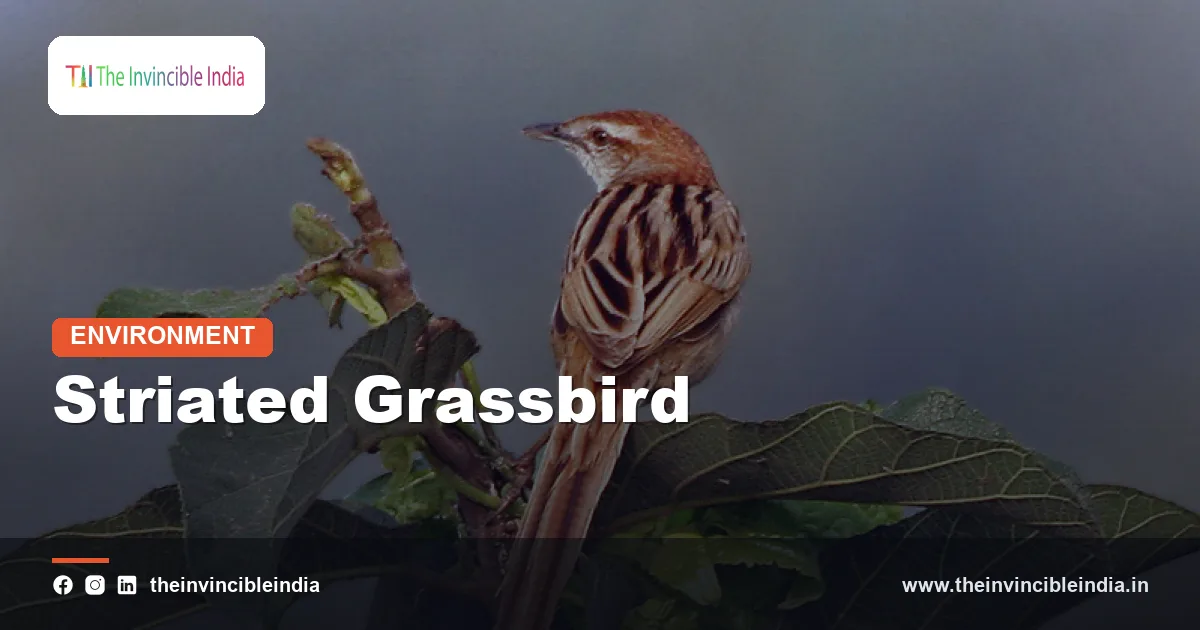
The striated grassbird (Megalurus palustris) is a large, streaky, long-tailed warbler-like bird that lives year-round in the tall grass, reed-beds and marsh edges of the Indian subcontinent, and is best known for its loud, ringing song delivered from an exposed perch or in a short display flight. It is one of the largest members of the grass warbler group, and although it is a resident species rather than a migrant, it is easily overlooked because it spends most of its time hidden deep in dense vegetation.
This guide explains what the striated grassbird is, how to identify it, where it lives in India, what it eats, how and when it breeds, how it differs from similar birds and why it is an important indicator of healthy wet grasslands. Last updated: 30 October 2026.
| Attribute | Detail |
|---|---|
| Common name | Striated grassbird (older Indian name: striated marsh warbler) |
| Scientific name | Megalurus palustris |
| Family | Locustellidae (grass warblers and allies) |
| Approximate length | About 23 to 28 cm including the long tail |
| Status in India | Resident, local and patchily distributed |
| Typical habitat in India | Tall wet grassland, reed-beds, marsh edges, floodplain grass and sugarcane margins |
| Diet | Insects and other small invertebrates, occasionally seeds |
| IUCN Red List category | Least Concern (global assessment) |
Key Takeaways
- The striated grassbird is a large, heavily streaked, long-tailed bird of tall grass and reed-beds that lives in India throughout the year.
- The striated grassbird sings loud, clear whistled phrases from an exposed perch or during a short display flight, which is the easiest way to find it.
- The striated grassbird belongs to the family Locustellidae, the grass warblers, and was formerly known in Indian literature as the striated marsh warbler.
- The striated grassbird feeds mainly on insects and other small invertebrates caught in dense grass and at the edges of marshes.
- The striated grassbird nests mostly during the monsoon, hiding a domed or cup-shaped grass nest low in tall vegetation.
- The striated grassbird is classified as Least Concern globally, but it depends on tall wet grassland that is shrinking because of drainage, burning and conversion to farmland.
What is the striated grassbird?
The striated grassbird is a big, streaky, long-tailed songbird in the family Locustellidae that inhabits wet grassland and reed-beds across South and South-East Asia. It is one of the larger grass warblers, noticeably bigger than a bulbul or a reed warbler, with a long, loosely graduated tail.
The family Locustellidae includes grasshopper warblers, bristlebirds and grassbirds, many of which are secretive and known for insect-like or reeling songs. The striated grassbird is less skulking than some of its relatives, because males often climb to the top of a reed or bush to sing. The older Indian name, striated marsh warbler, appears in many classic field guides and checklists, and some current sources use the name striated grassbird for the whole widespread species.
The species occurs widely, from the Indian subcontinent through South-East Asia to the Philippines, Indonesia and beyond. More than one subspecies is recognised across this range, and birds from different regions vary in size and plumage tone. Some authorities have proposed treating certain island forms as separate species.
How can you identify the striated grassbird?
The striated grassbird is identified by its large size, streaked brown upperparts, a rufous or chestnut crown, a plain whitish to buff underside, a pale eyebrow and a long, graduated tail. The tail is often held loosely, fanned or cocked, especially during song.
Key features in the field include:
- Upperparts: Heavily streaked blackish-brown and buff, giving a mottled look that matches dry grass.
- Crown: Reddish-brown with fine streaks; often looks warm toned in good light.
- Face: A pale supercilium above a dark eye-stripe gives a plain-faced, slightly stern expression.
- Underparts: Whitish on the throat and belly, with a buffier tone on the flanks and fine streaking on the breast sides in some individuals.
- Tail: Long, rounded and graduated, often held loosely and flicked or fanned.
- Bill: Fairly strong, slightly curved, with a dark upper mandible and paler lower mandible.
In flight the striated grassbird looks weak and fluttering, with rounded wings and a dangling tail. It flies only short distances before dropping back into cover. Its voice is the best guide: the song consists of loud, clear, whistled notes, rising and running together, delivered repeatedly.
Where does the striated grassbird live in India?
The striated grassbird lives in patches of tall, wet grassland and reed-beds across northern, north-eastern and parts of peninsular India, with local populations in floodplains, marshes and wetland edges. It is largely absent from dry, treeless regions and from dense forest.
Strongholds are the floodplain and Terai grasslands of the Gangetic plains and the foothills of the Himalaya, and the Brahmaputra valley and other low-lying parts of the north-east, where tall elephant grass and reeds form extensive habitats. Scattered populations also occur in suitable wetlands in southern India and in neighbouring Sri Lanka. The distribution is patchy because the bird depends on specific vegetation.
Habitats include:
- Tall grassland and savannah in river floodplains
- Reed-beds and cattail marshes at the edges of lakes and swamps
- Wet meadows and seasonally inundated grass
- Margins of sugarcane fields, paddy bunds and irrigation channels with rank grass
Protected areas with extensive tall grass, such as those in the Terai and the Brahmaputra floodplain, offer some of the best opportunities to hear and see the species.
What does the striated grassbird eat?
The striated grassbird eats mainly insects and other small invertebrates, which it gleans from grass stems, leaf bases and the ground in dense vegetation. Typical prey includes grasshoppers, beetles, bugs, caterpillars, flies and spiders.
The bird forages by climbing through grass and reeds, clambering up stems, peering into leaf sheaths and sometimes dropping to the ground or the water margin. It occasionally takes small snails or tiny frogs and may eat some seeds, though animal food dominates. The strong bill is well suited to probing into tangled vegetation and seizing larger insects than many smaller warblers can handle.
Feeding is mostly in the cooler parts of the day, early in the morning and late in the afternoon, but vocal birds may be active at any time during the breeding season. Because the bird eats many insects that feed on grass and crops, it contributes to natural pest control in the wetlands and fields where it lives.
How does the striated grassbird behave?
The striated grassbird behaves as a territorial, mostly solitary or paired bird that lives low in dense grass and climbs to a conspicuous perch to sing, then drops back out of sight. Birds are usually heard far more often than seen.
Characteristic behaviours include:
- Song perching: The male sings from the top of a reed, bush or fence post, often at dawn or dusk and during the breeding season.
- Display flight: The male may rise a short distance, sing and glide down with the tail spread.
- Skulking: When alarmed, the bird dives into the grass and runs along the ground, rarely flying far.
- Tail movements: The long tail is often flicked, cocked or spread.
- Territorial calling: Neighbouring males counter-sing along the edges of territories.
Predators include snakes, monitor lizards, harriers, owls, jungle cats and other small carnivores. The bird depends on thick cover for safety, and its dull streaking provides camouflage.
When and how does the striated grassbird breed?
The striated grassbird breeds mainly during the monsoon and the weeks around it, building a domed or cup-shaped nest of grass hidden low in tall vegetation, often within a tussock or among reeds. The timing varies somewhat with region and rainfall.
The nest is woven from grass blades and fine stems and is usually placed close to the ground or just above water in dense cover, which makes it hard to find. The female lays a small clutch of pale, speckled eggs, and both parents help feed the chicks, mainly with insects. The breeding season coincides with lush growth of grass and an abundance of insects, which provides plenty of food for the young.
The rise in singing at the onset of the rains is a reliable sign that breeding is starting. Because the nesting habitat is dense and often waterlogged, nests are vulnerable to flooding, grazing and the burning or cutting of grass.
| Stage | What happens |
|---|---|
| Pre-breeding | Males establish territories and sing from high perches |
| Nest building | Grass nest constructed low in tall grass or reeds |
| Egg laying and incubation | Small clutch of speckled eggs incubated in dense cover |
| Chick rearing | Both parents feed young on insects and invertebrates |
| Post-breeding | Family groups disperse; birds remain in grassland year-round |
How is the striated grassbird different from similar birds?
The striated grassbird differs from similar birds mainly in its larger size, long graduated tail, heavy streaking and loud whistled song, which together separate it from reed warblers, other grass warblers and babblers. Several streaked birds share the same habitats, so the differences are worth knowing.
| Species | How it compares with the striated grassbird |
|---|---|
| Bristled grassbird | Rarer and more secretive; found in specific tall grass areas; smaller and less vocal; a specialist of threatened grassland |
| Striated babbler | A babbler that also lives in tall riverine grass in northern India; smaller, with a shorter tail, a different shape and a different call; not a grass warbler |
| Clamorous reed warbler | Plainer brown without heavy streaks; bigger bill; very loud but different song |
| Zitting cisticola | Much smaller with a short tail; gives a repeated “zit” call in display flight |
| Bush warblers | Smaller and plain; usually skulking and unstreaked |
Experienced observers rely on size, tail length and the song to confirm the identification, especially in the early morning when the bird sings from the tips of reeds.
Is the striated grassbird threatened?
The striated grassbird is not globally threatened and is classified as Least Concern by the International Union for Conservation of Nature (IUCN), owing to its wide range, but its tall wet grassland habitat is declining, and some local populations in India are at risk. The bird is a good example of a common species that depends on a threatened ecosystem.
The main pressures are:
- Wetland drainage: Marshes and floodplain grasslands are filled in or drained for farming, construction and roads.
- Conversion of grassland: Tall grass areas are plantation-forested or ploughed for crops.
- Burning and cutting: Annual burning for fodder or management, if mistimed, destroys nests and cover.
- Overgrazing: Heavy livestock grazing shortens vegetation and removes nesting cover.
- Invasive plants: Weeds such as water hyacinth or invasive shrubs can alter the vegetation.
- Altered flooding patterns: Dams and embankments change the natural flood cycle that renews floodplain grass.
Managing grasslands with rotational burning, retaining reed-beds and protecting seasonal wetlands helps maintain the habitat. Since the bird shares its home with rarer grassland specialists such as the Bengal florican, hog deer and swamp francolin in places, measures for these species help it too.
Why does the striated grassbird matter for India’s wetlands?
The striated grassbird matters because its presence signals intact tall grass and reed-bed ecosystems that provide flood control, water filtration, fodder and shelter for many species. Birds of such habitats are often neglected in conservation planning.
India’s tall grasslands and wetlands are among its most threatened ecosystems, yet they are crucial for livelihoods through grazing, thatching grass, fishing and flood moderation. Birds like the striated grassbird, which have specific habitat requirements, reflect the condition of these systems. A healthy population suggests that vegetation structure, water regime and insect life are in good order.
Citizen-science records, particularly of vocalising birds, have improved knowledge of the species’ range in India. Because the bird sings so conspicuously, it is a good candidate for acoustic surveys and long-term monitoring.
How can you watch the striated grassbird in India?
The best way to watch the striated grassbird in India is to visit tall wet grassland or reed-beds early in the morning, listen for the loud whistled song and then scan the tops of reeds and bushes for a streaky, long-tailed bird singing in the open. Patience and a quiet approach are important.
These suggestions can help:
- Visit at dawn, when males sing most actively, especially around the onset of the rains.
- Stay on tracks or vehicle paths, and avoid trampling grass or approaching nests.
- Scan the tops of reeds, shrubs and fence posts with binoculars.
- Learn the song from recordings so that you can recognise it in the field.
- Photograph from a distance, and avoid excessive playback of recordings, which can stress breeding birds.
- Record the date and location, and submit observations to a citizen-science platform.
Grassland reserves in the Terai, the Brahmaputra floodplain and wetlands in other parts of India are good places to try, and local guides often know where the birds sing.
Bottom Line
The striated grassbird is a loud, streaky resident of India’s tall wet grasslands and reed-beds, more often heard than seen. Protecting seasonal wetlands, floodplain grass and carefully managed grazing and burning regimes will keep this and many other grassland birds singing.
Frequently Asked Questions
Is the striated grassbird a migratory bird?
No, the striated grassbird is a resident bird in India. It stays in tall wet grassland and reed-beds throughout the year, although it may move locally with changes in water and vegetation.
What does a striated grassbird look like?
The striated grassbird is a large, streaky brown bird with a reddish crown, a pale eyebrow, a whitish underside and a long, rounded tail. It is much bigger than a typical reed warbler.
Where can I see the striated grassbird in India?
The striated grassbird can be found in tall wet grassland and reed-beds, especially in the Terai, the Gangetic and Brahmaputra floodplains and the north-east. It also occurs in scattered wetlands in southern India.
What does the striated grassbird eat?
The striated grassbird eats mainly insects and other small invertebrates such as grasshoppers, beetles, caterpillars and spiders. It collects them from grass stems and the ground in dense vegetation.
When does the striated grassbird breed?
The striated grassbird breeds mainly during the monsoon season, though timing varies by region. It builds a domed or cup-shaped grass nest low in tall vegetation.
Is the striated grassbird endangered?
No, the striated grassbird is classified as Least Concern by the IUCN because of its wide range. However, the tall wet grassland it needs is shrinking in many parts of India due to drainage, burning and conversion to farmland.
{“@context”:”https://schema.org”,”@graph”:[{“@type”:”FAQPage”,”mainEntity”:[{“@type”:”Question”,”name”:”Is the striated grassbird a migratory bird?”,”acceptedAnswer”:{“@type”:”Answer”,”text”:”No, the striated grassbird is a resident bird in India. It stays in tall wet grassland and reed-beds throughout the year, although it may move locally with changes in water and vegetation.”}},{“@type”:”Question”,”name”:”What does a striated grassbird look like?”,”acceptedAnswer”:{“@type”:”Answer”,”text”:”The striated grassbird is a large, streaky brown bird with a reddish crown, a pale eyebrow, a whitish underside and a long, rounded tail. It is much bigger than a typical reed warbler.”}},{“@type”:”Question”,”name”:”Where can I see the striated grassbird in India?”,”acceptedAnswer”:{“@type”:”Answer”,”text”:”The striated grassbird can be found in tall wet grassland and reed-beds, especially in the Terai, the Gangetic and Brahmaputra floodplains and the north-east. It also occurs in scattered wetlands in southern India.”}},{“@type”:”Question”,”name”:”What does the striated grassbird eat?”,”acceptedAnswer”:{“@type”:”Answer”,”text”:”The striated grassbird eats mainly insects and other small invertebrates such as grasshoppers, beetles, caterpillars and spiders. It collects them from grass stems and the ground in dense vegetation.”}},{“@type”:”Question”,”name”:”When does the striated grassbird breed?”,”acceptedAnswer”:{“@type”:”Answer”,”text”:”The striated grassbird breeds mainly during the monsoon season, though timing varies by region. It builds a domed or cup-shaped grass nest low in tall vegetation.”}},{“@type”:”Question”,”name”:”Is the striated grassbird endangered?”,”acceptedAnswer”:{“@type”:”Answer”,”text”:”No, the striated grassbird is classified as Least Concern by the IUCN because of its wide range. However, the tall wet grassland it needs is shrinking in many parts of India due to drainage, burning and conversion to farmland.”}}]}]}


