

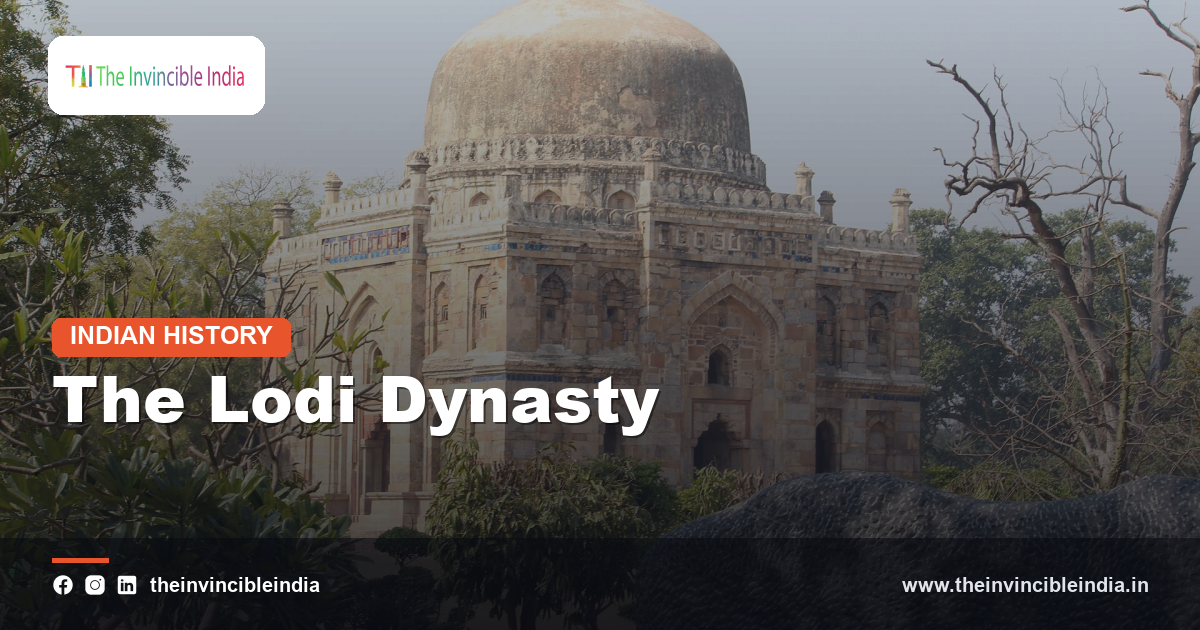
The Lodi dynasty was the last ruling house of the Delhi Sultanate, governing parts of northern India in the fifteenth and early sixteenth centuries. Its rulers were of Afghan origin and relied on a powerful tribal nobility whose loyalty shaped the character of the state. Over three reigns, the dynasty restored a measure of strength to a Sultanate that had been badly fragmented after the Tughlaq decline, then lost power in a decisive battle that opened the way for the Mughal Empire. Today the Lodis are remembered above all for the elegant tombs that still stand in the parkland of Delhi, among the most evocative monuments of the late Sultanate period.
Quick Facts
| Detail | Information |
|---|---|
| Sultanate | The last ruling dynasty of the Delhi Sultanate |
| Origin | Afghan tribal nobility |
| Founder | Bahlul Lodi |
| Three Sultans | Bahlul Lodi, Sikandar Lodi, and Ibrahim Lodi |
| Key Monuments | Tombs and mosques in Lodi Gardens, Delhi |
| End of Rule | Defeat at the First Battle of Panipat by Babur |
Background: A Fragmented Sultanate
The Lodi dynasty emerged against the backdrop of a Delhi Sultanate that had lost much of its former strength. After the invasion of Timur devastated the capital and the Tughlaq line collapsed, regional kingdoms such as Jaunpur, Malwa, Gujarat, and Bengal asserted their independence. The ruling house that followed controlled little beyond the immediate region around Delhi, and its authority was frequently challenged. This weakened state provided the setting in which an ambitious governor of Afghan origin could rise. The Lodis thus inherited a shrunken and divided Sultanate and set about rebuilding what they could from its remnants.
The Afghan Nobility and Their World
The strength of the Lodi dynasty rested on the Afghan nobility, whose tribal customs and personal loyalties shaped how the state functioned. Many Afghan chiefs had migrated into northern India over previous generations and had served as soldiers and provincial governors. In their tradition, the ruler was seen as first among equals, and the nobles expected to be consulted, rewarded, and treated with respect. This outlook influenced the early Lodi rulers, who shared power and spoils with their followers. It gave the dynasty a loyal base but also created tensions whenever a sultan sought to assert greater authority. The Afghan nobility thus gave the Lodi state both its main support and its chief challenge.
Bahlul Lodi and the Founding of the Dynasty
Bahlul Lodi, the founder of the dynasty, was an experienced governor in the Punjab who took control of Delhi at a time of weakness and confusion. He ruled in a manner that suited his Afghan companions, treating them as comrades and rewarding their loyalty. Much of his reign was spent in campaigns to restore the authority of Delhi over the surrounding territories, particularly against the neighboring state of Jaunpur. His skill as a soldier and his understanding of the nobility allowed him to establish a lasting dynasty. Bahlul’s reign laid the foundations for the Lodi revival and showed what determined leadership could accomplish.
The Struggle with Jaunpur
One of the major tasks of the early Lodi rulers was dealing with the Sharqi Sultanate of Jaunpur, a powerful neighboring kingdom that had been a rival of Delhi for years. Jaunpur was a wealthy and cultured state whose rulers had built impressive mosques and supported learning, and it threatened the eastern frontier of the Delhi Sultanate. A long contest followed, with campaigns and negotiations alternating over a period of time. Eventually, Lodi forces overcame Jaunpur and brought much of its territory back under Delhi’s control. This triumph significantly extended the dynasty’s reach and restored an important part of the Gangetic plain to the Sultanate.
Sikandar Lodi: The Strongest Sultan
Sikandar Lodi, who followed Bahlul, is generally regarded as the ablest ruler of the dynasty. Where his predecessor had treated the nobles as equals, Sikandar worked to bring them under more regular royal control, insisting on discipline and accountability. He extended Lodi authority over a wider area, consolidating the eastern territories and pressing into the central parts of the Gangetic plain. He also maintained an active interest in justice and in the welfare of his subjects. His reign is usually seen as the high point of Lodi power. Sikandar’s firm governance gave the dynasty its greatest period of strength and stability.
Administration and Governance under Sikandar
Sikandar Lodi paid attention to the machinery of government and tried to improve its efficiency. He maintained a network of reporters to keep him informed, required nobles to submit their accounts for scrutiny, and sought to keep the army well supplied and disciplined. Land revenue was organized with care, and the sultan encouraged cultivation and trade. Markets in the territories under his control flourished, and prices were relatively steady according to contemporary writers. These measures show a ruler concerned with sound administration as well as military strength. Sikandar’s approach to governance helped the Sultanate recover some of the stability it had long lacked.
Agra and the Shifting of Royal Attention
During Sikandar Lodi’s reign, the city of Agra on the Yamuna gained importance as a base of royal activity and military control over the central Gangetic region. Establishing a strong presence there allowed the sultan to manage the eastern and southern territories more effectively than from Delhi alone. The growth of Agra proved to have lasting consequences, since the city later became a great capital under the Mughals. Its rising prominence during the Lodi period illustrates how shifting political needs shape urban history. The attention Sikandar gave to Agra thus anticipated one of the major changes in the geography of power in northern India.
Learning, Culture, and Religious Policy
The Lodi period was not only a time of political maneuvering but also of cultural activity. Sikandar Lodi is remembered as a patron of scholars and as a ruler who encouraged learning, and works in medicine and other fields were produced or studied under his patronage. Persian remained the language of the court, while regional languages continued to flourish in the wider society. At the same time, devotional movements such as the teachings of Kabir and Nanak gained strength in northern India during this broader period. Religious policy under the sultans was not uniform, and historians view the record with nuance. Culturally, the era was lively and varied.
Ibrahim Lodi and Rising Tensions
Ibrahim Lodi, the son of Sikandar, inherited a state whose strength depended heavily on his ability to manage the Afghan nobles. He tried to continue his father’s policy of asserting royal authority and reducing the independent power of great chiefs. This effort caused resentment among powerful nobles, some of whom rebelled or withdrew their loyalty. Disputes within the ruling circle weakened the central government at a time when external threats were growing. Contemporary accounts describe the sultan as brave but unable to win the confidence of his nobility. Ibrahim’s reign thus became a period of mounting internal tension for the dynasty.
Regional Rivals and the Rajput Challenge
Beyond internal discord, the later Lodi sultans faced pressure from powerful regional rivals. In Rajasthan, the Rajput kingdom of Mewar under Rana Sanga was growing in strength and expanding its influence in neighboring areas. Contests with such powers tested the military resources of the Sultanate. At the same time, other regional states in the east and the south maintained their independence from Delhi. The Lodi realm, though large, was surrounded by rivals who watched for signs of weakness. These external pressures, together with internal discontent, left the dynasty exposed when a new challenger appeared from the northwest.
Babur and the First Battle of Panipat
The decisive end of the Lodi dynasty came when Babur, a ruler from Central Asia who had established himself at Kabul, advanced into northern India. According to traditional accounts, dissatisfied nobles within the Lodi realm encouraged his intervention. The two armies met at Panipat, in a battle that has become one of the best-known turning points in Indian history. Babur’s disciplined forces and his use of gunpowder weapons and field tactics proved decisive against the larger Lodi army. Ibrahim Lodi fell in the battle, and the Delhi Sultanate came to an end. The result opened the path for the founding of the Mughal Empire.
Why the Lodis Fell
Historians offer several explanations for the fall of the Lodi dynasty. A divided nobility, resistant to centralizing efforts, left the sultan without the unified support needed in a crisis. The army, though large, lacked the new techniques of warfare, including artillery and organized field formations, that Babur brought with him. Regional rivals also drained Lodi strength, while communications across the wide territory remained difficult. No single cause explains the outcome. Together, these factors show how the long-term weaknesses of a state can be exposed by a single decisive encounter. The fall of the Lodis was thus the result of both structural problems and a formidable adversary.
Architecture of the Lodi Period
The Lodi dynasty made a distinctive contribution to the architecture of Delhi, especially in tomb building. Its monuments favor stout proportions, raised platforms, and double-storied facades that give them a solid and dignified presence. Builders used local stone with plaster finishes, often adding tilework and carved ornament in places. The period saw the development of ideas that would influence later Mughal funerary architecture. These tombs, set in landscaped surroundings, reveal a growing interest in the relationship between buildings and gardens. Lodi architecture thus served as an important bridge between the earlier Sultanate styles and the grand structures of the Mughals.
Octagonal Tombs and the Garden Setting
Among the characteristic forms of the Lodi period is the octagonal tomb, usually surrounded by a veranda of arches and set within an enclosed garden. The tomb traditionally associated with Muhammad Shah Sayyid and that attributed to Sikandar Lodi are examples of this type. Octagonal plans give a sense of harmony and allow the building to be viewed from all sides. The enclosing walls and gardens create a quiet precinct for reflection and remembrance. This combination of tomb and garden later became a central idea in Mughal architecture. The Lodi octagonal tombs are therefore early expressions of a theme that would flourish in the Mughal world.
Lodi Gardens in Delhi
Today the best-known reminder of the dynasty is Lodi Gardens in New Delhi, a large park that preserves a group of fifteenth-century monuments among lawns, trees, and walkways. Visitors can see the Bara Gumbad, with its attached mosque, the Sheesh Gumbad with remnants of blue tilework, and the tombs of rulers from both the Lodi and the preceding Sayyid dynasties. The park is a favorite place for walks and quiet relaxation as well as for those interested in history. Few places in the city combine monumental heritage and green space so successfully. Lodi Gardens makes the legacy of the dynasty a living part of modern Delhi.
The Lodi Dynasty Today
Today the Lodi dynasty is remembered as the final chapter of the Delhi Sultanate and as the bridge to the Mughal age. Its history shows how political authority in medieval India depended on a delicate balance between rulers and nobles. Its monuments continue to shape the character of Delhi, drawing residents and visitors to the old tombs and gardens. Studying the Lodis helps explain how the Mughals found a ready political landscape on their arrival, and how architectural ideas passed from one era to the next. The dynasty’s legacy endures in both stone and memory.
Sources & Further Reading
- Archaeological Survey of India (asi.nic.in).
- Ministry of Culture, Government of India (indiaculture.gov.in).
Frequently Asked Questions
Who founded the Lodi dynasty?
The Lodi dynasty was founded by Bahlul Lodi, an Afghan governor in the Punjab who took control of Delhi and restored a measure of authority to the weakened Sultanate.
Who was the greatest Lodi ruler?
Sikandar Lodi is generally regarded as the ablest Lodi sultan, known for firm governance, administrative reform, and the consolidation of Lodi power across the Gangetic plain.
How did the Lodi dynasty end?
The dynasty ended when Ibrahim Lodi was defeated and killed by Babur at the First Battle of Panipat, which brought the Delhi Sultanate to a close.
What is Lodi Gardens known for?
Lodi Gardens in Delhi is a park containing fifteenth-century tombs and mosques, including the Bara Gumbad and Sheesh Gumbad, and is a popular heritage and leisure site.
Why is the Lodi dynasty important?
The Lodis were the last rulers of the Delhi Sultanate. Their fall opened the way for the Mughals, and their tombs influenced later Mughal funerary architecture.


