

The Tughlaq dynasty was one of the ruling houses of the Delhi Sultanate, governing large parts of northern and central India during the fourteenth century. Its rulers are remembered for a striking mix of ambition and experiment, from far-reaching administrative schemes to major programs of canals, towns, and public buildings. The dynasty reached its widest territorial extent under one of its early kings, then gradually lost ground as provincial governors and regional kingdoms asserted their independence. Today the Tughlaqs are recalled through their imposing, fortress-like architecture in Delhi and through the vivid accounts of chroniclers and travelers who observed their court at close quarters.
Quick Facts
| Detail | Information |
|---|---|
| Sultanate | A ruling dynasty of the Delhi Sultanate |
| Founder | Ghiyath al-Din Tughlaq |
| Most Famous Ruler | Muhammad bin Tughlaq, known for bold experiments |
| Major Builder | Firoz Shah Tughlaq, known for canals, towns, and public works |
| Key Monuments | Tughlaqabad fort, tomb of Ghiyath al-Din, Kotla Firoz Shah |
| Notable Observer | The traveler Ibn Battuta, who served at the Delhi court |
Origins and Rise to Power
The Tughlaq dynasty arose from the military nobility that served the earlier Delhi Sultanate rulers, drawing on a tradition of frontier command and loyalty to the throne. Its founder, Ghiyath al-Din Tughlaq, had made his reputation as an able governor and commander, particularly in defending the northwestern borders against raiding forces from beyond the frontier. When the preceding dynasty weakened amid internal conflict, he emerged as a capable figure around whom the nobility rallied. His accession brought a measure of stability after a period of turbulence. The rise of the Tughlaqs thus reflected the importance of military talent and frontier experience in shaping the politics of the Sultanate.
Ghiyath al-Din Tughlaq and Consolidation
As the first Tughlaq ruler, Ghiyath al-Din devoted his energy to restoring order and strengthening the finances of the Sultanate. He extended royal authority over restive regions and sought to make the administration more regular and dependable. Contemporary accounts describe a ruler who favored moderation in revenue demands so that cultivators could prosper, since a healthy countryside would support a strong state. He also began the construction of a new fortified city on the edge of Delhi, which would carry his dynastic name. His reign was relatively short, yet it set the foundations on which the dynasty built. Ghiyath al-Din is therefore remembered as a stabilizing founder who gave the Tughlaqs their early strength.
Tughlaqabad: The Fortress City
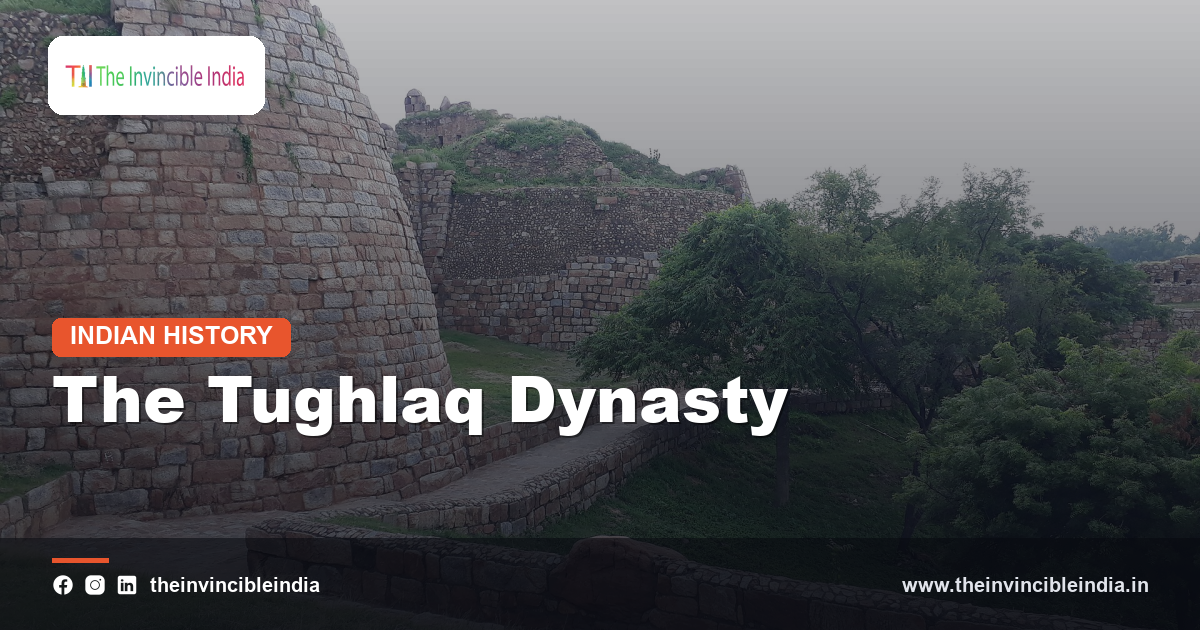
Tughlaqabad is the great fortified city begun by Ghiyath al-Din Tughlaq in the rocky terrain south of the older settlements of Delhi. Its massive sloping walls, built of rough local stone, give the site a grim and monumental character that reflects the military outlook of its builder. The complex once contained a citadel, palaces, and residential quarters, protected by bastions and gateways. Although the city was occupied only briefly and is now largely in ruins, its scale remains deeply impressive. The walls rise with a powerful, almost sculptural simplicity. Tughlaqabad stands as the clearest architectural statement of the early Tughlaq style and its emphasis on strength.
The Tomb of Ghiyath al-Din
Near the fort of Tughlaqabad lies the tomb of Ghiyath al-Din Tughlaq, a compact and austere monument that exemplifies the architectural taste of the dynasty. The tomb is built with inward-leaning walls, a feature often called battered construction, which gives the structure a firm and weighty appearance. Red sandstone is combined with white marble, and the whole stands on a raised platform within a fortified enclosure. The design is plain by later standards yet carefully balanced, with a gently rounded dome crowning the building. This tomb became an influential model for later funerary architecture in the region. Its sober dignity expresses the character of early Tughlaq building.
Muhammad bin Tughlaq: An Ambitious Ruler
Muhammad bin Tughlaq, who succeeded Ghiyath al-Din, is among the most discussed rulers in Indian history. Contemporaries and later writers describe him as highly educated, intellectually curious, and deeply interested in philosophy, medicine, and the arts. He was also a ruler of boundless ambition who sought to reshape the Sultanate through bold new schemes. Many of his plans were far ahead of the administrative capacity available to carry them out, and some produced unintended hardship. His reign saw the Sultanate reach its greatest extent and also the first signs of its fragmentation. Muhammad bin Tughlaq thus remains a fascinating and controversial figure, admired for his vision and criticized for his execution.
The Shift of the Capital to Daulatabad
One of the best-known decisions of Muhammad bin Tughlaq was the transfer of the capital from Delhi to Daulatabad in the Deccan. The reasoning behind the move was strategic, since Daulatabad lay closer to the center of an empire that now reached deep into the south and could be governed more effectively from a central location. The relocation, however, imposed heavy burdens on those who had to travel and resettle, and it created difficulties for the administration. The capital was later brought back to Delhi. Historians continue to debate the scale of the disruption, but the episode is often cited as an example of an imaginative idea undermined by practical challenges.
The Token Currency Experiment
Another famous initiative of Muhammad bin Tughlaq was the introduction of token currency, in which coins of cheaper metal were issued to stand in for more valuable ones. The idea was innovative and reflected an understanding of how money could function as a symbol of trust. However, the scheme proved difficult to protect against imitation, and confidence in the new coinage eroded. The state eventually withdrew the tokens and redeemed them. The episode is frequently remembered as a bold monetary experiment that outran the state’s ability to manage it. It shows both the creativity of the ruler and the limits of administrative control in a vast medieval realm.
Agrarian Measures and Their Challenges
Muhammad bin Tughlaq also attempted to strengthen agriculture and royal revenue through new measures in the fertile regions of the Ganga-Yamuna doab. Policies to expand cultivation and organize agricultural support were intended to improve the financial base of the Sultanate. Yet the effects of such efforts were uneven, and years of poor harvests and famine placed heavy strain on rural communities. Sources describe the sultan’s attempts to provide relief and encourage farming as the crisis deepened. These difficulties added to unrest in several provinces. The agrarian history of his reign shows how ambitious reform can falter when natural hardship and administrative limits combine.
Ibn Battuta at the Tughlaq Court
The travelogue of Ibn Battuta, the well-known Moroccan traveler, provides one of the most vivid outside views of the Tughlaq court. He came to Delhi, where he was appointed to a judicial position and spent a number of years observing the splendor and the dangers of life under the sultan. His account describes the generosity of the ruler, the scale of the court, and the harsh punishments that could fall on those who fell from favor. Like all travel writing, it reflects personal impressions and should be read with care. Even so, it remains an invaluable source on fourteenth-century Delhi and its society.
Firoz Shah Tughlaq: Builder and Administrator
Firoz Shah Tughlaq, who followed Muhammad bin Tughlaq, adopted a more cautious and conciliatory approach to governance. Rather than sweeping experiments, he focused on restoring stability, easing burdens on the nobility and the countryside, and investing in public works. His reign is remembered for peace at home, steady administration, and a notable program of construction. He took an interest in learning and in the preservation of earlier monuments. Firoz Shah’s long rule gave the Sultanate a period of relative calm after the turbulence of the preceding reign. He is therefore regarded as one of the great builders and administrators of the dynasty.
Canals, Towns, and Public Works
Firoz Shah Tughlaq is especially associated with irrigation canals that brought water to dry tracts of northern India and encouraged cultivation. He also founded several new towns, including Firozabad near Delhi, Hisar, and Jaunpur, which served administrative and economic purposes. Additional works included mosques, colleges, rest houses, and gardens designed for public benefit. These projects expanded agricultural output and strengthened urban life in several regions. The emphasis on practical infrastructure set his reign apart from that of his predecessor. His canals and towns demonstrate how careful investment in public works could support both the state and ordinary people.
Kotla Firoz Shah and the Ashokan Pillars
The citadel of Firozabad, known today as Kotla Firoz Shah, stands on the banks of the Yamuna in Delhi and once formed the heart of Firoz Shah’s new city. At its center rises a multistoried structure crowned with an ancient sandstone pillar, which had been inscribed in the time of the Mauryan emperor Ashoka and was moved there on the sultan’s orders. Another Ashokan pillar was relocated to a ridge elsewhere in Delhi. The removal and re-erection of these huge monoliths reveal the sultan’s curiosity about the ancient past. Their presence in Delhi connects the medieval city to the distant Mauryan world.
Architecture of the Tughlaq Period
Tughlaq architecture is characterized by a stern, strong, and economical style, using rubble masonry, plain surfaces, and sloping walls. Rather than elaborate decoration, buildings rely on solidity and proportion for their effect. Mosques such as the Khirki Masjid and the Begumpur Mosque display covered courtyards and distinctive gateways. The style also made use of the arch, the dome, and the lintel in combination, reflecting an adaptation of techniques from several traditions. This restraint stands in contrast to the richer ornament of earlier and later periods. The Tughlaq style therefore expresses an outlook shaped by military need and practical economy.
Administration and Society
Under the Tughlaqs, the Sultanate was administered through a hierarchy of provinces governed by appointed officers, supported by a revenue system and a standing military. The nobility included people of varied origins, among them Turkic, Persian, Afghan, and Indian groups, whose rivalries influenced court politics. Urban life centered on markets, mosques, and workshops, and scholars and Sufi saints played an important role in society. Chroniclers such as Ziauddin Barani and Shams-i-Siraj Afif recorded the events and ideals of the age. The administrative system worked best when the ruler was strong and attentive. Tughlaq society reflected a diverse and dynamic world.
Provincial Revolts and Weakening Authority
The reign of Muhammad bin Tughlaq witnessed growing unrest in distant provinces, as governors and local leaders resisted central control. In the south, new powers emerged that would shape the later history of the peninsula, among them the Vijayanagara kingdom in the south and the Bahmani Sultanate in the Deccan. In other regions, provincial governors increasingly acted as independent rulers. The center could no longer easily project its power over such vast distances. Firoz Shah’s cautious policies slowed the decline but did not reverse it. The Tughlaq experience shows how difficult it was to hold together a vast realm with limited communications.
The Invasion of Timur and the End of the Dynasty
The final blow to Tughlaq power came with the invasion of the Central Asian conqueror Timur, who attacked Delhi and left the city devastated. By that time the dynasty was already weakened by succession disputes and the rivalry of noble factions. After the invasion, central authority could not be restored, and the Sultanate broke into smaller regional states. The Tughlaq line ended, and a successor dynasty took control of a much reduced territory. The episode remains one of the darkest moments in the history of medieval Delhi. It marked the effective end of Tughlaq rule and a turning point for the Sultanate.
The Tughlaq Dynasty Today
Today the Tughlaq dynasty is remembered through its monuments, its chroniclers, and the lively debates over its most famous rulers. The ruins of Tughlaqabad, the tomb of Ghiyath al-Din, and Kotla Firoz Shah draw visitors who wish to understand medieval Delhi. Historians continue to discuss whether Muhammad bin Tughlaq was a visionary ahead of his time or an overreaching ruler, and Firoz Shah’s careful governance invites its own appraisal. Together, these figures illustrate the possibilities and limits of power in the Delhi Sultanate. The Tughlaq legacy endures as a vivid and instructive chapter in India’s medieval past.
Sources & Further Reading
- Archaeological Survey of India (asi.nic.in).
- Ministry of Culture, Government of India (indiaculture.gov.in).
Frequently Asked Questions
Who founded the Tughlaq dynasty?
The Tughlaq dynasty was founded by Ghiyath al-Din Tughlaq, an experienced frontier commander who became ruler of the Delhi Sultanate and began the fortified city of Tughlaqabad.
Why is Muhammad bin Tughlaq famous?
He is remembered for bold experiments such as shifting the capital to Daulatabad and introducing token currency, as well as for his learning and ambition.
What did Firoz Shah Tughlaq build?
Firoz Shah is known for irrigation canals, new towns such as Firozabad, Hisar, and Jaunpur, and public buildings including mosques, colleges, and rest houses.
What are the main Tughlaq monuments in Delhi?
Major Tughlaq monuments include Tughlaqabad fort, the tomb of Ghiyath al-Din Tughlaq, Kotla Firoz Shah, the Khirki Masjid, and the Begumpur Mosque.
How did the Tughlaq dynasty end?
Provincial revolts, factional rivalry, and the devastating invasion of Timur destroyed central authority, and the Sultanate fragmented into smaller regional kingdoms.


