

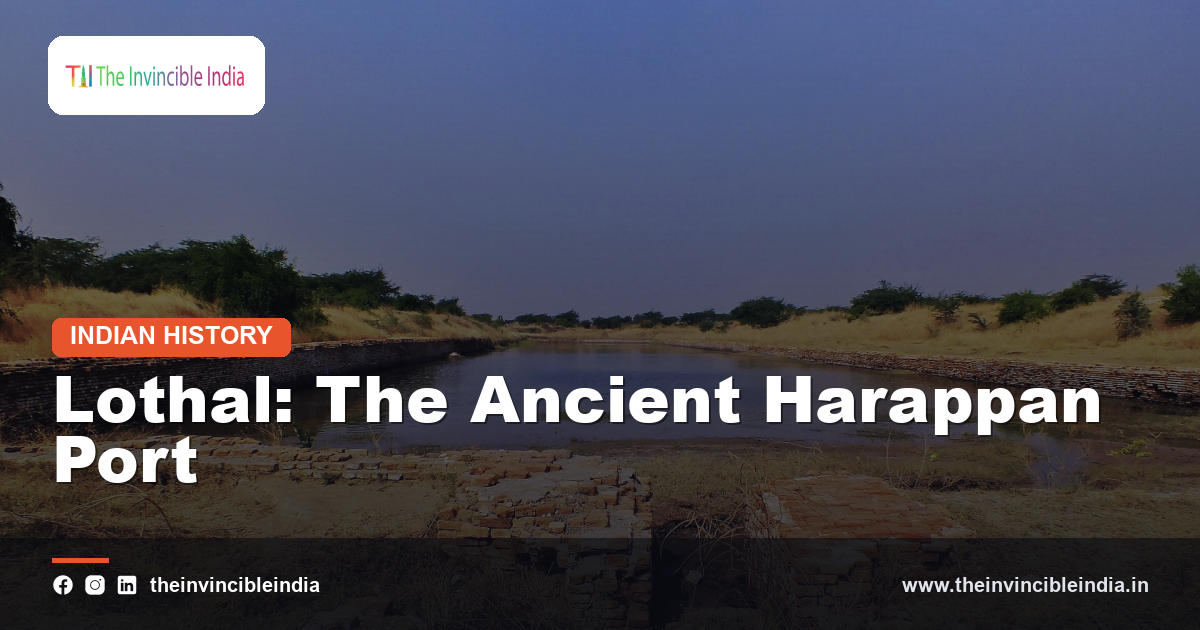
Lothal is one of the most significant archaeological sites of the Indus Valley Civilisation, located in the modern state of Gujarat in western India, and is celebrated above all for its ancient dockyard, among the earliest known structures of its kind anywhere in the world. As a thriving centre of trade, craft and maritime activity within the wider Indus Valley Civilisation, Lothal offers valuable insight into the sophistication of Harappan town planning, engineering and long-distance commerce. Excavations at the site have revealed a well-organised settlement with warehouses, workshops and evidence of trade connections reaching beyond the subcontinent. This guide explores the history, features and enduring significance of Lothal, one of the most remarkable sites of ancient India.
Quick Facts
| Detail | Information |
|---|---|
| Location | Gujarat, western India |
| Civilisation | Indus Valley Civilisation |
| Famous For | Its ancient dockyard |
| Economy | Trade, craft and bead-making |
| Excavated By | Archaeological Survey of India |
| Legacy | A protected national monument |
Discovery and Excavation
Lothal was identified and excavated in the twentieth century by archaeologists working under the Archaeological Survey of India, who uncovered the remains of a substantial settlement belonging to the Indus Valley Civilisation. The excavations revealed a carefully planned town with distinct residential, industrial and administrative areas, along with a remarkable structure identified as a dockyard, which immediately drew wide scholarly attention.
Subsequent seasons of excavation uncovered further structures, artefacts and evidence of craft production, gradually building a detailed picture of life at the site during its period of occupation. The discovery of Lothal significantly expanded understanding of the southern and coastal extent of the Indus Valley Civilisation, establishing it as one of the most important archaeological sites associated with this ancient culture in India.
Lothal within the Indus Valley Civilisation
Lothal formed part of the wider Indus Valley Civilisation, one of the great early urban civilisations of the ancient world, known for its advanced town planning, standardised weights and measures, and extensive trade networks. As a settlement of this civilisation, Lothal shared many of its defining features, including carefully planned streets, systems of drainage, and the use of a common script and seals for administrative and commercial purposes.
Its location in Gujarat placed it at the southern and coastal edge of the wider Harappan cultural zone, giving it a distinctive role in connecting the civilisation to maritime trade routes. This place within the broader civilisation illustrates both its shared cultural traits and the regional adaptations that allowed different settlements to flourish, underlining Lothal’s importance for understanding the full geographic reach of Harappan culture.
Location and Geography
Lothal is situated in the modern state of Gujarat, near the coast, in a location that gave the ancient settlement convenient access to both fertile agricultural land and maritime trade routes. The surrounding landscape, shaped by rivers and tidal creeks, provided the natural conditions that supported the settlement’s role as a centre of trade and craft production.
This coastal and riverine setting was central to Lothal’s development, enabling boats to reach the settlement and supporting the construction of the specialised structures for which the site is best known. The geography of the region also required careful engineering to manage seasonal flooding and shifting water levels, challenges that the settlement’s builders appear to have addressed through thoughtful and effective planning.
Town Planning and Layout
Lothal displays the careful and systematic town planning characteristic of Indus Valley Civilisation settlements, with clearly defined zones for residential, industrial and administrative activity. The settlement was laid out with attention to organisation, incorporating streets, drainage channels and distinct areas for different functions, reflecting a planned rather than haphazard approach to urban development.
This organisation allowed different activities, from craft production to trade and daily domestic life, to be accommodated within a coherent overall layout. The evident planning at Lothal is considered one of the clearest examples of Harappan urban design outside the civilisation’s larger northern cities, illustrating that sophisticated town planning extended to regional centres as well as major urban hubs.
The Citadel and Lower Town
Like several major settlements of the Indus Valley Civilisation, Lothal featured a raised area often identified as a citadel, distinguished from the lower town by its elevation and construction. This elevated section is generally understood to have housed structures associated with administration, storage or other significant civic functions, set apart from the residential areas of the lower town.
The lower town, in turn, contained housing, workshops and other structures supporting the daily life and economic activity of the settlement’s inhabitants. This division between citadel and lower town, seen in various forms across Harappan sites, reflects a broader pattern of urban organisation, highlighting how civic and economic functions were spatially arranged at Lothal.
The Famous Dockyard
The most celebrated feature of Lothal is its dockyard, a large rectangular basin identified by archaeologists as a structure built to accommodate boats, making it one of the earliest known examples of such maritime infrastructure anywhere in the world. The basin was connected to a nearby waterway, allowing vessels to enter and be loaded or unloaded in a controlled and sheltered environment, protected from the fluctuations of tide and current.
The scale and engineering of the dockyard indicate a sophisticated understanding of hydraulics and construction, reflecting the importance placed on maritime trade by the inhabitants of Lothal. This structure has become the defining symbol of the site, cited frequently as evidence of the advanced engineering capabilities of the Indus Valley Civilisation.
Maritime Trade and Connections
Lothal’s dockyard and its coastal location point to the settlement’s important role in maritime trade, connecting the Indus Valley Civilisation with distant regions across the sea. Evidence found at the site suggests that goods produced at Lothal, along with materials sourced from other parts of the Harappan world, were transported by boat for exchange with communities beyond the subcontinent.
This trade is understood to have included valuable materials and crafted goods, reflecting a broader pattern of long-distance exchange associated with the Indus Valley Civilisation. The presence of specialised facilities for handling and storing goods at Lothal further supports its role as a centre for organising and managing this significant maritime trade.
The Warehouse
Among the notable structures uncovered at Lothal is a substantial warehouse, believed to have been used for the storage of goods intended for trade or distribution within the settlement. The warehouse was constructed with a raised platform, designed to protect stored materials from moisture and flooding, reflecting practical engineering knowledge suited to the site’s coastal environment.
Evidence of sealed containers and administrative markings found in association with the warehouse suggests a system for tracking and managing goods, consistent with the broader use of seals and standardised measures across the Indus Valley Civilisation. This structure remains an important piece of evidence for understanding how goods were stored and prepared for exchange at this ancient port settlement.
Craft and Industry
Lothal was an important centre of craft production, with archaeological evidence pointing to a range of specialised activities carried out by its inhabitants. Workshops uncovered at the site indicate the working of various materials, including shell, metal and semi-precious stone, reflecting a diverse and skilled artisan community.
This craft production was closely tied to the settlement’s role in trade, as finished goods produced at Lothal are understood to have been exchanged both within the wider Indus Valley Civilisation and with more distant regions. This strong tradition of skilled manufacturing, alongside agriculture and trade, is one of the defining economic features of Lothal within the broader Harappan world.
The Bead-Making Industry
Among the most notable crafts practised at Lothal was the production of beads, and the site has yielded evidence of a substantial bead-making industry using materials such as semi-precious stones and shell. Workshops associated with bead production reveal a range of tools and techniques used to shape, drill and polish beads, indicating a high level of craftsmanship among the artisans of Lothal.
These beads are understood to have been an important trade item, valued both within the Indus Valley Civilisation and in exchange with other regions. The scale and sophistication of bead production at Lothal have led scholars to regard the site as one of the significant centres of this craft within the wider Harappan world.
Seals, Weights and Measures
Like other settlements of the Indus Valley Civilisation, Lothal has yielded seals and standardised weights, reflecting the administrative and commercial systems shared across the wider Harappan world. The seals found at Lothal, often bearing carved motifs and inscriptions in the undeciphered Indus script, are understood to have been used to mark ownership or authenticate goods in trade and administration.
Standardised weights uncovered at the site indicate a system for measuring goods with consistency, essential for a settlement engaged in significant trade activity. These artefacts demonstrate that Lothal participated fully in the broader administrative and commercial conventions of the Indus Valley Civilisation despite its location at the southern edge of the Harappan world.
Housing and Daily Life
Evidence uncovered at Lothal offers insight into the daily life of its inhabitants, including their housing, diet and everyday activities. Residential structures at the site indicate organised living spaces, while artefacts such as pottery, tools and personal ornaments provide clues about domestic routines and material culture.
The presence of craft workshops within residential areas suggests that many households were directly involved in production activities, blending domestic life with economic activity. Evidence of agricultural and marine resources found at the site also points to a diet drawing on both cultivated crops and the surrounding coastal environment, adding a human dimension to understanding of this ancient settlement.
Water Management and Drainage
Lothal’s builders demonstrated considerable skill in water management, constructing drainage systems and channels designed to cope with the settlement’s coastal and riverine environment. These systems were intended to manage rainfall, prevent flooding and direct water away from residential and industrial areas, reflecting a practical and sophisticated approach to urban engineering.
The careful management of water was particularly important given the settlement’s role in maritime activity and its exposure to tidal and seasonal water level changes. This attention to drainage is consistent with similar systems found at other Indus Valley Civilisation sites, underlining a shared engineering tradition across the wider Harappan world.
Burials and Religious Practices
Archaeological investigation at Lothal has also uncovered evidence relating to burial practices, contributing to understanding of the beliefs and customs of its inhabitants. Burials found at the site, along with associated grave goods, offer insight into how the community treated its dead, though interpretation of these practices remains an area of ongoing scholarly study.
As with other aspects of the Indus Valley Civilisation, religious and ritual practices at Lothal are understood mainly through material remains, since the script associated with the civilisation has not yet been deciphered. This evidence adds an important dimension to the broader picture of life at this ancient port settlement.
Decline of Lothal
Like other settlements of the Indus Valley Civilisation, Lothal eventually experienced decline, with archaeological evidence pointing to a combination of environmental and economic factors affecting the settlement over time. Changes in the course of nearby waterways and shifts in the coastal environment are understood to have affected the settlement’s access to the sea, gradually diminishing its role as a functioning port.
Broader changes affecting the Indus Valley Civilisation as a whole, including shifts in trade patterns and environmental conditions across the region, also contributed to the settlement’s eventual decline, mirroring the pattern seen across many settlements of this ancient urban culture during its later period.
Lothal Today
Today Lothal is recognised as one of the most important archaeological sites in India, protected and maintained by the Archaeological Survey of India as a valuable window into the Indus Valley Civilisation. The site continues to attract researchers, students and visitors interested in its remarkable dockyard, its evidence of craft production and trade, and its insights into ancient town planning.
Ongoing study of Lothal continues to inform broader understanding of the Indus Valley Civilisation, particularly regarding maritime trade and the southern extent of Harappan culture. As a site combining engineering achievement, craft tradition and evidence of ancient trade, Lothal endures as one of the most remarkable chapters in the story of India’s ancient past.
Sources & Further Reading
- Archaeological Survey of India (asi.nic.in).
- Ministry of Culture, Government of India (indiaculture.gov.in).
Frequently Asked Questions
What is Lothal famous for?
Lothal is best known for its ancient dockyard, considered one of the earliest known structures of its kind in the world, as well as its evidence of craft production, bead-making and long-distance maritime trade during the Indus Valley Civilisation.
Where is Lothal located?
Lothal is located in the modern state of Gujarat in western India, in a coastal and riverine setting that supported its role as a centre of trade within the Indus Valley Civilisation.
What was found at Lothal?
Excavations at Lothal have uncovered a planned town, a dockyard, a warehouse, craft workshops, bead-making industries, seals and standardised weights, together offering a detailed picture of life in this ancient port settlement.
How is Lothal connected to the Indus Valley Civilisation?
Lothal was a settlement of the Indus Valley Civilisation, sharing its characteristic town planning, seals and standardised weights, while also playing a distinctive role as a coastal centre of maritime trade at the southern edge of the Harappan world.
Why is Lothal historically important?
Lothal is historically important for its remarkable dockyard, its evidence of sophisticated engineering and town planning, and the insight it offers into ancient maritime trade, making it one of the most significant sites associated with the Indus Valley Civilisation.


