

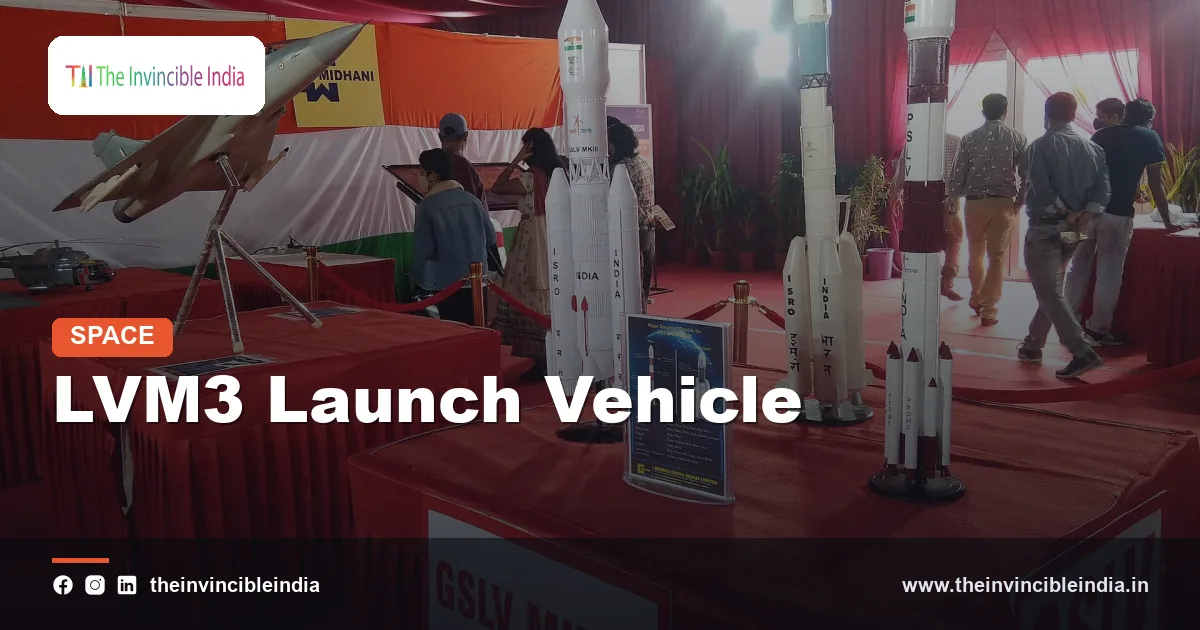
The LVM3 is ISRO’s heavy-lift, three-stage launch vehicle, formerly called the GSLV Mk III, which can carry about 8,000 kilograms to low Earth orbit and about 4,000 kilograms to geosynchronous transfer orbit. It combines two large solid boosters, a liquid-fuelled core stage and a cryogenic upper stage, and it is the most powerful rocket currently flown by India.
The LVM3 launched the Chandrayaan-2 and Chandrayaan-3 lunar missions, carried 72 OneWeb satellites on two commercial flights in 2022 and 2023, and is being adapted into a human-rated version for the Gaganyaan crewed spaceflight programme. This explainer sets out how the LVM3 is built, what it has flown and why it matters.
Quick Facts
| Attribute | Detail |
|---|---|
| Full name | Launch Vehicle Mark 3 (LVM3), formerly GSLV Mk III |
| Operator and developer | Indian Space Research Organisation (ISRO), Department of Space; vehicle design led by the Vikram Sarabhai Space Centre |
| Number of stages | Three: two S200 solid strap-on boosters, an L110 liquid core stage and a C25 cryogenic upper stage |
| Approximate height | About 43 metres |
| Approximate lift-off mass | About 640 tonnes |
| Payload capacity | About 8,000 kg to low Earth orbit; about 4,000 kg to geosynchronous transfer orbit |
| Launch site | Second Launch Pad, Satish Dhawan Space Centre SHAR, Sriharikota, Andhra Pradesh |
| First experimental flight | 18 December 2014 (suborbital, with the CARE crew module) |
| First orbital flight | 5 June 2017, carrying the GSAT-19 communication satellite |
Key Takeaways
- The LVM3 is ISRO’s heaviest operational launch vehicle, designed to carry about 4,000 kilograms to geosynchronous transfer orbit and about 8,000 kilograms to low Earth orbit.
- The LVM3 was known as the GSLV Mk III until it was renamed to Launch Vehicle Mark 3, because the rocket is largely different from the earlier GSLV vehicles.
- The LVM3 has three stages: two S200 solid boosters, an L110 liquid core stage powered by two Vikas engines, and a C25 cryogenic upper stage powered by a CE-20 engine.
- The LVM3 launched Chandrayaan-2 in July 2019 and Chandrayaan-3 on 14 July 2023, the mission that made India the fourth country to land on the Moon.
- The LVM3 carried 36 OneWeb satellites each on its flights of October 2022 and March 2023, marking its entry into the international commercial launch market.
- The LVM3 is the base for the human-rated launch vehicle that is intended to carry astronauts in India’s Gaganyaan programme.
What is the LVM3?
The LVM3 is an Indian medium-to-heavy launch vehicle built to place large communication satellites and deep-space spacecraft into orbit. It was developed by ISRO under the leadership of the Vikram Sarabhai Space Centre in Thiruvananthapuram, with the Liquid Propulsion Systems Centre providing the liquid and cryogenic engines.
The rocket was developed to end India’s dependence on foreign launchers for heavy satellites. Before the LVM3, the heaviest Indian satellites in the four-tonne class had to be sent abroad, for example on the European Ariane 5. The earlier Indian rockets, the PSLV and the GSLV Mk II, could handle smaller payloads, and the LVM3 filled the gap.
The vehicle takes off from the Second Launch Pad at Sriharikota, on the east coast of India, and its payload fairing has a diameter of about five metres, which allows large satellites and lunar spacecraft to be accommodated.
Why was the GSLV Mk III renamed LVM3?
The GSLV Mk III was renamed the LVM3 because the rocket is a new design rather than a modification of the GSLV family. The GSLV Mk I and Mk II used a single solid motor, four liquid strap-ons and an upper stage derived from earlier designs, whereas the LVM3 has a different configuration.
The LVM3 has a larger diameter, a more powerful pair of solid boosters and an entirely Indian cryogenic upper stage. The name “Mk III” had suggested that the vehicle was the third version of the GSLV, which would have been misleading. By the time of the Chandrayaan-2 launch in 2019, ISRO used the name LVM3 for the vehicle, and later flights carry the designation LVM3 with a mission number such as M2, M3 or M4.
How is the LVM3 built and how do its three stages work?
The LVM3 is built as a three-stage rocket with two parallel solid boosters, a liquid core and a cryogenic upper stage, and each stage fires in sequence to take the payload from the launch pad to orbit. This staged design helps the vehicle to shed weight as it climbs.
| Stage | Type | Description |
|---|---|---|
| S200 | Two solid strap-on boosters | Each booster carries about 200 tonnes of solid propellant and is among the largest solid boosters in the world; the pair provides most of the thrust during the first couple of minutes after lift-off |
| L110 | Liquid core stage | Powered by two Vikas engines burning unsymmetrical dimethylhydrazine (UDMH) and nitrogen tetroxide; the core carries about 110 tonnes of propellant and ignites during the burn of the boosters |
| C25 | Cryogenic upper stage | Uses a CE-20 engine fuelled by liquid hydrogen and liquid oxygen, with about 25 tonnes of propellant |
The S200 solid boosters
The S200 solid boosters are made of steel casings filled with a rubber-based composite propellant, and they are about 3.2 metres in diameter. They are cast and processed at Sriharikota. After burn-out, the boosters separate and fall into the Bay of Bengal.
The L110 liquid core
The L110 core stage uses the Vikas engine, the workhorse liquid engine of Indian rockets, which was developed in the 1970s and 1980s with technology transfer from a French engine and later adapted indigenously. The two engines in the core start while the boosters are still burning, and they continue after booster separation.
The C25 cryogenic stage
The C25 stage uses the CE-20, the first Indian cryogenic engine to be fully designed and built in the country. Cryogenic propellants are gases cooled until they become liquids at very low temperatures, which gives higher performance than ordinary fuels. The stage places the satellite in its final transfer orbit.
What payloads can the LVM3 carry?
The LVM3 can carry about 8,000 kilograms to low Earth orbit and about 4,000 kilograms to geosynchronous transfer orbit, which makes it roughly comparable to other medium-to-heavy rockets in its class. The precise capacity depends on the orbit and mission profile.
This capacity allows the LVM3 to carry a wide range of payloads:
- Heavy communication satellites in the four-tonne class bound for geostationary orbit.
- Groups of satellites for low Earth orbit, such as broadband constellation satellites.
- Large interplanetary spacecraft, including lunar orbiters, landers and rovers.
- Crewed spacecraft for human spaceflight, once the human-rated version is certified.
In comparison, the PSLV can carry about 1,750 kilograms to a sun-synchronous orbit, and the GSLV Mk II about 2,000 to 2,500 kilograms to geosynchronous transfer orbit. The LVM3 therefore roughly doubles India’s heavy-lift capacity.
What flights has the LVM3 made?
The LVM3 has made a series of developmental, scientific and commercial flights since 2014, with its first orbital launch in 2017 and its first interplanetary mission in 2019. The list below summarises the key flights.
| Flight | Date | Payload and significance |
|---|---|---|
| LVM3-X / CARE | 18 December 2014 | Suborbital experimental flight carrying the Crew Module Atmospheric Re-entry Experiment, which tested re-entry and parachute recovery |
| GSLV Mk III-D1 | 5 June 2017 | First orbital flight, with the GSAT-19 communication satellite |
| GSLV Mk III-D2 | 14 November 2018 | GSAT-29 communication satellite |
| LVM3-M1 | 22 July 2019 | Chandrayaan-2 lunar orbiter, lander and rover |
| LVM3-M2 | 23 October 2022 | 36 OneWeb broadband satellites; first commercial LVM3 launch |
| LVM3-M3 | 26 March 2023 | 36 more OneWeb satellites, completing the first OneWeb contract |
| LVM3-M4 | 14 July 2023 | Chandrayaan-3 lunar lander and rover |
After 2023, further LVM3 flights have carried heavy communication and other satellites, and the rocket continues to be the main option for India’s largest payloads.
How did the LVM3 launch Chandrayaan-2 and Chandrayaan-3?
The LVM3 launched Chandrayaan-2 on 22 July 2019 and Chandrayaan-3 on 14 July 2023, placing each spacecraft in an elongated Earth orbit from which the spacecraft’s own engines took it to the Moon. The LVM3 was selected because the lunar spacecraft, with their orbiter, lander and rover, were heavy.
Chandrayaan-2 had an orbiter, a lander named Vikram and a rover named Pragyan. The orbiter entered lunar orbit and remains in service, but the lander lost contact during descent in September 2019. The LVM3 had performed accurately, putting the spacecraft into a slightly better orbit than planned and thereby saving fuel.
Chandrayaan-3 carried a lander and rover, with a propulsion module that took them to lunar orbit. The lander touched down on 23 August 2023 near the south polar region of the Moon, and the Pragyan rover conducted experiments on the surface. The LVM3 flight was again flawless, which gave the mission a strong start.
What is the role of the LVM3 in commercial launches?
The LVM3 has opened the international commercial market to India through the launch of OneWeb broadband satellites. OneWeb, a satellite communications company, signed a contract with NewSpace India Limited (NSIL), the commercial arm of the Department of Space, for the launch of its satellites.
The LVM3-M2 mission in October 2022 carried 36 OneWeb satellites to low Earth orbit and was the first commercial launch of the vehicle. The LVM3-M3 mission in March 2023 carried another 36, taking the total to 72. The two flights showed that the LVM3 could deploy multiple satellites in precise orbital planes.
Commercial work through NSIL gives the rocket a regular manifest, helps to keep production lines active, and brings revenue that supports the Indian space programme.
What is the LVM3’s role in the Gaganyaan human spaceflight mission?
The LVM3 will be the launch vehicle for Gaganyaan, India’s planned human spaceflight mission, in a modified form called the human-rated LVM3 (HRLV). Gaganyaan aims to send a small crew of Indian astronauts to low Earth orbit, at an altitude of about 400 kilometres, for a mission of up to a few days, and to bring them back safely.
A human-rated rocket requires extra safety features. The HRLV includes changes to its systems to improve reliability, health monitoring of the engines and a crew escape system that can pull the crew module away if a failure occurs. The 2014 CARE flight on an experimental LVM3 had already tested the atmospheric re-entry of a crew module, and the test vehicle flights have since checked the escape system. ISRO plans uncrewed flights first, including a mission carrying a humanoid robot, before astronauts fly.
The timetable for crewed flight has changed over the years, so official ISRO announcements remain the best source for current dates.
How does the LVM3 compare with other Indian launch vehicles?
The LVM3 is the most powerful of ISRO’s operational rockets, with a higher payload capacity than the PSLV, GSLV Mk II and SSLV. Each of these vehicles serves a different type of mission.
| Vehicle | Best suited for | Approximate capacity |
|---|---|---|
| SSLV | Small satellites on demand | A few hundred kilograms to low Earth orbit |
| PSLV | Earth observation and small to medium satellites in polar orbits | About 1,750 kg to sun-synchronous orbit |
| GSLV Mk II | Communication and navigation satellites | About 2,000 to 2,500 kg to geosynchronous transfer orbit |
| LVM3 | Heavy satellites, lunar missions, crewed spaceflight | About 4,000 kg to geosynchronous transfer orbit; about 8,000 kg to low Earth orbit |
The LVM3 is not meant to replace the other vehicles. The PSLV is cheaper and reliable for smaller satellites, while the LVM3 is chosen when the payload is too heavy or the mission is too demanding for them.
Why does the LVM3 matter for India?
The LVM3 matters because it gives India independent access to space for heavy satellites, lunar missions and astronauts without relying on foreign rockets. This independence supports national security, communication services and scientific ambition.
The LVM3 also strengthens the Indian industrial base. Companies across the country manufacture tanks, structures, valves, electronics and propellant ingredients for the rocket, and the push for larger commercial launch business is expected to widen that base. At the same time, ISRO is studying improvements, such as semi-cryogenic engines and reusable technologies, that could make future vehicles more powerful and cost-effective.
Bottom Line
The LVM3 is India’s heavy-lift rocket, born as the GSLV Mk III and now the carrier of Chandrayaan, OneWeb satellites and, in future, Indian astronauts. It combines solid, liquid and cryogenic stages in a single vehicle and gives the country the reach it needs for the next stage of its space programme.
Frequently Asked Questions
What does LVM3 stand for?
LVM3 stands for Launch Vehicle Mark 3. It is the new name of the rocket formerly called the GSLV Mk III. ISRO adopted the name because the vehicle’s design differs significantly from the earlier GSLV rockets.
How much can the LVM3 carry?
The LVM3 can carry about 8,000 kilograms to low Earth orbit and about 4,000 kilograms to geosynchronous transfer orbit. These figures are approximate and depend on the specific orbit and mission requirements.
Which missions has the LVM3 launched?
The LVM3 has launched the GSAT-19 and GSAT-29 satellites, Chandrayaan-2, Chandrayaan-3 and two batches of 36 OneWeb satellites. It also flew the CARE crew-module experiment in 2014.
What are the stages of the LVM3?
The LVM3 has three stages: two S200 solid strap-on boosters, an L110 liquid core stage with two Vikas engines, and a C25 cryogenic upper stage with a CE-20 engine. The three stages fire in sequence to take the payload to orbit.
Will the LVM3 carry astronauts?
Yes, a human-rated version of the LVM3 is planned to launch India’s Gaganyaan crewed mission. It includes added safety features such as a crew escape system. Uncrewed test flights are planned before any astronauts fly, and the schedule is set by ISRO.
Where is the LVM3 launched from?
The LVM3 is launched from the Second Launch Pad at the Satish Dhawan Space Centre SHAR in Sriharikota, Andhra Pradesh. The spaceport is on the east coast of India, which allows rockets to launch over the sea.
{“@context”:”https://schema.org”,”@graph”:[{“@type”:”FAQPage”,”mainEntity”:[{“@type”:”Question”,”name”:”What does LVM3 stand for?”,”acceptedAnswer”:{“@type”:”Answer”,”text”:”LVM3 stands for Launch Vehicle Mark 3. It is the new name of the rocket formerly called the GSLV Mk III. ISRO adopted the name because the vehicle’s design differs significantly from the earlier GSLV rockets.”}},{“@type”:”Question”,”name”:”How much can the LVM3 carry?”,”acceptedAnswer”:{“@type”:”Answer”,”text”:”The LVM3 can carry about 8,000 kilograms to low Earth orbit and about 4,000 kilograms to geosynchronous transfer orbit. These figures are approximate and depend on the specific orbit and mission requirements.”}},{“@type”:”Question”,”name”:”Which missions has the LVM3 launched?”,”acceptedAnswer”:{“@type”:”Answer”,”text”:”The LVM3 has launched the GSAT-19 and GSAT-29 satellites, Chandrayaan-2, Chandrayaan-3 and two batches of 36 OneWeb satellites. It also flew the CARE crew-module experiment in 2014.”}},{“@type”:”Question”,”name”:”What are the stages of the LVM3?”,”acceptedAnswer”:{“@type”:”Answer”,”text”:”The LVM3 has three stages: two S200 solid strap-on boosters, an L110 liquid core stage with two Vikas engines, and a C25 cryogenic upper stage with a CE-20 engine. The three stages fire in sequence to take the payload to orbit.”}},{“@type”:”Question”,”name”:”Will the LVM3 carry astronauts?”,”acceptedAnswer”:{“@type”:”Answer”,”text”:”Yes, a human-rated version of the LVM3 is planned to launch India’s Gaganyaan crewed mission. It includes added safety features such as a crew escape system. Uncrewed test flights are planned before any astronauts fly, and the schedule is set by ISRO.”}},{“@type”:”Question”,”name”:”Where is the LVM3 launched from?”,”acceptedAnswer”:{“@type”:”Answer”,”text”:”The LVM3 is launched from the Second Launch Pad at the Satish Dhawan Space Centre SHAR in Sriharikota, Andhra Pradesh. The spaceport is on the east coast of India, which allows rockets to launch over the sea.”}}]}]}


