

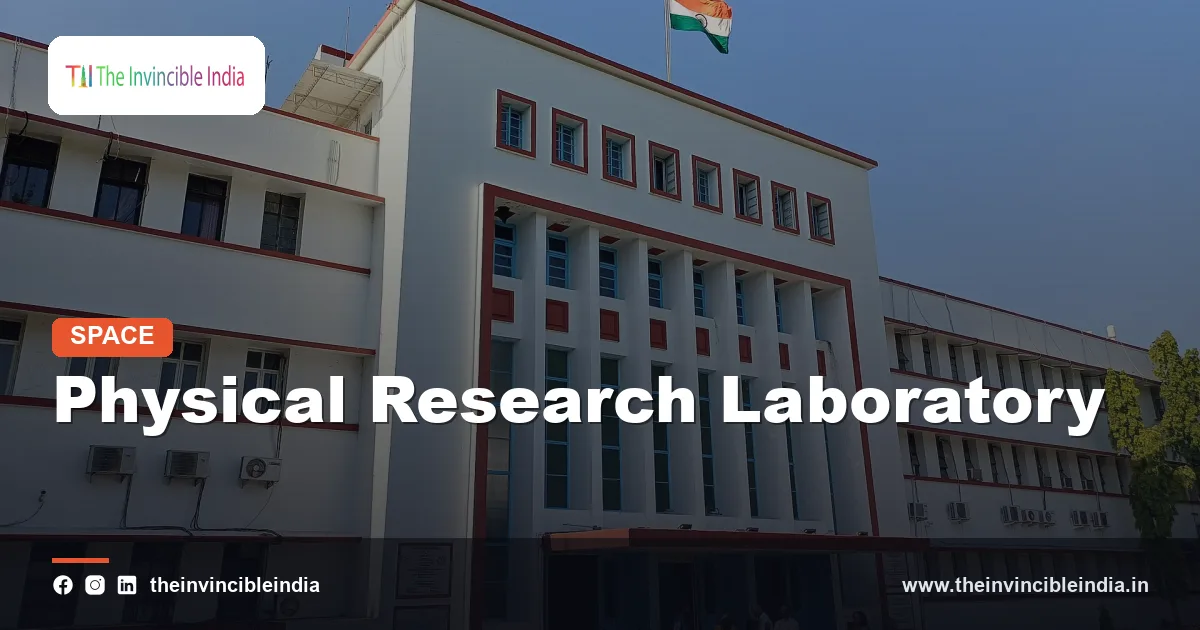
The Physical Research Laboratory (PRL) is a national research institute in Ahmedabad, Gujarat, founded in 1947 by Dr Vikram Sarabhai and funded today by the Department of Space, Government of India, that specialises in space and allied sciences. It is widely described as the cradle of Indian space science because the scientists who trained there, and the cosmic-ray and upper-atmosphere research done there, helped create the Indian space programme.
The Physical Research Laboratory studies astronomy and astrophysics, solar and planetary science, atmospheric and earth sciences, and theoretical and atomic physics. It runs observatories at Mount Abu and Udaipur, announced the discovery of an exoplanet in 2018, and builds instruments that have flown on ISRO missions such as Chandrayaan-3 and Aditya-L1.
Quick Facts
| Attribute | Detail |
|---|---|
| Full name | Physical Research Laboratory (PRL) |
| Founder | Dr Vikram Ambalal Sarabhai |
| Established | 11 November 1947 |
| Location | Ahmedabad, Gujarat (main campus), with field observatories at Mount Abu and Udaipur in Rajasthan |
| Funding body | Department of Space, Government of India |
| First director | Professor K. R. Ramanathan |
| Research areas | Astronomy and astrophysics, solar physics, planetary sciences, space and atmospheric sciences, geosciences, theoretical physics, atomic and molecular physics |
| Notable facilities | Gurushikhar Observatory at Mount Abu, Udaipur Solar Observatory, laboratories for mass spectrometry and planetary science |
Key Takeaways
- The Physical Research Laboratory is an Ahmedabad-based research institute founded on 11 November 1947 by Vikram Sarabhai and is now funded by the Department of Space.
- The Physical Research Laboratory began with research on cosmic rays and the upper atmosphere, which made it a training ground for the first generation of Indian space scientists.
- The Physical Research Laboratory operates the Gurushikhar Observatory at Mount Abu and the Udaipur Solar Observatory, both in Rajasthan.
- The Physical Research Laboratory announced in 2018 the discovery of an exoplanet roughly the mass of Saturn, made with its PARAS spectrograph at Mount Abu, the first such discovery by an Indian institution.
- The Physical Research Laboratory built the Alpha Particle X-ray Spectrometer on the Pragyan rover of Chandrayaan-3 and the ASPEX particle experiment on Aditya-L1.
- The Physical Research Laboratory is a research and training institution that runs doctoral programmes and does not build or launch rockets.
What is the Physical Research Laboratory?
The Physical Research Laboratory is a unit of the Department of Space that carries out basic research in physics, space science and earth science. It is separate from the launch-vehicle and satellite-building centres of ISRO, and its main role is scientific discovery and training of researchers.
The institute is organised into research areas, and the faculty include scientists, research scholars and postdoctoral fellows. The campus in Ahmedabad includes laboratories, a library, computing facilities and workshops for building and testing scientific instruments. Scientists at the Physical Research Laboratory use data from telescopes, rockets, balloons, satellites and planetary missions, along with laboratory experiments and computer simulations.
PRL’s work supports and benefits from ISRO programmes, but the institute also conducts independent academic research and publishes in international scientific journals.
How was the Physical Research Laboratory founded?
The Physical Research Laboratory was founded on 11 November 1947 in Ahmedabad by Vikram Sarabhai, with support from the Karmakshetra Educational Foundation, the Ahmedabad Education Society and the local community of industrialists. Sarabhai was then in his late twenties and had returned from Cambridge, where he had completed his doctorate.
The laboratory started in a modest setting in the M. G. Science Institute in Ahmedabad, and Professor K. R. Ramanathan, an eminent atmospheric physicist, became its first director. The early research concerned cosmic rays, meaning high-energy particles from space, along with the properties of the upper atmosphere.
Sarabhai’s idea was that India, soon after independence, should invest in modern science, and that an institute in a rapidly industrialising city could link research with the wider society. The laboratory also benefited from the guidance of leading scientists such as C. V. Raman and Homi Bhabha, who encouraged cosmic-ray studies in India.
Why is the Physical Research Laboratory called the cradle of Indian space science?
The Physical Research Laboratory is called the cradle of Indian space science because the researchers who trained there became the founders and leaders of India’s space programme. The laboratory gave them skills in instrumentation, data analysis and experiment design before ISRO existed.
Vikram Sarabhai led the institute while he pushed for the formation of the Indian National Committee for Space Research (INCOSPAR) in 1962. Several scientists who later led ISRO’s work in satellites and space applications, including U. R. Rao, began as researchers at PRL. The institute’s work on the ionosphere and cosmic rays also supplied the first scientific reasons for launching sounding rockets from Thumba in 1963.
When ISRO was set up in 1969 and the Department of Space in 1972, PRL became one of the research institutions supported by the Department, which continues to fund it.
What research does the Physical Research Laboratory do?
The Physical Research Laboratory does research in astronomy and astrophysics, solar physics, planetary sciences, space and atmospheric sciences, geosciences, and theoretical and atomic physics. The work ranges from nearby space to distant galaxies.
- Astronomy and astrophysics: Scientists study stars, galaxies, star-forming regions, exoplanets and the evolution of the universe, using optical and infrared telescopes.
- Solar physics: The Udaipur Solar Observatory records solar activity, magnetic fields and phenomena such as sunspots and flares.
- Planetary sciences: Researchers study meteorites, lunar and Martian samples and the formation of the solar system, using precise mass spectrometers.
- Space and atmospheric sciences: Studies of the Earth’s upper atmosphere, ionosphere, aerosols, trace gases and climate use ground instruments, balloons, rockets and satellites.
- Geosciences: Work on rivers, monsoons, past climate and the chemistry of rocks and water uses isotope techniques.
- Theoretical physics: Theorists work on particle physics, cosmology, condensed matter and nonlinear dynamics.
- Atomic, molecular and optical physics: Laboratory research examines lasers, cold atoms and how atoms and molecules interact with light.
A feature of PRL is the close link between theory, instruments and observations. Many experiments are designed and built in-house.
Where are the Physical Research Laboratory’s observatories?
The Physical Research Laboratory operates two main observatories: the Gurushikhar Observatory at Mount Abu, which is used for optical and infrared astronomy, and the Udaipur Solar Observatory, which is used for studying the Sun. Both are located in Rajasthan.
Gurushikhar Observatory, Mount Abu
The Gurushikhar peak at Mount Abu is the highest point of the Aravalli range, at roughly 1,700 metres above sea level. The site has relatively dark skies and a dry climate, which make it suitable for infrared observations. The Mount Abu Infrared Observatory has a 1.2-metre telescope, and the site also houses the PARAS spectrograph used for finding planets around other stars.
Udaipur Solar Observatory
The Udaipur Solar Observatory is built on an island in Fatehsagar Lake in Udaipur. Lake sites are favoured for solar observations because the water surface reduces heat-related turbulence in the air near the telescope, which sharpens the images of the Sun. The observatory studies solar magnetic fields, the solar atmosphere and space weather.
Did the Physical Research Laboratory discover an exoplanet?
Yes, scientists at the Physical Research Laboratory announced in 2018 the discovery of an exoplanet about the mass of Saturn orbiting a Sun-like star, which was the first exoplanet found with an Indian instrument by an Indian institution. The planet is designated EPIC 211945201b, also known as K2-236b.
The discovery used the PARAS (PRL Advanced Radial-velocity Abu-sky Search) spectrograph attached to the 1.2-metre telescope at Gurushikhar, Mount Abu. The method measures tiny shifts in the light of a star as a planet pulls it slightly back and forth. Scientists estimated that the planet is much larger than Earth and orbits very close to its star, completing a revolution in a matter of days, so it is too hot to support life. The star is hundreds of light-years away.
The finding placed India among the countries with a capability for detecting planets around other stars, and it has encouraged further work with an upgraded spectrograph and larger telescopes.
Which ISRO missions carry instruments from the Physical Research Laboratory?
The Physical Research Laboratory has provided scientific instruments for several ISRO missions, including Chandrayaan-3 and Aditya-L1. These instruments are designed and calibrated by PRL scientists and flown on spacecraft built by ISRO centres.
| Mission | PRL contribution | Purpose |
|---|---|---|
| Chandrayaan-3 (2023) | Alpha Particle X-ray Spectrometer (APXS) on the Pragyan rover; also involved with the ChaSTE thermal probe on the lander | Determine the chemical composition of lunar soil and rock near the landing site, and measure temperature below the surface |
| Aditya-L1 (2023) | Aditya Solar wind Particle Experiment (ASPEX) | Study the speed, direction and energy of particles in the solar wind |
| Earlier lunar and Mars missions | Scientific analysis of data and instrument design support | Understand the Moon and Mars, their surfaces and atmospheres |
| Balloon and rocket campaigns | Payloads for cosmic-ray, aerosol and atmospheric studies | Measure high-altitude radiation and atmospheric properties |
The scientists also analyse data returned by missions, publish results and prepare for future planetary exploration.
How does the Physical Research Laboratory study the Moon and planets?
The Physical Research Laboratory studies the Moon and planets by analysing meteorites and returned samples, building instruments for lunar spacecraft and interpreting spacecraft data. Its planetary sciences group is one of the most active in India.
The meteorite work uses sensitive mass spectrometers to measure isotopes in extraterrestrial rocks and thereby find out how old they are, which materials they contain and how the early solar system formed. PRL researchers also study lunar rocks, impact craters and the thermal and chemical properties of planetary surfaces. The Chandrayaan-3 instruments made in-situ measurements near the lunar south polar region, and PRL scientists took part in interpreting them.
The institute also works on the atmospheres of planets, searching for planets orbiting other stars, and on the possible conditions for habitability beyond Earth.
Who funds and governs the Physical Research Laboratory?
The Physical Research Laboratory is funded by the Department of Space, Government of India, and governed by a Council that includes scientists and officials, with a Director as the chief executive. It is an autonomous institution, meaning that it has academic freedom within the framework of government funding.
The Physical Research Laboratory has its own faculty, doctoral programmes and postdoctoral positions. Students are admitted through national selection processes and work toward a PhD on topics supervised by the faculty. The institute also offers visiting-student programmes, workshops and public outreach events, such as open days at the campus and science talks.
Since the laboratory is a research institute rather than an operational space agency, it has no role in building launch vehicles, selecting launch sites or running satellite operations.
What is the relationship between PRL and ISRO?
The Physical Research Laboratory is a sister institution of ISRO under the Department of Space, and the two organisations have complementary roles: PRL does basic science, while ISRO builds and operates space systems. PRL scientists plan experiments that fly on ISRO spacecraft, and ISRO data feed PRL research.
| Aspect | Physical Research Laboratory | ISRO centres |
|---|---|---|
| Main role | Basic research, instruments and training | Building and operating rockets and satellites |
| Location | Ahmedabad, with observatories in Rajasthan | Several cities, including Thiruvananthapuram and Bengaluru |
| Output | Scientific papers, instruments and trained researchers | Launch vehicles, satellites and space services |
| Link | Provides science goals and payloads | Provides spacecraft and launch opportunities |
This relationship dates back to Sarabhai, who was director of PRL before and during the early years of the space programme, and it ensures that Indian missions have a strong scientific purpose.
Why does the Physical Research Laboratory matter?
The Physical Research Laboratory matters because it supplies scientific insight, instruments and trained people to the Indian space programme and to the wider scientific community. Space missions are expensive, and good science is the reason to fly them.
The institute has trained generations of physicists, many of whom hold positions in universities and national laboratories. Its work on the atmosphere and climate supports understanding of the monsoon and pollution, while its research on the Sun and space weather is relevant to satellites and power grids. Its planetary and astronomy work places India in international research collaborations.
Bottom Line
The Physical Research Laboratory is the scientific root of the Indian space programme. Founded by Vikram Sarabhai in 1947, it continues to combine observations from Mount Abu and Udaipur with instruments on ISRO missions, and it trains the scientists who ask what space can teach us.
Frequently Asked Questions
Who founded the Physical Research Laboratory?
The Physical Research Laboratory was founded by Dr Vikram Sarabhai. It started on 11 November 1947 in Ahmedabad with support from local educational foundations and industrialists. Professor K. R. Ramanathan was its first director.
Where is the Physical Research Laboratory located?
The Physical Research Laboratory is located in Ahmedabad, Gujarat. It also operates the Gurushikhar Observatory at Mount Abu and the Udaipur Solar Observatory, both in Rajasthan.
Is the Physical Research Laboratory part of ISRO?
No, the Physical Research Laboratory is a unit of the Department of Space and not a centre of ISRO. It is an autonomous research institute funded by the Department. It works closely with ISRO by providing scientific instruments and research for space missions.
What did the Physical Research Laboratory discover in 2018?
In 2018 scientists at the Physical Research Laboratory announced the discovery of an exoplanet about the mass of Saturn. The planet, designated EPIC 211945201b or K2-236b, was found with the PARAS spectrograph at Mount Abu and was the first such discovery by an Indian institution.
Which ISRO missions have instruments from the Physical Research Laboratory?
Instruments from the Physical Research Laboratory flew on Chandrayaan-3 and Aditya-L1. The Alpha Particle X-ray Spectrometer on the Pragyan rover and the ASPEX particle experiment on Aditya-L1 were built by PRL scientists.
Why is the Physical Research Laboratory called the cradle of Indian space science?
The laboratory earned this title because it trained the scientists who built India’s space programme. Vikram Sarabhai, who founded it, also led the creation of INCOSPAR and ISRO, and its early research on cosmic rays and the upper atmosphere shaped the first space experiments.
{“@context”:”https://schema.org”,”@graph”:[{“@type”:”FAQPage”,”mainEntity”:[{“@type”:”Question”,”name”:”Who founded the Physical Research Laboratory?”,”acceptedAnswer”:{“@type”:”Answer”,”text”:”The Physical Research Laboratory was founded by Dr Vikram Sarabhai. It started on 11 November 1947 in Ahmedabad with support from local educational foundations and industrialists. Professor K. R. Ramanathan was its first director.”}},{“@type”:”Question”,”name”:”Where is the Physical Research Laboratory located?”,”acceptedAnswer”:{“@type”:”Answer”,”text”:”The Physical Research Laboratory is located in Ahmedabad, Gujarat. It also operates the Gurushikhar Observatory at Mount Abu and the Udaipur Solar Observatory, both in Rajasthan.”}},{“@type”:”Question”,”name”:”Is the Physical Research Laboratory part of ISRO?”,”acceptedAnswer”:{“@type”:”Answer”,”text”:”No, the Physical Research Laboratory is a unit of the Department of Space and not a centre of ISRO. It is an autonomous research institute funded by the Department. It works closely with ISRO by providing scientific instruments and research for space missions.”}},{“@type”:”Question”,”name”:”What did the Physical Research Laboratory discover in 2018?”,”acceptedAnswer”:{“@type”:”Answer”,”text”:”In 2018 scientists at the Physical Research Laboratory announced the discovery of an exoplanet about the mass of Saturn. The planet, designated EPIC 211945201b or K2-236b, was found with the PARAS spectrograph at Mount Abu and was the first such discovery by an Indian institution.”}},{“@type”:”Question”,”name”:”Which ISRO missions have instruments from the Physical Research Laboratory?”,”acceptedAnswer”:{“@type”:”Answer”,”text”:”Instruments from the Physical Research Laboratory flew on Chandrayaan-3 and Aditya-L1. The Alpha Particle X-ray Spectrometer on the Pragyan rover and the ASPEX particle experiment on Aditya-L1 were built by PRL scientists.”}},{“@type”:”Question”,”name”:”Why is the Physical Research Laboratory called the cradle of Indian space science?”,”acceptedAnswer”:{“@type”:”Answer”,”text”:”The laboratory earned this title because it trained the scientists who built India’s space programme. Vikram Sarabhai, who founded it, also led the creation of INCOSPAR and ISRO, and its early research on cosmic rays and the upper atmosphere shaped the first space experiments.”}}]}]}


