

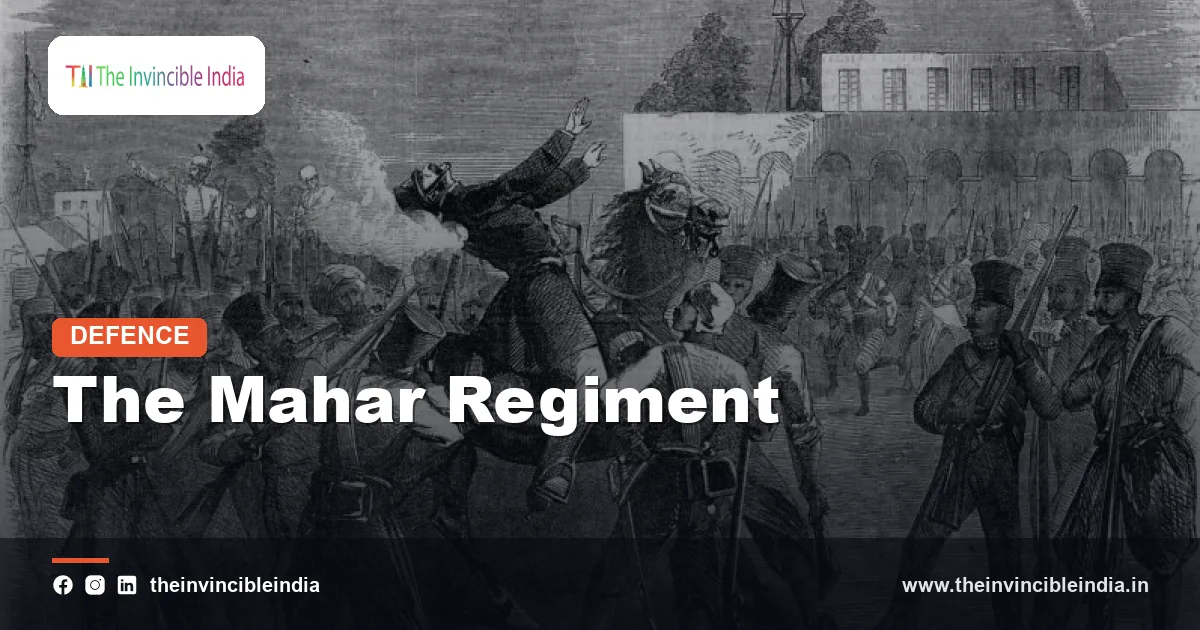
The Mahar Regiment is an infantry regiment of the Indian Army, raised in 1941 during the Second World War and now based at its regimental centre at Sagar (Saugor) in Madhya Pradesh. Its identity draws on the long record of military service by soldiers of the Mahar community in the armies of the Bombay Presidency, and it is also closely linked in public memory with Dr B. R. Ambedkar, who campaigned for the community’s right to serve in the armed forces.
The regiment sits at the meeting point of military history and social history. It is a modern regiment with a history of battalions serving in operations from Jammu and Kashmir to Sri Lanka, yet its story also includes the 1818 engagement at Koregaon, the later exclusion of Mahars from recruitment, and the re-raising of 1941. This explainer separates the verified record from popular simplification. It was last updated on 17 October 2026.
| Fact | Detail |
|---|---|
| Name | The Mahar Regiment |
| Type | Infantry regiment of the Indian Army |
| Raised | 1941 (raised during the Second World War) |
| Regimental centre | Sagar (Saugor), Madhya Pradesh |
| Early role | Machine-gun battalions during its first years |
| Composition today | All-class, with soldiers from many communities and states |
| War cry (as commonly cited) | Bolo Hindustan Ki Jai |
| Highest gallantry link | Param Vir Chakra: Major Ramaswamy Parameswaran, 1987 |
| Historic association | Koregaon obelisk (1818); Dr B. R. Ambedkar |
Key Takeaways
- The Mahar Regiment is an infantry regiment of the Indian Army that was raised in 1941 and has its regimental centre at Sagar in Madhya Pradesh.
- The Mahar Regiment takes its name from the Mahar community of western and central India, whose members served in large numbers in the armies of the Bombay Presidency in the 18th and 19th centuries.
- The Koregaon Bhima obelisk, put up by the East India Company in 1822 for the battle of 1 January 1818, carries the names of Company soldiers, and Mahar sepoys are widely cited among them.
- The Mahar Regiment of 1941 was a fresh raising, not a continuation of the Koregaon unit, whose own lineage belongs to the Bombay Native Infantry and later grenadier units.
- Today the Mahar Regiment is an all-class regiment, so soldiers of many communities and regions serve together in its battalions.
- Major Ramaswamy Parameswaran of the Mahar Regiment received the Param Vir Chakra, India’s highest wartime gallantry award, for action in Sri Lanka in November 1987.
What Is the Mahar Regiment?
The Mahar Regiment is a regular infantry regiment of the Indian Army whose battalions fight on foot, usually supported by artillery, armour and engineers. Like every Indian infantry regiment, it consists of a number of battalions, each of roughly a thousand men, plus a regimental centre where recruits are trained and the regiment’s records and traditions are maintained.
The regiment began its modern life with a heavy emphasis on machine-gun units, and it later settled into the broader infantry role. A battalion of the Mahar Regiment is not tied to a single formation: it can be posted to a brigade anywhere in the country, and in the past has served in field areas, counter-insurgency grids and United Nations missions.
The word “regiment” in the Indian Army has a specific meaning that differs from the British sense of a single fighting unit. The Indian regiment is a parent organisation: it raises, trains and gives an identity to battalions, while the battalions themselves are deployed under whichever brigade the Army assigns them.
Who Are the Mahars and What Was Their Military History Before 1941?
The Mahars are a community found mainly in Maharashtra and neighbouring regions, historically placed within the lower strata of the caste order, and many members served as soldiers in the forces of the Deccan and the East India Company. Mahar men were recruited into the Bombay Army of the Company in the 18th century, and Mahar sepoys formed an important share of several Bombay Native Infantry battalions.
The record of that service is generally treated as one of the strongest examples of a community entering the military profession on merit even while facing exclusion in civil life. Later in the 19th century, the colonial army shifted to a theory of “martial races”, under which recruitment was increasingly confined to groups that British officers considered to be fighting stock. Mahars, like several other communities, were affected, and recruitment of Mahars into combat units was curtailed from the 1890s onward.
The community’s leaders petitioned against the exclusion. During the First World War, when the army needed large numbers of men, a Mahar unit was raised in 1917 and then disbanded in the early 1920s after the war. The memory of that disbandment shaped later demands for recruitment.
| Period | Development |
|---|---|
| 18th century | Mahar men are recruited into the Bombay Army of the East India Company. |
| 1818 | Company troops, including Mahar sepoys, hold Koregaon against a larger force of the Peshwa. |
| 1822 | The Koregaon obelisk is raised to commemorate the fallen. |
| 1890s | Recruitment of Mahars into combat units is curtailed as the “martial race” policy hardens. |
| 1917 to early 1920s | A Mahar unit is raised for the First World War and later disbanded. |
| 1941 | The Mahar Regiment is raised. |
| After 1947 | The regiment continues in the Indian Army and moves to an all-class model. |
What Happened at Koregaon in 1818?
The battle of Koregaon Bhima was an engagement fought on 1 January 1818 during the Third Anglo-Maratha War, in which a small East India Company force held a village near Pune against a much larger Peshwa army. The Company detachment, commanded by Captain Francis Staunton, numbered roughly 800 men in all, of whom about 500 were infantry drawn from a Bombay Native Infantry battalion, supported by a small number of horse and guns.
The detachment marched through the night, reached the village of Koregaon on the Bhima river and found itself cut off by the Peshwa’s troops, who numbered several thousand. The soldiers fought through the day without water, held the village and the surrounding buildings, and the Peshwa’s forces withdrew by the evening. The Company suffered heavy casualties.
The Koregaon obelisk
The Koregaon Bhima obelisk, also called the Koregaon Vijay Stambh, is a stone pillar erected in 1822 by the Company at the site to commemorate the soldiers killed. The names of the dead are engraved on its faces, and a substantial number of them are identified as Mahar names, which is why the monument has become so closely associated with Mahar military service.
The engagement is read in different ways today. Some see it chiefly as a British military success in a war that ended Peshwa rule, while others see it as a symbol of Mahar valour and self-respect. Historians generally accept that the soldiers fought with great determination and that Mahars formed a major part of the infantry, while the political meaning given to the event varies by perspective.
One point needs care. The Koregaon unit was a battalion of the Bombay Native Infantry, whose lineage was later absorbed into other units, and the Mahar Regiment raised in 1941 is not the same unit by descent. The connection between Koregaon and the regiment is one of community heritage and symbolism, not regimental succession.
Why Was the Mahar Regiment Raised in 1941?
The Mahar Regiment was raised in 1941 because the Second World War created a heavy demand for manpower, and because the earlier restrictions on recruiting Mahars into combat units had been criticised for years. The expansion of the Indian Army in the war opened recruitment to a wider set of communities, and the raising of a Mahar battalion was a result of that opening and of sustained representations.
The first battalion was raised in 1941 with a machine-gun role, which was a practical choice at a time when the army was building up specialised support units for rapid expansion. After 1947 the regiment continued as part of the new Indian Army, and its battalions took on the standard infantry role.
The revival of Mahar recruitment is often described as a turning point for the community’s representation in the armed forces, and the regiment became a lasting symbol of that shift.
What Is the Association between the Mahar Regiment and Dr Ambedkar?
Dr Bhimrao Ramji Ambedkar, the jurist and chairman of the Constituent Assembly’s Drafting Committee, is closely associated with the Mahar Regiment because he argued strongly for the community’s right to serve in the army. Ambedkar himself came from a family with a military background, since his father served in the army as a subedar, and he often cited the community’s military history when making the case for open recruitment.
Ambedkar was a member of the National Defence Council in 1941, the year the regiment was raised, and he later became a member of the Viceroy’s Executive Council in 1942. Historians usually note that the raising of the regiment resulted from a mix of wartime need and political advocacy, and that his advocacy was one of the important influences.
The regiment honours that association in its traditions, and Ambedkar is remembered in the regiment and in the wider Mahar community as a key figure in the story of access to military service. This association is a matter of heritage and respect rather than a formal command relationship.
Where Is the Mahar Regimental Centre and How Does It Work?
The Mahar Regimental Centre is located at Sagar (Saugor) in Madhya Pradesh, and it is the home base of the regiment, where recruits are trained and where the regiment’s records, museum and ceremonial traditions are kept. Every infantry regiment of the Indian Army has such a centre.
The functions of the regimental centre include:
- Recruit training: new soldiers go through basic military training, drill, weapon handling and physical conditioning.
- Record keeping: the centre holds the service records of serving soldiers and veterans of the regiment.
- Welfare: it is a point of contact for veterans, pensioners and the families of serving soldiers.
- Tradition: it hosts regimental ceremonies, the raising-day events and the regimental museum.
Recruits are posted from the centre to battalions of the regiment after training. The centre itself does not command the battalions in the field; it supports them with trained manpower and administrative backup.
Is the Mahar Regiment an All-Class Regiment?
Yes, the Mahar Regiment is generally described as an all-class regiment, meaning that soldiers of different communities and regions serve side by side in its battalions rather than the regiment being limited to one caste or community. This is a change from the pre-independence model of class-based recruitment.
The idea behind class composition is that the army once organised many regiments around particular castes, tribes or regions. After independence, a number of regiments moved toward mixed composition, and some, such as the Brigade of the Guards and several others, were all-India from the start. The Mahar Regiment’s name therefore refers to its heritage and not to a condition for enlistment.
A soldier of any eligible background can be posted to the regiment, and the regiment’s traditions are shared by all who serve in it. The policy of enrolment is set by the Army and is subject to the rules of the central recruitment system, which are public.
What Are the Traditions of the Mahar Regiment?
The traditions of the Mahar Regiment include a war cry, a motto, regimental colours and an annual raising-day observance, all of which are common to Indian Army infantry regiments but carry their own details. The war cry commonly cited for the regiment is “Bolo Hindustan Ki Jai”, which expresses a broad national call rather than a community-specific slogan.
The regimental motto is reported as “Yash Siddhi”, a Sanskrit-derived phrase usually rendered as success and glory. Details of badges, colours and ceremonial dress are regulated by the Army and are best confirmed from the regiment’s own publications.
- War cry: “Bolo Hindustan Ki Jai”, as commonly cited.
- Motto: “Yash Siddhi”, as commonly cited.
- Heritage links: the Koregaon obelisk and the memory of Dr Ambedkar.
- Raising day: an annual observance connected to the regiment’s founding in 1941.
What Battle Honours and Gallantry Awards Are Linked to the Mahar Regiment?
The Mahar Regiment has earned battle honours and gallantry decorations since independence, and its most celebrated individual award is the Param Vir Chakra won by Major Ramaswamy Parameswaran in 1987. Major Parameswaran was serving with a Mahar battalion in Sri Lanka as part of the Indian Peace Keeping Force when, in November 1987, he led his men against militants in an action in which he was mortally wounded. The Param Vir Chakra was awarded to him posthumously.
Param Vir Chakra recipients are few, with 21 awards given in the history of the honour, so a Mahar Regiment link to one of them is a notable distinction. Beyond that award, the regiment’s battalions have received various other decorations for operations in Jammu and Kashmir, in the counter-insurgency grid of the north-east and in other theatres. A reader wanting the full list of the regiment’s battle honours and decorations should consult the regiment’s own records or official Army publications, because lists change as new honours are gazetted.
How Does the Mahar Regiment Compare with Other Infantry Regiments?
The Mahar Regiment is one of several dozen infantry regiments and corps in the Indian Army, and it differs from others mainly in its history and heritage rather than its function. All infantry regiments train soldiers for similar roles. What distinguishes each is its origin, traditions, regimental centre and the stories its soldiers carry.
| Feature | Mahar Regiment | Typical older line regiment |
|---|---|---|
| Raised | 1941 | Often 18th or 19th century lineage |
| Early identity | Machine-gun role | General infantry or class-based |
| Composition | All-class | Varies; many once class-based |
| Heritage | Mahar community service, Koregaon, Dr Ambedkar | Regional or presidency army roots |
| Centre | Sagar, Madhya Pradesh | Varies by regiment |
Bottom Line
The Mahar Regiment is a 1941 infantry regiment of the Indian Army with its centre at Sagar, built on the heritage of Mahar military service and linked to Dr Ambedkar’s advocacy. The Koregaon link is one of heritage, not descent, and today the regiment is all-class, with a Param Vir Chakra to its credit.
Frequently Asked Questions
What is the Mahar Regiment?
The Mahar Regiment is an infantry regiment of the Indian Army, raised in 1941 and based at its regimental centre at Sagar in Madhya Pradesh. It draws its name and heritage from the Mahar community’s long military service. Its battalions serve in operations across the country like those of any other infantry regiment.
When was the Mahar Regiment formed?
The Mahar Regiment was raised in 1941, during the Second World War. It followed an earlier Mahar unit of the First World War that was disbanded in the early 1920s. The 1941 raising came after years of representations by the community and amid the wartime expansion of the Indian Army.
Is the Mahar Regiment connected to the Battle of Koregaon?
The Mahar Regiment is connected to the Battle of Koregaon through heritage, not through direct descent. Mahar sepoys were widely cited among the Company soldiers commemorated on the Koregaon obelisk of 1822, but the unit that fought in 1818 was a Bombay Native Infantry battalion and not the regiment raised in 1941.
What was Dr Ambedkar’s role in the Mahar Regiment?
Dr B. R. Ambedkar campaigned for the right of Mahars to serve in the army and was a member of the National Defence Council in 1941, the year the regiment was raised. Historians view the raising as a result of wartime need and political advocacy together, with Ambedkar’s advocacy among the key influences. He held no command role in the regiment.
Is the Mahar Regiment only for Mahars?
No, the Mahar Regiment is an all-class regiment, so soldiers from different communities and regions serve in it. The name reflects the regiment’s origin and heritage and is not a condition for enlistment. Recruitment follows the Army’s general rules for eligible candidates.
Has the Mahar Regiment won a Param Vir Chakra?
Yes, Major Ramaswamy Parameswaran of the Mahar Regiment was awarded the Param Vir Chakra posthumously for an action in Sri Lanka in November 1987. He was serving with the Indian Peace Keeping Force at the time. It is one of 21 awards of India’s highest wartime gallantry decoration.
{“@context”:”https://schema.org”,”@graph”:[{“@type”:”FAQPage”,”mainEntity”:[{“@type”:”Question”,”name”:”What is the Mahar Regiment?”,”acceptedAnswer”:{“@type”:”Answer”,”text”:”The Mahar Regiment is an infantry regiment of the Indian Army, raised in 1941 and based at its regimental centre at Sagar in Madhya Pradesh. It draws its name and heritage from the Mahar community’s long military service. Its battalions serve in operations across the country like those of any other infantry regiment.”}},{“@type”:”Question”,”name”:”When was the Mahar Regiment formed?”,”acceptedAnswer”:{“@type”:”Answer”,”text”:”The Mahar Regiment was raised in 1941, during the Second World War. It followed an earlier Mahar unit of the First World War that was disbanded in the early 1920s. The 1941 raising came after years of representations by the community and amid the wartime expansion of the Indian Army.”}},{“@type”:”Question”,”name”:”Is the Mahar Regiment connected to the Battle of Koregaon?”,”acceptedAnswer”:{“@type”:”Answer”,”text”:”The Mahar Regiment is connected to the Battle of Koregaon through heritage, not through direct descent. Mahar sepoys were widely cited among the Company soldiers commemorated on the Koregaon obelisk of 1822, but the unit that fought in 1818 was a Bombay Native Infantry battalion and not the regiment raised in 1941.”}},{“@type”:”Question”,”name”:”What was Dr Ambedkar’s role in the Mahar Regiment?”,”acceptedAnswer”:{“@type”:”Answer”,”text”:”Dr B. R. Ambedkar campaigned for the right of Mahars to serve in the army and was a member of the National Defence Council in 1941, the year the regiment was raised. Historians view the raising as a result of wartime need and political advocacy together, with Ambedkar’s advocacy among the key influences. He held no command role in the regiment.”}},{“@type”:”Question”,”name”:”Is the Mahar Regiment only for Mahars?”,”acceptedAnswer”:{“@type”:”Answer”,”text”:”No, the Mahar Regiment is an all-class regiment, so soldiers from different communities and regions serve in it. The name reflects the regiment’s origin and heritage and is not a condition for enlistment. Recruitment follows the Army’s general rules for eligible candidates.”}},{“@type”:”Question”,”name”:”Has the Mahar Regiment won a Param Vir Chakra?”,”acceptedAnswer”:{“@type”:”Answer”,”text”:”Yes, Major Ramaswamy Parameswaran of the Mahar Regiment was awarded the Param Vir Chakra posthumously for an action in Sri Lanka in November 1987. He was serving with the Indian Peace Keeping Force at the time. It is one of 21 awards of India’s highest wartime gallantry decoration.”}}]}]}


