

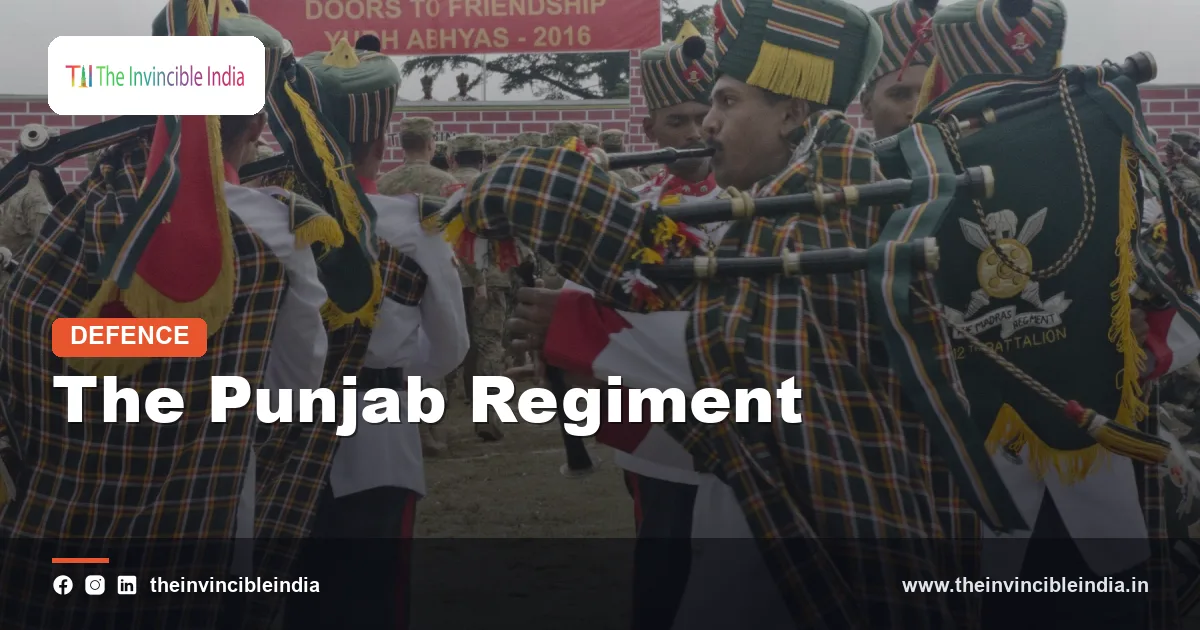
The Punjab Regiment is one of the oldest line infantry regiments of the Indian Army, with a lineage that stretches back to units raised in the Madras Presidency in the early 18th century, and it is headquartered at its regimental centre in Ramgarh Cantonment, Jharkhand. Despite the name, the regiment’s history does not begin in the Punjab region, and it should not be confused with the Pakistan Army’s regiment of the same name.
The Punjab Regiment has served in both World Wars and in India’s conflicts since 1947, and it is a good example of how Indian regiments carry names and traditions that are older and more tangled than they first appear. This explainer lays out where the regiment came from, where it is based, what it has done and what it has not done, correcting some common assumptions. It was last updated on 17 October 2026.
| Fact | Detail |
|---|---|
| Name | The Punjab Regiment |
| Type | Infantry regiment of the Indian Army |
| Lineage | Traced to early 18th-century units of the Madras Presidency (1705 is commonly cited) |
| Present form | Consolidated in the 1950s from surviving Indian Punjab Regiment battalions |
| Regimental centre | Ramgarh Cantonment, Jharkhand |
| Recruitment base | Mixed; not confined to the state of Punjab |
| Wars served | First World War, Second World War, India’s wars since 1947 |
| Param Vir Chakra | None credited to the regiment in the standard list of 21 awards |
| Easily confused with | Punjab Regiment of the Pakistan Army; the Sikh Regiment |
Key Takeaways
- The Punjab Regiment is an infantry regiment of the Indian Army whose lineage goes back to Madras Presidency units of the early 18th century, so the name does not reflect the origin of the oldest battalions.
- The Punjab Regiment has its regimental centre at Ramgarh Cantonment in Jharkhand, where recruits are trained and the regiment’s records and traditions are kept.
- The Punjab Regiment of the Indian Army and the Punjab Regiment of the Pakistan Army are separate organisations in separate armies, formed from the same colonial-era roots after the 1947 partition.
- The Punjab Regiment, in its modern shape, drew together battalions from several numbered Punjab regiments of the British Indian Army, which had themselves been grouped in 1922.
- No Param Vir Chakra appears against the Punjab Regiment in the standard roll of the 21 recipients, although the regiment’s battalions have earned other gallantry awards and battle honours.
- The regiment recruits from mixed classes and regions, so its soldiers are not all from the state of Punjab.
What Is the Punjab Regiment?
The Punjab Regiment is a regular infantry regiment of the Indian Army consisting of several battalions, each of roughly a thousand soldiers, plus a regimental centre that trains recruits and maintains the regiment’s identity. Like all Indian infantry regiments, it is a parent body: it raises and supports battalions, while the battalions are deployed wherever the Army needs them.
The regiment is among the senior infantry regiments by seniority of its oldest units, and it is regarded as a regiment with a long and varied history because the units which became part of it were raised at different times, in different places and for different masters. Some began as units of a presidency army serving the East India Company; later they were folded into the British Indian Army; and after 1947 they became part of the Indian Army.
How Old Is the Punjab Regiment and Where Does Its Lineage Come From?
The Punjab Regiment traces its oldest elements to the early 18th century, with 1705 commonly cited as the starting point, and those elements came from the Madras Presidency in southern India rather than from the Punjab. The East India Company raised companies of troops at Madras to guard its settlements and to support its trading and military operations on the Coromandel coast.
Over the following decades these units were reorganised and renumbered many times as the Madras Army grew. Many of the regiments that existed in the 19th century were designated by numbers such as the 1st, 2nd or 3rd Madras Native Infantry, and over the years some of them were converted, merged or renamed.
The Punjab link entered the story later. As the Company and then the Crown extended control over north-western India in the mid-19th century, new units were raised in the Punjab region, and the army increasingly drew on Punjabi recruits. When the Indian Army was reorganised into larger multi-battalion regiments after the First World War, battalions of different origins were grouped under the name Punjab. This is the main reason why the regiment’s name and its deepest history do not match.
Because of the long chain of renamings, claims about the exact year of the regiment’s raising should be treated with caution. The widely used 1705 date refers to the regiment’s oldest lineage as the Army records it, and it can differ from the dates given for individual battalions.
Is the Punjab Regiment Recruited Only from Punjab?
No, the Punjab Regiment is not recruited only from the state of Punjab; its soldiers come from a mix of communities and regions, and the name refers to the regiment’s historical grouping rather than to a strict recruitment boundary. Under the older class-based system, companies of Sikhs, Dogras, Punjabi Muslims and other groups served in the Punjab regiments of the British Indian Army.
After 1947 Punjabi Muslim companies went with the regiments that were allotted to Pakistan, while the Indian Punjab Regiment continued with the remaining classes. In general terms, the Indian regiment today draws on Sikhs, Dogras and other communities, mainly from the northern states, along with soldiers from other regions where the Army’s recruitment policy allows.
The war cries in the regiment have traditionally varied by class company, since each group of soldiers brought its own religious or community call. Readers who need exact current recruitment categories should consult official Army recruitment notices, because the rules are revised from time to time.
How Was the Punjab Regiment Formed in 1922 and Reorganised After 1947?
The Punjab Regiment’s structure derives from the 1922 reorganisation of the Indian Army, when single-battalion units were grouped into larger multi-battalion regiments with a shared training centre, and from the redistribution of units at the 1947 partition. In 1922 several numbered Punjab regiments were created, each grouping battalions that had earlier been numbered as separate infantry regiments.
At partition in 1947, the British Indian Army was divided between India and Pakistan, and units were allocated according to their class composition. Punjab regiments were therefore split, with some battalions going to the Pakistan Army and others staying with India. In the 1950s the surviving Indian battalions of the numbered Punjab regiments were consolidated into a single Punjab Regiment, with one regimental centre.
| Period | Development |
|---|---|
| Early 18th century | Companies are raised in the Madras Presidency; 1705 is cited for the oldest lineage. |
| 19th century | Madras and Punjab-raised units expand, are renumbered and take part in many campaigns. |
| 1914 to 1918 | Battalions that later form part of the regiment serve overseas in the First World War. |
| 1922 | The Indian Army groups battalions into multi-battalion regiments, creating numbered Punjab regiments. |
| 1939 to 1945 | Battalions serve in the Second World War in theatres including Burma, North Africa and Italy. |
| 1947 | Partition divides the Punjab regiments between India and Pakistan. |
| 1950s | Indian battalions are consolidated into the Punjab Regiment of the Indian Army. |
How Is the Indian Punjab Regiment Different from the Pakistan Army’s Punjab Regiment?
The Indian Punjab Regiment and the Pakistan Army’s Punjab Regiment are separate regiments in separate armies, and they share a name because both inherited units from the pre-1947 British Indian Army. Since 1947 they have developed different traditions, different recruitment and different histories.
This overlap is a frequent source of confusion in search results, because the two regiments have the same name and a similar historical record up to 1947. Honours earned by a battalion before 1947 belong to whichever army and regiment inherited that battalion, so the pre-1947 record of the colonial Punjab regiments cannot be assigned to one side alone.
| Feature | Punjab Regiment (India) | Punjab Regiment (Pakistan) | Sikh Regiment (India) |
|---|---|---|---|
| Army | Indian Army | Pakistan Army | Indian Army |
| Regimental centre | Ramgarh Cantonment, Jharkhand | In Pakistan | Ramgarh Cantonment, Jharkhand |
| Composition | Mixed classes | Mainly Punjabi recruits | Sikhs |
| Oldest lineage | Madras Presidency units | Pre-1947 Punjab regiments | Sikh battalions raised mainly in the 19th century |
Where Is the Punjab Regimental Centre and What Does It Do?
The Punjab Regimental Centre is at Ramgarh Cantonment in Jharkhand, and it is the training and administrative home of the Punjab Regiment. The cantonment is one of the older military stations of eastern India and also hosts other regimental establishments.
At the centre, new recruits receive basic training in drill, weapons, fieldcraft and physical fitness before being posted to the regiment’s battalions. The centre also holds the regiment’s records, runs a museum and carries out ceremonial functions, and it is a reference point for veterans and the families of serving soldiers.
- Training: basic and advanced infantry training for new soldiers.
- Records: service files of serving and retired personnel.
- Welfare: contact for veterans, pensioners and military families.
- Heritage: regimental museum, memorials and ceremonial days.
What Role Did the Regiment’s Battalions Play in the World Wars?
Battalions that later became part of the Punjab Regiment served in both World Wars, mainly as part of the British Indian Army, and fought in several theatres. In the First World War, Indian infantry units went to France and Flanders, Egypt and Palestine, East Africa and Mesopotamia, and battalions of the Punjab regiments were among those deployed.
In the Second World War, Indian infantry formed a large share of the Allied forces in Asia and in the Mediterranean. Battalions of the Punjab regiments took part in the Burma campaign, in the North African and Middle Eastern theatres and in Italy. Individual gallantry in these campaigns, including awards of the Victoria Cross to soldiers of Punjab regiments, is recorded in the official histories.
It is important to remember that because of the partition of 1947, the honours of the pre-1947 period are inherited by whichever successor regiment holds a particular battalion’s lineage. Accordingly, the Indian Punjab Regiment claims the honours of its own constituent battalions and not of every Punjab battalion of the colonial army.
What Role Has the Punjab Regiment Played in India’s Wars since 1947?
The Punjab Regiment has served in India’s wars and internal security operations since independence, with its battalions deployed in Jammu and Kashmir, in the wars of 1965 and 1971 and in counter-insurgency tasks. As an infantry regiment, it supplies battalions that serve as part of brigades and divisions assigned to different sectors, and the exact deployment of any battalion at any time is set by the Army.
Battle honours are awarded to regiments for specific engagements, and they are recorded on the regiment’s colours. The full list is lengthy and is best checked from the Army’s published records, since honours were awarded in several stages and some are shared between regiments that fought in the same action.
Units of the regiment have also been deployed on United Nations peacekeeping missions and in disaster relief, which are tasks that now form part of the routine of most Indian infantry regiments.
Does the Punjab Regiment Have a Param Vir Chakra?
No Param Vir Chakra is credited to the Punjab Regiment in the standard list of the 21 recipients of India’s highest wartime gallantry award, although the regiment’s battalions have won other decorations. This is worth stating plainly, because the regiment’s long history and large profile lead many people to assume a link.
The recipients of the Param Vir Chakra belong to a variety of regiments and services, including the Kumaon Regiment, the Sikh Regiment, the Rajput Regiment, the Gorkha Rifles, the Grenadiers, the Mahar Regiment, the Corps of Engineers, the Poona Horse, the Jammu and Kashmir Rifles and the Indian Air Force, among others. The Punjab Regiment’s record is better described in terms of battle honours, Maha Vir Chakras, Vir Chakras and other decorations earned over many campaigns. Readers who see a claim to the contrary should check it against the Army’s official roll of honour.
What Traditions Does the Punjab Regiment Keep?
The Punjab Regiment keeps traditions that are common to Indian infantry regiments, such as a regimental centre with a museum, a raising-day observance, regimental colours bearing battle honours, and war cries that reflect the communities within the regiment. These traditions are the means by which the regiment passes on its history from one generation of soldiers to the next.
Because the regiment has a mixed composition, the war cries of its companies have varied by class. A Sikh company has traditionally used the Sikh call, while others have used their own, and the regiment as a whole is bound by a common regimental identity. Details of colours, badge and dress are laid down by the Army and are best confirmed from official sources.
Bottom Line
The Punjab Regiment is an old and layered Indian Army infantry regiment with Madras Presidency roots, a regimental centre at Ramgarh and a mixed recruitment base. Its name is misleading, it must be kept separate from Pakistan’s regiment of the same name, and it should not be credited with a Param Vir Chakra that the official roll does not show.
Frequently Asked Questions
What is the Punjab Regiment?
The Punjab Regiment is an infantry regiment of the Indian Army with a regimental centre at Ramgarh Cantonment in Jharkhand. It traces its oldest lineage to units raised in the Madras Presidency in the early 18th century. Its present form was consolidated in the 1950s from surviving Indian Punjab Regiment battalions.
Is the Punjab Regiment the oldest regiment of the Indian Army?
The Punjab Regiment is among the oldest infantry regiments of the Indian Army, with 1705 commonly cited for its oldest lineage. Claims of being the single oldest regiment depend on how lineage is counted, because many units were renamed, merged and reorganised over the centuries. It is safest to describe it as one of the oldest.
Does the Punjab Regiment recruit only from Punjab?
No, the Punjab Regiment does not recruit only from Punjab. Its soldiers come from several communities and regions, and the name reflects the historical grouping of battalions into Punjab regiments in 1922. Current recruitment categories are set by the Army and published in its recruitment notices.
Is the Indian Punjab Regiment the same as the Pakistan Army’s Punjab Regiment?
No, the Indian Punjab Regiment and Pakistan’s Punjab Regiment are separate regiments of separate armies. Both inherited units of the British Indian Army at the 1947 partition, which is why they share a name. Their traditions, composition and later histories differ.
Where is the Punjab Regimental Centre?
The Punjab Regimental Centre is at Ramgarh Cantonment in Jharkhand. It trains recruits for the regiment, keeps its records and museum, and supports veterans and families. Recruits are posted from the centre to the regiment’s battalions after training.
Has the Punjab Regiment won a Param Vir Chakra?
No Param Vir Chakra is credited to the Punjab Regiment in the standard list of the 21 recipients of the award. The regiment’s battalions have earned other gallantry awards and battle honours across the World Wars and India’s later conflicts. Claims of a Param Vir Chakra should be checked against the Army’s official roll.
{“@context”:”https://schema.org”,”@graph”:[{“@type”:”FAQPage”,”mainEntity”:[{“@type”:”Question”,”name”:”What is the Punjab Regiment?”,”acceptedAnswer”:{“@type”:”Answer”,”text”:”The Punjab Regiment is an infantry regiment of the Indian Army with a regimental centre at Ramgarh Cantonment in Jharkhand. It traces its oldest lineage to units raised in the Madras Presidency in the early 18th century. Its present form was consolidated in the 1950s from surviving Indian Punjab Regiment battalions.”}},{“@type”:”Question”,”name”:”Is the Punjab Regiment the oldest regiment of the Indian Army?”,”acceptedAnswer”:{“@type”:”Answer”,”text”:”The Punjab Regiment is among the oldest infantry regiments of the Indian Army, with 1705 commonly cited for its oldest lineage. Claims of being the single oldest regiment depend on how lineage is counted, because many units were renamed, merged and reorganised over the centuries. It is safest to describe it as one of the oldest.”}},{“@type”:”Question”,”name”:”Does the Punjab Regiment recruit only from Punjab?”,”acceptedAnswer”:{“@type”:”Answer”,”text”:”No, the Punjab Regiment does not recruit only from Punjab. Its soldiers come from several communities and regions, and the name reflects the historical grouping of battalions into Punjab regiments in 1922. Current recruitment categories are set by the Army and published in its recruitment notices.”}},{“@type”:”Question”,”name”:”Is the Indian Punjab Regiment the same as the Pakistan Army’s Punjab Regiment?”,”acceptedAnswer”:{“@type”:”Answer”,”text”:”No, the Indian Punjab Regiment and Pakistan’s Punjab Regiment are separate regiments of separate armies. Both inherited units of the British Indian Army at the 1947 partition, which is why they share a name. Their traditions, composition and later histories differ.”}},{“@type”:”Question”,”name”:”Where is the Punjab Regimental Centre?”,”acceptedAnswer”:{“@type”:”Answer”,”text”:”The Punjab Regimental Centre is at Ramgarh Cantonment in Jharkhand. It trains recruits for the regiment, keeps its records and museum, and supports veterans and families. Recruits are posted from the centre to the regiment’s battalions after training.”}},{“@type”:”Question”,”name”:”Has the Punjab Regiment won a Param Vir Chakra?”,”acceptedAnswer”:{“@type”:”Answer”,”text”:”No Param Vir Chakra is credited to the Punjab Regiment in the standard list of the 21 recipients of the award. The regiment’s battalions have earned other gallantry awards and battle honours across the World Wars and India’s later conflicts. Claims of a Param Vir Chakra should be checked against the Army’s official roll.”}}]}]}


